
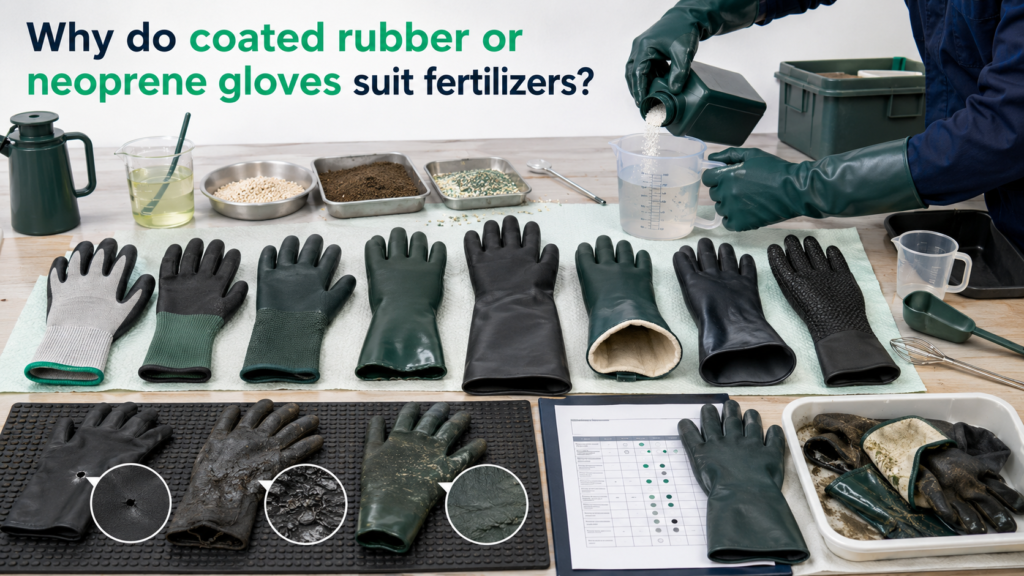
Why do coated rubber or neoprene gloves suit fertilizers?
Coated rubber or neoprene gloves may suit some fertilizer tasks because a compatible, sufficiently covered glove construction can reduce direct skin contact with fertilizer dust, granules, liquids, and residue. The decision must begin with the exact fertilizer, defined task, contact pattern, and complete glove product.
Neither rubber nor neoprene is universally suitable for every fertilizer. Suitability depends on the complete product label, formulation, concentration, exposure duration, glove model, coating coverage, compatibility information, condition, and change schedule.
Why Do Coated rubber or neoprene gloves Suit Some Fertilizer Tasks?
Coated rubber or neoprene gloves may suit fertilizer tasks when an exact, compatible glove barrier covers the expected contact zones and remains suitable for the product form, concentration, task, and exposure period. Occupational hand-protection guidance likewise bases selection on the task, conditions, duration, and identified hazards. OSHA
Which fertilizer contacts may require glove protection?
Dry dust may settle on hands, granules may enter cuffs or seams, liquids may splash during pouring, and damp residue may transfer from containers, tools, applicators, or cleanup surfaces.
Why may ordinary fabric or leather be unsuitable?
Some porous or absorbent constructions may hold liquid, damp residue, or dust against the skin and may be difficult to decontaminate. This does not mean every fabric or leather glove fails; it means the exact product must match the exact exposure.
Why are Coated rubber or neoprene gloves not automatically suitable?
Material formulation, thickness, coating coverage, seams, cuffs, fertilizer compatibility, exposure duration, change schedule, condition, and manufacturer instructions still control suitability.
How Do Coated rubber or neoprene gloves Limit Fertilizer Contact?
A verified glove barrier may reduce direct contact, but barrier performance must be described through separate mechanisms.
How may Coated rubber or neoprene gloves reduce direct contact?
Continuous compatible material over expected contact zones may reduce transfer from dust, granules, liquids, wet containers, and residue. Safe performance still depends on intact construction and use within documented limits.
How can penetration affect Coated rubber or neoprene gloves?
Penetration occurs through pinholes, tears, seams, closures, cuff openings, material defects, damaged coating, or exposed textile zones. ISO 374-2
How can permeation affect Coated rubber or neoprene gloves?
Permeation is molecular movement through protective material and may occur without visible wetness, odor, holes, or obvious leakage. Laboratory permeation results are tied to the tested material and defined conditions rather than automatic whole-glove approval. ISO 6529
How can degradation affect Coated rubber or neoprene gloves?
Possible findings include swelling, softening, tackiness, hardening, cracking, distortion, loss of strength, and coating separation. Appearance alone does not identify the exact chemical mechanism. ISO 374-4
Why does breakthrough time matter for Coated rubber or neoprene gloves?
Breakthrough time is measured under defined laboratory conditions for a specific chemical, material, thickness, and method. Heat, pressure, flexing, abrasion, mixtures, thinning, damage, and reuse may shorten actual performance. NIOSH
Which Fertilizer Conditions Should Coated rubber or neoprene gloves Be Matched To?
Start with the exact product label and determine whether the product is fertilizer-only or contains a pesticide, herbicide, fungicide, or insecticide. Combination products follow the complete pesticide label. SDS Sections 2, 6, 7, 8, and 10 serve different roles in hazard, cleanup, handling, PPE, and incompatibility review. OSHA SDS EPA
What should be checked for dry fertilizer?
Assess dust, granule size, cuff-entry risk, repeated container contact, spreading method, cleanup residue, and whether the glove construction can be managed without trapping contamination.
What should be checked for diluted liquid fertilizer?
Review splash, wet-container contact, mixing, measuring, applicator handling, concentration, temperature, and expected duration.
What should be checked for concentrated fertilizer?
Concentrate requires exact compatibility data, sufficient coverage, a defined change schedule, controlled pouring, and strict management of cuffs, seams, and removal.
What should be checked during equipment cleaning?
Cleanup can create a new exposure involving residue, contaminated water, splash, longer contact, and cuff entry. Follow the label and approved procedure rather than assuming the application glove can be reused.
Where the task also introduces pesticides, sharp equipment, heat, inhalation, or eye exposure, Glove Hazard Match can route each hazard to its correct protection owner without replacing the product label or final compatibility evidence.
| Fertilizer Condition | Primary Contact Pattern | Required Verification | Stop or Reassess When |
|---|---|---|---|
| Dry dust or granules | Settling, cuff entry, repeated handling | Label, coverage, seams, cuff and cleanup plan | Dust enters the interior or compatibility is unclear |
| Damp granules or residue | Transfer from surfaces and containers | Barrier coverage, grip, interior protection | Residue reaches lining or exposed textile |
| Diluted liquid | Splash, wet containers, repeated contact | Exact compatibility, cuffs, grip, duration | Contact exceeds verified conditions |
| Concentrated liquid | Higher-consequence splash and contact | Exact glove data, change schedule, full contact-zone coverage | Compatibility or change interval is unknown |
| Equipment cleaning | Residue, rinse water, longer contact | Label-approved cleanup and decontamination instructions | Runoff or interior contamination cannot be controlled |
Which Construction Features Matter in Coated rubber or neoprene gloves?
The complete finished glove—not the polymer name—is the decision unit.
Readers who need the underlying terminology for palms, fingers, cuffs, liners, coatings, and complete glove construction can review the Glove Basics guide.
How does coating coverage affect Coated rubber or neoprene gloves?
Palm-coated, three-quarter-coated, and fully coated gloves leave different zones exposed. Full coating may widen coverage but does not prove compatibility.
How do seams affect Coated rubber or neoprene gloves?
Seams can become penetration paths or wear points. Their placement, construction, and condition must suit the contact pattern.
How do cuffs affect Coated rubber or neoprene gloves?
Cuffs must reduce entry risk without collecting liquid. Length, opening, closure, sleeve interface, and movement all matter.
How do linings affect Coated rubber or neoprene gloves?
Linings may support comfort, but they can retain contamination and may be difficult to decontaminate. Interior contamination is a strict rejection condition.
How does thickness affect Coated rubber or neoprene gloves?
Thickness may influence durability, dexterity, flexibility, and breakthrough performance, but thicker does not automatically mean compatible or suitable for longer contact.
| Construction Zone | What to Verify | Important Limitation |
|---|---|---|
| Palm and fingers | Continuous coverage over expected contact zones | Palm coating does not protect an exposed back |
| Back of hand | Coated or otherwise documented for the exposure | Uncoated textile may remain vulnerable |
| Seams and closures | Integrity, placement, construction and contamination risk | A seam can become a penetration path |
| Cuff and sleeve interface | Length, security and entry control | Long cuffs do not prove chemical compatibility |
| Lining and interior | Clean, dry, uncontaminated and permitted for reuse | Interior contamination prohibits reuse |
| Material and thickness | Exact formulation and tested thickness | Material name or thickness alone is insufficient |
How Should Coated rubber or neoprene gloves Be Selected Without Generic Polymer Rules?
Selection must connect one exact fertilizer exposure to one exact glove model. Chemical-protective glove terminology and performance requirements still need to be connected to the exact documented product. ISO 374-1
The Glove Material Compare can explain broad differences among neoprene, nitrile, natural rubber, PVC, and other material families, but final fertilizer approval still requires exact product compatibility data.
Which documents should be checked for Coated rubber or neoprene gloves?
- Read the complete fertilizer label.
- Review the SDS where available, especially hazard, handling, PPE, and incompatibility sections.
- Identify the exact glove manufacturer and model.
- Review exact material, thickness, compatibility, breakthrough, degradation, change, reuse, and care information.
Why is “neoprene” insufficient to select Coated rubber or neoprene gloves?
The word does not establish formulation, thickness, construction, tested chemical, contact zone, breakthrough result, or reuse conditions.
Why is “rubber-coated” insufficient to select Coated rubber or neoprene gloves?
A rubber coating may cover only the palm or part of the fingers. The polymer formulation, exposed zones, seams, cuffs, and documentation remain unknown.
What should users do when compatibility data are unavailable?
Do not guess. Contact the fertilizer manufacturer and glove manufacturer, select another documented product, or avoid the task until suitability is established.
| Record Field | What to Enter | Verification Source |
|---|---|---|
| Fertilizer identity | Exact name, manufacturer and classification | Complete product label |
| Form and concentration | Dust, granule, diluted liquid, concentrate and temperature | Label and SDS |
| Task and contact | Pouring, measuring, spreading, cleanup, splash, duration | Defined work plan |
| Glove identity | Manufacturer, model, material, thickness and coverage | Technical datasheet |
| Compatibility evidence | Tested formulation, breakthrough and degradation information | Glove manufacturer data |
| Use limits | Change schedule, reuse, decontamination and disposal | Label, SDS and glove instructions |
| Final decision | Use, shorten exposure, select another glove or do not proceed | Completed verification |
How Do Fit, Cuff Coverage, and Grip Affect Coated rubber or neoprene gloves?
Compatibility cannot compensate for unsafe fit, poor grip, unstable cuffs, or loss of control.
What happens when Coated rubber or neoprene gloves are too loose?
Loose gloves may twist, fold, move seams, reduce grip, catch on equipment, and make removal less controlled.
What happens when Coated rubber or neoprene gloves are too tight?
Tight gloves may stretch material, restrict movement, increase fatigue, reduce dexterity, and make safe removal more difficult.
How should grip be checked in Coated rubber or neoprene gloves?
Confirm controlled handling of containers, measuring tools, mixing equipment, and applicators under the expected dry or wet surface condition.
How should cuffs be positioned in Coated rubber or neoprene gloves?
Position cuffs according to the label and task so liquid cannot collect or run inside. Verify the glove-to-sleeve interface during realistic movement.
The Glove Size Translator can help interpret sizing systems before the exact model is checked through an on-hand fit and representative task assessment.
Repeated sweating, pressure, lining discomfort, or internal slipping can be screened through the Glove Comfort Troubleshooter without treating comfort changes as proof of chemical compatibility.
| Check | Passing Condition | Failure Response |
|---|---|---|
| Size and finger position | Fingers reach correct positions without excess tension | Choose another size or model |
| Palm fit | No excessive bunching, folding or twisting | Reject unstable fit |
| Grip | Containers and tools remain controlled | Choose a more suitable documented construction |
| Dexterity | Measuring, opening and removal can be performed safely | Do not proceed when control is inadequate |
| Cuff security | Cuff remains stable and limits entry during movement | Add suitable coverage or select another glove |
| Removal readiness | Glove can be removed without touching contaminated exterior | Review approved removal method before use |
How Should Damage in Coated rubber or neoprene gloves Be Recognized?
Stop use and reassess whenever the barrier, interior, fit, or exposure history becomes uncertain.
What does swelling mean in Coated rubber or neoprene gloves?
Swelling is a possible degradation sign and requires stopping. It does not identify the exact chemical cause.
What does tackiness or softening mean in Coated rubber or neoprene gloves?
Tackiness or permanent softening may indicate deterioration, contamination, or incompatible exposure. Replace or follow the exact rejection guidance.
What does hardening mean in Coated rubber or neoprene gloves?
Hardening may reduce flexibility, grip, and safe removal. Do not diagnose one exact mechanism from appearance alone.
What do cracks, pinholes, or tears mean in Coated rubber or neoprene gloves?
They create structural entry paths and require replacement for fertilizer protection.
What does persistent odor mean in Coated rubber or neoprene gloves?
Unexplained odor requires stopping and reassessment, but absence of odor does not prove cleanliness, decontamination, compatibility, or absence of permeation.
| Observation | Why It Matters | Decision |
|---|---|---|
| Pinhole, tear or seam opening | Creates a penetration path | Replace |
| Swelling or permanent softening | Possible degradation or incompatibility | Stop, replace and reassess compatibility |
| Tackiness | May indicate material deterioration | Replace |
| Hardening or cracking | Reduces flexibility and barrier integrity | Replace |
| Coating separation or distortion | Construction no longer reliable | Replace |
| Interior moisture or fertilizer residue | Interior contamination | Do not reuse |
| Unknown exposure history | Compatibility and change schedule cannot be verified | Replace or do not proceed |
How Should Coated rubber or neoprene gloves Be Removed and Managed After Fertilizer Contact?
Removal and post-exposure management must prevent transfer to skin, clean surfaces, tools, clothing, or the glove interior.
Should Coated rubber or neoprene gloves always be rinsed while worn?
No. Rinse only when the label or approved procedure permits it and contaminated runoff can be contained. Do not assume a hose, sink, or universal rinse method is acceptable.
How should Coated rubber or neoprene gloves be removed?
Use the exact approved removal procedure. Avoid touching the exterior with bare skin, snapping the glove, or contacting clean surfaces.
Can Coated rubber or neoprene gloves be washed in a household sink?
Not automatically. Household sink washing may spread contamination and create uncontrolled wash water. Use only a specifically permitted process.
Can Coated rubber or neoprene gloves be reused?
Reuse requires documented compatibility, exposure within limits, a valid change schedule, permitted decontamination, a clean dry interior, no degradation, no structural damage, and known exposure history.
| Management Group | Required Check | Reject Reuse When |
|---|---|---|
| Exterior control | Approved rinse or residue-removal method only | Runoff cannot be safely controlled |
| Removal | No bare-skin contact with contaminated exterior | Removal transfers residue to skin or interior |
| Interior | Clean, dry and uncontaminated | Dust, liquid, residue or wash water enters |
| Decontamination | Exact process is explicitly permitted | Only ordinary washing is assumed |
| Drying and storage | Approved drying, inspection and protected storage | Interior remains damp or storage is unsuitable |
| Exposure record | Fertilizer, duration, change schedule and prior use are known | History or limits are unknown |
| Final decision | Reuse, replace, dispose or stop | Any compatibility or integrity requirement fails |
When Should Coated rubber or neoprene gloves Be Replaced?
Replacement is required when compatibility, integrity, interior cleanliness, exposure history, or change-schedule compliance can no longer be relied upon.
Which interior conditions require Coated rubber or neoprene gloves replacement?
Fertilizer liquid, dust, residue, contaminated wash water, or uncertain lining contamination prohibits reuse.
Which structural failures require Coated rubber or neoprene gloves replacement?
Pinholes, tears, seam failure, abrasions through the barrier, damaged cuffs, and coating separation require replacement.
Which degradation findings require Coated rubber or neoprene gloves replacement?
Swelling, tackiness, permanent softening, hardening, cracking, distortion, and loss of strength require stopping and replacement.
Which exposure-history problems require Coated rubber or neoprene gloves replacement?
Replace when the exact fertilizer, previous chemical contact, duration, change schedule, cleaning history, or compatibility cannot be verified.
| Replacement Group | Trigger | Required Action |
|---|---|---|
| Interior contamination | Fertilizer or contaminated water enters | Do not reuse |
| Structural failure | Pinhole, tear, seam opening, abrasion or coating separation | Replace |
| Degradation | Swelling, tackiness, softening, hardening, cracking or distortion | Replace and reassess compatibility |
| Exceeded schedule | Documented change interval or exposure limit is exceeded | Replace |
| Unknown history | Fertilizer, duration, prior exposure or cleaning is unknown | Replace |
| Functional failure | Grip, fit, cuff security or safe removal is unreliable | Select another glove |
| Missing evidence | Compatibility or instructions cannot be verified | Do not proceed |
Which Mistakes Reduce the Protection of Coated rubber or neoprene gloves?
Which selection mistakes affect Coated rubber or neoprene gloves?
- Selecting by polymer name, color, price, appearance, or thickness alone.
- Applying fertilizer-only guidance to pesticide combination products.
- Treating palm coating as full-hand protection.
- Ignoring exact compatibility, breakthrough, degradation, and change data.
Which use mistakes affect Coated rubber or neoprene gloves?
- Exceeding verified contact duration.
- Allowing liquid to collect in cuffs.
- Continuing after swelling, tackiness, cracking, or coating separation.
- Using a glove with poor grip or unstable fit.
Which removal mistakes affect Coated rubber or neoprene gloves?
- Touching the contaminated exterior with bare skin.
- Snapping gloves during removal.
- Touching clean surfaces before removal is complete.
Which care mistakes affect Coated rubber or neoprene gloves?
- Universally rinsing while worn, using a household sink, machine washing, inversion, solvents, or improvised air tests.
- Assuming ordinary washing equals validated decontamination.
- Reusing after interior contamination.
Which inspection mistakes affect Coated rubber or neoprene gloves?
- Relying on smell, visible dryness, or appearance alone.
- Ignoring unknown exposure history.
- Assuming no hole means no permeation.
What Should Users Check Before Wearing Coated rubber or neoprene gloves?
Complete all verification groups before application. Final approval applies only to the next defined use.
After the fertilizer, contact pattern, required coverage, and evidence needs have been defined, the Advanced Glove Recommendation Engine can support task-first screening while leaving final approval to the label, SDS, and exact manufacturer compatibility data.
| Checklist Group | What Must Be Verified | Final Response |
|---|---|---|
| Identify the product | Exact fertilizer, manufacturer, fertilizer-only or pesticide combination | Follow pesticide label when applicable |
| Review hazards and PPE | Complete label and SDS where available | Do not substitute generic advice |
| Define the exposure | Form, concentration, splash, contact, duration, temperature and cleanup | Stop when exposure cannot be defined |
| Verify the exact glove | Manufacturer, model, material, thickness, compatibility and change schedule | Select another glove when data are missing |
| Check coverage and construction | Palm, fingers, back, seams, cuffs, lining, closures and sleeve interface | Add coverage or reject insufficient construction |
| Inspect condition | No pinholes, tears, swelling, tackiness, cracks, separation or interior contamination | Replace damaged or uncertain gloves |
| Check fit and function | Correct size, grip, dexterity, cuff security and safe removal | Do not proceed with unsafe control |
| Make the final decision | Use, shorten exposure, select another glove, add coverage, replace, dispose or stop | Proceed only when every required check passes |
- OSHA — 29 CFR 1910.138, Hand Protection
- OSHA — Safety Data Sheets, Appendix D to 29 CFR 1910.1200
- ISO 374-1:2024 — Chemical protective glove terminology and performance requirements
- ISO 374-2:2019 — Resistance to penetration
- ISO 374-4:2019 — Resistance to degradation by chemicals
- ISO 6529:2026 — Resistance to permeation by liquids and gases
- NIOSH — Recommendations for Chemical Protective Clothing
- EPA — Introduction to Pesticide Labels
Conclusion
Coated rubber or neoprene gloves may suit fertilizer handling only when the exact glove product is compatible with the exact fertilizer, concentration, exposure duration, task, contact pattern, and required coverage.
No polymer is universally compatible. The complete label comes first, pesticide combinations follow the pesticide label, palm coating does not equal full-hand protection, visible dryness does not rule out permeation, and breakthrough time is not automatic safe-wear time. Stop after degradation or contamination, clean only as specifically permitted, and replace whenever compatibility, integrity, interior condition, or exposure history is uncertain.
Frequently Asked Questions
01Do Coated rubber or neoprene gloves suit every fertilizer?
No. Suitability depends on the exact fertilizer, concentration, glove model, material formulation, thickness, coverage, duration, and manufacturer information.
02Are Coated rubber or neoprene gloves chemical-proof?
No. No glove material protects against every chemical or unlimited exposure.
03Can palm-dipped Coated rubber or neoprene gloves handle liquid fertilizer?
Only when exact product documentation confirms that the coating coverage and compatibility are adequate for the expected contact. An exposed fabric back may remain vulnerable.
04Does a long breakthrough time make Coated rubber or neoprene gloves safe for that full period?
Not automatically. Heat, pressure, flexing, abrasion, mixtures, thinning, and reuse may shorten actual performance.
05Can Coated rubber or neoprene gloves be used for weed-and-feed products?
Follow the complete pesticide label. Weed-and-feed and other pesticidal combination products are outside ordinary fertilizer-only guidance.
06Should Coated rubber or neoprene gloves be rinsed before removal?
Only when the label or approved procedure permits exterior rinsing and contaminated runoff can be safely controlled.
07Can Coated rubber or neoprene gloves be reused after fertilizer enters the lining?
No. Interior-contaminated gloves should not be reused for fertilizer protection.
08When should Coated rubber or neoprene gloves be replaced?
Replace them after interior contamination, pinholes, tears, seam failure, swelling, tackiness, permanent softening, hardening, cracking, coating separation, exceeded change schedule, unknown exposure history, or loss of compatibility.