
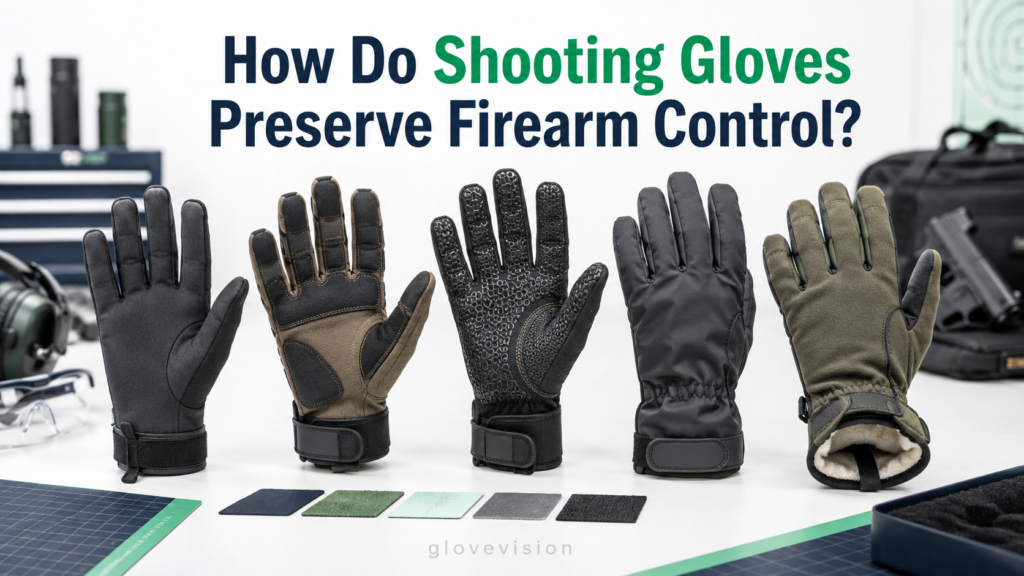
How Do Shooting Gloves Preserve Firearm Control?
Shooting gloves help preserve firearm control when their fit, palm interface, finger construction, and surface materials maintain a stable hand-to-equipment connection without blocking necessary tactile feedback, safe clearance, or required external-control access.
Shooting gloves do not create firearm skill or guarantee accuracy. Poor fit, excessive bulk, internal slippage, unsuitable grip, incorrect finger length, interfering construction, environmental mismatch, or worn condition can reduce rather than preserve control.
This article covers Shooting gloves as personal protective equipment and equipment-interface accessories. It does not provide marksmanship, tactical, firing, reloading, weapon-manipulation, or firearm-modification instruction. Follow established firearm-safety procedures, applicable organizational requirements, and the exact glove and equipment manufacturer guidance.
What Are Shooting gloves, and What Does Preserving Firearm Control Require?
Shooting gloves are role-specific handwear intended to balance protection with stable grip, tactile feedback, finger movement, fit, and safe equipment-interface compatibility.
OSHA requires hand protection to be selected according to the task, conditions present, duration of use, and identified hazards. That supports a role-first approach rather than selecting from tactical appearance or material reputation alone. [OSHA 1910.138]
What distinguishes Shooting gloves from ordinary protective gloves?
Shooting gloves add a demanding equipment-interface requirement: protection must coexist with tactile feedback, independent finger movement, hand closure, wrist motion, safe clearances, and required external-control accessibility. Styling alone does not establish suitability.
Which elements make up control at the glove interface?
Stable palm contact, internal hand stability, external friction, tactile awareness, independent finger movement, wrist security, safe clearance, and required external-control access make up the glove-interface side of control. These are not marksmanship or operating techniques.
Why must Shooting gloves balance protection and hand function?
Reinforcement, insulation, padding, and thicker materials may add protection while also adding stiffness or bulk. The broader issue of shooting glove protection and dexterity is therefore role-specific.
Proof Asset 1. Control depends on several glove functions working together.
| Control Factor | Glove Contribution | Possible Failure |
|---|---|---|
| Palm contact | Stable contact and suitable surface interaction | Slippage, bunching, worn or contaminated palm |
| Tactile feedback | Transmits contact and pressure information | Excess thickness, seam bulk, fingertip excess |
| Finger mobility | Allows required independent movement | Short stalls, stiffness, heavy insulation |
| Internal stability | Keeps the hand seated inside the glove | Loose fit, liner shift, sweat, seam rotation |
| Wrist security | Limits glove migration | Loose closure or cuff movement |
| Protection | Addresses defined hazards | Unsupported ratings or excessive bulk |
How Do Shooting gloves Support Grip and Tactile Control?
Shooting gloves preserve a stable interface only when external palm grip and internal hand stability work together without excessive material interfering with tactile feedback.
OSHA lists dexterity, dry, wet and oily grip, size, comfort, mechanical resistance, thermal protection, contact type, and task conditions as separate glove-selection considerations. Grip, dexterity, tactility, fit, and environment should therefore be assessed separately. [OSHA Grip & Dexterity]
How does the palm interact with the equipment surface?
Palm material, texture, grip-print placement, reinforcement, moisture, dust, sweat, residue, and wear can change the external interface. More friction is not automatically better if it creates uneven pressure or if the hand still moves inside the glove.
Why does internal glove stability matter?
A loose shell, moving liner, sweaty interior, palm bunching, or rotating seams can let the hand shift independently of the outer palm. A textured exterior cannot compensate for uncontrolled internal movement.
How do Shooting gloves preserve tactile feedback?
Palm and fingertip thickness, seam placement, reinforcement, liner structure, material stiffness, and wear affect contact awareness. A deeper comparison of shooting-glove palm grip and tactility should evaluate these factors together.
Why does grip change with conditions?
Dry, wet, sweaty, dusty, cold, or residue-contaminated conditions can produce different palm and liner behavior. Dry grip should not be extrapolated automatically to wet or contaminated conditions.
How Does the Fit of Shooting gloves Affect Firearm Control?
Shooting gloves should fit securely enough to prevent internal sliding and material bunching while preserving circulation, required movement, tactile feedback, and safe equipment clearance.
NIOSH emphasizes hazard-based PPE selection and the importance of fit and comfort within protective systems. Fit should therefore be treated as functional compatibility rather than simple tightness. [NIOSH PPE]
How should Shooting gloves fit across the palm and wrist?
Assess palm width and length, back-of-hand tension, wrist closure, cuff position, palm bunching, and internal movement. Too loose can cause sliding, folds, and seam rotation; too tight can create pressure, numbness, fatigue, and restricted movement.
Why does finger length matter?
Unused fingertip material can fold or shift, while short finger stalls can pull against seams and restrict movement. Fingertip seam position, finger circumference, and independent movement should be checked.
How can thumb construction affect function?
Thumb angle, thumb-crotch depth, seam bulk, reinforcement, rotation, and opposition affect how naturally the glove follows the hand.
Which movements belong in a glove-fit check?
Under established safety procedures, evaluate only glove function: finger flexion and extension, thumb movement, firm hand closure, wrist movement, safe external-control accessibility, and adjacent-equipment compatibility. A dedicated shooting glove fit assessment should compare these functions with hand dimensions, seam position, internal movement, and pressure.
Proof Asset 3. Diagnose fit defects by the interface problem they create.
| Fit Finding | Possible Effect | Decision |
|---|---|---|
| Excess fingertip material | Folding and reduced tactile precision | Recheck size; reject if clearance is affected |
| Palm bunching | Uneven contact and internal movement | Recheck palm dimensions and pattern |
| Finger restriction | Reduced independent movement | Check size, seams, insulation |
| Rotating seams | Pressure and unstable alignment | Check fit and construction |
| Cuff migration | Changing wrist fit | Check closure and cuff geometry |
| Numbness / pressure | Reduced hand function | Reject tight fit; reassess size/model |
Which Materials and Construction Features in Shooting gloves Preserve Control?
Shooting gloves should be compared by complete construction because palm materials, thickness, seams, reinforcement, liners, membranes, insulation, padding, closures, and cuffs can each improve one function while reducing another.
ISO 21420 covers protective-glove design, construction, comfort, efficiency, marking, and manufacturer information, while hazard-specific performance belongs to the relevant specific standards. Material identity alone is not a complete performance rating. [ISO 21420]
How do leather and synthetic palm constructions differ?
Surface feel, conformability, dry grip, wet behavior, abrasion performance, drying, care, and thickness consistency vary across products. Neither leather nor synthetic constructions are universal winners.
Which palm reinforcements can help or hinder?
High-wear overlays, grip prints, textured panels, double layers, and thumb-crotch reinforcement can add local durability or friction but may also add bulk, stiffness, pressure points, or reduced feedback.
How do seams influence Shooting gloves?
Fingertip seams, fourchettes, palm seams, seam thickness, thread condition, and seam rotation affect comfort and interface consistency.
How do liners, membranes, and insulation affect control?
Internal movement, moisture retention, drying, layer separation, insulation bulk, and finger mobility can all change the hand-to-glove interface.
When does impact padding matter?
Only when the role includes a defined impact hazard and the product has relevant evidence. ISO 23388 treats abrasion, blade cut, tear, puncture, and impact where applicable as separate mechanical-risk domains. [ISO 23388]
Proof Asset 4. Compare what a feature may add against what it may cost in hand function.
| Feature | Possible Benefit | Possible Cost | Verify |
|---|---|---|---|
| Thin palm | Lower bulk, clearer feedback | May reduce durability/protection | Exact role evidence |
| Reinforced palm | Local wear management | Stiffness or pressure | Placement and performance |
| Grip print | Local surface friction | Wear or residue sensitivity | Wet/dry behavior |
| Insulation | Cold protection | Bulk, reduced finger mobility | Environmental evidence |
| Membrane | Weather barrier | Moisture retention or liner shift | Finished-product performance |
| Impact padding | Local impact protection | Reduced articulation | Area-specific evidence |
Which Shooting gloves Match the Role, Equipment Interface, and Environment?
Shooting gloves should be selected by defining the lawful role, expected environment, equipment interface, hand hazards, required protection, grip, tactility, dexterity, and safe clearance before comparing glove models.
OSHA’s PPE-selection guidance recommends evaluating glove performance for anticipated hazards through appropriate test procedures and obtaining performance documentation, while considering dexterity and physical stresses. [OSHA PPE Selection]
How should the role be defined?
Controlled range use, sport shooting, hunting, authorized duty or training, cold-weather handling, wet-weather handling, and extended outdoor use can impose different requirements.
Which interface details must Shooting gloves accommodate?
At compatibility level only, assess grip geometry, safe clearance, required external-control accessibility, adjacent equipment, clothing interfaces, storage or retention equipment, and excess glove material. Do not turn the check into an operating procedure.
How should hot or sweaty environments change selection?
Evaluate internal stability, sweat, liner movement, ventilation, drying, and grip.
How should wet environments change selection?
Evaluate wet grip, water uptake, liner stability, drying, and fit change.
How should cold environments change selection?
Balance insulation, finger mobility, bulk, tactile feedback, moisture, and environmental documentation. Where a glove also claims heat or flame protection, those thermal risks require separate evidence; ISO 23407 addresses flame, contact heat, convective heat, and radiant heat as distinct thermal risks. [ISO 23407]
Selecting shooting gloves for cold and wet conditions requires balancing insulation, moisture management, wet grip, liner stability, drying, finger movement, and exact product evidence.
Which product evidence should guide selection?
Look for the exact model, intended role, materials, construction, sizing system, relevant grip, mechanical or environmental evidence, care instructions, inspection criteria, and retirement guidance.
Proof Asset 5. Start with context before comparing glove features.
| Context | Key Interface Need | Environmental Need | Protection Focus | Reject If |
|---|---|---|---|---|
| Controlled range | Fit, tactility, clearance | Typical conditions | Role-specific protection | Bulk or fit causes interference |
| Sport shooting | Stable palm and finger movement | Event weather | Relevant documented hazards | Control factors cannot be verified |
| Hunting / outdoor | Grip with extended wear | Moisture, cold, dirt | Abrasion/weather as required | Wet/cold performance unsupported |
| Wet outdoor use | Wet grip and liner stability | Rain / moisture | Weather barrier as required | Grip or fit changes when wet |
| Cold weather | Movement despite insulation | Cold plus moisture | Environmental protection | Bulk blocks required movement/access |
| Extended outdoor wear | Comfort and stable fit | Sweat, dust, temperature shifts | Role-specific durability | Pressure or liner movement develops |
| Documented training role | Exact compatibility | Defined environment | Organizational requirement | Evidence or compatibility uncertain |
What Problems in Shooting gloves Reduce Firearm Control?
Shooting gloves can reduce control when poor fit, internal slippage, excessive bulk, fingertip excess, seam interference, environmental mismatch, or wear disrupts the stable hand-to-equipment interface.
Why do Shooting gloves slip despite textured palms?
Possible causes include loose fit, liner movement, sweat, palm bunching, worn grip surfaces, contamination, or environmental mismatch. Separate internal movement from external friction.
Why can Shooting gloves reduce tactile feedback?
Excess fingertip material, thick seams, extra palm layers, stiff reinforcement, heavy insulation, poor thumb patterning, or incorrect sizing can reduce contact awareness.
How can excessive friction become a problem?
Very high external friction can create unwanted resistance to normal hand repositioning, raised pressure areas, or uneven contact. It also does not correct a moving liner.
Why can repeated use change performance?
Palm polishing, stretching, liner movement, seam deformation, grip-print loss, repeated wetting and drying, contamination, or unapproved cleaning can alter fit and interface behavior.
Which problems require replacement rather than adjustment?
Replacement or formal reassessment becomes appropriate when fit cannot be corrected, the palm is excessively worn, seams fail, fingertips distort, the liner detaches, closures fail, protection is compromised, or safe compatibility becomes uncertain.
Proof Asset 6. Diagnose the glove problem before blaming palm material alone.
| Observed Problem | Possible Glove Cause | Next Decision |
|---|---|---|
| Hand movement inside glove | Loose fit, sweat, liner shift | Reassess size/model |
| Fingertip folding | Excess finger-stall length | Reject fit if clearance is affected |
| Reduced tactile feedback | Bulk, seams, reinforcement, insulation | Compare another construction |
| Wet-grip loss | Palm/environment mismatch | Use wet-condition evidence |
| Glove rotation | Palm fit, cuff, liner movement | Reassess fit and closure |
| New pressure points | Seam shift, tightness, deformation | Stop and reassess |
How Should Shooting gloves Be Evaluated Before Use?
Shooting gloves should be evaluated before use by checking fit, internal stability, finger movement, safe clearances, required external-control accessibility, environmental suitability, complete construction, and current condition under established safety procedures.
How should size and fit be verified?
Check palm width, hand length, finger length, thumb alignment, wrist security, seam position, movement, pressure, bunching, and internal sliding.
How should interface compatibility be checked?
Under lawful, controlled safety procedures, evaluate stable contact, safe clearance, required external-control accessibility, finger and thumb freedom, wrist movement, adjacent equipment, snagging, and glove displacement. Do not turn this into a weapon-operation sequence.
How should Shooting gloves be assessed across environmental conditions?
Where safe and relevant, consider expected dry, wet, sweaty, cold, hot, dusty, or extended-wear conditions. Environmental suitability should be based on exact product evidence.
Which findings should cause rejection?
Reject or reassess when safe clearance is compromised, required external-control access is obstructed, the glove moves independently of the hand, excess material enters important interfaces, pain or numbness develops, movement is restricted, or required evidence is unavailable.
A complete shooting glove pre-use inspection should cover palm wear, grip surfaces, fingertips, seams, liners, reinforcement, closures, fit, contamination, and compatibility.
Proof Asset 7. This evaluates glove compatibility only; it does not provide firearm-operation instruction.
- Exact glove model identified
- Correct size selected
- Required hand movement preserved
- No excess fingertip material
- No palm bunching
- No significant liner movement
- Wrist closure secure
- Required external controls accessible
- Safe clearances preserved
- No interface traps excess material
- Adjacent equipment does not displace glove
- Environment addressed
- Product limitations understood
- Protection documented
- Safety requirements followed
How Should Shooting gloves Be Inspected and Maintained?
Shooting gloves should be inspected and maintained according to the exact finished-product instructions because palm wear, liner movement, seam damage, contamination, improper cleaning, or closure failure can change protection and interface performance.
If a glove is expected to protect against a chemical hazard rather than merely encounter incidental residue, chemical compatibility must be evaluated separately. ISO 374-1 specifies requirements for chemical-risk gloves; a shooting-glove material, membrane, coating, or thickness does not establish universal chemical protection. [ISO 374-1]
What should be inspected?
Inspect palm, grip surface, fingertips, thumb crotch, seams, fourchettes, reinforcement, liner, membrane, padding, closure, cuff, contamination, and previous repairs.
How should Shooting gloves be cleaned and dried?
Follow exact manufacturer guidance for cleaning method, agent, water conditions, drying method and temperature where specified, leather care, membrane care, grip-print care, liner care, and closure care. Detailed shooting glove cleaning and maintenance should follow the finished product rather than a universal recipe.
How should contaminated Shooting gloves be managed?
Identify the contaminant, affected component, product instructions, approved cleaning method, and remaining grip or protective function. Visible cleanliness does not automatically restore original performance.
Which repairs are appropriate?
Use only manufacturer-approved or issuing-authority-approved procedures and materials where applicable. Do not cut fingertips, add homemade grip coatings, apply household adhesives, alter seams, or remove protective layers.
When should Shooting gloves be removed from service?
Remove or reassess when palm wear becomes excessive, grip surfaces fail, seams open, fingertips deform, liners migrate or detach, closures or reinforcement fail, contamination remains unresolved, fit changes, or safe compatibility cannot be verified. The broader shooting glove replacement decision should use exact product criteria rather than invented session counts or damage thresholds.
Proof Asset 8. Preserve documented fit, grip, protection, and compatibility through exact-product inspection and care.
- Exact model identified
- Intended role confirmed
- Documentation available
- Care instructions match exact glove
- Palm stable
- Finger stalls correctly positioned
- Thumb alignment correct
- Wrist secure
- Required access unobstructed
- Safe clearance preserved
- Palm not excessively worn
- Grip surface functional
- Seams intact
- Liner stable
- Reinforcement secure
- No unresolved contamination
- Approved cleaning used
- Approved drying used
- Component-specific care followed
- No unauthorized treatment
- Use: all checks pass.
- Clean: approved care is needed.
- Reassess: compatibility is uncertain.
- Repair: approved repair can restore construction.
- Replace: required function or protection cannot be restored.
- Do not use: suitability cannot be verified.
Why Should Selection of Shooting gloves Follow a Complete-Control Decision?
Shooting gloves should be selected through a complete-control decision that begins with the role, equipment interface, environment, hazards, and wearer’s hand dimensions before evaluating construction, fit, grip, tactility, evidence, and condition.
What final questions determine suitability?
Define the lawful role, equipment interface, expected environment, hand hazards, required tactility and finger mobility, palm stability, fingertip fit, thumb alignment, liner stability, safe clearances, required external-control accessibility, relevant product evidence, care requirements, and current condition.
Which decision rule should readers retain?
Begin with role, interface, and environment; define protection and control requirements; evaluate complete construction; confirm hand dimensions; check internal stability, external grip, tactile feedback and movement; verify safe clearance and required access; review product evidence; inspect condition; and reject any configuration whose safe compatibility remains uncertain.
Proof Asset 9. Use one repeatable path from context to final suitability.
| Step | Verification | Decision Question |
|---|---|---|
| Role | Lawful context and intended use | What role is supported? |
| Equipment interface | Contact, clearance, accessibility | What must the glove accommodate? |
| Environment | Wet, cold, heat, sweat, dust | Does the exact glove match conditions? |
| Hand hazards | Relevant protection needs | Which claims require evidence? |
| Construction | Palm, fingers, seams, liner, cuff | Is construction understood? |
| Fit and stability | Palm, fingertips, thumb, wrist, liner | Does the glove stay properly seated? |
| Grip / tactility / dexterity | Surface plus internal stability and movement | Are required functions preserved? |
| Safe compatibility | Clearance, external access, adjacent equipment | Is unwanted interference absent? |
| Evidence and condition | Documentation, wear, contamination, repairs | Is performance still verifiable? |
| Final decision | Use, reassess, select another, clean, repair, replace, do not use | Which action is supported? |
Conclusion
Shooting gloves preserve firearm control only when their fit, palm interface, finger construction, materials, and condition support secure contact and necessary hand function without introducing excessive bulk, slippage, unsafe interference, or loss of tactile feedback.
They do not create skill or guarantee accuracy. External friction cannot compensate for internal glove movement; correct fit involves palm width, finger length, thumb alignment, wrist security, liner stability, seam placement, and circulation; thinner is not automatically better and thicker is not automatically safer. Final suitability depends on the lawful role, equipment interface, environment, protection needs, complete construction, documented performance, safe clearance, required external-control accessibility, maintenance history, and condition.
Frequently Asked Questions
Do Shooting gloves automatically improve firearm accuracy?
No. They may help preserve grip, tactility, and hand function when properly matched, but they cannot replace training, skill, or established firearm-safety procedures.
Should Shooting gloves fit tightly?
They should fit securely without significant internal movement, pressure, numbness, bunching, restricted motion, or reduced hand function. Tightness alone is not a correct-fit standard.
Are thinner Shooting gloves always better for firearm control?
No. Lower bulk may help tactile feedback, but suitability also depends on fit, seams, grip, durability, environment, and required protection.
Why can Shooting gloves feel slippery despite textured palms?
Possible causes include internal hand movement, liner shift, palm contamination, worn texture, moisture, poor fit, or an environmental mismatch.
Can one pair of Shooting gloves work for every firearm and environment?
Not reliably. Equipment interfaces, hand dimensions, environmental conditions, protection needs, fit, grip, and adjacent equipment can require different glove constructions.
When should Shooting gloves be replaced?
Replace or stop using them when palm wear, grip loss, seam failure, fingertip distortion, liner instability, closure failure, unresolved contamination, fit change, or another condition makes protection or safe equipment compatibility uncertain.