
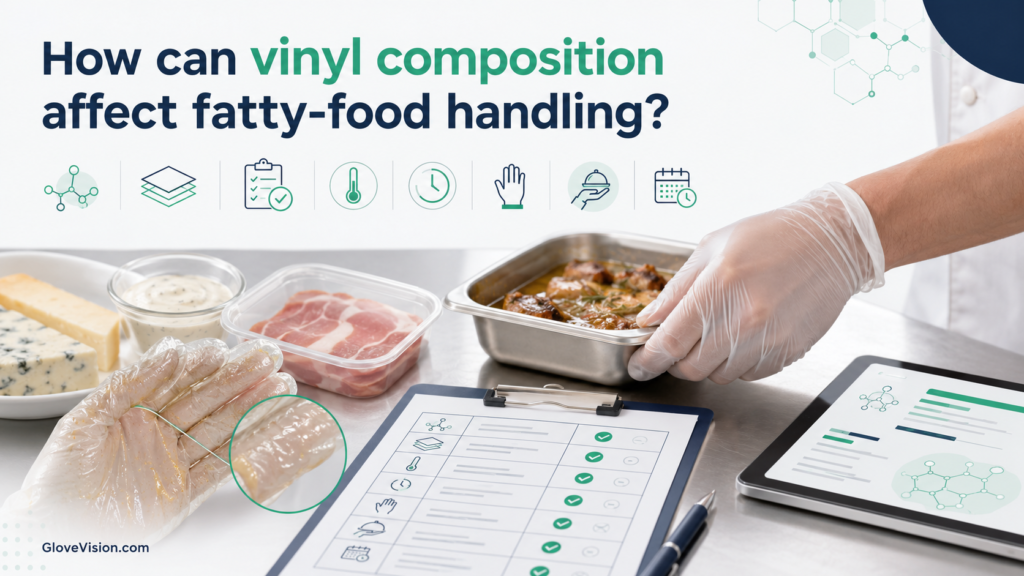
How can vinyl composition affect fatty-food handling?
Vinyl composition can affect fatty-food handling because flexibility, additive migration, fit, grip, and durability depend on the exact PVC formulation, plasticizer system, finished-product construction, and documented conditions of use. Vinyl is a broad material label, so kitchens should not treat every vinyl glove as the same product or assume that one plasticizer claim decides suitability.
This article explains which formulation details matter, how food type, temperature, and duration affect suitability, how to verify an exact glove, when to select another product, and how to respond to damage or suspected residue. It keeps chemical migration, physical failure, food-contact documentation, and task performance separate so decisions stay product-specific and evidence-controlled.
This article provides educational guidance about vinyl-glove composition, plasticizers, food-contact documentation, fatty-food conditions, task performance, glove replacement, and failure response. It does not replace local food law, formal migration assessment, exact supplier documentation, manufacturer instructions, the facility food-safety plan, handwashing rules, worker training, medical evaluation, machine guarding, or task-specific heat, cut, and chemical protection. Verify the exact finished glove, additive system, food, temperature, duration, worker fit, task, jurisdiction, and product restrictions before use.
How Can Vinyl Composition Influence Fatty-Food Handling?
Vinyl composition can affect fatty-food handling because flexibility, additive migration, grip, fit, and durability depend on the exact PVC formulation, plasticizer system, finished-product construction, and documented conditions of use.
For broad food-glove context, food-handling gloves explains the wider category; this page owns the narrower question of exact vinyl composition in fatty-food handling.
What Is a Vinyl Food Glove Made From?
A vinyl food glove is generally based on PVC or a related vinyl formulation, but the complete product may include different plasticizers, stabilizers, pigments, lubricants, surface treatments, dimensions, and manufacturing controls. The finished glove, not the word “vinyl,” is the unit that must be evaluated.
Why Are Plasticizing Additives Used?
Plasticizing additives may be used to help convert a rigid PVC-based formulation into a flexible finished glove. Their identity, concentration, authorization, and migration behaviour vary by product, so the article should not call them loose chemicals or treat every plasticizer system as identical.
What Can Composition Potentially Affect?
Composition may affect flexibility, stretch recovery, fit, grip, tackiness, tear behaviour, shape retention, migration potential, temperature restrictions, food-type restrictions, comfort, and storage stability. None of these outcomes can be proven from the material category alone.
Why Is Fatty-Food Suitability Product-Specific?
Fatty-food suitability depends on the exact additive system, food-fat content, contact area, temperature, duration, movement, construction, and applicable restrictions. A selected PVC-film migration study can illustrate that formulation and fatty simulants matter, but its specific results should not be generalized to every current vinyl glove. [Study]
What Does Vinyl Composition Not Establish by Itself?
Material name alone does not prove compliance, fatty-food suitability, migration performance, grip, tear resistance, puncture resistance, heat resistance, cut protection, duration, or worker suitability. “Vinyl” is a broad material label; suitability must be established for the exact finished glove.
Which Vinyl Formulation Details Matter Most?
The most important formulation details are the exact polymer system, plasticizers and other additives, finished-product coverage, migration restrictions, and stated food-contact conditions.
Which Plasticizer Information Should Be Verified?
Request plasticizer identity, phthalate or non-phthalate status, authorization, restrictions, migration limits where applicable, finished-product coverage, food restrictions, temperature, and duration. “Phthalate-free” may address a specific claim, but it does not prove plasticizer-free, additive-free, migration-free, or unlimited use.
Can Historical Glove Studies Be Applied to Every Current Product?
No. Historical studies describe the particular formulations, plasticizers, products, and test conditions examined. They can support why exact formulation matters, but they should not be used as proof of the current composition, migration rate, or safety outcome of every glove.
What Does “Phthalate-Free” Establish?
A phthalate-free claim may establish only that specified phthalates are absent or below a defined threshold under a particular claim or test. It does not establish fatty-food suitability, migration-free status, unlimited temperature, unlimited duration, or better mechanical performance.
What Do Appearance and Odour Reveal?
Cloudiness, tackiness, oily film, discoloration, odour, or residue may justify stopping use and investigating the product, but they do not identify a chemical or prove noncompliance. These signs should trigger quarantine, product-code review, storage review, and supplier contact when needed.
How Can Storage Affect the Product?
Verify storage temperature, sunlight exposure, humidity, shelf life, packaging condition, nearby chemicals, and stock rotation. A product that has been stored outside instructions should not be approved for fatty-food contact until its identity, condition, and supplier guidance are clear.
How Do Food Type, Temperature, and Contact Duration Affect Vinyl-Glove Suitability?
Fat content alone does not determine suitability; kitchens must evaluate the exact food, temperature, duration, contact area, mechanical task, and stated limitations of the finished glove.
Why Can Fatty Food Matter?
Fatty foods can matter because some lipophilic additives may transfer differently under specific food, simulant, temperature, duration, contact-area, and movement conditions. EU plastics rules use migration-related concepts, food simulants, and test conditions where the regulation applies, but the exact scope still has to be verified. [EU]
Which Food Details Should Be Considered?
Consider total fat, surface oil, emulsions, dairy fat, meat fat, sauces, dressings, fillings, coatings, acidity, water content, ready-to-eat status, and whether the food will later be cooked. A dry-looking food may still contain oil, filling, coating, or fat.
Why Does Contact Duration Matter?
Longer contact can increase the opportunity for migration, mechanical fatigue, soil buildup, fit change, grip loss, and contamination. Do not invent one safe contact time; use product documentation and representative task trials.
Why Does Temperature Matter?
Temperature may affect migration, flexibility, fit, grip, additive movement, and product stability. A universal temperature limit should not be invented for all vinyl gloves; hot-food handling may also require separate thermal protection.
Why Does Mechanical Action Matter?
Repeated flexing, stretching, pulling, gripping, utensil contact, packaging-edge contact, and friction may affect performance independently of chemical migration. A failed glove does not prove chemical extraction.
Table 1. This matrix matches formulation and food-contact variables without creating a universal vinyl ranking or plasticizer-danger score.
| Evaluation Area | Evidence Needed | Contact Variable | Warning Sign | Decision |
|---|---|---|---|---|
| Polymer and plasticizer system | Product or formulation documentation | Exact SKU and lot | Generic “vinyl” only | Request details |
| Fatty-food coverage | Food-contact statement or test scope | Fat type and amount | Fatty food omitted | Restrict or reject |
| Temperature | Conditions-of-use statement | Actual food temperature | Temperature outside scope | Use another product |
| Duration | Documented contact condition | Actual handling time | Duration exceeds scope | Restrict or replace |
| Physical performance | Representative task trial | Actual food and utensils | Slipping, tearing, tackiness | Reject or restrict |
| Storage condition | Manufacturer instructions | Stock age and environment | Film, odour, distortion | Quarantine and investigate |
This asset does not diagnose migration visually; it identifies when evidence is missing, when restrictions apply, and when the glove should be investigated or replaced.
How Should Kitchens Verify an Exact Vinyl-Glove Product?
A vinyl glove should be approved by exact manufacturer and product code only after its food-contact basis, formulation coverage, food restrictions, temperature, duration, fit, grip, and task performance have been verified.
For broad material comparisons, use Glove Material Compare; this page focuses on the exact finished vinyl glove rather than a vinyl-versus-nitrile ranking.
Which Product Details Should Be Recorded?
Record manufacturer, product name, code, lot where relevant, intended use, single-use or reusable status, powder status, latex status, sizes, thickness, glove length, texture, storage, shelf life, and supplier. Size-system interpretation can be supported by Glove Size Translator, but the actual glove must still be fitted to the worker and task. For general product-class context, disposable gloves explains the disposable category.
Which U.S. Food-Contact Information Should Be Requested?
Request regulatory basis, product or formulation coverage, foods, temperature, duration, conditions, restrictions, and testing. FDA explains food-contact-substance pathways, but the exact finished glove still needs supplier documentation for its intended use. [FDA] [FCS]
Which EU Information Should Be Requested?
Where EU plastic-material rules apply, verify scope, substances, migration, simulants, testing, food, temperature, duration, Declaration of Compliance, and supporting evidence. The broader EU framework also requires food-contact materials to be evaluated in context rather than by material name alone. [EU]
Which Claims Are Insufficient by Themselves?
Claims such as food grade, food safe, FDA compliant, EU compliant, phthalate-free, DEHP-free, powder-free, premium vinyl, industrial grade, medical grade, non-toxic, or low migration are not enough without exact scope. Exact CFR provisions should be checked by scope and should not be mapped automatically to every vinyl or disposable glove. [CFR]
How Should the Product Be Task-Tested?
Use the actual food, temperature, duration, movements, size, utensils, fat conditions, and task-change triggers. Record fit, grip, slippage, tearing, stretching, tackiness, shape, comfort, residue, and worker feedback.
Which Findings Should Prevent Approval?
Do not approve the product if identity, documentation, fatty-food coverage, temperature, duration, fit, grip, condition, sizing, or supplier substitution remains unresolved. A task-first screening step can be supported by the Glove Recommendation Engine, but final approval still depends on facility evidence.
Table 2. This table approves, restricts, or rejects an exact vinyl product by documentation, contact conditions, fit, grip, and separate hazard controls.
| Verification Question | Evidence Needed | Contact Condition | Warning Sign | Decision |
|---|---|---|---|---|
| Is the exact glove documented? | Supplier statement and basis | Intended food and use | Vague claim | Do not approve |
| Is fatty-food contact addressed? | Restrictions and test basis | Fat, temperature, duration | Fatty-food status omitted | Seek clarification |
| Is formulation coverage clear? | Finished-product evidence | Actual SKU and lot | Raw-material evidence only | Do not assume |
| Does it fit and grip safely? | Size chart and trial | Actual food and tools | Slipping or overstretching | Change product |
| Does performance remain acceptable? | Trial and product data | Representative duration | Tackiness or tearing | Reject or restrict |
| Are separate hazards controlled? | PPE and machine assessment | Heat, cuts, chemicals, machinery | Vinyl used as hazard PPE | Add controls |
This table does not create a universal material ranking or suggest that another material is automatically migration-free.
When Should a Different Documented Glove Product Be Selected?
A different documented product should be selected when the vinyl glove’s food-contact conditions exclude the task, its formulation is unclear, or it fails to provide acceptable fit, grip, durability, or worker control.
Which Conditions May Justify Another Product?
Another documented product may be needed when documentation is missing, fatty-food restrictions exclude the task, temperature or duration is outside scope, the glove becomes tacky or loses shape, grip is unsafe, tearing repeats, sizing is unreliable, worker symptoms are reported, supplier information is incomplete, or separate hazards are present.
Should Nitrile Automatically Replace Vinyl?
No. Nitrile may avoid PVC plasticizers when the exact product contains no PVC, but nitrile formulations may contain other additives and migrants and still require full verification. Alternatives should be compared by exact food-contact basis, restrictions, temperature, duration, fit, grip, dexterity, tear performance, worker sensitivity, change frequency, waste, and supplier reliability.
Can Vinyl Be Approved for a Low-Fat or Short Task?
Possibly, when the exact documentation and representative trial support that use. Do not approve solely because the food looks dry, cold, prepackaged, low-risk, or briefly handled.
How Should Alternatives Be Compared?
Compare exact product documentation, fatty-food scope, performance in task trials, glove size options, worker fit, grip, dexterity, tearing pattern, change frequency, supplier reliability, and use restrictions. Non-emergency fit, pressure, sweating, or slippage problems can be routed through the Glove Comfort Troubleshooter.
Which Hazards Need Separate Protection?
Disposable vinyl gloves do not automatically provide heat, cut, chemical, puncture, or machinery-entanglement protection. Use Glove Hazard Match or facility hazard procedures for separate hazards; OSHA’s hand-protection rule also requires PPE selection to match identified hand hazards. [OSHA]
When Must Vinyl Food Gloves Be Replaced?
A vinyl glove identified as single-use should be discarded when it becomes damaged, soiled, contaminated, unsuitable, or involved in an operational interruption or incompatible task change.
Which Physical Signs Require Replacement?
Replace the glove after tear, puncture, seam split, cuff damage, shape loss, stretching, slippage, tackiness, residue, deterioration, fragments, grip loss, unexplained film, or odour. These signs do not prove chemical migration, but they can show the product is no longer acceptable for use.
Which Soil and Contamination Triggers Require Replacement?
Replace after grease, food buildup, raw soil, waste contact, dirty equipment, floor contact, cleaning activity, phone, face, hair, clothing, chemical exposure, allergen transition, or other contamination triggers.
Which Task Changes Require Replacement?
Task changes include raw-to-ready-to-eat work, incompatible food categories, cleaning work, leaving and returning to the station, operational interruption, allergen transition, and moving from soiled to controlled work. The Food Code is a model document, so local adoption and facility procedures still matter. [Food Code]
Does Switching Glove Material Always Require Handwashing?
No. Handwashing depends on task, contamination, glove removal, raw-food contact, personal contact, environmental contact, facility procedure, and adopted requirements—not merely on the name of the new glove material.
Can Grease Be Wiped From a Single-Use Glove?
No. A heavily soiled single-use glove or one that has lost safe grip should be removed and discarded. Stop, secure tools, remove the glove, wash hands as required, assess food and surfaces, and don a fresh approved glove.
What Should Workers Do After Vinyl-Glove Damage or Suspected Residue?
When a vinyl glove tears, loses grip, changes condition, or may have left residue, the worker should stop the task and assess the glove, worker, food, tools, and workstation before restarting.
What Should Happen Immediately?
Stop handling or cutting, secure tools, control the food, remove and discard the glove, wash hands as required, inspect the hand, identify product and lot, isolate food, assess tools and surfaces, and quarantine the box if a defect is suspected.
Does a Tear Prove Chemical Migration?
No. A tear may result from fit, tension, sharp contact, packaging, tools, storage, age, manufacturing defects, task mismatch, donning, or exposure effects. A physical failure should trigger assessment, but it should not be converted into proof of migration.
How Should Suspected Residue Be Assessed?
Review product identity, lot, food, fat, temperature, duration, direct contact, glove condition, restrictions, storage, and other possible residue sources. Staff cannot visually identify a named migrant from film, odour, or tackiness alone.
How Should Affected Food Be Handled?
Affected food should be isolated, discarded, or reprocessed according to the approved facility procedure. Do not automatically discard an entire batch or release it merely because no fragment is immediately visible.
How Should Greasy Tools and Surfaces Be Reset?
Stop, remove gross soil, wash or clean, sanitize where required, drain or dry appropriately, and confirm safe grip before restarting. Use the facility cleaning and food-contact-surface procedure for the actual station.
What Should Happen After Repeated Failures?
Review code, lot, size, task, food, temperature, duration, failure point, storage, substitution, technique, and documents. Suspend the product until the cause is understood.
Workflow 1. This corrective-response workflow controls damage, loss of grip, suspected residue, food, tools, and surfaces without visually diagnosing migration.
- Damage, loss of grip, or suspected residue detected
- Stop the task and secure tools
- Remove and discard the glove
- Wash hands as required
- Inspect the worker’s hand
- Identify product code and lot
- Isolate affected food
- Check direct contact, possible fragments, and residue
- Assess tools and surfaces
- Apply the facility food-disposition procedure
- Clean and sanitize as required
- Quarantine suspected product
- Investigate the cause
- Select an approved replacement
- Restart after controls are restored
Restart only after worker condition, product status, food assessment, tool and surface condition, replacement glove, and failure cause have been addressed.
Which Shift-Start Checks Confirm Vinyl-Glove Readiness?
Before food preparation begins, supervisors should confirm that each active vinyl glove matches an approved product code and is assigned only to tasks covered by its documented food-contact conditions.
Table 3. This checklist verifies product identity, formulation scope, task assignment, physical condition, stock control, and incident readiness before service.
| Check | Verification | Corrective Action |
|---|---|---|
| Exact product identity | Manufacturer, product, code, lot, station, and task | Quarantine unmatched products |
| Food-contact documentation | Basis, formulation coverage, foods, fatty restrictions, temperature, duration | Do not approve incomplete evidence |
| Plasticizer and additive claims | Phthalate, DEHP, alternatives, scope, and test basis | Do not interpret claim broadly |
| Task assignment | Ingredients, fat, temperature, duration, stress, ready-to-eat status, hazards | Move task to another product |
| Physical condition | Packaging, shelf life, tackiness, film, odour, distortion | Quarantine and contact supplier |
| Fit and grip | Sizes, movement, slack, stretch, grip, removal | Change size or product |
| Handwashing readiness | Sink, running water, soap, drying, waste, access | Restore facilities |
| Replacement and incident supplies | Gloves, sizes, isolation, cleaning, sanitation, waste, reporting | Restock |
| Powered-equipment boundary | Guards, instructions, entanglement, lockout, training | Do not proceed unless permitted |
| Supplier substitution | Supplier, code, written review, documents, receiving record | Quarantine substitution |
This checklist is an operational readiness screen, not toxicological approval, migration testing, formal legal opinion, machine inspection, clinical assessment, or supervision substitute.
- FDA — Food Code 2022 Full Document — used for model food-service provisions, single-use glove context, handwashing, and event-driven change context.
- FDA — Food Packaging and Other Food-Contact Substances — used for general food-contact framework.
- FDA — Understanding How FDA Regulates Food-Contact Substances — used for U.S. food-contact pathway context.
- FDA — CFR Title 21 Search — used for exact CFR-scope checking without universalizing one section.
- EUR-Lex — Regulation (EC) No 1935/2004 — used for general EU food-contact-material framework.
- EUR-Lex — Regulation (EU) No 10/2011 — used for EU plastic material and migration-condition context where applicable.
- EPA HERO — Coltro et al. 2014 PVC Plasticizer Migration Study — used for selected PVC-film study context showing why formulation and fat simulants must not be generalized.
- OSHA — 29 CFR 1910.138 Hand Protection — used for separate task- and hazard-based hand-protection boundary.
Frequently Asked Questions
Can Vinyl Gloves Be Used With Fatty Foods?
Possibly, but only when the exact finished product’s documentation covers the intended fatty food, temperature, duration, and conditions, and the glove performs adequately in the task.
Are Phthalate-Free Vinyl Gloves Automatically Suitable for Fatty Foods?
No. A phthalate-free claim does not prove additive-free, migration-free, unlimited-temperature, unlimited-duration, or fatty-food suitability.
Does a Tacky or Cloudy Vinyl Glove Prove Migration?
No. Tackiness, cloudiness, film, odour, or residue may justify stopping use and investigating, but they do not identify a chemical or prove migration.
Is Nitrile Always the Best Replacement for Vinyl?
No. Another product may be better for a task, but exact nitrile products may contain other additives and still need food-contact documentation, fit checks, and task trials.
What Should Happen if a Vinyl Glove Tears?
Stop the task, secure tools, remove the glove, wash hands as required, inspect the worker, identify product and lot, isolate affected food, check residue or fragments, assess surfaces, and restart only after controls are restored.
Conclusion
Vinyl composition can affect fatty-food handling because migration, flexibility, fit, grip, and durability depend on the exact formulation, additive system, finished-product construction, food, temperature, duration, worker, and task. Material name is insufficient, and historical studies, phthalate-free claims, dry-looking food, short contact, or broad “food safe” wording should not be converted into automatic approval.
Vinyl gloves should be approved, restricted, or replaced by exact product code—not by broad assumptions about PVC, phthalates, nitrile, or dry versus fatty work. Kitchens should verify formulation scope, food-contact documentation, food type, fat content, temperature, duration, contact area, mechanical action, task trials, alternative products, event-driven replacement, failure and residue response, supplier substitutions, and separate hazards before service.