
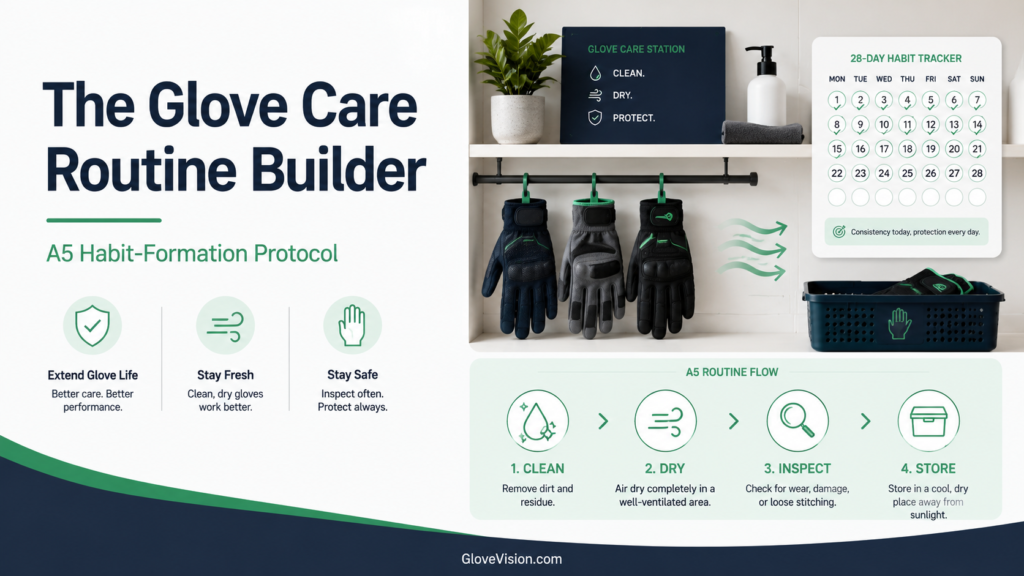
The Glove Care Routine Builder: A5 Habit-Formation Protocol
The Glove Care Routine Builder is an A5 habit-formation protocol that helps glove users build a repeatable care routine through Anchor, Access, Action, Audit, and Adjust instead of relying on willpower after activity.
This article covers safety and replacement boundaries, manufacturer and workplace care rules, the A5 system, Minimum Viable Habits, care-station setup, anchor pairing, 28-day tracking, weekly debriefing, system refinement, and final care-success validation while keeping routine care separate from cleaning, disinfection, decontamination, repair, certification, or restoration of unsafe gloves.
Why Does a Glove Care Routine Builder Reduce Glove-Care Failure After Activity?
A Glove Care Routine Builder reduces glove-care failure after activity by turning glove maintenance into one small action that is anchored to an existing routine and supported by an easy-to-reach care station.
Care-routine failure usually appears after the hardest moment of the day, when the user is tired, rushed, sweaty, distracted, or already thinking about the next task.
A complex care list creates skipped routine because the user has to decide what to do, where to put the gloves, which supplies to use, and whether the task is worth doing.
A Minimum Viable Habit removes that decision load by making the first action so small that it can happen even when energy is low.
Figure 1: The A5 habit loop keeps glove care behavioral, small, and adjustable instead of turning it into a fragile chore list.
Why Do Glove-Care Routines Fail After Training or Work?
Glove-care routines fail after training or work because users are often tired, rushed, distracted, or already focused on the next task.
Energy is lower after activity, so a routine that looked simple earlier can feel too large when the gloves actually need attention.
Decision load makes care easier to skip because the user has to choose the next step instead of following a visible cue.
How Does the Glove Care Routine Builder Solve the Behavior Problem?
The Glove Care Routine Builder solves the behavior problem by reducing care to one small action, placing the station near the transition point, and treating missed days as system feedback.
Anchor gives the user a cue, Access removes physical friction, and Action makes the first step small enough to repeat.
A missed day is a signal that the cue, station, action, or review process needs adjustment.
What Should the Glove Care Routine Builder Not Try to Replace?
The Glove Care Routine Builder should not replace manufacturer instructions, workplace PPE rules, decontamination procedures, formal inspection, replacement decisions, deep cleaning, or single-use disposal rules.
| Routine Failure | Why It Happens | Better System Fix |
|---|---|---|
| Gloves stay sealed in a bag | User is tired or distracted | Create a visible bag-opening anchor |
| Routine feels too large | Too many care steps at once | Start with one Minimum Viable Habit |
| Care station is far away | Access friction blocks action | Move station to the transition point |
| Weekly care is skipped | Support task is not scheduled | Attach it to laundry, rest, or gear-packing day |
| Unsafe gloves stay in use | Care routine hides replacement need | Add replacement boundary checks |
When Should a Glove Care Routine Builder Stop and Glove Replacement or Disposal Begin?
A Glove Care Routine Builder should stop and glove replacement or disposal should begin when gloves are torn, moldy, contaminated, chemically exposed, structurally degraded, no longer protective, or not allowed to be reused.
The stop boundary is the page’s most important safety gate because routine care must never become an excuse for keeping unsafe gloves in service.
PPE use and maintenance must follow workplace hazard protection requirements, and hand protection must be selected for the actual hazards involved. [OSHA] [OSHA]
Which Gloves Should Not Be Handled as Routine-Care Candidates?
Gloves should not be handled as routine-care candidates when they have torn linings, collapsed padding, split seams, visible mold, persistent musty odor, chemical contamination, biological contamination, degraded grip, damaged protective layers, or rules against reuse.
Chemicals, pesticides, solvents, oils, hazardous dust, blood, and biological material must not be treated as casual drying or deodorizing problems.
Why Can Care Habits Not Restore Unsafe Gloves?
Care habits cannot restore unsafe gloves because routine drying, wiping, airing, or organizing does not reverse structural failure, remove hazardous contamination, disinfect gloves, or restore lost protection.
Care neglect can sometimes be corrected with a better routine, but true glove failure requires replacement, disposal, or approved professional handling.
What Should Users Do When Gloves Fail the Safety Boundary?
Users should stop using gloves for protective tasks when they fail the safety boundary and should follow manufacturer, workplace, disposal, decontamination, or replacement rules.
If workplace PPE is involved, the failed condition should be documented so the glove is not returned to protective service by mistake.
| Condition | Routine Care Allowed? | Action |
|---|---|---|
| Mild sweat or dampness | Yes | Air out and follow care routine |
| Loose surface dirt | Usually | Brush or wipe only if allowed |
| Persistent musty odor | Maybe | Follow manufacturer care; replace if unresolved |
| Visible mold | No | Replace or follow professional guidance |
| Torn lining | No | Replace |
| Collapsed padding | No | Replace |
| Chemical contamination | No unless protocol allows | Follow site safety procedure |
| Disposable glove after use | Usually no | Dispose according to rules |
| Blood or biological contamination | No unless protocol allows | Follow workplace rules |
Which Manufacturer and Workplace Rules Must the Glove Care Routine Builder Follow?
The Glove Care Routine Builder must follow manufacturer and workplace rules because different glove categories have different cleaning, drying, deodorizing, storage, reuse, and disposal limits.
Manufacturer instructions are the first authority for glove-specific drying, conditioning, deodorizing, storage, and replacement limits.
Disposable, medical, lab, food-handling, chemical, and contamination-risk gloves must also follow workplace, hygiene, and infection-control rules. [CDC] [CDC]
How Should Sports Gloves Be Handled Inside the Glove Care Routine Builder?
Sports Gloves should be aired out after use, separated from damp wraps or liners, and maintained only with manufacturer-approved cleaning or deodorizing methods.
Sports Gloves should be checked for padding collapse, lining failure, mold, or deep odor that signals a replacement boundary.
How Should Work Gloves Be Handled Inside the Glove Care Routine Builder?
Work gloves should be brushed free of loose debris when allowed, safely air-dried, stored away from wet gear, and inspected for grip, seams, coating, and protective-layer damage.
Cut, puncture, chemical, heat, or grip protection failure overrides any habit streak.
How Should Leather Gloves Be Handled Inside the Glove Care Routine Builder?
Fashion Gloves or Work Gloves should be dried with room-temperature airflow and handled according to manufacturer care instructions because high heat, direct heaters, and strong sunlight can damage leather.
Conditioning belongs only where the glove maker allows it, and cracked, moldy, stiff, or structurally weakened leather needs replacement or professional review.
How Should Disposable Gloves Be Handled Inside the Glove Care Routine Builder?
Disposable gloves usually should not be handled inside a care routine because single-use medical, food-handling, lab, or chemical gloves normally follow disposal or site-specific reuse rules.
Disposable gloves should not be dried, wiped, or cleaned for casual reuse.
How Should Chemical, Lab, Medical, or Safety-Rated Gloves Be Handled?
Laboratory Gloves, Medical Gloves, and Work Gloves should be handled only according to manufacturer instructions, workplace protocols, contamination rules, storage rules, and disposal requirements.
If exposure or protocol is uncertain, routine care should stop before the glove is mixed with personal gear.
| Glove Category | Care Rule | Safety Limit |
|---|---|---|
| Sports Gloves | Air out, separate wet wraps, follow manufacturer cleaning rules | Replace if padding, lining, mold, or deep odor is unsafe |
| Work gloves | Remove loose debris if allowed, air dry, inspect grip and seams | Do not reuse if protection is damaged |
| Fashion Gloves or Work Gloves | Use room-temperature airflow and approved conditioning only | Avoid heat; replace or professionally treat unsafe leather |
| Disposable gloves | Usually dispose after use | Do not dry or clean for casual reuse |
| Work Gloves | Follow manufacturer and workplace protocol | Do not improvise after exposure |
| Medical Gloves / Laboratory Gloves | Follow site hygiene and disposal rules | Do not treat routine care as infection control |
What A5 Steps Structure the Glove Care Routine Builder?
The Glove Care Routine Builder is structured by five A5 steps: Anchor, Access, Action, Audit, and Adjust.
The A5 framework is a practical care-system structure, not a clinical adherence model.
What Does Anchor Mean in the Glove Care Routine Builder?
Anchor means attaching glove care to an existing routine that already happens after activity.
Useful anchors include setting down keys, removing shoes, unpacking gear, or returning to a locker.
What Does Access Mean in the Glove Care Routine Builder?
Access means making the care station easy to reach so the user does not need extra motivation to start.
Hooks, racks, shelves, pouches, and visible containers reduce friction because the next step is physically obvious.
What Does Action Mean in the Glove Care Routine Builder?
Action means choosing one Minimum Viable Habit that is small enough to complete even when the user is tired.
Opening the bag, placing gloves in airflow, separating damp liners, or checking obvious damage can be enough for the daily baseline action.
What Does Audit Mean in the Glove Care Routine Builder?
Audit means reviewing what worked, what failed, and which part of the system created friction.
The review should inspect the system design rather than blame the user.
What Does Adjust Mean in the Glove Care Routine Builder?
Adjust means changing the cue, station, action, or review process after a missed day or weak streak.
One small change is better than rebuilding the whole routine every time the streak breaks.
| A5 Step | Meaning | Example |
|---|---|---|
| Anchor | Link care to an existing routine | After I set down keys, I open my glove bag |
| Access | Make the station easy to reach | Keep rack beside gear bag |
| Action | Choose one tiny care action | Place gloves in airflow |
| Audit | Review what worked or failed | Check missed days weekly |
| Adjust | Improve the system | Move rack closer or shrink MVH |
What Minimum Viable Habit Should the Glove Care Routine Builder Start With?
The Glove Care Routine Builder should start with one Minimum Viable Habit that is small, visible, repeatable, safe for the glove category, and allowed by manufacturer or workplace rules.
Consistency comes before complexity because a completed tiny action gives the routine a stable base.
1Minimum Viable Habit Planning Template
Use this section like a workbook. Select one glove category, one care purpose, one tiny action, and one stop boundary before the 28-day tracker begins.
| Planning Field | Example Entry | Your Entry Fill this column |
|---|---|---|
| Glove category | Medical Gloves, Disposable Gloves, Work Gloves, Food Handling Gloves, Laboratory Gloves, Household Gloves, Tactical Gloves, Sports Gloves, Fashion Gloves | |
| Care purpose | Airflow, wet-gear separation, safe storage, loose dirt removal if allowed, or obvious damage check | |
| Minimum Viable Habit | Open glove bag, place gloves on rack, hang gloves on hooks, separate damp liners, or check obvious damage | |
| Anchor routine | After I set down keys, remove shoes, unpack gear, drink water, or return to locker | |
| Weekly support task | Storage reset, liner restock, grip inspection, manufacturer-approved cleaning, or leather conditioning if allowed | |
| Safety stop boundary | Visible mold, contamination, torn lining, collapsed padding, degraded grip, chemical exposure, or rule against reuse |
What Makes a Strong Minimum Viable Habit?
A strong Minimum Viable Habit is very small, physically easy, visible, repeatable when tired, linked to one anchor, safe for the glove category, and allowed by relevant rules.
Which Minimum Viable Habit Should Users Choose First?
Users should choose one daily baseline action such as opening the glove bag, placing gloves in safe airflow, hanging gloves on hooks, separating wet liners, brushing loose dirt if allowed, checking obvious damage, or moving gloves away from wet gear.
Choosing multiple baseline actions too early turns the habit back into a chore list.
Why Should Users Start Smaller Than They Think?
Users should start smaller than they think because the first goal is consistency, not full maintenance perfection.
Larger care tasks can be added later as weekly support tasks when the daily baseline is reliable.
| MVH Option | Time Needed | Care Purpose |
|---|---|---|
| Open glove bag | 2 seconds | Prevent sealed damp storage |
| Place gloves on rack | 5 seconds | Start airflow habit |
| Hang gloves on hooks | 5 seconds | Keep gloves open |
| Separate damp liners/wraps | 10 seconds | Reduce moisture transfer |
| Brush off loose dirt | 10 seconds | Reduce abrasive debris if allowed |
| Check for obvious damage | 10 seconds | Catch replacement issues early |
How Do You Configure the Environment for the Glove Care Routine Builder?
You configure the environment for the Glove Care Routine Builder by placing a visible care station at the user’s natural transition point and removing physical friction before the routine starts.
Station placement matters because the routine should happen where the gloves already pass.
2Care Station Setup Template
How Do You Configure Existing Habits as Triggers for the Glove Care Routine Builder?
You configure existing habits as triggers by attaching the glove-care action to a routine the user already performs after training, work, lab tasks, or long shifts.
The anchor formula is simple because the glove-care action needs to happen immediately after an existing cue.
What Is the Anchor Formula?
The anchor formula is: “After I [existing routine], I will immediately [glove care MVH].”
Examples include “After I set down keys, I open my glove bag” and “After I unpack gear, I place gloves in airflow.”
Which Anchors Work Best?
The best anchors are already repeated, close to the glove location, physical, visible, hard to ignore, and easy to connect with the Minimum Viable Habit.
Physical cues beat memory-only intentions because the environment reminds the user before the routine is skipped.
What Makes an Anchor Weak?
An anchor is weak when it is hidden, optional, too late in the day, far from the gloves, dependent on memory only, or not connected to a physical action.
Weak anchors usually produce missed days, which should be sent into the adjustment loop.
| Existing Routine | Glove Care MVH | Behavioral Goal |
|---|---|---|
| After I set down keys | I open my glove bag | Make care immediate |
| After I remove shoes | I hang gloves on rack | Link care to entry routine |
| After I drink water | I separate damp liners | Pair with recovery habit |
| After I unpack gear | I place gloves in airflow | Connect to cleanup |
| After laundry day | I restock clean liners/wraps | Prepare weekly support |
How Do You Execute the 28-Day Streak Tracker With the Glove Care Routine Builder?
You execute the 28-day streak tracker by marking whether the chosen Minimum Viable Habit was completed each active day and reviewing one weekly support task when needed.
What Counts as a Successful Daily Streak?
A successful daily streak counts when the selected Minimum Viable Habit is completed on an active glove-use day.
Success can mean the bag was opened, gloves were placed in airflow, damp liners were separated, gloves were moved to the station, obvious damage was checked, or loose dirt was brushed if allowed.
How Should the 28-Day Tracker Be Used?
The 28-day tracker should be used by marking completed days, reviewing missed days weekly, and adjusting the anchor, station, or action when needed.
A missed day should not restart the whole system because the miss is feedback about the cue, station, action, or review process.
Which Weekly Support Tasks Can Be Added?
Weekly support tasks can include deeper drying review, manufacturer-approved cleaning, leather conditioning if allowed, odor check, lining inspection, grip inspection, storage reset, or restocking clean liners and wraps.
Weekly support tasks must match the glove category and its rules.
328-Day Consistency Streak Template
Strong routine. Maintain the baseline and add only one small support task if rules allow it.
Good foundation. Improve the cue or move the station closer.
Friction interruption. Reduce the MVH and strengthen the anchor.
System failure. Rebuild smaller and simpler.
Which Environmental Friction Points Does the Glove Care Routine Builder Debrief Analyze?
The Glove Care Routine Builder debrief analyzes friction points such as hidden cues, exhaustion, cluttered stations, skipped weekly tasks, and glove problems that care habits cannot solve.
A weekly debrief works best when it uses if/then logic rather than vague motivation advice.
What If Gloves Are Forgotten Inside the Bag?
If gloves are forgotten inside the bag, the cue is hidden or the bag-opening action is not attached to a strong anchor.
A visible reminder tag or a care station closer to the bag drop zone makes the routine harder to miss.
What If Users Skip the Routine Because They Are Exhausted?
If users skip the routine because they are exhausted, the Minimum Viable Habit is too large.
The routine should shrink to the smallest allowed action, such as opening the bag or placing gloves on the rack.
What If the Care Station Is Cluttered?
If the care station is cluttered, the environment creates friction that makes the habit easier to skip.
A permanent visible space beats a station that has to be rebuilt after every use.
What If Weekly Care Tasks Are Skipped?
If weekly care tasks are skipped, the weekly routine is too complex, poorly scheduled, or not attached to an existing weekly anchor.
One support task attached to laundry day, rest day, gear-packing day, or inspection day is enough.
What If Odor, Damage, or Contamination Persists Despite the Routine?
If odor, damage, or contamination persists despite the routine, the issue is no longer only habit-related.
Manufacturer care rules, damage inspection, contamination review, mold checks, and replacement limits should control the next decision.
| Breakdown | Root Cause | System Adjustment |
|---|---|---|
| Gloves forgotten in bag | Hidden cue | Add reminder tag |
| Gloves left in vehicle | Transition skipped | Carry gloves inside first |
| Routine skipped from exhaustion | MVH too large | Shrink to 2-second action |
| Care station cluttered | Access friction | Clear permanent space |
| Weekly care skipped | Poor scheduling | Link to laundry/rest day |
| Odor persists | Care not enough | Inspect, clean if allowed, or replace |
4Weekly System Debrief Template
How Do You Refine the System Using the Glove Care Routine Builder Adjustment Loop?
You refine the system by reviewing which A5 element broke—Anchor, Access, Action, Audit, or Adjust—and changing one small part before the next cycle.
The adjustment loop prevents missed days from becoming emotional resets.
What Should Users Do After a Missed Day?
After a missed day, users should record what broke, identify whether the problem was Anchor, Access, Action, Audit, or Adjust, make one small correction, and continue the next day.
The miss is system evidence, not a verdict on discipline.
How Should the A5 Loop Be Refined?
The A5 loop should be refined one element at a time by strengthening the cue, moving the station closer, shrinking the action, reviewing weekly, or changing the system when friction appears.
Major redesign is only needed when the habit keeps failing after smaller corrections.
How Should Habit Success Be Measured?
Habit success should be measured by completed active days out of the 28-day cycle and by whether the care system becomes easier to repeat.
The active-day bands are internal habit-tracking bands, not scientific adherence standards.
| Active Days Completed | Automation Level | Next Cycle Strategy |
|---|---|---|
| 24–28 | Strong routine | Maintain and add small support task |
| 16–23 | Good foundation | Improve cue or station |
| 8–15 | Friction interruption | Reduce MVH and strengthen anchor |
| 0–7 | System failure | Rebuild smaller and simpler |
How Does the Glove Care Routine Builder Validate Care Success Without Ignoring Safety Limits?
The Glove Care Routine Builder validates care success by checking that the habit is repeatable, the glove remains safe to maintain, manufacturer rules are followed, and unsafe gloves are not kept in service.
Care consistency and glove safety must be validated separately because a repeated habit can still be applied to the wrong glove.
What Shows the Glove Care Routine Builder Is Working?
The Glove Care Routine Builder is working when the Minimum Viable Habit is completed most active days, gloves are not left sealed while damp, the care station is easier to use, and missed days are corrected quickly.
Wet gear separation and weekly support tasks can be added only when they remain safe and rule-compatible.
What Safety Checks Must Still Pass?
Safety checks must confirm no torn lining, damaged padding, visible mold, chemical contamination, biological contamination, degraded grip, broken seams, manufacturer rule against reuse, or workplace rule requiring disposal.
Contamination, damage, and reuse restrictions should be checked as separate decisions.
When Does the Glove Care Routine Builder Fail the Safety Boundary?
The Glove Care Routine Builder fails the safety boundary when gloves are cared for but still unsafe, dried but contaminated, deodorized but moldy, aired out but structurally damaged, or reused against rules.
Care habits cannot replace inspection or replacement.
What Is the Final Rule for the Glove Care Routine Builder?
The final rule is that a glove-care habit is successful only when it is repeatable and safe for the glove category.
A glove-care habit is successful only if it is repeatable, allowed for the glove category, compatible with manufacturer instructions, and never used to justify keeping unsafe gloves in service.
5Weekly Care and Replacement Limit Template
Frequently Asked Questions
The Glove Care Routine Builder helps users create a repeatable post-use care habit using Anchor, Access, Action, Audit, and Adjust. It turns glove care into a small behavior system rather than a large chore list that gets skipped after training, work, or long shifts.
No, the Glove Care Routine Builder does not clean, disinfect, decontaminate, repair, certify, or restore gloves. It helps users repeat basic care actions, but contaminated, damaged, moldy, chemically exposed, or structurally failed gloves need manufacturer, workplace, disposal, or replacement guidance.
Gloves are not good routine-care candidates when they have torn linings, collapsed padding, split seams, visible mold, persistent musty odor, degraded grip, chemical exposure, biological contamination, damaged protective layers, or rules against reuse. These require replacement, disposal, or professional review.
The 28-day tracker should record whether the selected Minimum Viable Habit was completed on active glove-use days. It measures routine consistency only, not cleanliness, disinfection, contamination safety, structural integrity, or approval for reuse, so safety checks still have to happen separately.
Conclusion
The Glove Care Routine Builder gives glove users a practical way to make care easier to repeat by designing the cue, station, action, review, and adjustment process around real behavior.
It reduces care-routine failure by using safety boundaries, manufacturer and workplace rules, the A5 framework, Minimum Viable Habits, care-station setup, anchor pairing, 28-day tracking, weekly debriefing, adjustment, and final validation without treating routine consistency as proof of glove safety. The best glove-care routine is the one that is simple enough to repeat and strict enough to stop when a glove is no longer safe to maintain.