
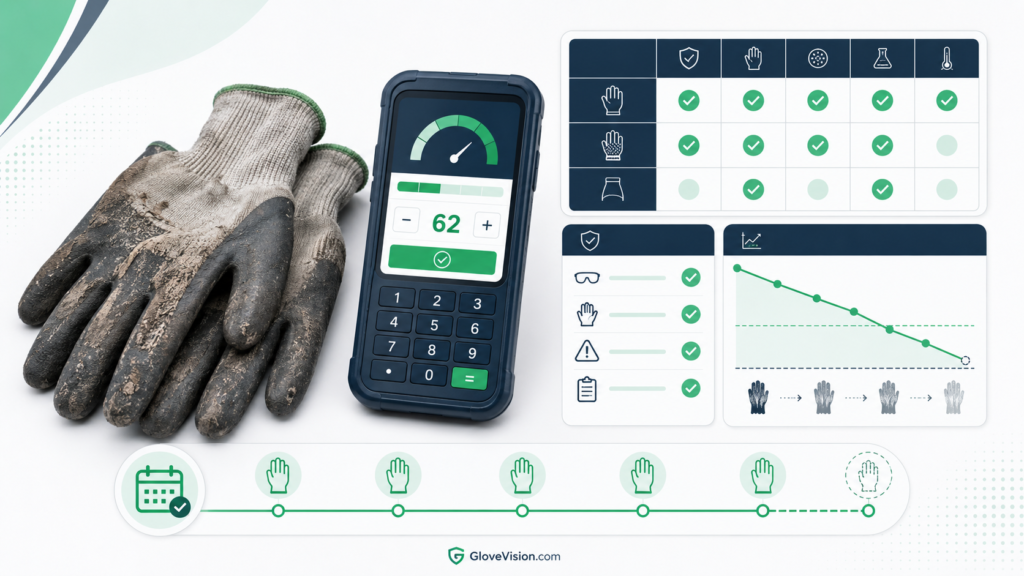
Glove Replacement Calculator: S5 Operational Lifespan Protocol
The Glove Replacement Calculator is an S5 operational lifespan protocol that estimates conservative glove replacement timing by combining Surface, Seams, Saturation, Sensation, and Safety Gate checks with active use hours and Material Wear Index trends. It does not prove continued glove safety, and immediate replacement gates, manufacturer instructions, chemical exposure limits, and workplace PPE rules override the calculator. [OSHA]
This webpage covers immediate replacement gates, S5 wear drivers, baseline controls, MWI scoring, chemical barrier overrides, Wear Velocity, CRIE, primary wear-vector interpretation, replacement planning, and safe validation so glove users can replace gloves before failure rather than waiting for visible damage.
Why Does a Glove Replacement Calculator Reduce Unsafe Glove Overuse?
A Glove Replacement Calculator reduces unsafe glove overuse by replacing visual guessing with logged active use hours, repeated wear scores, immediate replacement gates, and conservative replacement timing.
Visual guessing fails because a glove can lose protection through progressive thinning, grip decay, seam stress, stiffness, chemical limits, or inner material breakdown before an obvious hole appears.
The calculator improves replacement timing through repeated data, not one inspection, because active use hours, MWI decline, and Wear Velocity reveal whether condition is degrading faster than expected.
The mistake it prevents is simple: assuming a glove is still suitable only because it has no visible hole.
Figure 1: Visual inspection sees obvious surface damage, while replacement calculation adds active use hours, wear scores, immediate gates, and trend logic.
| Replacement Method | What It Sees | What It Can Miss |
|---|---|---|
| Visual guessing | Holes, tears, obvious seam splits | Chemical limits, grip loss, thinning, stiffness |
| Habit-based replacement | Usual replacement routine | Task severity changes and faster wear |
| Calendar-based replacement | Time since first use | Actual active use hours |
| MWI tracking | Wear categories over use hours | Still requires gate and chemical overrides |
| CRIE planning | Estimated replacement point | Not valid after sudden damage or chemical limit failure |
When Must a Glove Replacement Calculator Trigger Immediate Glove Replacement?
A Glove Replacement Calculator must trigger immediate glove replacement when a safety gate fails, including holes, punctures, tears, split seams, chemical breakthrough, swelling, tackiness, melting, unsafe grip loss, or exposed-skin risk. [OSHA]
Scoring stops after a gate failure because one critical breach can make the glove unsuitable even when the average wear score looks acceptable.
After a gate fails, stop using the glove for the active task, stop the replacement-cycle test, record the failure type and active use hours, and follow workplace disposal, decontamination, downgrade, or replacement rules.
Immediate Replacement Gate Checker
Select any condition found during inspection. Any checked gate cancels MWI, WV, and CRIE for active use.
| Gate Failure | Continue Use? | Required Action |
|---|---|---|
| Hole, tear, or puncture | No | Replace or remove from active service |
| Split seam | No | Replace, remove, or downgrade if allowed |
| Chemical breakthrough | No | Follow chemical PPE procedure |
| Interior contamination | No | Follow workplace disposal or decontamination rule |
| Swelling, tackiness, or softening | No | Remove and review chemical compatibility |
| Melting or burn damage | No | Replace immediately |
| Unsafe grip loss | No | Replace or downgrade from tool-handling tasks |
| Exposed-skin risk | No | Replace immediately |
What S5 Wear Drivers Should the Glove Replacement Calculator Track?
The Glove Replacement Calculator should track five S5 wear drivers: Surface, Seams, Saturation, Sensation, and Safety Gate.
Surface wear records abrasion, coating loss, thinning, cracks, scuffing, and grip texture loss that can affect puncture resistance, grip safety, and durability.
Seam condition records stitch stress, seam separation, cuff detachment, liner separation, finger-side splitting, and stress-zone openings that can cause sudden structural failure.
Saturation records chemical contact, moisture loading, oil absorption, solvent exposure, breakthrough limits, swelling, tackiness, and softening that may compromise barrier performance.
Sensation records tactile control, grip feel, slickness, finger stiffness, over-gripping, and tool-control feedback that can affect safe handling.
Safety Gate status is pass/fail and must be checked before normal MWI scoring begins.
Figure 2: The S5 model separates surface damage, seam integrity, saturation risk, grip feedback, and non-negotiable safety gates before replacement math begins.
| S5 Driver | What It Tracks | Replacement Risk |
|---|---|---|
| Surface | Abrasion, thinning, coating wear, palm damage | Puncture risk, grip loss, wear-through |
| Seams | Stitch stress, seam separation, cuff detachment | Sudden structural failure |
| Saturation | Chemical, oil, fluid, or moisture loading | Barrier failure, swelling, breakthrough risk |
| Sensation | Grip feel, tactile control, stiffness | Unsafe handling or over-gripping |
| Safety Gate | Critical failures or hazards | Immediate replacement |
How Should the Glove Replacement Calculator Control Test Variables Before Replacement Tracking?
The Glove Replacement Calculator should control test variables by tracking each glove model separately, recording task profile and active use hours, documenting chemical exposure data, and applying consistent inspection rules.
Glove model and material should be controlled by recording manufacturer, model, polymer or material, thickness, coating, liner, and cuff type for each tracked glove.
Task profile should be controlled by recording task type, tool use, grip force, abrasion level, puncture risk, chemical exposure, wet or dry work, heat or cold exposure, and active use hours.
Chemical exposure variables require exact chemical name, concentration, contact duration, contact type, breakthrough time, degradation warnings, manufacturer compatibility data, and site change-out rules.
Inspection intervals should be planned around active-use checkpoints, but earlier inspection is required after heavy abrasion, chemical exposure, puncture risk, heat exposure, or unusual damage.
Storage and cleaning should follow manufacturer-approved methods because unapproved solvents, high heat, harsh drying, and poor storage can distort replacement estimates.
Baseline Controls Checklist
Control Rule
Do not blend unrelated glove categories into one estimate. Disposable, reusable, chemical, mechanical, thermal, and cut-resistant gloves may follow different replacement logic.
Different glove types do not share one clean lifespan average. That shortcut is exactly how bad replacement schedules get built.
How Does the Glove Replacement Calculator Log Material Wear Index Scores?
The Glove Replacement Calculator logs Material Wear Index scores by checking immediate replacement gates first, scoring four wear categories on a 0–10 scale, and calculating an internal average only for gloves that remain eligible for active use.
MWI is an internal tracking score. It does not prove regulatory compliance, chemical safety, manufacturer approval, safe reuse after contamination, safe use beyond breakthrough time, or safe use after a replacement gate fails.
The MWI should score Seam Tension, Surface/Material Thickness, Grip Retention, and Barrier/Saturation Status as separate categories before an average is calculated.
Figure 3: MWI scoring only works when all four category scores remain eligible and no immediate gate, chemical limit, single-use rule, or workplace rule overrides the average.
| Score | Meaning |
|---|---|
| 10 | New or near-new condition |
| 8–9 | Minor wear; normal use may continue if no gate failure exists |
| 6–7 | Noticeable wear; monitor more closely |
| 4–5 | Significant wear; replacement planning required |
| 1–3 | Critical weakness; remove, downgrade, or replace depending on task rules |
| 0 | Failed / unsafe / immediate replacement gate |
Functional Material Wear Index Log Matrix
Enter scores from 0–10. The matrix automatically calculates MWI and flags low-category overrides. A checked gate failure forces removal before scoring.
| Audit Interval | Active Use Hours | Gate Failure? | Seam | Surface / Thickness | Grip | Barrier / Saturation | MWI | Decision |
|---|
Click Check Result to show the MWI guidance below the matrix.
How Does the Glove Replacement Calculator Handle Chemical Barrier Replacement Limits?
The Glove Replacement Calculator handles chemical barrier replacement limits by applying manufacturer breakthrough, permeation, degradation, and compatibility data before normal MWI or CRIE replacement math. [ASTM]
Chemical exposure overrides normal replacement math because chemical protection depends on exact compatibility data, not only visible condition or average wear score.
Chemical data must include exact chemical, concentration, glove material, glove thickness, contact type, expected contact duration, breakthrough time, permeation data, degradation warnings, manufacturer instructions, and workplace PPE rules.
A chemical glove must be replaced immediately when breakthrough is known or suspected, interior contamination occurs, swelling appears, the glove becomes sticky or soft, cracking or discoloration appears after exposure, or exposure exceeds approved limits.
The chemical replacement rule is that the replacement interval must be shorter than the manufacturer-supported exposure limit for the exact glove, chemical, concentration, and contact condition.
Figure 4: Chemical exposure changes the logic. MWI and CRIE can support planning only after exact manufacturer compatibility and exposure limits are known.
Chemical Replacement Decision Panel
| Chemical Condition | Calculator Decision |
|---|---|
| Unknown chemical | No approval for continued use |
| Unknown concentration | No approval for continued use |
| No manufacturer data | No approval for chemical replacement estimate |
| Breakthrough time shorter than task duration | Replace before exposure limit or choose different glove |
| Swelling, tackiness, or cracking | Immediate removal |
| Interior contamination | Immediate removal |
| Manufacturer change-out rule exists | Follow manufacturer/site rule |
| Site PPE rule is stricter | Follow site rule |
How Does the Glove Replacement Calculator Calculate Wear Velocity and Conservative Replacement Timing?
The Glove Replacement Calculator calculates Wear Velocity and conservative replacement timing by measuring MWI decline over active use hours and estimating replacement before the internal threshold is reached.
Wear Velocity shows how quickly the Material Wear Index drops over active use time.
The Conservative Replacement Interval Estimate predicts when a glove should be replaced before it reaches the internal replacement threshold.
CRIE is not a guaranteed safe lifetime because sudden damage, chemical limits, manufacturer rules, single-use restrictions, contamination, and workplace PPE rules can require replacement before the calculated hour.
Replacement buffers should be set conservatively based on task severity, chemical exposure risk, abrasion level, puncture risk, heat or cold exposure, manufacturer data, workplace policy, and historical failure patterns.
Figure 5: WV measures the slope of MWI decline. CRIE estimates the replacement point before the internal threshold, but gates and chemical limits still override it.
WV and CRIE Calculator
Which Wear Vector Does the Glove Replacement Calculator Identify as the Main Replacement Trigger?
The Glove Replacement Calculator identifies the main replacement trigger by finding the lowest or fastest-dropping MWI category and matching it to the primary wear vector.
A low seam score may suggest stitch stress, seam splitting, cuff detachment, over-stretching, poor fit, or task-related pulling.
A low surface or thickness score may suggest abrasion, thinning, coating wear, puncture risk, or friction damage.
A low grip retention score may suggest coating degradation, slick surface, oil loading, worn grip texture, or unsafe tool control.
A low barrier or saturation score may suggest chemical exposure risk, fluid saturation, swelling, tackiness, softening, or breakthrough concern.
| Lowest / Fastest-Dropping Parameter | Primary Wear Vector | Replacement Planning Action |
|---|---|---|
| Seam Tension | Mechanical stress or seam splitting | Replace sooner or choose stronger construction |
| Surface / Thickness | Abrasion or thinning | Choose abrasion-suited glove or shorten interval |
| Grip Retention | Coating or texture loss | Replace before unsafe slippage |
| Barrier / Saturation | Chemical, fluid, or barrier risk | Follow chemical PPE rules and remove if uncertain |
How Should the Glove Replacement Calculator Validate the Replacement Schedule Safely?
The Glove Replacement Calculator validates the replacement schedule safely by testing the interval across repeated glove cycles while checking immediate gates, MWI trends, WV stability, chemical limits, and workplace rules before each planned replacement. [OSHA]
The replacement interval should be tested across repeated glove cycles using the same glove model, same task category, active use hour tracking, planned inspections, immediate gate checks, MWI scoring, and WV review.
A replacement interval is working when gloves are retired before critical wear, no gate failures occur during normal use, MWI stays above the internal threshold, wear patterns remain predictable, and workplace and manufacturer rules remain satisfied.
The replacement interval should be shortened when gate failures occur before planned replacement, MWI drops faster than expected, WV increases, chemical exposure changes, task severity increases, grip becomes unsafe, or workers report early damage.
The final rule is that a glove should not stay in service just because the calculated replacement hour has not arrived.
Immediate replacement gates, chemical exposure limits, manufacturer instructions, site PPE rules, and sudden damage always override the calculator.
Figure 6: Replacement validation requires repeated cycles, gate checks, MWI logging, WV review, and earlier retirement whenever wear appears before the planned interval.
| Validation Test | Target Metric | Pass / Fail |
|---|---|---|
| Immediate gates checked before every interval | No gate failure before planned replacement | |
| MWI logged at each interval | MWI remains above internal threshold until replacement | |
| WV calculated across cycles | Wear rate remains predictable | |
| Chemical limits checked where relevant | Replacement occurs before supported exposure limit | |
| Retired glove inspected | No critical failure occurred before retirement | |
| Replacement interval reviewed | Interval shortened if early wear appears | |
| Workplace rules checked | Site PPE policy remains satisfied | |
| Manufacturer rules checked | Manufacturer limits are not exceeded |
Frequently Asked Questions
Conclusion
The Glove Replacement Calculator gives glove users a structured way to estimate replacement timing from active use hours, wear scores, and conservative safety rules.
It brings together immediate replacement gates, S5 wear drivers, baseline controls, MWI scoring, chemical barrier overrides, Wear Velocity, CRIE, primary wear-vector analysis, replacement planning, and validation. The safest replacement schedule is the one that replaces gloves before failure while still allowing every safety gate, chemical limit, manufacturer rule, and workplace requirement to override the calculator.