
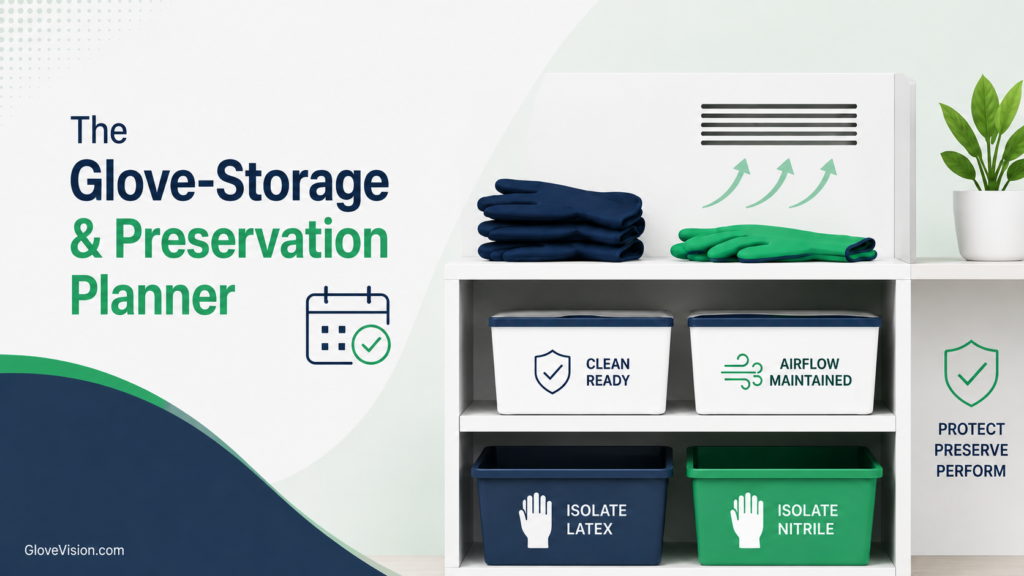
The Glove-Storage & Preservation Planner: A 14-Day Storage Setup System
The Glove-Storage & Preservation Planner is a 14-day setup system that helps users create a dedicated storage zone where reusable gloves stay organized, ventilated, supported, separated from unsafe contamination, and easier to inspect before future use. Storage planning does not restore unsafe gloves, manufacturer and workplace rules override the planner, and contaminated gloves should not enter normal storage until approved procedures are followed.
This article covers manufacturer storage rules, removal and isolation gates, location selection, material sorting, glove-category handling, shape support, breathable barriers, reminder cycles, accountability checks, and post-project diagnostics so reusable gloves remain easier to review without allowing damaged, expired, moldy, or contaminated gloves to hide inside active inventory.
How Does a Glove-Storage & Preservation Planner Reduce Seasonal Glove Degradation Risk?
A Glove-Storage & Preservation Planner reduces seasonal glove degradation risk by moving reusable gloves away from moisture, direct sunlight, heat cycling, chemical fumes, compression, dirty gear, and poorly ventilated storage.
Improvised storage creates material and shape degradation risk because gloves often get mixed with wet gear, tools, cleaning products, seasonal clothing, or compressed inventory before they are ready for long-term storage.
Planned storage separates storage threats into visible controls: dry before storage, avoid direct sunlight, reduce heat cycling, prevent heavy stacking, separate chemical exposure, and keep dirty gear out of clean storage.
Figure 1: Storage degradation risk map. The planner reduces hidden storage threats by separating moisture, sunlight, heat cycling, compression, dirty gear, and chemical-fume risks before gloves enter active storage.
Why Does Poor Glove Storage Cause Material Degradation?
Poor glove storage can cause material degradation when gloves are exposed to excess humidity, trapped moisture, direct sunlight, heat cycling, heavy compression, dust, dirt, chemical fumes, wet gear contact, poor airflow, or shape collapse.
Excess moisture can create damp storage conditions that increase odor risk and make gloves harder to inspect before reuse.
Compression damage can flatten insulation, crease leather, deform padding, or make gloves lose their natural shape when heavy items sit on top of them.
Why Should Glove Storage Be Planned Instead of Improvised?
Glove storage should be planned instead of improvised because different materials, use cases, reuse rules, and inspection needs require different storage decisions.
Leather, insulated, coated, disposable, chemical, and safety-rated gloves should not be treated as one storage group because their care limits and next-use risks are not the same.
What Does the 14-Day Planner Help Users Build?
The 14-day planner helps users build a dedicated storage location, material-sorted glove inventory, airflow setup, shape-support system, breathable storage barriers, maintenance reminders, and replacement or isolation rules.
The 14-day timeframe is the planner structure, not a scientific standard for glove preservation.
| Storage Risk | Why It Matters | Planner Control |
|---|---|---|
| Damp storage | Traps moisture and odor risk | Dry before storage and improve airflow |
| Direct sunlight | Can stress sensitive materials | Use shaded storage |
| Heat cycling | Can stiffen, dry, or weaken materials | Use cool, stable locations |
| Compression | Can flatten insulation or distort shape | Use dedicated compartments |
| Chemical fumes | Can contaminate or degrade materials | Store away from chemicals |
| Mixed dirty gear | Can transfer residue or odor | Separate clean and exposed gear |
Which Manufacturer Storage Rules Must the Glove-Storage & Preservation Planner Follow?
The Glove-Storage & Preservation Planner must follow manufacturer storage rules first because glove materials, PPE certifications, shelf-life limits, and care requirements vary by glove type and model.
General storage advice cannot override glove-specific instructions because the manufacturer may define limits for heat, sunlight, moisture, cleaning, conditioning, shelf life, certified storage, inspection, or retirement.
For workplace PPE, storage decisions must preserve suitability for the actual hazard and cannot turn damaged or unsuitable equipment into acceptable active protection. [OSHA 1910.132] [OSHA 1910.138]
Why Do Manufacturer Storage Rules Come First?
Manufacturer storage rules come first because different glove materials react differently to heat, moisture, sunlight, cleaning products, conditioning products, compression, and shelf-life conditions.
Some gloves also have expiration, certified storage, or workplace inspection requirements that general storage advice cannot replace.
Which Manufacturer Details Should Be Checked Before Storage?
Users should check manufacturer details for storage temperature guidance, humidity or moisture guidance, UV restrictions, cleaning and drying instructions, leather conditioning rules, shelf-life limits, reusable or disposable status, chemical exposure handling, inspection rules, and retirement rules.
What Should Users Do When Manufacturer Instructions Are Missing?
When manufacturer instructions are missing, users should choose conservative storage that is cool, dry, ventilated, shaded, uncompressed, away from chemical fumes, and free from sealed damp conditions.
Safety-rated gloves should be escalated to manufacturer or workplace guidance instead of being handled through guesswork.
| Rule Area | Checked? |
|---|---|
| Manufacturer storage guidance reviewed | |
| Heat restrictions checked | |
| Sunlight / UV restrictions checked | |
| Humidity or moisture guidance checked | |
| Cleaning and drying rules checked | |
| Conditioning rules checked if leather | |
| Disposable stock shelf-life checked | |
| Safety-rated PPE storage rules checked | |
| Workplace storage rules checked |
When Should the Glove-Storage & Preservation Planner Remove, Replace, or Isolate Stored Gloves?
The Glove-Storage & Preservation Planner should remove, replace, or isolate gloves when mold, persistent odor, contamination, structural failure, expired stock, or damaged protection makes normal storage unsafe.
The storage gate protects the active inventory by separating gloves that are safe to store from gloves that need disposal, replacement, isolation, professional care, downgrade labeling, or workplace review.
Disposable or contaminated gloves in healthcare and infection-control contexts should follow applicable facility and infection-control procedures before any storage decision is made. [CDC]
Figure 2: Storage gate decision pathway. Gloves either pass into active inventory or move into isolation, replacement, disposal, decontamination review, or downgrade labeling.
Which Gloves Should Be Removed From Normal Storage?
Gloves should be removed from normal storage when they have visible mold, persistent musty odor, chemical contamination, blood or biological contamination, hazardous dust exposure, pesticide exposure, fuel exposure, oil or solvent exposure, torn linings, split seams, collapsed insulation, cracked leather, damaged padding, failed grip surfaces, degraded protective layers, expired disposable status, or failed certified PPE status.
Why Should Damaged or Contaminated Gloves Not Be Preserved With Clean Gear?
Damaged or contaminated gloves should not be preserved with clean gear because they can transfer residue, odor, moisture, mold risk, or confusion into the storage system.
Chemical-exposed gloves need approved compatibility, handling, and workplace procedures before they are treated as storage-ready. [NIOSH]
What Should Users Do With Gloves That Fail the Storage Gate?
Users should replace, dispose, isolate, downgrade, decontaminate under approved procedure, send for professional care, label as not for active protection, or remove gloves from active inventory when the storage gate fails.
| Condition | Storage Allowed? | Action |
|---|---|---|
| Fully dry and structurally sound | Yes | Store normally |
| Mild surface dirt | Maybe | Clean only as allowed |
| Visible mold | No | Isolate and follow guidance |
| Persistent musty odor | No / review | Inspect, clean if allowed, or replace |
| Torn lining | No | Replace or remove |
| Collapsed insulation | No / review | Replace if function is affected |
| Chemical contamination | No unless approved | Follow site procedure |
| Biological contamination | No unless approved | Follow workplace rules |
| Expired disposable stock | No | Dispose according to rules |
| Damaged protection layer | No | Remove from active inventory |
How Do You Select the Ideal Storage Location Using the Glove-Storage & Preservation Planner?
You select the ideal storage location by choosing a shaded, dry, ventilated, stable, accessible area away from direct heat, moisture, damp walls, heavy compression, chemical fumes, and contaminated gear.
Specific temperature, humidity, UV, or chemical-fume limits should come from manufacturer or workplace guidance, not a universal rule applied to every glove type.
How Should Users Avoid UV and Direct Sunlight Exposure?
Users should avoid UV and direct sunlight exposure by choosing shaded storage away from windowsills, sunny shelves, glass-front cabinets exposed to sun, and areas with repeated direct light.
How Should Users Avoid Heat and Temperature Cycling?
Users should avoid heat and temperature cycling by storing gloves away from radiators, heaters, HVAC blasts, hot vehicles, direct heat, and places where temperature shifts sharply during the day.
How Should Users Avoid Moisture and Damp-Wall Exposure?
Users should avoid moisture and damp-wall exposure by keeping gloves out of basements, damp closets, wet floors, unventilated bins, damp walls, and direct contact with concrete floors.
How Should Users Avoid Chemical Fumes and Contamination?
Users should avoid chemical fumes and contamination by storing gloves away from solvents, fuels, oils, pesticides, cleaning chemicals, paints, strong fumes, and contaminated work gear.
How Should Humidity Targets Be Treated?
Humidity targets should be treated as monitoring signals unless manufacturer guidance gives a specific range for the glove type.
When no target exists, the safer approach is stable, dry, ventilated storage while watching for excess moisture, stale odor, cracking, condensation, mold signs, or over-drying.
| Location Factor | Pass / Fail |
|---|---|
| Away from direct sunlight | |
| Away from direct heat or HVAC blasts | |
| Stable temperature zone | |
| Dry and ventilated location | |
| Away from damp walls or floors | |
| Away from chemical fumes or solvents | |
| Enough shelf space to prevent compression | |
| Easy to inspect and access | |
| Manufacturer rules compatible with location |
What Categorization and Asset Audit Tasks Does the Glove-Storage & Preservation Planner Require?
The Glove-Storage & Preservation Planner requires users to sort gloves by material, reuse status, safety role, hygiene condition, storage sensitivity, season of use, current condition, and inspection priority.
Sorting prevents one-size-fits-all storage and keeps active inventory separate from isolation inventory.
Figure 3: Material-sorted glove audit shelves. Different glove groups need different storage barriers, visibility, airflow, and rule checks before entering active inventory.
How Should Gloves Be Sorted Before Storage?
Gloves should be sorted before storage by material type, reuse status, safety role, hygiene condition, storage sensitivity, season of use, current condition, and inspection priority.
Which Material Groups Should Be Separated?
Material groups should be separated into leather gloves, synthetic fabric gloves, coated work gloves, insulated winter gloves, waterproof membrane gloves, padded sports gloves, disposable glove stock, chemical or lab gloves, and safety-rated PPE gloves.
What Should Be Recorded in the Asset Audit?
The asset audit should record glove ID or model, material class, use case, condition, cleaning status, drying status, storage barrier needed, shape support needed, last inspection date, manufacturer care notes, and replacement or isolation status.
How Should Pre-Storage Cleaning Be Handled?
Pre-storage cleaning should be handled only as a readiness check inside this planner, while detailed cleaning, disinfection, decontamination, conditioning, and repair remain separate care processes.
Fill only the Condition and Next Review cells. Choose the real condition from the dropdown and pick a current or future review date. The other cells are fixed guidance, not user-entry fields.
| Glove Type / Example | Material Class | Condition | Storage Need | Care Rule | Next Review | Audit Result |
|---|---|---|---|---|---|---|
| LeatherExample model: leather work pair #1 | Animal hideMaterial group, not the condition. | Ready example: Sound / dry. Choose cracked, mold, torn, or musty only when the glove must be reviewed or removed. | Breathable storageUse only after the glove is dry and allowed for reuse. | Manufacturer-approved care onlyNo random oils, sprays, or conditioners. | Pick the next inspection date. | Not checked |
| SyntheticExample model: gym glove / liner pair | Nylon / spandex / fabricFabric-based reusable gloves. | Ready example: Dry / clean. Choose odor, damp, or torn only if the glove should not enter normal storage. | Ventilated trayKeep visible and away from damp gear. | Clean only as allowedFollow tag or manufacturer rules. | Pick the next inspection date. | Not checked |
| InsulatedExample model: winter glove pair | Fleece / down / mixed fibersWarmth layer or padded lining. | Ready example: Fully dry / loft intact. Choose collapsed, musty, or torn lining only when storage should fail. | Uncompressed storageDo not stack heavy gear on top. | Fully dry before storageDryness is required before storage. | Pick the next inspection date. | Not checked |
| MembraneExample model: waterproof shell glove | Waterproof laminateMembrane or waterproof layer. | Ready example: Dry / intact. Choose leaking, delaminating, or damaged only when the glove should be removed or reviewed. | Loose, uncinched storageAvoid tight folds and compression. | Follow membrane-safe careNo heat drying unless allowed. | Pick the next inspection date. | Not checked |
| Disposable stockExample model: unopened nitrile box | Nitrile / latex / vinylUnopened stock only. | Ready example: Unopened / in date. Expired, contaminated, or used disposable gloves should fail storage. | Original packagingUsed disposable gloves do not enter storage. | Store unopened onlyCheck shelf-life and packaging status. | Pick the stock review date. | Not checked |
| Chemical / labExample model: chemical-rated pair | Safety-rated materialChemical, lab, medical, or certified PPE. | Ready example: Approved / clean. Exposed, contaminated, or failed inspection gloves should not enter normal storage. | Site-specific storageFollow workplace or manufacturer protocol. | Follow workplace protocolDo not guess decontamination or reuse. | Pick the next formal review date. | Not checked |
Which Glove Categories Need Special Storage Handling Inside the Glove-Storage & Preservation Planner?
Different glove categories need special storage handling because leather, insulated, waterproof, coated, disposable, chemical, lab, medical, and safety-rated gloves have different storage needs and safety limits.
Category-specific handling stops users from applying one storage solution to every glove and accidentally hiding material damage or contamination risk.
How Should Leather Gloves Be Stored?
Leather gloves should be stored in breathable, shaded, room-stable storage away from sealed damp containers, direct heat, and direct sunlight.
How Should Insulated Winter Gloves Be Stored?
Insulated winter gloves should be stored fully dry and uncompressed so insulation loft remains open and heavy gear does not flatten padding or liners.
How Should Waterproof Membrane Gloves Be Stored?
Waterproof membrane gloves should be stored dry, loose, uncinched, away from sharp folds, compression, and heat, while following membrane-safe manufacturer care.
How Should Coated Work Gloves Be Stored?
Coated work gloves should be stored dry, ventilated, visible for inspection, away from chemical fumes, direct sunlight, and compressed piles.
How Should Disposable Glove Stock Be Stored?
Disposable glove stock should be stored unopened in original packaging away from sunlight, heat, moisture, and chemical fumes while following shelf-life and manufacturer storage instructions.
How Should Chemical, Lab, Medical, or Safety-Rated Gloves Be Stored?
Chemical, lab, medical, or safety-rated gloves should be stored only according to manufacturer and workplace storage rules, with contaminated or exposed gloves separated from normal storage.
| Glove Category | Storage Method | Main Limit |
|---|---|---|
| Leather gloves | Breathable, shaded, room-stable storage | Avoid direct heat and sealed damp storage |
| Insulated gloves | Uncompressed ventilated storage | Protect insulation loft |
| Waterproof membrane gloves | Loose, dry, uncinched storage | Avoid heat and sharp folds |
| Coated work gloves | Dry, visible, ventilated storage | Inspect grip and coating |
| Disposable glove stock | Original carton, shaded, stable storage | Used gloves do not enter storage |
| Chemical / lab gloves | Site-approved storage | Contaminated gloves require protocol |
| Safety-rated gloves | Manufacturer/workplace storage | Formal inspection rules override planner |
How Do You Construct Physical Support and Shape Protection Using the Glove-Storage & Preservation Planner?
You construct physical support and shape protection by using light, breathable, glove-appropriate supports that preserve natural shape without overstretching, compressing, trapping moisture, or stressing materials.
Shape support should protect natural volume and inspection visibility, not force a glove into a new shape.
Figure 4: Shape support and breathable barrier setup. Support should be light, dry, glove-appropriate, and separated from any isolation process for exposed gloves.
How Should Internal Glove Shape Be Supported?
Internal glove shape should be supported with light, appropriate materials such as acid-free tissue paper, glove forms, breathable inserts, suitable cedar forms, or light finger stuffing that does not overstretch the glove.
How Should Breathable Storage Barriers Be Used?
Breathable storage barriers should be used to protect suitable gloves while allowing appropriate airflow and avoiding sealed plastic when gloves are not fully dry.
How Should Compression Damage Be Prevented?
Compression damage should be prevented by keeping heavy boots, tools, boxes, and gear off gloves and giving padded, insulated, and technical gloves enough shelf space.
How Should Moisture-Control Accessories Be Used?
Moisture-control accessories should be used only where appropriate, kept away from direct glove-surface contact when warned against, and replaced or recharged as needed.
Desiccants do not replace drying wet gloves before storage.
| Structural Threat | Protective Tool | Execution Method | Intended Benefit |
|---|---|---|---|
| Finger collapse | Acid-free tissue or glove forms | Lightly support natural shape | Reduce creasing and lining collapse |
| Palm flattening | Breathable palm support | Avoid heavy stacking | Preserve ergonomic volume |
| Leather moisture trap | Breathable cotton bag | Store only when dry | Reduce condensation risk |
| Membrane compression | Loose shelf placement | Avoid cinched cuffs and sharp folds | Reduce pressure on laminates |
| Insulation flattening | Dedicated open shelf | Do not stack heavy gear | Preserve loft |
| Chemical transfer | Isolation area | Separate exposed gloves | Prevent contamination spread |
Which Long-Term Maintenance Cycles Must the Glove-Storage & Preservation Planner Schedule?
The Glove-Storage & Preservation Planner should schedule monthly checks, 90-day reviews, seasonal reviews, and annual audits to keep the storage system clean, organized, visible, and safe over time.
These intervals are internal planner cycles and should not be treated as universal manufacturer inspection standards.
Manufacturer and workplace inspection schedules override this planner whenever they are stricter, more specific, or tied to certified protective use.
Figure 5: Storage review cycle calendar. Monthly, 90-day, seasonal, and annual cycles are planner reminders, not universal manufacturer standards.
What Monthly Checks Should the Planner Schedule?
Monthly checks should review humidity readings, airflow, visible mold signs, odor, compression, shelf clutter, storage-barrier condition, and disposable stock expiration risk.
What Should a 90-Day Review Include?
A 90-day review should inspect shelf position, reusable glove airflow, seams, linings, leather dryness, insulation loft, membrane condition, and storage compliance.
What Should Seasonal Review Include?
Seasonal review should prepare gloves for storage transitions, remove damaged gear, apply manufacturer-approved care if needed, check waterproof or membrane gloves, update inventory, and reset reminders.
What Should the Annual Audit Include?
The annual audit should update inventory, remove retired gloves, check expired disposable stock, review condition, plan replacement, improve storage layout, and revisit manufacturer-care rules.
| Alert Frequency | Review Focus | Action |
|---|---|---|
| Monthly | Moisture and airflow | Check humidity, airflow, odor, and mold signs |
| 90-Day | Physical inspection | Inspect seams, linings, shape, and shelf pressure |
| Seasonal | Material preparation | Review leather, insulation, membrane, and storage needs |
| Annual | Inventory audit | Remove damaged, expired, or unused gloves |
How Do You Run the Accountability Check and Post-Project Review Inside the Glove-Storage & Preservation Planner?
You run the accountability check and post-project review by confirming the storage setup is complete, then diagnosing failures such as mold, cracking, collapsed insulation, stale odor, deformation, expired stock, or contamination.
The accountability check is the final setup gate before the storage system can be treated as launched.
What Confirms the Storage Setup Is Complete?
The storage setup is complete when the storage zone is cleared, manufacturer rules are checked, unsafe gloves are removed or isolated, gloves are sorted, gloves are fully dry before storage, shape supports are installed where appropriate, breathable barriers are used correctly, compression risks are removed, monitoring is active where needed, and calendar reminders are scheduled.
| Completion Item | Pass / Fail |
|---|---|
| Dedicated storage zone cleared | |
| Manufacturer rules checked | |
| Unsafe gloves removed or isolated | |
| Gloves sorted by category | |
| Gloves fully dry before storage | |
| Contaminated gloves excluded from normal storage | |
| Shape supports installed where appropriate | |
| Compression risks removed | |
| Breathable barriers used correctly | |
| Calendar reminders scheduled |
What If Surface Mold Appears?
If surface mold appears, the likely system weakness is excess moisture, poor airflow, contaminated storage, or gloves entering storage before they were safe.
Affected gloves should be isolated and reviewed through manufacturer, workplace, or professional guidance instead of being cleaned through guesswork.
What If Leather Cracks or Stiffens?
If leather cracks or stiffens, the likely system weakness is excess dryness, heat exposure, poor conditioning, unsuitable products, or the wrong storage location.
What If Insulation or Padding Collapses?
If insulation or padding collapses, the likely system weakness is compression damage, poor shelf layout, overstacking, or long-term pressure on soft structures.
What If Gloves Smell Stale After Storage?
If gloves smell stale after storage, they may have entered storage before fully drying or were stored with damp, dirty, or contaminated gear.
What Is the Final Rule for the Glove-Storage & Preservation Planner?
The final rule is that storage is only appropriate for gloves that are dry, reusable, uncontaminated, structurally intact, manufacturer-compliant, and suitable for their next use.
A glove should enter long-term storage only if it is dry, allowed to be reused, free from unsafe contamination, structurally intact, stored according to manufacturer rules, and suitable for its next use.
| Storage Finding | Likely System Weakness | Correction |
|---|---|---|
| Surface mold appears | Excess moisture or poor airflow | Isolate gloves, improve airflow, review humidity |
| Leather cracks | Heat or over-dry storage | Move location, follow approved leather care |
| Insulation flattens | Compression damage | Add dedicated uncompressed shelf |
| Linings smell stale | Stored before fully dry | Add post-activity drying step |
| Material deforms | Poor support or hanging stress | Use light shape support or better shelf method |
| Disposable stock expires | Weak inventory control | Add shelf-life review |
| Contamination appears | Unsafe storage mixing | Isolate and follow site protocol |
Frequently Asked Questions
Conclusion
The Glove-Storage & Preservation Planner gives users a structured way to organize reusable gloves into a storage zone that protects materials, shape, airflow, visibility, and future inspection readiness.
The planner works by combining manufacturer rules, replacement and isolation gates, location selection, material audits, glove-category handling, shape support, breathable barriers, review cycles, accountability checks, and post-project diagnostics. The best storage system is the one that keeps reusable gloves organized and protected without allowing unsafe gloves to hide inside the active inventory.