
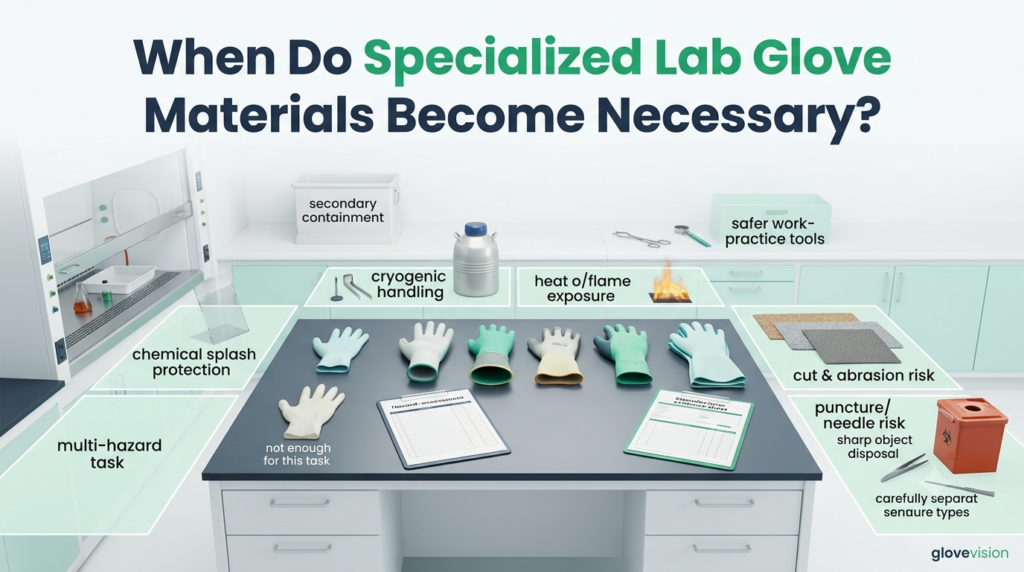
When Do Specialized Lab Glove Materials Become Necessary?
Specialized lab glove materials become necessary when the exact glove routinely approved for a task lacks sufficient documented protection, coverage, construction, or usability for the identified hazards. The final selection is an exact Specialized Lab Glove, not a material name, price tier, thickness category, or formal glove class.
Before selecting a Specialized Lab Glove, laboratories should determine whether the hazard can be eliminated or reduced through substitution, engineering controls, safer equipment, or revised work practices. The glove controls residual hand risk after stronger controls are reviewed, and this article covers evidence gaps, hazard branches, exact products, layering, selection mistakes, and approval.
Why can a Specialized Lab Glove become necessary when a routine glove is inadequate?
A Specialized Lab Glove becomes necessary when the routinely approved glove no longer has relevant and sufficient documented performance for the actual task. Escalation should remain grounded in the broader rule that laboratory gloves match the exact hazard, contact pattern, construction, and approved procedure.
OSHA requires appropriate hand protection when hands are exposed to hazards such as harmful skin absorption, severe cuts, severe abrasions, punctures, chemical burns, thermal burns, and harmful temperature extremes; selection must evaluate performance relative to the task, conditions, duration, and hazards. [HP]
Which task changes can make the routine glove inadequate?
Changes in chemical identity, concentration, mixture, temperature, contact mode, duration, splash frequency, pressure, abrasion, blade exposure, puncture exposure, needle exposure, heat, cryogenic handling, required coverage, grip, dexterity, or emergency removal can move a task outside the routine glove’s approved conditions.
Which construction limitations can make the routine glove inadequate?
Insufficient cuff length, missing insulation, missing chemical evidence, inadequate cut or puncture performance, missing needle evidence, weak seams, unprotected glove areas, poor grip, poor fit, unsafe doffing, or inability to remove the glove quickly can all create a documented mismatch.
When can strong test results still be insufficient?
Strong test results can remain insufficient when the glove causes loss of instrument control, unsafe grip, reduced tactile precision, excessive fatigue, restricted movement, cuff interference, inability to operate controls, difficult emergency removal, or entanglement risk.
| Current glove evidence | New task requirement | Evidence gap | Risk consequence | Required decision |
|---|---|---|---|---|
| Examination barrier evidence | Sustained chemical contact | No relevant chemical data | Unknown barrier performance | Evaluate a Specialized Lab Glove |
| Room-temperature data | Cryogenic splash | No cryogenic evidence | Cold injury or liquid-entry uncertainty | Investigate cryogenic product evidence |
| Cryogenic evidence | Contact heat | Wrong hazard branch | Thermal performance unknown | Select heat-specific evidence |
| Blade-cut evidence | Needle exposure | No needle-specific data | Needlestick risk not addressed | Require needle-specific review |
| Chemical evidence | Chemical-plus-cut task | Only one hazard supported | Combined hazard unresolved | Evaluate multi-hazard or layering |
| Strong protection data | Precision instrument handling | Poor usability | Loss of control or unsafe doffing | Reject or restrict |
| No traceable evidence | Hazardous task | Unverified protection | Uncontrolled residual risk | Suspend, redesign, or request evidence |
What makes a Specialized Lab Glove task-specific?
A Specialized Lab Glove is task-specific because it is an exact product approved for a defined hazard, exposure condition, coverage need, and usability requirement. Specialized is a working selection term, not a universal certification level or guarantee of greater overall protection.
Is a Specialized Lab Glove defined by its material?
No. Material is one input. The final decision must evaluate material, formulation, coating, lining, layers, insulation, thickness, cuff design, seams, closures, fit, grip, dexterity, doffing, whole-glove construction, manufacturer limitations, and hazard-specific evidence.
Is a Specialized Lab Glove always more protective?
No. A glove can be highly protective for one task and unsuitable for another. Cryogenic evidence does not prove heat protection, chemical evidence does not prove mechanical protection, and a high-protection glove can become unsafe if it reduces grip, dexterity, or emergency removal.
Is Specialized Lab Glove a formal performance rating?
No. Routine and specialized are not formal glove classes. Routine means the exact product is already approved for a recurring task. Specialized means a documented task requires product-specific protection, construction, coverage, or usability beyond the routine glove’s approved conditions.
What should final Specialized Lab Glove approval identify?
Approval should identify manufacturer, product name, product code, material and construction, approved task, approved hazards, exposure conditions, limitations, required size, fit requirements, inspection, replacement, retirement, donning, doffing, cleaning or disposal, and approval authority.
ISO 21420 sets general requirements for glove design, construction, innocuousness, comfort, efficiency, marking, and manufacturer information, but it does not independently establish protective performance without relevant hazard-specific standards or exact-product evidence. [21420]
Which evidence gaps show that a Specialized Lab Glove is necessary?
A Specialized Lab Glove is necessary when the current glove has missing, irrelevant, outdated, conflicting, material-only, or unusable evidence for the task after stronger controls have been reviewed.
Which documentation gaps require escalation?
Escalate when exact manufacturer, product name, product code, material, formulation, test method, test conditions, exposure mode, duration, whole-glove limitations, inspection requirements, or revision dates are missing, untraceable, outdated, or tied to another product.
Which performance gaps require escalation?
Escalate when chemical data do not match the chemical, concentration, mixture, temperature, or contact mode; cryogenic data do not match the exposure; heat or flame data do not match the heat form; mechanical data do not match abrasion, blade cut, puncture, impact, or needle mechanisms; or combined hazards are not addressed.
Which task events require reassessment?
Reassess when the procedure changes, the material handled changes, a new concentration or temperature is introduced, contact frequency increases, equipment changes, tasks become longer, a splash or puncture event occurs, user control becomes poor, or workers report fit, grip, dexterity, or doffing problems.
When should the task stop instead of selecting another Specialized Lab Glove immediately?
Stop the task when hazards remain uncontrolled, evidence is absent, the exact product cannot be verified, the user cannot perform the task safely, a layered arrangement is unvalidated, or no suitable product is available. Missing evidence should lead to manufacturer contact, qualified review, stronger controls, redesign, or suspension—not guesswork.
OSHA’s general PPE requirements include workplace hazard assessment, PPE selection, fit, written certification, training, PPE limitations, donning and doffing, useful life, disposal, and removal of defective or damaged PPE from use. [PPE]
Which hazards require separate evaluation before selecting a Specialized Lab Glove?
A Specialized Lab Glove should be selected only after the laboratory identifies which hazard branch applies and confirms that the exact product has relevant evidence for that branch.
When does chemical work require a Specialized Lab Glove?
Chemical work may require escalation when the routine glove lacks exact chemical resistance evidence for the chemical, mixture, concentration, temperature, contact mode, duration, and whole-glove construction. Chemical work should begin with exact-product evidence rather than broad material families. ISO 374-1:2024 addresses terminology and performance requirements for gloves intended to protect against dangerous chemicals, while other protective features still require the appropriate additional standards. [374]
When does cryogenic work require a Specialized Lab Glove?
Cryogenic work requires separate review when the task includes cryogenic splash, cold-surface contact, liquid entry risk, cuff coverage needs, loose or rapid removal requirements, dexterity limits, manufacturer restrictions, or additional PPE. Cryogenic evidence should not be used as heat or flame evidence.
When does heat or flame require a Specialized Lab Glove?
Heat or flame requires separate review when the task includes contact heat, convective heat, radiant heat, flame, small molten-material splash, or large molten-material exposure. ISO 23407:2021 addresses protective gloves against thermal risks involving heat and fire forms, but it does not establish cryogenic protection. [23407]
When does cut or abrasion risk require a Specialized Lab Glove?
Cut or abrasion risk requires review of the specific mechanism, affected glove area, tool geometry, pressure, motion, grip, entanglement, and whole-glove construction. ISO 23388:2018 covers protective gloves against mechanical risks including abrasion, blade cut, tear, puncture, and impact where applicable, and those categories should not be merged into one identical hazard. [23388]
When does puncture risk require a Specialized Lab Glove?
Puncture risk requires evidence that matches the probe or object involved. General puncture evidence does not prove hypodermic-needle resistance. ASTM F2878-19(2024) evaluates protective clothing material resistance to hypodermic-needle puncture using specified needle probes, but it does not guarantee protection against every use condition or replace safer sharps controls. [F2878]
When does a multi-hazard task require additional evaluation of a Specialized Lab Glove?
A multi-hazard task requires evidence for every relevant function and the interaction between them. Chemical plus cut, chemical plus heat, cryogenic splash plus contamination, biological contamination plus needle exposure, or heat plus precision handling should not be approved from one hazard rating alone.
| Hazard | Required evidence | Main failure mechanism | Critical boundary | Better-owner detail |
|---|---|---|---|---|
| Chemical | Exact chemical and product data | Permeation, degradation, penetration | Does not prove thermal or cut protection | Chemical material page |
| Cryogenic | Cold splash and contact evidence | Cold transfer and liquid entry | Does not prove heat protection | Cryogenic page |
| Contact heat | Relevant contact-heat data | Heat transfer | Does not prove flame protection | Thermal page |
| Flame or radiant heat | Evidence for exact heat form | Ignition or heat transfer | Do not combine thermal forms | Thermal page |
| Abrasion | Abrasion-specific data | Surface wear | Does not prove cut or puncture | Mechanical page |
| Blade cut | Relevant cut data | Blade action | Does not prove needle resistance | Mechanical page |
| General puncture | Relevant probe evidence | Point penetration | Probe must match hazard | Mechanical page |
| Hypodermic needle | Needle-specific evidence | Needle puncture | Does not guarantee needlestick prevention | Needle page |
| Multi-hazard | Evidence for every hazard and interaction | Combined failure | Ratings are not additive | Task-specific review |
How should laboratories select an exact Specialized Lab Glove?
Laboratories should select an exact Specialized Lab Glove by matching its documented performance, whole-glove construction, coverage, and usability to the complete task profile.
What task profile must be documented for a Specialized Lab Glove?
Document the exact task, hazard type, severity, exposure mode, duration, maximum credible duration, frequency, temperature, chemical details, mechanical mechanism, required coverage, required grip, dexterity, emergency-removal needs, and existing controls. The task profile should distinguish contact modes before chemical evidence is selected.
What product information is required for a Specialized Lab Glove?
Confirm manufacturer, product name, product code, material, formulation, coating, lining, layers, thickness, cuff, seams, closures, sizes, intended use, hazard-specific evidence, test conditions, manufacturer limitations, inspection, replacement, and retirement requirements.
How should evidence relevance be checked for a Specialized Lab Glove?
Ask whether the tested hazard, exposure mode, temperature, duration, exact product code, whole-glove construction, protected areas, test conditions, revision date, and evidence source match the task. Chemical performance data must match the expected contact duration without being converted directly into a workplace countdown.
How should usability be evaluated for a Specialized Lab Glove?
Assess fit, dexterity, grip, instrument control, fatigue, tactile sensitivity, cuff interference, emergency-control operation, donning, doffing, entanglement, and representative task performance. A task trial must not expose the worker to an uncontrolled hazard.
What are the possible Specialized Lab Glove selection outcomes?
The laboratory may approve the exact product, approve it with restrictions, require another PPE component, evaluate another glove layer, request more evidence, require stronger engineering controls, reject the product, suspend the task, or redesign the procedure.
| Candidate product | Hazard evidence | Whole-glove coverage | Usability | Evidence status | Outcome |
|---|---|---|---|---|---|
| Supports all hazards | Relevant | Adequate | Acceptable | Traceable | Approve with restrictions |
| Supports one hazard only | Incomplete | Adequate | Acceptable | Partial | Add another PPE component |
| Marketing claim only | Unverified | Unknown | Unknown | Untraceable | Request more evidence |
| Strong test evidence | Relevant | Adequate | Poor dexterity | Traceable | Reject for task |
| Inadequate cuff | Relevant | Incomplete | Acceptable | Traceable | Evaluate a validated layer |
| No suitable product | Insufficient | Not applicable | Not applicable | Unresolved | Redesign or suspend task |
When should a Specialized Lab Glove be combined with another glove layer?
A Specialized Lab Glove should be combined with another layer only when the task requires separate protective functions and the complete arrangement has been evaluated.
Why might an additional layer be considered with a Specialized Lab Glove?
Additional layers may be considered for chemical barrier plus cut resistance, chemical barrier plus puncture resistance, a replaceable contamination-control layer, additional cuff coverage, a thermal liner, controlled doffing, or protection of a reusable outer glove.
Why are separate Specialized Lab Glove ratings not automatically additive?
Layering may alter flexing, compression, grip, dexterity, fit, chemical contact, heat transfer, cuff alignment, fatigue, moisture, contamination transfer, and doffing time. Breakthrough times, cut ratings, puncture ratings, thermal values, and protection levels should not be added unless the complete arrangement has been evaluated that way.
Which Specialized Lab Glove arrangement questions must be answered?
Confirm which glove is inside, which glove is outside, the function of each layer, whether one layer damages another, whether cuffs overlap, whether contamination can collect between layers, which layer is removed first, whether layers change together, whether heat or moisture builds up, and whether emergency removal remains possible.
What should layered Specialized Lab Glove approval document?
Record exact products, product codes, layer order, approved task, approved hazards, evidence for each component, interaction review, known limitations, donning, doffing, change triggers, disposal or decontamination, and approval authority.
| Layer purpose | Example configuration | Interaction risk | Required validation | Change or removal boundary |
|---|---|---|---|---|
| Chemical barrier plus cut protection | Chemical inner and cut outer | Abrasion or compression | Barrier integrity and task trial | Define which layer changes after contamination |
| Disposable inner plus reusable outer | Barrier inner and durable outer | Trapped contamination | Change and cleaning procedure | Define layer removal order |
| Thermal liner plus outer glove | Insulating inner and protective outer | Heat build-up and poor fit | Temperature and usability review | Define emergency removal |
| Needle-resistant outer plus barrier inner | Mechanical outer and barrier inner | Reduced dexterity | Sharps-task trial | Replace after damage or contamination |
| Different cuff lengths | Overlapping cuffs | Wrist gap or trapped liquid | Cuff-overlap assessment | Define correct overlap and removal |
Which mistakes weaken Specialized Lab Glove selection?
Specialized Lab Glove selection becomes unreliable when laboratories treat uncommon materials, high prices, thickness, single hazard ratings, or unsupported layering as proof of task suitability.
Which Specialized Lab Glove classification mistakes are common?
Common mistakes include treating specialized as a formal class, treating expensive gloves as inherently superior, treating thick gloves as automatically safer, selecting from material name alone, or assuming uncommon materials are automatically specialized.
Which chemical Specialized Lab Glove mistakes are common?
Chemical mistakes include using general chemical claims without exact-product evidence, treating breakthrough values as safe-wear deadlines, ignoring concentration and temperature, using chemical evidence for a different formulation, or treating chemical evidence as thermal or mechanical protection.
Which thermal Specialized Lab Glove mistakes are common?
Thermal mistakes include using cryogenic evidence for heat, using contact-heat evidence for flame, ignoring radiant or convective heat, treating thermal test performance as unlimited exposure time, or ignoring rapid removal and dexterity needs.
Which mechanical Specialized Lab Glove mistakes are common?
Mechanical mistakes include treating abrasion, blade cut, tear, puncture, impact, and needle puncture as one category; treating cut resistance as puncture resistance; treating general puncture as needle evidence; or ignoring entanglement and task usability.
Which Specialized Lab Glove layering mistakes are common?
Layering mistakes include assuming two layers double protection, adding separate ratings, ignoring fit and compression, ignoring heat and moisture, ignoring cuff alignment, ignoring contamination transfer, or approving layers without a complete configuration review.
Which Specialized Lab Glove overuse and underuse mistakes are common?
Overuse occurs when a bulky or unnecessary glove reduces control and creates new risk. Underuse occurs when the routine glove is kept despite missing evidence, wrong hazard evidence, poor coverage, or unsafe usability. Both require task-specific reassessment.
What should laboratories verify before approving a Specialized Lab Glove?
Before approving a Specialized Lab Glove, the laboratory should verify the need, stronger controls, exact hazard, exposure conditions, exact product, hazard-specific evidence, coverage, usability, layering, procedures, and approval authority.
Where OSHA’s Laboratory Standard applies, the Chemical Hygiene Plan must include procedures, control measures, equipment, PPE, and work practices capable of protecting workers from laboratory chemical hazards. [CHP]
- Exact task, routine glove, and supporting evidence are documented.
- A specific protection, construction, coverage, or usability gap is identified.
- Escalation is based on hazard assessment, not marketing language.
- Elimination, substitution, enclosure, guards, hoods, gloveboxes, splash shields, tongs, remote tools, safer sharps, automation, and work-practice controls are considered.
- The glove controls residual hand risk only after stronger controls are reviewed.
- Chemical, cryogenic, heat, flame, abrasion, cut, puncture, needle, impact, tear, entanglement, and multi-hazard combinations are documented separately.
- Exposure mode, duration, maximum credible duration, frequency, temperature, pressure, flexing, abrasion, coverage, and emergency-removal needs are documented.
- Manufacturer, product name, product code, material, formulation, coating, lining, layers, thickness, cuff, seams, closures, sizes, intended use, and limitations are known.
- Evidence applies to the exact product, exact hazard, relevant test method, and relevant test conditions.
- Chemical, cryogenic, heat, cut, puncture, needle, and whole-glove limits are not substituted for one another.
- Finger, palm, back-of-hand, cuff, wrist, and forearm coverage are adequate.
- Fit, grip, dexterity, tactile control, donning, doffing, and representative safe task performance are acceptable.
- Every layer is identified by product code.
- Layer purpose, order, interaction, cuff arrangement, contamination transfer, heat or moisture, dexterity, doffing, and emergency removal are tested.
- Ratings are not added.
- Approved tasks, prohibited uses, inspection, replacement, retirement, cleaning or disposal, storage, training, limitations, supervisor approval, CHO or EHS review, and substitution reapproval are documented.
Checklist completion does not prove universal protection, suitability for another task, unlimited wear, zero injury risk, complete regulatory compliance, or additive protection in a layered configuration.
Conclusion :
A Specialized Lab Glove becomes necessary when a documented task mismatch shows that the routine glove lacks sufficient protection, coverage, construction, or usability for the actual hazard and conditions. The decision is not based on price, thickness, material prestige, or marketing language.
The final output should be an exact approved glove product, or a validated layered arrangement, with documented hazards, conditions, limitations, inspection, replacement, donning, doffing, training, and approval requirements. When evidence is missing, conflicting, or unusable, the task should be restricted, redesigned, escalated, or suspended.
Frequently Asked Questions About a Specialized Lab Glove
Should a Specialized Lab Glove be used for every hazardous task?
No. It should be investigated when the routinely approved glove lacks sufficient documented performance for the remaining hazard after stronger controls have been assessed.
Is a Specialized Lab Glove defined by an unusual material?
No. Material is only one part of the finished product. Construction, coating, lining, layers, coverage, evidence, fit, grip, and usability also matter.
Can one Specialized Lab Glove control several hazard types?
Only when exact evidence supports every relevant hazard, the protected areas are appropriate, and the product remains usable under the actual task conditions.
Does cut resistance prove puncture or needle resistance?
No. Abrasion, blade cut, tear, puncture, and impact are separate mechanical risk areas, while hypodermic-needle puncture requires separate evidence.
Does adding another glove double the protection of a Specialized Lab Glove?
No. Layering may change fit, flexing, grip, compression, heat transfer, contamination transfer, and doffing. The complete arrangement must be evaluated.
When should the laboratory suspend the task?
Suspend the task when relevant product evidence is absent, hazards remain uncontrolled, glove-layer interactions are unknown, no suitable product is available, or qualified approval has not been obtained.