
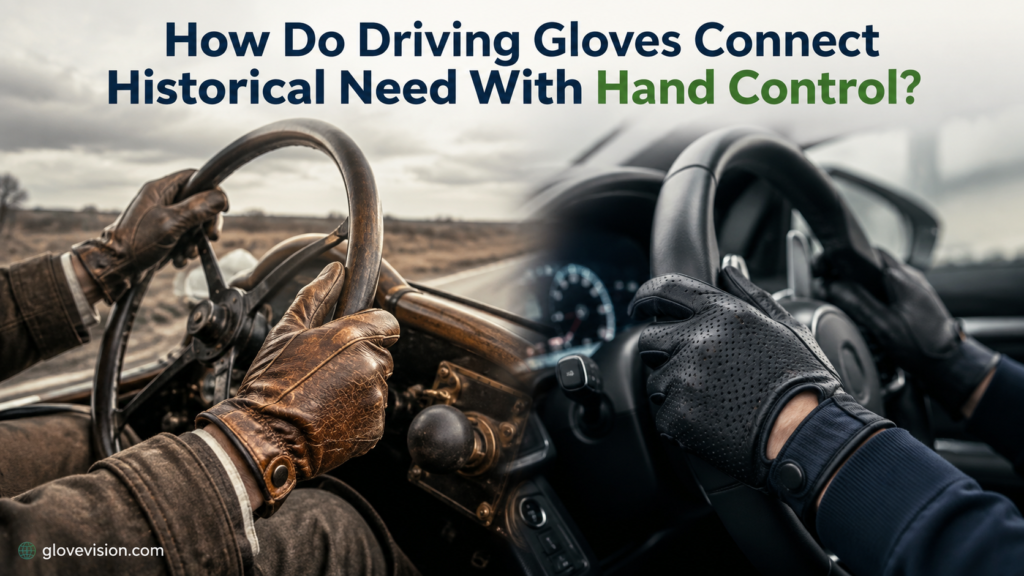
How Do Driving Gloves Connect Historical Need With Hand Control?
Driving Gloves emerged when early motorists operated open or partially exposed automobiles and needed hand protection from cold air, dust, weather, and repeated contact with vehicle controls. Their historical role was practical: preserve enough warmth, coverage, and usable hand movement to keep operating the vehicle.
Modern Driving Gloves retain selected historical principles but often emphasize closer fit, grip consistency, tactile feedback, finger articulation, ventilation, and controlled hand repositioning. Their usefulness is context-dependent: a loose, bulky, slippery, restrictive, or worn glove may reduce rather than improve control.
Functional qualification: Driving Gloves cannot improve driving skill or prevent crashes. Any glove that slips, bunches, restricts movement, catches during hand repositioning, or blocks access to vehicle controls should not be used for driving.
Why Did Driving Gloves Emerge During Early Motoring?
Driving Gloves developed because early motoring could expose the hands to cold moving air, dust, dirt, changing weather, and prolonged contact with manually operated controls. They were not one universal design, and their construction varied with period, climate, vehicle, purpose, material, lining, cuff length, and closure.
How Did Open Automobiles Expose Early Motorists’ Hands?
Open or partly open cabins offered much less separation from moving air and road debris than modern enclosed vehicles. Depending on the car and period, a driver could face cold air, dust, dirt, rain, and long-duration exposure. The Metropolitan Museum of Art’s motoring-goggles record describes protective motoring ensembles that could include gloves; the object itself is goggles, not glove-construction evidence. [Met]
How Did Early Vehicle Controls Affect the Hands?
Steering, levers, gear controls, and other manual interfaces required repeated hand contact. Cold, moisture, dirt, wear, and surface finish could change how comfortable that contact felt. Historical evidence does not support describing every early steering wheel as wood, metal, rough, or mechanically identical.
Why Did Early Driving Gloves Often Use Gauntlet Construction?
Longer cuffs could cover the wrist, overlap a coat sleeve, and reduce cold air entering the sleeve opening. The Henry Ford documents a pair of leather Driving Gloves dated 1910–1920 whose gauntlet form was associated with warmth and sleeve protection; that object is a documented example, not a template for every early glove. [Ford]
Why Was Warmth Sometimes More Important Than Fine Tactility?
In exposed motoring, protecting the hand from cold could matter more than maximizing fine surface feel. Lining, longer cuffs, and more coverage could support warmth and gross finger movement while adding bulk. Historical gloves therefore should not be judged only against modern close-fitting performance expectations.
Were Early Driving Gloves All Constructed the Same Way?
No. Early automobile-racing gloves also existed, showing that vehicle-specific handwear appeared in more than one motoring context. A circa-1905 racing-glove artifact, however, does not make ordinary road Driving Gloves equivalent to modern certified motorsport PPE. [Racing]
How Did Historical Driving Gloves Preserve Usable Hand Control?
Historical Driving Gloves linked protection and control through trade-offs. Warmth, sleeve overlap, surface separation, and coverage could help keep the hands usable, but added material could also reduce fine tactility or flexibility.
How Could Driving Gloves Help Maintain Hand Use in Cold Conditions?
Suitable gloves can slow heat loss and shield skin from moving cold air. Retaining warmth may help preserve comfortable finger movement, but performance depends on material, lining, fit, moisture, exposure, and duration. Historical artifacts do not provide universal safe-temperature or exposure-time ratings.
How Could Driving Gloves Stabilize Contact With Early Controls?
A glove could create a more consistent hand-contact layer by separating skin from cold, dirty, worn, or damp surfaces. That does not prove a universal increase in friction. Useful control requires predictable contact plus the ability to reposition and release.
How Did Driving Gloves Protect Against Repeated Surface Contact?
Repeated steering, lever, and gear-selector contact could create localized palm pressure, irritation, or cold-contact discomfort. Ordinary historical Driving Gloves should still not be described as impact-protective, abrasion-certified, flame-resistant, or crash-protection equipment.
Which Trade-Offs Shaped Historical Driving Gloves?
Warmth could compete with tactile feedback; long wrist coverage with freedom at the cuff; durable material with flexibility; lining with direct control sensitivity; and weather protection with ventilation. Museum interpretation also documents a broader evolution in motoring fashion as automobiles and their cabins changed. [SLAM]
| Historical Need | Historical Driving-Glove Response | Modern Functional Descendant | Important Limitation |
|---|---|---|---|
| Cold open cabin | Lining and extended gauntlet | Weather-appropriate hand coverage | Added bulk may reduce feedback |
| Cold air entering sleeves | Long cuff overlap | Secure wrist coverage | Extended cuffs are not always necessary |
| Dirty or worn controls | Leather or other contact barrier | Palm-interface management | No material suits every control surface |
| Moisture and perspiration | Hand-covering contact layer | Ventilation and moisture management | Performance remains construction-specific |
| Demanding manual controls | Secure whole-hand coverage | Close fit and finger articulation | Gloves cannot replace driver capability |
How Do Modern Driving Gloves Support Steering and Hand Control?
Modern Driving Gloves work only when the glove, hand, and actual vehicle controls function together. Close fit, palm friction, tactile feedback, finger movement, hand repositioning, and access to secondary controls matter more than heritage appearance alone.
How Can Driving Gloves Influence Steering-Wheel Contact?
A suitable palm may help maintain consistent surface contact, manage some perspiration, reduce direct skin slippage, and make hand repositioning more predictable. This is a balance problem rather than a search for maximum friction: the driver still needs smooth release and repositioning. That same human-factor principle appears in discussions of stable friction and deliberate hand release, although vehicle and equestrian control contexts must remain separate.
How Do Driving Gloves Preserve Tactile Feedback?
Close anatomical fit, low-bulk palm construction, flexible fingers, controlled seam placement, stable lining, and limited internal hand movement can preserve usable surface feedback. General glove research shows that glove thickness and construction can affect grip strength and dexterity, but those non-driving results should be transferred only as human-factor principles. [Grip]
How Do Driving Gloves Support Finger Articulation?
Finger length, thumb position, material flexibility, seam placement, knuckle tension, palm tension, and wrist closure influence whether the hand can open, close, reposition, shift gears, and operate secondary controls. Fit-and-material research in sports gloves also shows that glove fit interacts with hand performance and comfort; it does not directly prove automotive performance. [Fit] Related sports glove control and hand-performance demands illustrate why task-specific fit matters.
How Do Driving Gloves Affect Gear and Secondary Controls?
A glove that feels secure on a steering wheel may still interfere with gear selectors, paddles, switches, buttons, rotary controls, parking controls, or touch-sensitive interfaces. The complete vehicle-control set must therefore be tested, not just steering contact.
How Can Driving Gloves Influence Grip Effort or Hand Fatigue?
A well-matched contact interface may reduce repeated surface irritation or moisture-related repositioning, but gloves cannot correct poor posture, excessive gripping, unsuitable control geometry, long-duration overuse, or a hand condition. University of Waterloo guidance likewise emphasizes that gloves can alter sensitivity, effective hand size, and required grip effort in task-dependent ways rather than automatically improving performance. [Waterloo]
When Can Driving Gloves Reduce Hand Control?
Loose fit, palm bunching, excess fingertip material, slippery palms, excessive friction, thick seams, restricted flexion, unstable lining, closure failure, or worn contact surfaces can all interfere with vehicle operation. Occupational glove studies likewise show that different constructions can affect manual dexterity, but they do not establish exact steering-wheel performance. [Dexterity]
Which Driving Gloves Features Connect Historical Need With Modern Hand Control?
Recognizable Driving Gloves features often carry both functional and heritage meanings. A feature should be judged by what it actually does in the finished glove—not by appearance, tradition, or material name alone.
How Does Leather Affect Driving Gloves Contact and Flexibility?
Leather type, surface finish, thickness, softness, flexibility, break-in behavior, moisture response, and wear all influence the hand-to-control interface. The word “leather” alone does not establish friction, tactility, durability, or suitability, and synthetic alternatives should not be dismissed by category alone.
Why Do Some Driving Gloves Use Perforations?
Perforations may support air exchange, moisture management, reduced coverage, flexibility, or traditional styling. Their real ventilation effect depends on hole size, distribution, lining, material, fit, airflow, and total construction. The broader trade-off between palm friction and breathability is likewise construction-specific.
Why Do Some Driving Gloves Have Knuckle Openings?
Knuckle openings may reduce localized material tension during hand closure, allow more air exposure, or preserve a traditional visual language. A visible opening does not prove improved flexibility or control; the rest of the glove can still bind, bunch, or shift.
How Do Seams Affect Driving Gloves Hand Control?
Internal and external seams can create pressure, change palm smoothness, stiffen finger zones, or influence durability. Contact-zone placement matters because a raised seam beneath the palm or finger can be more disruptive than the same seam placed away from the main control surface.
How Do Wrist Closures Affect Driving Gloves?
A closure may stabilize glove position, manage the cuff opening, and limit rotation. Overtightening can create restriction or discomfort, and closure style cannot compensate for fundamentally incorrect sizing.
How Do Lined and Unlined Driving Gloves Differ?
Lined construction may support warmth but can add bulk, moisture retention, and internal movement. Unlined construction may reduce layers between hand and control but does not guarantee better feedback. Climate, fit, steering surface, and the driver’s functional needs determine which trade-off is more suitable.
| Construction Feature | Historical Connection | Possible Modern Function | Possible Trade-Off |
|---|---|---|---|
| Leather palm | Barrier against exposed controls | Consistent contact and flexibility | Friction varies by finish and condition |
| Extended cuff | Weather and sleeve coverage | Wrist coverage or heritage styling | May interfere with clothing |
| Perforations | Air exposure and reduced coverage | Moisture and heat management | Benefit may be limited |
| Knuckle openings | Flexibility and ventilation | Reduced tension during closure | Exposed skin or mainly stylistic value |
| Close fit | Secure hand–glove contact | Reduced internal movement | Poor sizing may restrict movement |
| Thin or unlined palm | Greater control sensitivity | More direct tactile feedback | Less warmth and cushioning |
| Lining | Cold-weather protection | Thermal comfort | Added bulk and internal movement |
| Wrist closure | Glove retention | Stable hand-to-glove interface | Restriction when overtightened |
How Should Driving Gloves Be Evaluated for Modern Vehicle Control?
Driving Gloves should be evaluated against the actual vehicle, climate, steering surface, hand shape, and control layout. The goal is not to prove that gloves are necessary; it is to verify whether the exact pair provides a real comfort or contact benefit without interfering with any required control.
What Should Be Defined Before Using Driving Gloves?
Identify the vehicle type, steering-wheel material, transmission, secondary-control requirements, touch-sensitive interfaces, cabin temperature, expected weather, journey duration, hand shape, warmth need, and tactile preference. A glove should not be prescribed before the actual need is defined.
How Should Driving Gloves Fit Be Checked?
Confirm that the fingers reach their intended positions, fingertip excess is limited, the palm stays substantially smooth, the glove does not rotate, the thumb aligns naturally, the hand can open and close comfortably, the wrist closure is secure without pressure, and seams do not create painful contact points. The underlying principle is similar to glove fit and tactile control in other hand-control tasks, but driving still requires its own vehicle-specific check.
How Should Driving Gloves Be Tested Against Vehicle Controls?
With the vehicle safely stationary and secured, verify stable steering-wheel contact, smooth deliberate repositioning, deliberate release, gear-selector operation, paddle access where relevant, switch and button access, rotary-control use, parking-control access, and unrestricted finger and thumb movement. Do not perform the first functional check while the vehicle is moving.
How Should Driving Gloves Condition Be Inspected?
Check palm wear, contamination, hardening, seam failure, loose lining, finger deformation, closure failure, holes, stretching, changed fit, and left-to-right consistency. A once-suitable glove can become unsuitable as its contact surface or internal stability changes.
Which Driving Gloves Problems Require Rejection?
Reject or reassess gloves that slip on the steering surface, catch during repositioning, prevent deliberate release, bunch under the palm, rotate around the hand, restrict fingers or thumb, reduce access to required controls, cause numbness or pain, or have damaged and unpredictable contact surfaces.
When Are Driving Gloves Unnecessary?
They may provide little functional benefit when bare-hand contact is already secure and comfortable, cabin conditions keep the hands comfortable, the steering surface is predictable, or gloves reduce feedback or interfere with smaller controls. Historical importance does not create a universal modern requirement.
How Are Ordinary Driving Gloves Different From Specialized PPE?
Road Driving Gloves should not be presented as automatically flame-resistant, heat-protective, impact-protective, abrasion-certified, homologated, or competition-compliant. Suitability is task-specific, as it is with task-specific glove dexterity and control; specialized contexts require their own equipment rules and evidence.
Verified comfort/contact benefit; all controls remain easy to operate.
Construction is promising but fit, friction, or closure needs adjustment.
Bare-hand contact already works and the glove adds no functional benefit.
Wear, damage, instability, catching, or restriction makes control unpredictable.
Conclusion
Driving Gloves began as practical protection for motorists exposed to cold air, dust, weather, and demanding vehicle controls, then evolved toward closer-fitting construction intended to preserve grip consistency, finger movement, tactile contact, and deliberate hand repositioning. Early designs were not uniform: some gauntlets prioritized warmth and sleeve coverage, while later and modern forms could place more emphasis on flexibility, ventilation, and close contact.
The final test is functional rather than stylistic. Maximum friction, thin leather, perforations, knuckle openings, or a heritage look do not prove better control. Driving Gloves are optional in many modern vehicles and should be used only when the exact pair provides a verified comfort or contact benefit while preserving steering repositioning, deliberate release, finger articulation, tactile feedback, and access to every required control.
Frequently Asked Questions
Why Did Early Motorists Wear Driving Gloves?
Early motorists wore Driving Gloves partly to protect their hands from cold air, dust, weather, and repeated contact with vehicle controls. Exact needs varied by historical period, vehicle, climate, journey, and glove construction.
Were Driving Gloves Originally Designed Only for Better Grip?
No. Historical Driving Gloves could provide warmth, wrist and sleeve coverage, surface separation, weather protection, and usable control contact. Grip was one potential function rather than the only purpose.
Do Driving Gloves Improve Steering Control?
They may support consistent contact when their palm, fit, flexibility, friction, and condition match the steering surface and required controls. They cannot improve driving skill, and unsuitable gloves may interfere with control.
Why Do Driving Gloves Have Knuckle Holes and Perforations?
These features may support localized flexibility, ventilation, moisture management, reduced material tension, or traditional styling. Their actual effect depends on the complete glove construction and should not be inferred from appearance alone.
Are Driving Gloves Necessary in Modern Cars?
Usually not. Modern enclosed cabins, climate control, assisted steering, and refined control surfaces have reduced many original needs. Driving Gloves should be used only when they provide a verified comfort or contact benefit without restricting steering, repositioning, deliberate release, or secondary-control access.