
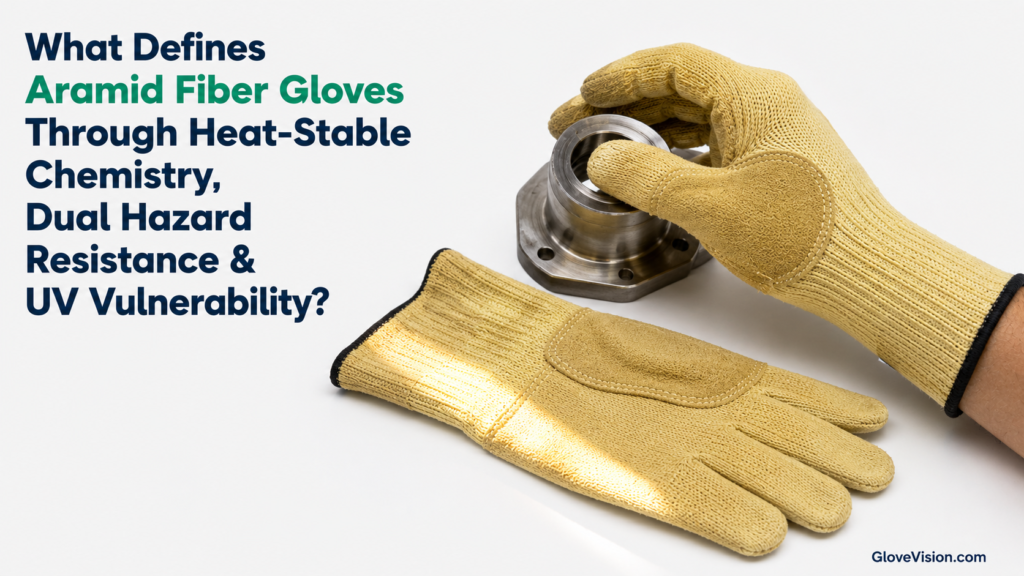
What Defines Aramid Fiber Gloves Through Heat-Stable Chemistry, Dual Hazard Resistance & UV Vulnerability?
Aramid Fiber Gloves use heat-stable aromatic polyamide fibers with rigid molecular structures, strong intermolecular bonding, and engineered yarns. In suitable knit or composite constructions, these features can support thermal stability and selected mechanical resistance.
Actual performance varies with aramid type, blend, yarn, knit, thickness, liner, coating, reinforcement, verified ratings, UV exposure, wear, and contamination. Aramid is not automatically fireproof, cut-proof, chemical-resistant, electrically insulating, or unaffected by sunlight.
What Are Aramid Fiber Gloves, and How Do Para-Aramid and Meta-Aramid Structures Shape Their Performance?
Aramid Fiber Gloves contain aromatic polyamide fibers whose amide linkages, aromatic rings, rigid chains, and intermolecular bonding support heat stability and strong textile structures, while para- and meta-oriented chemistries create different performance balances. Chem
What Does “Aramid” Mean?
Aramid names a family of high-performance synthetic aromatic polyamides, not one uniform fiber or one brand. Its aromatic backbone distinguishes it from aliphatic nylon gloves; its chemistry and heat response also differ from common polyester gloves.
How Does Aramid Chemistry Support Heat Stability and Strength?
Rigid rings restrict chain rotation, amide groups support hydrogen bonding, and molecular orientation can improve load transfer. These fiber-level mechanisms create potential; yarn architecture and complete-glove construction determine usable protection.
How Is Para-Aramid Structured?
Para-oriented aromatic groups support relatively linear, strongly aligned chains. This structure commonly emphasizes high tensile strength, high modulus, and low elongation, which can support cut-resistant yarns, composite reinforcement, or heat-stable liners. It does not prove that every para-aramid glove has a high cut rating.
How Is Meta-Aramid Structured?
Meta-oriented aromatic groups create a less linear arrangement with a different flexibility–stability balance. Meta-aramid may contribute thermal liners, flame-resistant textile layers, or back-of-hand panels, but it does not automatically provide strong cut protection.
How Do Para-Aramid and Meta-Aramid Blends Change the Balance?
Meta-/para blends may balance tensile strength, thermal behavior, flexibility, comfort, durability, and UV response. Their properties overlap, and blend percentage alone cannot predict finished-glove ratings.
How Are Aramid Fibers Converted Into Glove Construction?
Continuous filament, staple-spun, textured, composite, terry-loop, seamless-knit, cut-and-sewn, and multilayer systems distribute fibers differently. Each construction changes thickness, air space, edge engagement, flex, seam behavior, and surface contact.
| Feature or type | General fiber behavior | Possible glove contribution | Required qualification |
|---|---|---|---|
| Aromatic backbone | Restricts chain movement | Heat-stability potential | Can still degrade or char |
| Amide bonding | Supports chain cohesion | Strength potential | Construction-dependent |
| Para-aramid | High strength and modulus | Cut-resistant or reinforced yarn | Verify ratings |
| Meta-aramid | Thermal and flame stability | Heat-stable textile layer | Verify heat mode |
| Meta-/para blend | Balances selected properties | Dual-hazard potential | Verify hazards separately |
| Terry-loop aramid | Adds loft and air spaces | Insulation potential | Compression reduces loft |
| Composite yarn | Combines fibers | Mechanical reinforcement | Performance belongs to composite |
| Coated aramid | Changes surface contact | Grip and wear behavior | Coating has separate limits |
How Do Aramid Fiber Gloves Use Heat-Stable Chemistry Without Becoming Heatproof?
Aramid Fiber Gloves may retain structural integrity under heat better than many common thermoplastic-fiber gloves, but hand protection still depends on how rapidly heat passes through the complete construction and how every component responds.
What Happens Under Heat?
Aramid fibers generally do not melt like nylon or polyester; under sufficiently severe heat they degrade or char. Heating can also cause oxidation, strength loss, discoloration, embrittlement, and loss of textile integrity. Non-melting behavior does not prevent burns. Therm
Why Can Heat Still Reach the Hand?
Thin fabric offers limited separation, compression removes insulating air, moisture changes heat transfer, and seams or coatings can form thermal pathways. Longer contact allows more energy to reach skin.
How Do Thickness, Liners, and Coatings Change Performance?
Fabric weight, loft, terry loops, trapped air, liners, leather, silicone, and other surfaces can change heat transfer and grip. More bulk may reduce dexterity and emergency release, while compression can defeat part of the insulating benefit.
Why Must Heat Modes Be Separated?
Ignition, flame spread, afterflame, charring, contact heat, convective heat, radiant heat, and molten splash are different exposures. A flame-related result does not prove contact-heat insulation; use a complete heat-resistant glove assessment for the actual mode.
When Does Heat Exposure Become Unsafe?
Reassess or reject the glove when exposure exceeds documented limits, contact continues too long, fabric is compressed, the glove is wet or contaminated, a seam or liner is damaged, char remains in service, or the wearer cannot release the object quickly. Molten, pressurized, or energized sources require hazard-specific evidence.
How Can Aramid Fiber Gloves Combine Mechanical and Thermal Resistance?
Aramid Fiber Gloves combine mechanical and thermal protection only when their yarns, layers, coatings, reinforcements, seams, and complete design are separately tested for both required hazard categories.
What Does “Dual Hazard” Mean Here?
It means separately demonstrated mechanical and thermal performance within one complete glove—not universal multi-hazard protection or one combined score. Cut, abrasion, tear, puncture, needle, impact, contact heat, convection, radiation, flame, and molten splash remain separate outcomes. Mech Heat
How Can Aramid Yarn Resist Cutting?
High fiber strength and modulus can help yarn networks engage an edge, but fiber fineness, orientation, density, knit, reinforcement, coating, coverage, condition, and test method determine the result. Material content cannot replace a finished-glove rating or a full cut-resistant glove selection.
Why Are Puncture and Needle Hazards Different?
A blade travels across yarns; a point concentrates force, spreads yarns, and may pass between fibers. Ordinary aramid knit therefore cannot be assumed puncture- or needle-resistant.
How Can One Aramid Fiber Glove Address Cut and Heat?
A complete design may combine para-aramid mechanical yarn, a meta-aramid or terry-loop thermal layer, a heat-stable liner, a tested contact surface, reinforced wear zones, and an extended cuff. The exact layers and coverage—not the aramid name—must support both hazards.
Which Construction Trade-offs Matter?
Metallic reinforcement may conduct heat, a thin high-cut knit may insulate poorly, and coatings may stiffen or degrade. Conversely, thick thermal layers may reduce tactile feedback, finger flexion, grip control, and emergency release.
Which Ratings Must Be Verified Separately?
Verify cut, abrasion, tear, puncture, needle, impact, contact heat, convective heat, radiant heat, flame, and molten splash only when each is relevant. Never combine independent results into an invented protection score.
| Hazard combination | Possible construction | Main trade-off | Required verification |
|---|---|---|---|
| Sharp edge + warm component | Para-aramid knit with thermal thickness | Bulk versus dexterity | Cut + contact heat |
| Sheet metal + radiant heat | Reinforced aramid, extended cuff | Control and coverage | Mechanical + radiant heat |
| Hot object + abrasion | Aramid liner, durable surface | Wear and heat transfer | Abrasion + contact heat |
| Flame + sharp object | Meta-/para blend | Construction balance | Flame + cut |
| Needle + heat | Specialized composite | Point penetration | Needle + thermal |
| Molten splash + cut | Specialized complete PPE | Splash entry and bulk | Molten splash + mechanical |
Why Do UV Exposure and Unsupported Hazards Limit Aramid Fiber Gloves?
UV exposure may progressively damage aramid polymer chains and reduce mechanical strength, while ordinary visual inspection cannot reliably determine how much protection remains.
How Does UV Radiation Affect Aramid?
Absorbed UV energy can contribute to bond disruption, chain scission, surface oxidation, defect growth, fiber weakening, and lower tensile properties. Response varies with fiber type, blend, yarn, thickness, coating, wavelength, intensity, duration, and storage. UV
Does Discoloration Measure Strength Loss?
No. Fading can occur without a known retained-strength value, strength may decline without obvious change, and dyes, dirt, or coatings can alter what is visible. Research on aramid blends also cannot be converted into a universal glove retirement schedule. Blend
Does UV Damage Every Aramid Property at the Same Rate?
Do not assume so. Mechanical strength, thermal behavior, surface appearance, coatings, and seams may change differently. Fiber type, blend ratio, geometry, thickness, dye, and exposure conditions all affect the response, so product guidance must control the decision.
How Should Exposure Be Controlled?
Follow product instructions for covered storage, sunlight through windows, vehicle storage, outdoor staging, drying, artificial UV sources, stock rotation, and exposure records. Avoid outdoor drying unless the exact manufacturer permits it.
Which Hazards Remain Unsupported?
Ordinary aramid knit does not establish chemical permeation resistance, waterproofing, a biological barrier, electrical insulation, arc rating, needle resistance, impact protection, crush protection, molten-material suitability, or unlimited heat resistance. A porous knit can retain liquids and allow entry through openings, seams, or cuffs.
How Should Aramid Fiber Gloves Be Selected, Inspected, Stored, and Replaced?
Aramid Fiber Gloves should be selected by defining every mechanical and thermal hazard first, then verifying the complete glove’s construction, separate ratings, fit, grip, exposure limits, UV history, care instructions, and current condition.
What Must Be Defined First?
Identify the exact task, edge or point geometry, abrasion, heat-transfer mode, intensity and duration, flame or molten exposure, contamination, electrical risk, required dexterity, grip, cuff coverage, wear duration, outdoor exposure, and reuse expectations. OSHA requires hazard-based selection rather than reliance on a material name. OSHA
What Construction and Ratings Must Be Verified?
Confirm aramid type, fiber percentage, composite components, knit, fabric weight, thickness, loops, liner, coating, reinforcement, seams, and cuff. Then verify each required mechanical and thermal result separately; missing evidence cannot be inferred.
How Should Fit and Function Be Checked?
Finger length, palm stability, thumb motion, hand opening, cuff security, circulation, bulk, object pickup, positioning, control operation, grip, coverage, and emergency release must all remain acceptable. Never function-test thermal performance on an uncontrolled hot object.
What Damage Requires Reassessment?
Look for cuts, holes, open seams, broken or thinned yarn, fuzzing, brittleness, char, heat or UV discoloration, coating cracks, delamination, displaced reinforcement, embedded debris, residue, contamination, lost grip, or distorted fit. Laundering cannot restore broken fibers, charred material, failed coatings, or UV-degraded strength.
How Should Care and Retirement Be Managed?
Follow the exact product instructions for laundering, detergents, bleach, rinse, agitation, drying temperature, direct heat, sunlight, decontamination, and reuse. Isolate uncertain contamination; remove gloves when identity, ratings, condition, UV history, or safe decontamination cannot be confirmed.
Hazard definition
- Mechanical hazards identified separately
- Thermal modes identified separately
- Intensity and duration defined
- Chemical and biological exposures considered
- Electrical, arc, impact, and needle hazards considered
- No unsupported dual-hazard claim required
Construction and ratings
- Aramid type and blend known
- Yarn and knit verified
- Liner, coating, and reinforcement verified
- Mechanical ratings match the task
- Thermal ratings match the task
- Coverage applies to every exposed area
- No missing result inferred
Fit and function
- Finger length is correct
- Palm fabric remains stable
- Thumb and finger movement remain complete
- Grip matches the working surface
- Cuff coverage is sufficient
- Tool control remains acceptable
- Emergency release remains possible
Exposure and condition
- No holes, cuts, or open seams
- No broken, thinned, charred, or brittle yarn
- Coating coverage remains intact
- Reinforcement remains positioned correctly
- UV history is acceptable
- No unknown contamination remains
- Approved reusable gloves are clean and dry
- Identity and ratings remain verifiable
Task and hazards → aramid type → complete construction → separate mechanical ratings → separate thermal ratings → fit and grip → UV history → contamination and condition → use, layer, clean, isolate, store, replace, or reject.
Conclusion
Aramid Fiber Gloves use heat-stable aromatic polyamide fibers that can support strong mechanical yarns and thermally stable glove structures, but every protection claim belongs to the complete tested glove. Para-aramid, meta-aramid, and blends provide different performance balances; none makes a glove automatically heatproof, cut-proof, puncture-proof, or multi-hazard certified.
Choose Aramid Fiber Gloves only when their complete construction, separate mechanical and thermal ratings, fit, grip, exposure limits, UV history, contamination status, and current condition match the task—and select another tested glove whenever the hazard exceeds their documented protection.
Frequently Asked Questions
Are Aramid Fiber Gloves heatproof?
No. Aramid fibers are heat-stable and generally do not melt like common thermoplastic fibers, but gloves can still transmit heat, char, degrade, or fail when exposure exceeds their construction and ratings.
Are all Aramid Fiber Gloves cut-resistant?
Not automatically. Para-aramid may support cut-resistant yarn systems, but exact performance depends on yarn, knit, reinforcement, coating, coverage, condition, and finished-glove testing.
Can one aramid glove protect against cuts and heat?
Yes, when the exact complete glove has separately verified mechanical and thermal ratings appropriate to the task. Neither rating should be inferred from the other.
Does sunlight permanently damage aramid gloves?
Repeated or intense UV exposure can progressively reduce mechanical strength, but retained performance cannot be determined reliably from appearance alone. Follow product-specific exposure, storage, inspection, and replacement guidance.
When should Aramid Fiber Gloves be replaced?
Replace them when holes, broken yarns, abrasion thinning, char, brittleness, open seams, coating failure, reinforcement displacement, unreliable grip, unresolved contamination, unacceptable UV history, or uncertain ratings prevent reliable use.