
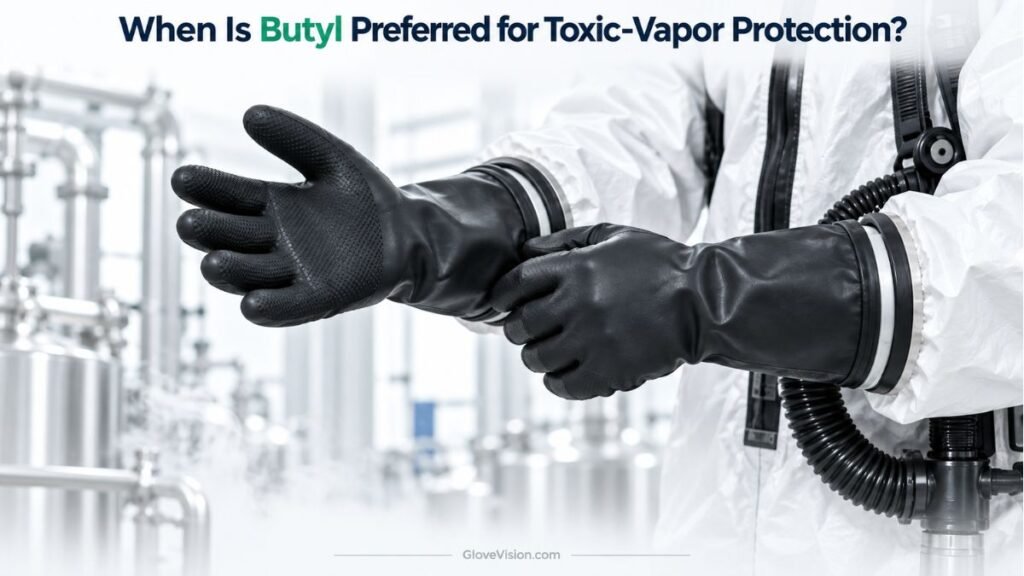
When Is Butyl Preferred for Toxic-Vapor Protection?
Butyl Rubber can be preferred when a toxic vapor creates a meaningful skin or skin-absorption hazard and exact testing shows that the selected Butyl glove, clothing material, or ensemble component provides adequate resistance to that specific agent.
Butyl Rubber does not protect the lungs and does not make a garment gas-tight by itself. Significant inhalation hazards require separately selected respiratory protection, while severe whole-body dermal vapor hazards may require a tested gas-tight or totally encapsulating protective ensemble. This page moves through material barrier, dermal permeation, favorable use scenarios, the glove-versus-ensemble boundary, and exact system verification.
What Makes Butyl Rubber Useful as a Toxic-Vapor Dermal Barrier?
Butyl Rubber can be useful against toxic-vapor skin exposure because its intrinsically low molecular permeability can reduce transport of compatible agents, but only exact-agent data establish whether that structural advantage provides adequate protection.
How Does Low Gas Permeability Help?
Low intrinsic gas permeability can slow molecular transport and makes Butyl a strong screening candidate where gas or vapor diffusion through the barrier matters. That tendency is explained further under Butyl gas-barrier behavior. Low gas permeability remains a material tendency—not universal toxic-vapor compatibility.
Why Does Chemical Compatibility Matter More Than Gas Permeability Alone?
A specific vapor can still sorb strongly into the polymer, swell or degrade it, and permeate faster than expected. Low intrinsic permeability plus poor chemical compatibility does not equal adequate protection. See Butyl resistance strengths for the chemical-specific boundary.
Why Can Butyl Rubber Appear in Gloves and Protective Ensembles?
Butyl is used in finished chemical PPE, including gloves and as one component in gas-tight suit systems. Current AlphaTec 38-560 is an unsupported Butyl glove whose product page lists a 0.70-mm palm thickness and states excellent protection against gas and ozone; that exact claim does not establish protection against every toxic gas or vapor. [Ansell 38-560]
For finished-glove context, see Butyl Rubber gloves.
Why Is Finished Construction Separate From Material Performance?
Seams, zippers, cuffs, glove rings, boots, valves, closures, pinholes, and tears can bypass the bulk barrier. OSHA’s totally encapsulating suit test evaluates gas-tight integrity of the complete construction and explicitly states that this test does not determine resistance to permeation, penetration, or degradation by a specific hazardous substance. [OSHA App A]
| Protection Factor | Why It Matters | Evidence Required |
|---|---|---|
| Exact vapor | Permeation is chemical-specific | Agent-specific data |
| Butyl formulation/product | Performance varies | Exact product |
| Thickness | Changes diffusion path | Tested thickness |
| Temperature | Can alter molecular transport | Relevant test temperature |
| Vapor concentration/partial pressure | Changes transport driving force | Exposure-relevant evidence |
| Seams/closures/interfaces | Can bypass bulk barrier | Construction integrity test |
| Dermal toxicity/absorption | Determines skin-protection requirement | Hazard assessment |
| Inhalation hazard | Butyl material cannot protect lungs | Independent respiratory assessment |
How Does Butyl Rubber Reduce Dermal Exposure to Toxic Vapors?
Butyl Rubber reduces dermal vapor exposure by slowing the molecular sequence required for a compatible vapor to enter, diffuse through, and emerge from the barrier material.
What Must a Vapor Molecule Do to Cross Butyl Rubber?
The sequence is vapor contact → sorption into the polymer → diffusion through the Butyl matrix → arrival at the inner surface → desorption toward the wearer. The material-level transport mechanism is developed further under Butyl low-permeation behavior.
Why Can Vapor Exposure Matter Without Liquid Contact?
Some airborne chemicals can injure skin, contribute to systemic exposure through skin absorption, or deposit and condense on surfaces. OSHA’s HAZWOPER rule requires totally encapsulating chemical-protective suits in defined circumstances where skin absorption could result in severe immediate harm or impair escape. [OSHA 1910.120]
Why Is Permeation Different From Penetration?
Permeation is molecular transport through otherwise intact material. Penetration is movement through defects, seams, closures, tears, pinholes, or interfaces. A chemically resistant layer cannot compensate for an unsealed pathway around that material.
Why Does Breakthrough Time Require Context?
Breakthrough depends on the exact chemical, concentration, temperature, thickness, material or product, test protocol, and endpoint. It should not be republished as a universal safe exposure time.
Which Toxic-Vapor Scenarios Can Favor Butyl Rubber?
Butyl Rubber is most valuable when the vapor creates a significant dermal hazard and exact chemical data show that the selected Butyl barrier maintains an adequate margin under the actual exposure conditions.
When Does a Skin-Absorbable Vapor Favor Butyl Rubber?
The case strengthens when dermal dose matters, the agent can harm or penetrate skin, exact Butyl data are favorable, and the PPE covers the skin area that requires protection. As dermal consequence rises, both material compatibility and construction integrity become more important.
When Can CBRN Vapor Hazards Favor Butyl Rubber?
OSHA’s CBRN PPE selection matrix recognizes Butyl Rubber or layered impervious clothing only where the material and construction have been tested against the specific chemical agent by the manufacturer, government, or a third-party laboratory using an accepted protocol. Agent-specific testing controls; polymer identity does not. [OSHA CBRN]
When Can Butyl Rubber Be Part of a Gas-Tight Ensemble?
Current AlphaTec 6500 Type 1 / Limited Use Level A gas-tight systems provide an exact example: the Model 819 uses a GA2 glove set consisting of an AlphaTec 02-100 barrier inner glove plus an AlphaTec 38-560 Butyl outer glove. The system evidence belongs to the complete ensemble, not to the Butyl layer by itself. [Ansell 6500]
| Vapor Scenario | Potential Butyl Rubber Role | Additional Requirement | Decision Direction |
|---|---|---|---|
| Localized hand dermal hazard | Chemical glove | Exact-agent data | Product-specific candidate |
| Skin-absorbable vapor | Dermal barrier | Coverage + agent evidence | Stronger protection may be warranted |
| Toxic industrial vapor | Glove/clothing component | Route-specific assessment | Exact chemical decision |
| CBRN vapor | Specifically tested barrier component | Accepted agent-specific protocol | Specialized use only |
| Gas-tight Level A/Type 1 system | Glove/ensemble component | Certified whole system + respiratory protection | Ensemble decision |
| Inhalation hazard with minimal skin hazard | Secondary dermal role | Respiratory protection controls inhalation | Butyl is not primary control |
When Does Toxic-Vapor Protection Require More Than Butyl Rubber Gloves?
Butyl Rubber gloves are insufficient whenever the hazard assessment shows that inhalation, exposed skin elsewhere on the body, or whole-ensemble leakage must also be controlled.
When Does Inhalation Risk Require Separate Respiratory Protection?
Butyl Rubber does not protect the respiratory tract. Respiratory equipment must be selected independently through the applicable respiratory-protection program and hazard assessment.
When Does a Dermal Vapor Hazard Require More Than Gloves?
Whole-body protection may be needed when airborne contaminant is harmful to skin, significant absorption is possible, exposed body surfaces could receive vapor, or the hazard assessment requires encapsulation. OSHA Level A is selected when the greatest combined level of skin, respiratory, and eye protection is required and includes positive-pressure respiratory protection plus a totally encapsulating chemical-protective suit. Level B retains the highest respiratory protection but provides less skin protection. [OSHA App B]
Why Can’t a Splash Suit Be Turned Into Vapor Protection With Tape?
OSHA’s Technical Manual distinguishes vapor-protective suits from liquid-splash clothing, states that gas-tight integrity requires appropriate testing, and explicitly notes that duct tape does not make a splash suit protective against vapors. [OSHA OTM]
Why Must the System Be Evaluated as a Whole?
Cuffs, glove and boot attachments, zippers, valves, seams, face/respirator interfaces, and garment damage can become the weak point. The weakest required component can determine whether the full system is adequate.
How Should Butyl Rubber Be Verified Near Toxic-Vapor Protection Limits?
Butyl Rubber should be retained near a toxic-vapor boundary only when both the exact chemical barrier and the complete PPE construction remain supported under the actual temperature, concentration, duration, and exposure-route requirements.
When Does Chemical Incompatibility Override Low Permeability?
Reject generic Butyl reasoning when the exact agent has poor permeation performance, causes unacceptable swelling or degradation, or belongs to a known weak zone without supporting product data. Low gas permeability cannot be converted into universal organic-vapor resistance.
Where exact Butyl evidence is inadequate, a different validated barrier may need comparison; for a relevant alternative class, see fluoroelastomer gloves.
How Do Temperature, Vapor Activity, and Duration Change the Boundary?
Higher temperature can increase molecular transport, greater vapor activity or partial pressure can increase the transport driving force, and longer duration creates more opportunity for cumulative permeation. Evidence should be sufficiently relevant to the actual conditions.
Why Is Gas-Tight Integrity Testing Separate From Chemical Testing?
Use the same two-gate distinction established earlier: the complete suit’s gas-tight integrity is a separate question from agent-specific material resistance. Ask Does the material resist the exact agent? and Does the complete suit remain gas-tight?
When Should a Tested Gas-Tight Ensemble Enter the Decision?
Where hazard assessment requires whole-body vapor protection, use complete ensemble evidence rather than material-only data. ISO 17723-1:2019 remains current after confirmation in 2023 and establishes design and performance requirements for Type 1 gas-tight vapor-protective emergency-response ensembles; it explicitly does not address respiratory protection. [ISO 17723-1]
| Boundary Condition | Why Protection Can Become Inadequate | Required Direction |
|---|---|---|
| Agent incompatible with Butyl | Rapid sorption/permeation/degradation | Alternative barrier |
| Hydrocarbon/chlorinated vapor without data | Generic Butyl weakness | Exact test or alternative |
| Elevated temperature | Faster transport possible | Temperature-relevant evidence |
| Higher vapor concentration/partial pressure | Larger transport driving force | Condition-matched assessment |
| Long exposure | Greater cumulative permeation opportunity | Duration-relevant data |
| Damaged Butyl component | Physical barrier compromised | Replace/remove per protocol |
| Non-gas-tight seams/closure | Vapor bypasses barrier material | Appropriate tested ensemble |
| Significant inhalation hazard | Dermal PPE cannot protect lungs | Separate respiratory protection |
| Unknown chemical | Compatibility cannot be established | Identify/escalate |
Butyl Rubber Vapor-Protection Verification Checklist
Hazard Identity
- Exact vapor/gas identified.
- CAS/formulation confirmed.
- Mixture composition known.
- Relevant airborne conditions characterized.
- Temperature and duration defined.
Exposure Routes
- Inhalation hazard assessed.
- Hand/skin-contact hazard assessed.
- Skin-absorption potential assessed.
- Eye exposure considered.
- Liquid condensation/splash potential considered.
Exact Butyl Rubber Barrier
- Exact product/material identified.
- Thickness known.
- Agent-specific permeation reviewed.
- Breakthrough interpreted in test context.
- Degradation reviewed.
- Test temperature/concentration relevant.
Garment/System Construction
- Required coverage defined.
- Gas-tight requirement determined.
- Seams/closures evaluated.
- Glove and boot interfaces evaluated.
- Suit integrity evidence reviewed.
- Complete ensemble certification reviewed where required.
Respiratory Protection
- Inhalation protection requirement determined separately.
- Applicable respiratory-protection program controls selection/use.
- Butyl Rubber is not being treated as respiratory protection.
Exact-agent evidence supports the localized dermal role.
Whole-body dermal vapor protection is required and the system is appropriately tested.
Inhalation hazard exists.
Butyl evidence is weak or another material is better supported.
Agent, concentration, exposure route, or system requirement remains uncertain.
Generic Butyl or gas-barrier reputation is the primary evidence.
For the broader specialist-versus-alternative decision, see Butyl selection trade-offs.
What Should Readers Remember About Butyl Rubber for Toxic-Vapor Protection?
Butyl Rubber can be an important dermal vapor barrier when the exact toxic agent has favorable permeation and degradation evidence and the finished glove, boot, clothing component, or ensemble provides the coverage and construction integrity required by the hazard.
Butyl Rubber alone does not create complete toxic-vapor protection. Material compatibility, gas-tight construction, skin coverage, seams and interfaces, eye exposure, and respiratory protection are separate requirements that must be matched to the same hazard assessment.
Which Questions Clarify Toxic-Vapor Protection With Butyl Rubber?
Does Butyl Rubber Protect Against Toxic Vapors?
It can provide dermal barrier protection against selected vapors when the exact Butyl Rubber product has appropriate agent-specific permeation, degradation, and construction evidence. Low gas permeability alone does not establish universal toxic-vapor protection.
Do Butyl Rubber Gloves Protect Against Inhaling Toxic Vapors?
No. Butyl Rubber gloves protect covered skin only. Inhalation hazards require independently selected respiratory protection under the applicable respiratory-protection and hazard-assessment requirements.
When Are Butyl Rubber Gloves Enough Instead of a Vapor-Tight Suit?
Only when the hazard assessment establishes that localized hand protection provides the required dermal coverage and whole-body gas-tight protection is unnecessary. Where hazardous vapor can harm or significantly penetrate exposed skin elsewhere, gloves alone are incomplete protection.
When Is Butyl Rubber Used in Level A Protection?
Butyl Rubber can be one tested glove or barrier component within a Level A-type system, but Level A is defined by the complete protective ensemble rather than by Butyl itself. OSHA Level A includes a totally encapsulating chemical-protective suit plus positive-pressure respiratory protection, and current gas-tight suit systems can incorporate outer Butyl Rubber gloves.
When Should Butyl Rubber Not Be Chosen for a Toxic Vapor?
Do not choose Butyl Rubber generically when the vapor is unidentified, exact-agent evidence is absent or inadequate, exposure conditions exceed testing, construction cannot provide required coverage or gas-tight integrity, or a different verified barrier provides stronger agent-specific protection. Inhalation hazards must also be controlled independently.