
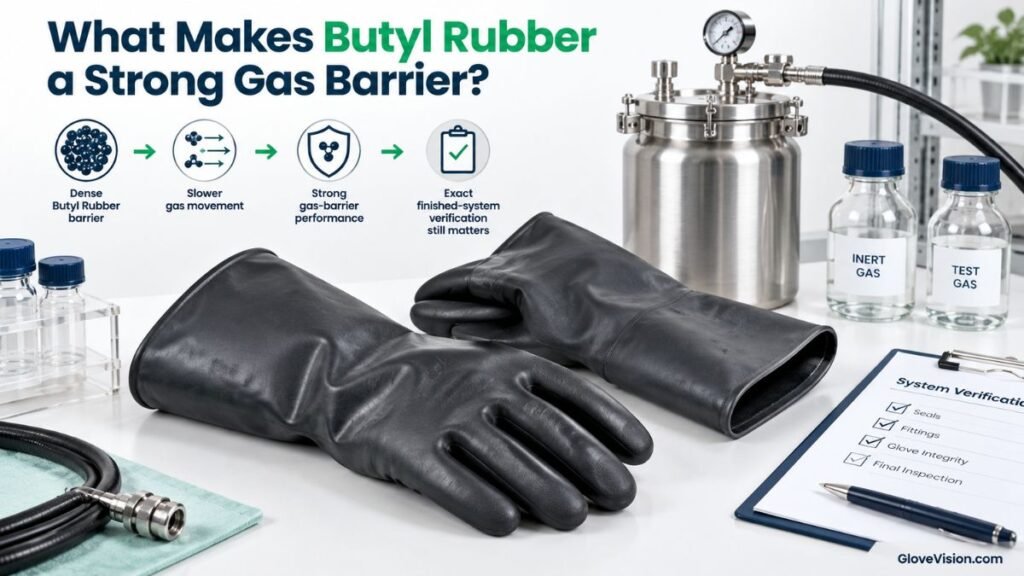
What Makes Butyl Rubber a Strong Gas Barrier?
Butyl Rubber is an unusually strong elastomeric gas barrier because its isobutylene-rich molecular architecture combines slow segmental dynamics with penetrant-specific reductions in gas sorption and diffusion, allowing many small gases to move through the polymer much more slowly than through more permeable elastomers.
Low intrinsic permeability does not mean zero gas transmission. Gas identity, temperature, partial-pressure difference, formulation, cure, morphology, thickness, aging, joints, seals, and other finished-product details determine actual gas transmission and leakage. This page moves from molecular architecture to sorption and diffusion, practical barrier value, transmission variables, and finished-system verification.
What Structural Features Make Butyl Rubber a Strong Molecular Gas Barrier?
Butyl Rubber’s gas-barrier strength begins with its polyisobutylene-rich molecular architecture: a highly saturated isobutylene-dominated chain containing only enough isoprene to provide practical curing sites.
Why Is Butyl Rubber Dominated by Isobutylene?
Conventional Butyl Rubber is built mainly from isobutylene with a small amount of isoprene, so the matrix retains characteristic polyisobutylene transport behavior while still providing unsaturation that can support curing. ExxonMobil describes Butyl grades as isobutylene–isoprene copolymers and identifies very low gas permeability as a defining property. [ExxonMobil]
For protective-barrier context, finished Butyl Rubber gloves must still be judged at product level.
How Do Methyl Groups Affect Butyl Rubber Molecular Motion?
Dense methyl substitution and molecular packing can constrain segmental dynamics, making the PIB matrix unusually slow-moving relative to many elastomeric systems. Peer-reviewed work reports relatively slow PIB segmental dynamics above its glass transition because of steric constraints associated with methyl-group packing. [ACS]
How Can Molecular Packing Contribute to Butyl Rubber’s Gas Barrier?
Chain geometry and packing can reduce how easily local molecular rearrangements create transport opportunities. ExxonMobil’s technical discussion links ultra-low permeability in isobutylene-based chains partly to high packing density and chain geometry, but this is one contributor rather than a complete explanation. [Exxon]
What Roles Do Saturation, Isoprene, and Crosslinking Play?
High saturation mainly supports aging and weathering stability; it does not by itself explain low gas permeability. The small isoprene fraction introduces cure sites. Crosslinking then stabilizes the elastomeric network and can modify morphology and transport, but the intrinsic low-permeability tendency begins in the PIB-rich matrix.
| Structural Feature | Molecular Effect | Gas-Barrier Relevance | Qualification |
|---|---|---|---|
| Isobutylene-rich matrix | Establishes PIB-like transport environment | Very low intrinsic gas permeability | Gas and formulation specific |
| Dense methyl substitution | Constrains segmental dynamics | Can reduce molecular diffusion | Not sole permeability mechanism |
| Molecular packing | Creates restrictive transport environment | Can suppress gas motion | Compound morphology can alter it |
| High saturation | Improves aging/weathering stability | Helps preserve barrier integrity | Does not alone cause low permeability |
| Small isoprene fraction | Supplies reactive cure sites | Enables practical vulcanization | Not primary gas-barrier mechanism |
| Crosslinked network | Stabilizes finished elastomer | Influences morphology and transport | Cure effects are formulation specific |
How Does Butyl Rubber Reduce Gas Sorption and Diffusion?
Butyl Rubber reduces gas transmission because a gas molecule must first partition into the polymer and then migrate through a matrix with unusually restrictive molecular dynamics; low uptake and slow movement can therefore combine to produce very low permeability.
What Must a Gas Molecule Do to Permeate Butyl Rubber?
The sequence is surface contact → sorption into the polymer → diffusion through the matrix → arrival at the opposite surface → desorption. It is molecular transport through intact material, not movement through permanent microscopic holes.
How Do Solubility and Diffusivity Combine?
At a conceptual level, dense-polymer gas transport is often expressed as P = D × S: permeability depends on both diffusivity and solubility. A Journal of Membrane Science study found that PIB’s lower O₂/N₂ permeability than polybutadiene resulted from reductions in both coefficients.
This mechanism explains why Butyl low-permeation behavior must remain penetrant-specific rather than becoming a universal compatibility claim.
Why Is Free Volume an Incomplete Explanation?
Diffusion also depends on transient cavity size, cavity formation frequency, segmental dynamics, gas size and shape, temperature, polymer–gas affinity, and compound morphology. Saying that Butyl Rubber has “no free volume” would be chemically misleading.
Why Can Butyl Rubber Transmit Gas Without Visible Damage?
Gas permeation can occur through apparently intact bulk polymer. The absence of cracks, pinholes, discoloration, or visible deterioration therefore does not establish zero transmission.
Which Applications Best Demonstrate the Gas-Barrier Strength of Butyl Rubber?
Butyl Rubber’s gas-barrier strength is most visible where slow diffusion of air or other gases through an elastomeric wall is valuable, provided that joints and interfaces do not bypass the bulk barrier.
Why Is Butyl Rubber Used Where Air Retention Matters?
Low bulk gas transmission supports uses such as inner tubes, curing bladders, hoses, and sealants. These applications illustrate material behavior rather than proving that any specific protective product is gas-tight.
Why Do Oxygen and Nitrogen Demonstrate the Molecular Advantage?
O₂/N₂ research provides a clear mechanism example because the lower PIB permeability relative to polybutadiene reflects both reduced sorption and reduced diffusion. The result should not be converted into a numeric universal Butyl Rubber permeability for other gases.
How Can Butyl Rubber Support Protective Gas or Vapor Barriers?
Where a protective barrier must reduce molecular transmission of a defined gas or vapor, Butyl Rubber can be a strong candidate, but exact gas- and product-level evidence still controls use. See Butyl vapor protection for that narrower decision problem.
Why Must Bulk Butyl Rubber Be Separated From the Finished Barrier?
An excellent bulk polymer can still be defeated by a poor seam, joint, valve, fitting, or adhesive interface. ISO 4080:2024 separately evaluates hose wall permeability, hose–fitting interface permeability, and complete assemblies, illustrating why system construction matters. [ISO 4080]
| Barrier Need | Butyl Rubber Advantage | System Variable | Required Verification |
|---|---|---|---|
| Air retention | Very low bulk gas permeability | Thickness, valves, seams | Finished product/assembly |
| O₂/N₂ restriction | Low sorption + diffusion demonstrated in PIB | Temperature and pressure | Gas-specific data |
| Moisture/vapor restriction | Strong intrinsic barrier tendency | Interfaces and compound | Product-level test |
| Hose containment | Low-permeability elastomeric layer | Reinforcement and fittings | Complete hose/system |
| Seal/closure | Low bulk transmission | Compression and interface integrity | Exact closure assembly |
| Protective gas/vapor barrier | Strong candidate material | Exact gas + construction | Product-specific evidence |
For broader chemical and physical context, review Butyl resistance strengths.
How Do Temperature, Pressure, Thickness, and Formulation Change Butyl Rubber Gas-Barrier Performance?
Observed gas transmission through Butyl Rubber changes with both intrinsic material properties and extrinsic barrier conditions, so permeability coefficient, permeance, gas transmission rate, and leakage must not be treated as interchangeable measurements.
How Does Temperature Affect Butyl Rubber Gas Permeability?
Higher temperature generally increases polymer segmental mobility and can accelerate diffusion, while solubility can also change. The net permeability response remains gas- and material-specific, which is why rubber permeability testing uses controlled conditions.
How Does Pressure Difference Drive Gas Transmission?
A larger partial-pressure difference generally increases the transport driving force and therefore flux under ordinary solution–diffusion behavior. A higher measured flux does not automatically mean the normalized intrinsic permeability coefficient has increased.
How Does Thickness Affect Butyl Rubber Gas Transmission?
For a homogeneous barrier under ideal steady-state conditions, greater thickness lengthens the diffusion path and typically lowers permeance or GTR. Thickness alone should not be described as inherently lowering the material’s normalized permeability coefficient. ASTM D1434-23 explicitly distinguishes GTR, permeance, and permeability and cautions that morphology and thermal history can affect results. [ASTM]
How Can Crosslinking and Fillers Change Butyl Rubber Gas Transmission?
Crosslinking can alter mobility, morphology, dimensional stability, and network structure. Fillers can alter tortuosity, polymer/filler interfaces, and cure behavior. A 2024 IIR study found filler-dependent changes in diffusion and permeability, showing that compounding effects cannot be assumed to move in one direction. [IIR Study]
Why Can IIR, CIIR, and BIIR Differ?
Standard Butyl, chlorobutyl, bromobutyl, and proprietary compounds differ in cure behavior, additives, morphology, and other properties. Low-permeability reputation can apply broadly to isobutylene-based systems, but exact transport numbers should not be transferred among formulations.
| Variable | Intrinsic Permeability | Finished-Barrier Transmission | Correct Interpretation |
|---|---|---|---|
| Gas identity | Can change greatly | Changes | Always gas specific |
| Temperature | Can change | Changes | Match test temperature |
| Partial-pressure difference | May expose nonideal behavior | Directly drives flux | Do not confuse flux with intrinsic P |
| Thickness | Ideally not inherently changed for same homogeneous material | Usually lowers permeance/GTR as thickness rises | Permeability ≠ permeance |
| Crosslinking | Can change | Can change | Cure/formulation specific |
| Fillers | Can change | Can change | Morphology and interfaces matter |
| Compound formulation | Can change | Changes | Exact compound required |
| Seams/joints/interfaces | Bulk P unchanged | Can dominate total leakage | Test complete construction |
| Cracks/defects | Bulk value may be unchanged | Can overwhelm molecular barrier | Inspect/test whole system |
How Should Butyl Rubber Gas-Barrier Performance Be Verified in a Finished System?
Butyl Rubber should be verified at both material and system level: first confirm relevant gas-transport data for the exact compound, then confirm that thickness, joints, seals, interfaces, and finished construction preserve that barrier advantage.
What Gas and Service Conditions Must Be Defined?
Record the exact gas or mixture, composition, humidity, contaminants, temperature, absolute pressure, differential or partial pressure, exposure duration, cycling, flexing, and expected service life. “Air” data cannot automatically support every other gas.
Which Butyl Rubber Material Must Be Identified?
Identify standard IIR, CIIR, or BIIR; the exact grade or compound; filler package where relevant; cure system; thickness; manufacturing state; and aging condition. These variables can change measured transport behavior.
Which Barrier Metric Should Be Used?
Permeability coefficient describes material transport under defined assumptions; permeance describes the barrier at actual thickness; GTR reports quantity transmitted through defined area and time; and leak or pressure-loss rate can include system defects and interfaces. ISO 2782-1:2022 provides rubber-specific methods for GTR, permeability, diffusion, and solubility coefficients. [ISO 2782]
How Should Butyl Rubber Test Data Be Compared?
Match the same gas, comparable temperature, comparable pressure basis, known thickness, the same metric and units, a relevant compound morphology, and an appropriate test method. Raw PIB film, filled vulcanizate, and a complete assembly are not interchangeable evidence.
Why Must Interfaces Be Verified Separately?
Seams, pinholes, joints, adhesives, valves, closures, fittings, and cracks can bypass the intended bulk barrier. Complete-system verification is necessary whenever these paths can govern retention.
How Should “Impermeable Butyl” Claims Be Handled?
Require a defined gas, test method, detection limit, temperature, pressure basis, thickness, exact material, and clear system scope. Prefer “very low measured gas permeability under the stated conditions” unless a source defines a specific impermeability criterion.
Finished-Barrier Verification Checklist
Gas Definition
- Exact gas or mixture is identified.
- Composition is known.
- Humidity/moisture condition is defined.
- Partial-pressure conditions are known.
Service Conditions
- Temperature is defined.
- Pressure differential is defined.
- Exposure duration is known.
- Cycling, flexing, and aging are considered.
Exact Butyl Material
- IIR/CIIR/BIIR identity is known.
- Exact compound/grade is identified.
- Thickness is known.
- Cure/formulation matches the evidence closely enough.
Barrier Evidence
- Metric and units are identified correctly.
- Gas identity matches.
- Temperature and pressure basis match sufficiently.
- Thickness basis and test method are understood.
Finished System
- Seams, joints, seals, closures, and fittings are evaluated.
- Defects and cracks are controlled.
- Interface leakage is assessed.
- Assembly testing is used where required.
For the broader material-vs-task decision, use Butyl selection trade-offs. Where repeated movement can become limiting, review Butyl flexibility limits.
What Should Readers Remember About the Gas-Barrier Strength of Butyl Rubber?
Butyl Rubber is an unusually effective elastomeric gas barrier because its polyisobutylene-rich architecture creates a restrictive transport environment in which many small gases show both low uptake and slow molecular diffusion.
Intrinsic permeability is only the starting point. The exact gas, temperature, pressure conditions, compound formulation, thickness, aging state, seams, joints, and interfaces determine how much gas the finished barrier actually transmits or leaks.
Which Questions Clarify Why Butyl Rubber Is a Strong Gas Barrier?
Why Is Butyl Rubber So Impermeable to Air?
It is more accurate to call Butyl Rubber very low-permeability rather than absolutely impermeable. Its polyisobutylene-rich architecture produces unusually slow gas transport, and O₂/N₂ research shows that both lower gas solubility and lower diffusivity contribute to the barrier.
Do Methyl Groups Make Butyl Rubber a Better Gas Barrier?
They are an important contributor. Methyl-rich molecular packing creates steric constraints and relatively slow segmental dynamics, which can hinder molecular diffusion. Gas permeability also depends on gas solubility, temperature, compound morphology, cure, and other transport factors.
Does Crosslinking Cause Butyl Rubber’s Low Gas Permeability?
Not by itself. The intrinsic low-permeability tendency already exists in the polyisobutylene-rich matrix. Crosslinking creates a stable elastomeric network and can modify morphology and transport, but its effect depends on the exact compound and cure system.
Does Thicker Butyl Rubber Have Lower Permeability?
Not necessarily in the strict materials-science sense. Greater thickness usually lowers permeance or gas transmission through the finished barrier by lengthening the diffusion path, but the normalized intrinsic permeability coefficient should not automatically be described as lower solely because thickness increased.
When Can Butyl Rubber Fail to Act as a Strong Gas Barrier?
Finished performance can become inadequate when the gas, temperature, pressure conditions, formulation, aging, thin construction, cracks, joints, seals, or interfaces allow transmission or leakage beyond the system requirement. Low bulk-polymer permeability therefore cannot replace complete-product verification.