
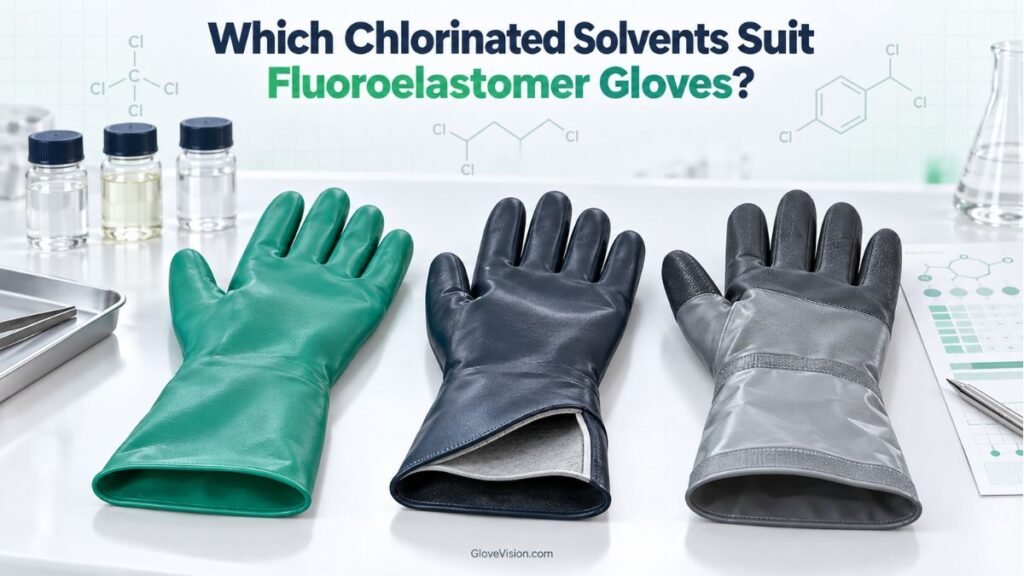
Which Chlorinated Solvents Suit Fluoroelastomer Gloves?
Fluoroelastomer Gloves can be candidates for selected chlorinated solvents when chemical-specific permeation, degradation, and integrity evidence supports the exact finished glove. Trichloroethylene and tetrachloroethylene warrant separate screening; dichloromethane, chloroform, and chlorobenzene each require their own product-specific assessment.
Chlorinated solvents are not interchangeable. Favorable data for one solvent, a polymer-family recommendation, or a supplier’s intended-use description cannot establish protection for another chemical or construction. Selection must match the complete formulation, temperature, concentration, contact mode, duration, and physical task.
What Determines Whether Fluoroelastomer Gloves Suit a Chlorinated Solvent?
Fluoroelastomer Gloves suit a task only when the exact finished product has evidence supporting the named solvent and the actual contact conditions—not merely because its material family appears on a generic compatibility list.
Why must the chemical be identified precisely?
Record the full chemical name and CAS number, concentration, complete commercial formulation, and any added co-solvents. Chlorinated methanes, ethanes, ethenes, and aromatics are separate molecular families. Class membership identifies what to investigate; it does not settle compatibility.
Which barrier results determine the answer?
Permeation is transport through otherwise intact material. Degradation includes swelling, softening, embrittlement, tackiness, or layer separation. Penetration occurs through holes, seams, tears, or other discontinuities. A visually undamaged glove can still permit molecular permeation. Review all three failure modes for the tested construction.
Why is a breakthrough result not a wear-time instruction?
ASTM F739-20 distinguishes breakthrough detection, standardized breakthrough, permeation rate, and cumulative permeation under continuous-contact test conditions. A reported breakthrough beyond the test period does not prove zero lower-rate transport or establish a safe workplace wear interval. Match chemical, specimen, endpoint, temperature, and exposure mode before interpreting any number. [ASTM F739]
Which construction and task details change suitability?
Distinguish a homogeneous fluorinated barrier from a fluoroelastomer-over-butyl composite. Record coating and total thickness, lining, seams, cuff coverage, and physical integrity. Assess splash versus sustained contact, duration, flexing, grip, puncture, and abrasion. See Fluoroelastomer Gloves for material and construction context.
| Selection factor | Why it matters | Evidence required |
|---|---|---|
| Exact solvent and CAS | Similar chlorinated compounds can behave differently | Named-chemical results |
| Concentration and mixture | Additional ingredients can change transport | Relevant formulation data |
| Temperature | May change uptake, permeation, and material condition | Test conditions matching use |
| Contact mode and duration | Splash differs from sustained immersion | Exposure-matched test evidence |
| Thickness and construction | Layers, interfaces, and diffusion path differ | Exact finished-glove details |
| Degradation and penetration | Physical damage can defeat a favorable barrier result | Condition and integrity evidence |
Why Can the Solvent–Barrier Chemistry of Fluoroelastomer Gloves Resist Selected Chlorinated Solvents?
The exact solvent and the formulated fluorinated polymer determine how much chemical enters the material, how it moves, and whether physical damage occurs. Carbon–fluorine bonds contribute to stability, but cannot establish impermeability.
How do affinity and sorption begin the process?
On contact, chemical-specific polymer affinity influences solvent uptake or sorption. Sorbed molecules may swell the glove, change hardness or strength, and diffuse within the barrier. Different sizes, structures, and chemical interactions make closely related chlorinated solvents separate tests; chlorine count alone is not a resistance rule.
Why must swelling and permeation be separated?
Limited swelling may help preserve dimensions and physical properties, but does not quantify how quickly molecules pass through an intact glove. ASTM F739-20 treats breakthrough time, permeation rate, and cumulative permeation as distinct measurements; a satisfactory result for one cannot replace the others. [ASTM F739]
Why does finished construction complete the mechanism?
Polymer grade and cure chemistry affect material behavior, while coating thickness, an underlying layer, seams, and damage affect the finished system. A favorable raw-FKM or seal test cannot be assigned to a different glove. For the chemistry underlying these variations, see fluorinated molecular chemistry.
Competing failure route: unfavorable uptake, inadequate layers, or damaged interfaces can increase transport or penetration; compare another verified construction instead of relying on fluorination alone.
Which Named Chlorinated Solvents Have Supporting Evidence for Fluoroelastomer Gloves?
Trichloroethylene and tetrachloroethylene are separate screening targets for Fluoroelastomer Gloves; dichloromethane, chloroform, chlorobenzene, and legacy chlorinated chemicals require equally independent evidence. None is approved for a particular glove by the information in this article alone.
What must be established for trichloroethylene and tetrachloroethylene?
Trichloroethylene (TCE; CAS 79-01-6) and tetrachloroethylene (PCE; CAS 127-18-4) are distinct chlorinated ethenes. Each may prompt evaluation of a relevant fluoroelastomer barrier, but each needs its own exact-model permeation, degradation, temperature, and contact-mode results. A favorable TCE finding cannot be applied automatically to PCE.
Why does dichloromethane require a dedicated decision?
Dichloromethane (DCM, methylene chloride; CAS 75-09-2) requires chemical-specific glove evidence rather than a generic FKM claim. The US EPA advises using methylene-chloride-resistant gloves and identifies latex, nitrile, neoprene, polyethylene, and butyl rubber as glove materials it does not recommend for this solvent. Its fact sheet does not establish a DCM permeation result for any fluoroelastomer glove. Evaluate each proposed fluoroelastomer or alternative barrier using its own exact DCM-specific finished-product evidence. [EPA]
How should chloroform and chlorobenzene be assessed?
Chloroform (trichloromethane; CAS 67-66-3) is a chlorinated methane, but DCM data do not validate it. Chlorobenzene (CAS 108-90-7) contains a chlorinated aromatic ring and needs its own exact-product results; those results do not extend automatically to dichlorobenzenes or trichlorobenzenes.
What about older solvent charts and mixtures?
1,1,1-Trichloroethane (CAS 71-55-6) and carbon tetrachloride (CAS 56-23-5) may appear in older charts. Confirm current glove construction and current, relevant chemical-specific evidence before relying on a legacy entry. Mixed products need complete-formulation assessment; do not assume the dominant solvent determines the full result.
| Named solvent | Screening position | Evidence still required | Decision boundary |
|---|---|---|---|
| TCE · 79-01-6 | Named candidate for separate screening | Exact TCE permeation and degradation | Conditional; no product approved here |
| PCE · 127-18-4 | Independent candidate, not a TCE substitute | Exact PCE product results | Conditional; no transfer from TCE |
| DCM · 75-09-2 | Dedicated high-consequence assessment | Exact DCM results; compare suitable laminate | Escalate without adequate evidence |
| Chloroform · 67-66-3 | Chemical-specific assessment | Exact chloroform results | No inference from DCM |
| Chlorobenzene · 108-90-7 | Chlorinated aromatic assessment | Exact chlorobenzene results | No inference to other aromatics |
| 1,1,1-Trichloroethane · 71-55-6 | Legacy/specialized assessment | Current model and test documentation | Old chart alone insufficient |
| Carbon tetrachloride · 56-23-5 | Dedicated hazardous-chemical assessment | Exact product and full exposure assessment | Escalate where results are absent |
| Mixed chlorinated solvents | No family-level approval | Complete-formulation data | Mixture-specific decision |
Evidence gap: No original, identifiable finished-glove permeation report for these seven named chemicals was provided in the brief. Therefore this matrix presents verification tasks, not measured breakthrough times, approved chemical lists, or a compatibility ranking.
How Do Exposure Conditions Change the Protection Boundaries of Fluoroelastomer Gloves?
A favorable test result for Fluoroelastomer Gloves requires reassessment if temperature, concentration, contact mode, duration, mixture composition, thickness, or physical stress differs materially from the tested conditions.
Why do temperature and sustained contact matter?
Higher temperature can change solvent uptake, diffusion, and physical deterioration. Prolonged immersion maintains chemical contact and should not be justified by a brief-splash rating. ASTM F1383-20 addresses intermittent contact, whereas F739-20 addresses continuous contact; the methods answer different exposure questions. [ASTM F1383]
Can greater thickness overcome chemical incompatibility?
Under otherwise comparable conditions, a thicker barrier can lengthen the diffusion path. But thicker gloves may have different compounds, layers, and mechanical behavior; thickness cannot repair fundamental chemical incompatibility. Use data for the actual product rather than scaling a thin-glove breakthrough figure.
How can mixtures and repeated handling invalidate a result?
Ketones, esters, alcohols, other chlorinated solvents, additives, and aqueous ingredients can change the full formulation’s behavior. Repeated flexing, grip pressure, abrasion, pinholes, and cuff damage create additional failure routes. Stop use if the glove shows unacceptable swelling, cracking, tackiness, delamination, or loss of integrity. These limits require reassessment of the exact glove rather than reliance on a broad material-family rating.
What does a continuous-contact result actually establish?
An F739 breakthrough result applies to its tested chemical, specimen, analytical endpoint, and conditions. The standard cautions that a standardized breakthrough beyond the test interval need not mean the chemical was entirely absent below the defined rate; it is not a universal replacement schedule. [ASTM F739]
| Changed condition | Why earlier data may not apply | Required response |
|---|---|---|
| Higher temperature | Transport and material response may shift | Obtain relevant-temperature data |
| Different concentration | Solvent uptake can change | Match tested concentration |
| Prolonged immersion | Sustained contact differs from splash | Use continuous-contact evidence |
| Different thickness or layers | Diffusion path and interfaces change | Check exact product construction |
| Mixed formulation | Co-components may alter response | Seek complete-mixture evidence |
| Repeated mechanical stress | Wear or defects can compromise integrity | Verify task durability and inspect |
| Unknown chemical or damage | No defensible compatibility or integrity match | Stop, identify, replace, or escalate |
How Should Fluoroelastomer Gloves Be Compared and Verified Before Chlorinated-Solvent Handling?
Compare exact finished-glove test evidence for the named solvent first. Only after chemical adequacy is supported should grip, dexterity, coverage, mechanical durability, and other construction requirements determine the task choice.
What does a fluoroelastomer-over-butyl product example establish?
Globus describes the SHOWA/Globus 892 as an unlined Viton-over-butyl glove with 0.30 mm nominal thickness and positions that complete product for many chlorinated-solvent applications. That is a specific construction and manufacturer intended-use description, not measured approval for every named solvent above or evidence that either individual layer alone provides the composite’s total protection. Obtain the model’s exact chemical-specific test results separately. [Globus 892]
When should another barrier be compared?
Consider an exact-product laminate when relevant fluoroelastomer evidence is missing, inadequate, or unsuitable for a solvent such as DCM. Polyvinyl alcohol (PVA) gloves are a separate material option only if their exact-chemical evidence and environmental limitations—including water sensitivity—match the task. Do not treat a general butyl or PVA compatibility claim as a substitute for finished-product data. For contextual comparisons, read Butyl selection trade-offs and PVA glove material and water-sensitivity limits.
Does a chemical-protective-glove classification approve every solvent?
No. ISO 374-1:2024 establishes terminology and requirements for protective gloves against chemical risks; it does not make every certified glove suitable for every chlorinated solvent, and additional mechanical or thermal protection must be addressed separately where needed. Compare the exact model’s applicable chemical-specific documentation. [ISO 374-1]
What completes the selection?
Identify the chemical and current SDS; document concentration, mixture, temperature, quantity, contact duration and mode; then match the glove’s model, material, thickness, layers, seams, and cuff to its tested evidence. Compare permeation endpoints separately from degradation and penetration. After confirming protection, assess hand fit, grip, flexing, cut/puncture hazards, doffing, inspection, and the manufacturer’s replacement or reuse directions. Consult the Glove Materials Explained guide when a different polymer class is being considered.
Fluoroelastomer Gloves Verification Checklist
Chemical identity
- Exact named solvent and CAS number confirmed.
- Complete formulation, concentration, and co-solvents identified.
- Current SDS and task hazards reviewed.
Exposure definition
- Temperature, quantity, duration, and frequency recorded.
- Splash, repeated splash, continuous contact, or immersion defined.
- Required hand/forearm coverage and mechanical stresses identified.
Exact finished glove
- Manufacturer, model, grade where available, and construction identified.
- Coating and total thickness, underlying polymer, seams, cuff, and lining match the evidence.
- Exact-solvent permeation results and reported endpoints reviewed.
- Degradation, penetration, and mixture data assessed where relevant.
- Test temperature, concentration, duration, and contact mode sufficiently match use.
Task and alternatives
- Fit, grip, dexterity, abrasion, puncture, and doffing assessed.
- Any laminate, PVA, or other alternative has its own chemical-specific evidence.
- Inspection, replacement, decontamination, and reuse follow product/workplace instructions.
Exact-product evidence supports the complete task.
Evidence supports narrower documented conditions only.
Evaluate another product with relevant test evidence.
Chemical identity, mixture, conditions, or data remain uncertain.
Only generic FKM reputation or an unsupported intended-use claim supports selection.
Final rule: named solvent → full formulation → exposure conditions → exact finished construction → matching permeation, degradation, and integrity evidence → physical-task fit → use, limit, compare, escalate, or reject.
What Should Readers Remember About Chlorinated-Solvent Protection With Fluoroelastomer Gloves?
Selected Fluoroelastomer Gloves can provide useful barriers for defined chlorinated-solvent tasks, but trichloroethylene, tetrachloroethylene, dichloromethane, chloroform, and chlorobenzene require separate chemical-specific verification. A broad material-family label or one favorable solvent result does not approve a different agent.
The decisive evidence belongs to the exact finished glove and the actual task: concentration, mixture, temperature, contact mode and duration, thickness, construction, permeation, degradation, and physical integrity must all match. Use generic fluorinated-material guidance only to identify candidates, never to replace complete-product evidence.
Which Questions Clarify Chlorinated-Solvent Suitability for Fluoroelastomer Gloves?
Are Fluoroelastomer Gloves Suitable for Trichloroethylene?
Selected models are plausible candidates for TCE, but only exact-glove TCE permeation and degradation evidence under relevant task conditions can establish suitability.
Can Fluoroelastomer Gloves Protect Against Tetrachloroethylene?
They may suit a defined PCE task when the exact finished glove has supporting PCE-specific results. TCE data cannot automatically establish PCE suitability.
Are Fluoroelastomer Gloves Appropriate for Dichloromethane?
DCM needs dedicated exact-product verification. Generic FKM claims and unverified composite results are insufficient; compare complete-task evidence for an appropriate methylene-chloride-resistant laminate where relevant.
Can Fluoroelastomer Gloves Be Used With Chloroform?
Only where chloroform-specific permeation, degradation, and integrity evidence for the exact finished glove supports the exposure. Do not infer chloroform protection from DCM, TCE, or PCE results.
When Should Fluoroelastomer Gloves Be Rejected for Chlorinated-Solvent Work?
Reject or escalate when the solvent or mixture is unidentified, exact-model results are inadequate or missing, exposure exceeds tested conditions, or degradation, damage, and task demands compromise the finished barrier.