
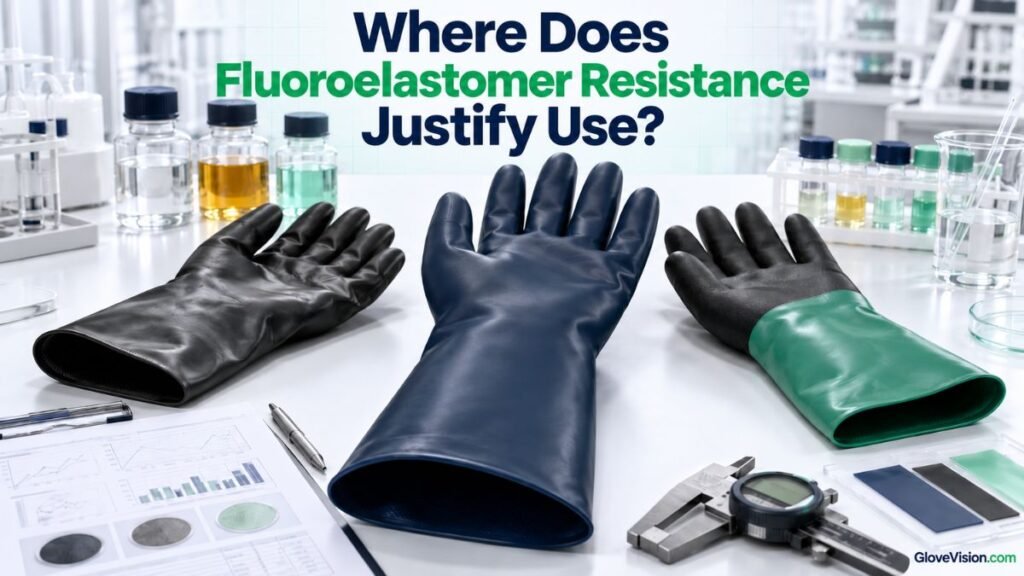
Where Does Fluoroelastomer Resistance Justify Use?
Fluoroelastomers justify use when an exact product provides the resistance needed for a defined chemical exposure and that capability matters to the task. Selected aromatic hydrocarbons, chlorinated solvents, oils, and fuels can create reasons to evaluate these specialist barriers.
A generic material reputation is not product approval or proof that a specialist polymer is necessary. The controlling chemical, complete mixture, concentration, temperature, contact duration, permeation, degradation, finished construction, and other adequate product options must determine selection.
What Determines Whether Fluoroelastomers Resistance Justifies Use?
Fluoroelastomers resistance justifies use when an exact product provides the chemical protection required for the controlling hazard, meets the complete task’s physical demands, and offers a meaningful reason to select it over other adequately protective products.
What chemical requirement must Fluoroelastomers satisfy?
Start with the exact chemical name and CAS number, complete formulation, concentration, expected contact mode, duration, and required barrier performance. OSHA’s glove-selection guidance emphasizes choosing hand protection according to the hazard, glove performance characteristics, conditions of use, and duration—not from material reputation alone. [OSHA]
Why must the controlling chemical be identified?
A mixture can contain several ingredients with different effects on candidate barriers. The component that limits one glove may not be the component that limits another, and complete-mixture behavior may differ from individual-component results. Do not assume the highest-concentration ingredient automatically controls the selection.
How does exposure severity affect the value of Fluoroelastomers?
Incidental splash, repeated contact, continuous contact, immersion, and high-consequence skin exposure create different demands. More demanding contact increases the importance of relevant chemical-specific evidence, but no laboratory breakthrough number alone converts directly into a safe-wear period.
When is strong chemical resistance alone insufficient?
The exact product must also provide adequate grip, dexterity, flexibility, abrasion and puncture resistance, cuff coverage, compatibility with adjacent PPE, and safe removal. A chemically capable barrier that cannot be used reliably for the physical task is not a complete solution.
Why must Fluoroelastomers be compared with other adequate products?
Specialist chemistry is justified by a specific protection need, not prestige. When several products meet the chemical requirement, compare fit, durability, task control, replacement needs, availability, and operational burden without turning those factors into universal material rankings. The broader Glove Materials Explained guide helps separate material-family screening from finished-product selection, while Fluoroelastomer Gloves covers the finished-product family in more detail.
| Selection factor | Question to resolve | Justification condition |
|---|---|---|
| Chemical identity | What is the exact controlling chemical? | Relevant exact-product data exist |
| Mixture composition | Are all significant ingredients accounted for? | The complete chemical challenge is assessed |
| Exposure severity | What contact must the barrier withstand? | Evidence matches the actual task |
| Alternative products | Do other products provide adequate protection? | Fluoroelastomer has a relevant documented advantage or task fit |
| Mechanical demands | Can the product perform the work safely? | Grip, flexibility, and integrity are adequate |
| Finished construction | Does testing represent the actual product? | Model, thickness, layers, and interfaces match |
| Coverage | Which skin surfaces require protection? | Cuff and interfaces provide required coverage |
| Operational practicality | Can protection be maintained throughout use? | Inspection, change, and handling procedures are workable |
Which Chemical Exposures Can Give Fluoroelastomers Specialist Value?
Selected aromatic hydrocarbons, chlorinated solvents, oils, and fuels can give Fluoroelastomers specialist value when exact-product evidence supports the chemical exposure and the material’s resistance is relevant to the task.
When do aromatic hydrocarbons support Fluoroelastomers selection?
Benzene, toluene, xylene, and selected related aromatics are recognized screening areas for fluoroelastomer materials. OSHA’s generic chemical-glove table lists fluoroelastomer/Viton as an organic-solvent material and includes chlorinated solvents, aliphatics, and alcohols among example applications while also noting material-family limitations. That screening guidance does not approve an unspecified finished glove. [OSHA]
When do chlorinated solvents justify evaluation?
Trichloroethylene, tetrachloroethylene, dichloromethane, and chloroform must be treated as separate verification tasks. “Chlorinated solvent” is a screening category, not one compatibility result, so performance against one named solvent cannot be transferred to another.
When do oils, fuels, and lubricants create specialist value?
Selected petroleum oils, lubricants, hydrocarbon fuels, and related process fluids may create a useful specialist role. Chemours’ Viton selection guidance shows that fluoroelastomer families and grades differ in composition, fluorine content, fluid resistance, and low-temperature behavior, so material-level fuel or hydrocarbon data must remain grade-specific and cannot be transferred directly to a glove. [Chemours]
When can repeated solvent contact strengthen the case?
Repeated contact can increase the importance of permeation behavior, cumulative chemical loading, swelling, physical-property retention, and mechanical durability. Splash evidence should not be treated as proof for repeated or continuous contact without matching test conditions.
Why do high-consequence chemicals need more than generic material guidance?
High-consequence chemicals require chemical-specific test evidence, relevant hazard assessment, adequate skin coverage, and any additional exposure controls needed by the task. Chemical-resistant gloves protect covered skin only; they do not independently control inhalation exposure or exposure to uncovered areas.
| Exposure category | Potential specialist value | Evidence required | Editorial classification |
|---|---|---|---|
| Selected aromatic hydrocarbons | Resistance to particular challenging organic solvents | Exact chemical and finished-product data | Established candidate zone |
| Selected chlorinated solvents | Specialized solvent-barrier performance | Named-solvent testing | Conditional candidate zone |
| Petroleum oils and selected fuels | Resistance to compatible hydrocarbon fluids | Actual fluid and product testing | Product-specific candidate |
| Oxygenated or additive-rich fuels | Certain formulations may address a defined fluid challenge | Exact formulation and product evidence | Conditional |
| Repeated solvent contact | Potential value from verified barrier durability and permeation performance | Exposure-duration and task data | Task-dependent |
| High-consequence chemical exposure | Potential need for a specifically verified barrier | Chemical-specific evidence and complete hazard assessment | Evidence-dependent |
| Unknown solvent mixtures | No defensible generic assumption | Full formulation and relevant testing | Escalate |
How Does Resistance in Fluoroelastomers Translate Into Practical Task Protection?
Fluoroelastomers provide practical protection when tested chemical resistance limits the relevant exposure through the complete product and the glove or barrier retains the physical performance required for the task.
How can fluorinated chemistry support Fluoroelastomers resistance?
Fluorinated polymer architecture can support chemical stability, but polymer composition, grade, cure system, additives, and finished construction still determine interaction with a particular chemical. Strong carbon–fluorine bonding alone does not establish low uptake, low permeation, or universal compatibility.
Why does limited swelling matter?
Favorable polymer–chemical interaction can reduce uptake and help preserve dimensions and physical properties. Excessive swelling, softening, hardening, or cracking can undermine integrity. Low swelling alone, however, is not proof of low permeation.
How does permeation performance translate into a barrier advantage?
Solvent molecules can sorb into intact material, diffuse through it, and emerge at the inner surface. OSHA distinguishes permeation, degradation, and penetration as separate chemical-protective-clothing performance questions and notes that material thickness, temperature, concentration, and construction can change the result. [OSHA]
Why can a finished composite behave differently from a single-layer product?
The SHOWA 892 provides a concrete example: SHOWA describes a fluoroelastomer-over-Butyl construction intended for selected aliphatic and aromatic hydrocarbons, including benzene, toluene, and xylene. That product positioning belongs to the complete composite and must not be transferred to a homogeneous FKM glove or another layer configuration. [SHOWA]
Why is a laboratory breakthrough time not a workplace wear time?
ASTM F739-20 treats breakthrough detection time, standardized breakthrough time, permeation rate, and cumulative permeation as distinct continuous-contact measures. The standard states that its data cannot by themselves establish safe exposure levels, and a standardized breakthrough value beyond a specified period does not prove that no lower-rate permeation occurred. [ASTM]
When does chemical resistance fail to deliver a practical advantage?
A chemically adequate product can still be unsuitable if it cannot provide secure grip, required dexterity, mechanical integrity, adequate coverage, reliable PPE interfaces, or safe removal. Chemical adequacy is necessary; complete-task suitability determines whether the exact product can be used.
Alternative branch: inadequate chemical data, poor task fit, or no meaningful specialist advantage → compare another verified barrier, redesign the task, or escalate.
When Do Fluoroelastomers Resistance Boundaries Favor Another Barrier?
Fluoroelastomers lose a defensible selection advantage when the exact chemical or exposure exceeds verified resistance, the finished construction cannot perform the task, or another adequately protective product satisfies the same requirements without a meaningful need for specialist chemistry.
Why can ketones and esters challenge conventional Fluoroelastomers?
Some conventional FKM families have important limitations with selected low-molecular-weight ketones, esters, amines, and strongly alkaline fluids, while specialty formulations can differ. Chemours’ product guidance demonstrates that conventional and specialty fluoroelastomer families are not interchangeable, so the decision must return to the exact grade, chemical, and finished product. [Chemours]
How can mixtures, temperature, and duration remove a previously supported advantage?
A product that resists the primary ingredient may still be challenged by another mixture component. Higher temperature can accelerate uptake or transport, while longer or repeated contact increases cumulative chemical and mechanical demands. Do not transfer a result from milder conditions to a more demanding exposure without relevant evidence.
Why can construction invalidate material-level guidance?
Homogeneous fluoroelastomer gloves, coatings, composites, multilayer laminates, different thicknesses, and lined constructions are different protective systems. Product-level test results must represent the actual configuration being selected.
When should Butyl Rubber, neoprene, or PVA be compared?
Compare an exact Butyl Rubber product where its chemical-specific data support the controlling exposure, especially when a different solvent family changes the material requirement. Use Butyl selection trade-offs for that boundary. An exact neoprene product can also be considered when verified resistance and task fit support it; see Neoprene specialization trade-offs . PVA can be relevant for selected organic solvents but requires specific attention to water sensitivity and wet conditions; the PVA Gloves page covers those limits.
When can a multilayer laminate be a relevant alternative?
For a named high-consequence chemical, another verified barrier may be more appropriate. OSHA’s methylene chloride alert specifically recommends resistant PE/EVOH or other suitable laminate gloves for that chemical and states that Butyl Rubber gloves are not recommended for meeting the requirements discussed in the alert. This chemical-specific guidance must not be generalized to every chlorinated solvent. [OSHA]
When is Fluoroelastomers specialization unnecessary?
If another exact product provides adequate chemical protection and meets all physical, environmental, coverage, and operational requirements, the specialist fluoroelastomer chemistry may offer no necessary advantage for that use. That does not make the alternative universally safer, more comfortable, less expensive, or more resistant.
| Controlling exposure or need | Candidate strategies to evaluate | Critical evidence | Decision condition |
|---|---|---|---|
| Selected aromatic solvent | Fluoroelastomer or another tested solvent barrier | Exact aromatic permeation and degradation | Complete-task suitability |
| Selected chlorinated solvent | Fluoroelastomer, appropriate laminate, or another verified barrier | Named-solvent finished-product data | Chemical-specific adequacy |
| Selected ketone or ester | Butyl, appropriate specialty fluoroelastomer, or another tested product | Exact chemical and formulation | No generic family transfer |
| Amine or strongly alkaline chemical | Formulation-specific barrier options | Exact chemical, grade, and product evidence | Relevant compatibility established |
| Organic solvent with water contact | Chemically adequate, water-compatible barrier | Solvent and water-exposure data | Entire environment supported |
| Complex solvent mixture | Product with applicable mixture evidence | Complete formulation and test conditions | All significant hazards assessed |
| High-dexterity chemical task | Chemically adequate products with suitable fit and construction | Barrier and task-performance evidence | Safe control without sacrificing protection |
| No unique chemical need | Any exact product meeting the complete task | Matched chemical and physical evidence | Specialist chemistry not required |
How Should Fluoroelastomers Be Verified Before Their Resistance Justifies Selection?
Fluoroelastomers should be selected only after chemical-specific evidence for the exact finished product supports the actual exposure and the product meets the complete task’s physical and operational requirements.
What chemical and exposure information must be confirmed?
Record the exact chemical name, CAS number, concentration, complete formulation, additional ingredients, relevant SDS information, temperature, contact pattern, duration, frequency, pressure where relevant, mechanical stresses, and required coverage. The goal is to define the real task rather than force a material choice into an incomplete hazard description.
Which product details must match the evidence?
Verify manufacturer, exact model, FKM formulation or grade where available, material construction, coating and total thickness, underlying layers, liner, cuff, seams, interfaces, and the specific product documentation supporting the claim.
Which chemical-resistance measurements matter?
Review permeation rate, breakthrough detection time, standardized or normalized breakthrough time, cumulative permeation where available, degradation, physical integrity, test method, concentration, temperature, and tested specimen construction. Interpret the laboratory method first, then decide whether the workplace conditions are sufficiently comparable.
How should practical suitability and alternatives be evaluated?
Assess fit, grip, dexterity, flexibility, abrasion, puncture and tear performance, cuff coverage, repeated flexing, safe removal, and interaction with other PPE. Compare alternatives using evidence for the same chemical or complete mixture, relevant concentration and temperature, contact mode, duration, and finished construction.
When should the proposed Fluoroelastomers product be rejected or escalated?
Reject or escalate when chemical identity is unknown, mixture composition is unresolved, exact-product data are absent or inadequate, actual exposure exceeds supported conditions, permeation or degradation is unacceptable, product integrity is compromised, required physical performance is inadequate, or generic fluoroelastomer reputation is the primary basis for selection.
Fluoroelastomers Selection Verification Checklist
Chemical and exposure
- Exact chemical and CAS confirmed.
- Complete mixture and concentration known.
- Potentially controlling ingredients assessed.
- Temperature, contact pattern, duration, and frequency defined.
- Mechanical demands and required coverage documented.
Exact product
- Manufacturer and model confirmed.
- Material formulation or grade identified where available.
- Thickness and layer construction documented.
- Cuff, liner, seams, and interfaces reviewed.
- Supporting evidence represents the actual finished product.
Chemical-barrier evidence
- Applicable permeation data reviewed.
- Breakthrough method and endpoint understood.
- Degradation and physical integrity reviewed.
- Test concentration and temperature sufficiently match use.
- Mixture-specific evidence reviewed where needed.
- No universal safe-wear time inferred from laboratory results.
Complete-task performance
- Fit, grip, dexterity, and flexibility are adequate.
- Mechanical durability and coverage are adequate.
- Safe removal and replacement procedures are established.
- Other required exposure controls are addressed.
Alternative comparison
- Other chemically adequate products considered where relevant.
- Comparisons use appropriate product-level evidence.
- Environmental and mechanical limitations reviewed.
- The specialist fluoroelastomer advantage is relevant to the task.
Exact-product evidence supports the chemical exposure and complete task.
Available evidence supports only narrower documented conditions.
Another verified product may provide a more appropriate complete-task fit.
Chemical identity, mixture, test data, or task requirements remain uncertain.
Generic material reputation is the primary justification or a required protection condition fails.
Final selection rule: exact controlling chemical → required protection → applicable fluoroelastomer product evidence → exposure-condition match → physical-task suitability → comparison with other chemically adequate barriers → use, limit, compare, escalate, or reject.
What Should Readers Remember About When Fluoroelastomers Justify Use?
Fluoroelastomers justify consideration when verified resistance to a defined chemical exposure provides a meaningful protection advantage. Selected aromatic hydrocarbons, chlorinated solvents, oils, and fuels are relevant candidate areas, but chemical-family membership cannot establish suitability for every fluid, formulation, or finished product.
The final decision must account for the controlling chemical, complete mixture, concentration, temperature, contact duration, permeation, degradation, construction, coverage, and physical demands. Select Fluoroelastomers because verified performance solves a specific protection problem—not because fluorinated chemistry is assumed to be universally superior.
Which Questions Clarify When Fluoroelastomers Justify Use?
When Are Fluoroelastomers Worth Choosing for Chemical Protection?
Fluoroelastomers are worth choosing when an exact product has documented resistance to the controlling chemical under the intended exposure conditions and can perform the complete task. A specialist polymer reputation alone is not enough.
Do Aromatic Hydrocarbon Exposures Justify Fluoroelastomers?
They can. Selected aromatic hydrocarbons are a recognized candidate area for Fluoroelastomers, but the exact chemical, complete formulation, concentration, exposure conditions, and finished-product evidence must support the choice.
Do Chlorinated Solvent Exposures Always Justify Fluoroelastomers?
No. Individual chlorinated solvents can behave differently, and a favorable result for one cannot be transferred to another. The proposed product requires relevant solvent-specific permeation and degradation evidence, and another verified barrier may be needed for some exposures.
When Is Another Material More Practical Than Fluoroelastomers?
Another material may be more practical when an exact product provides adequate protection against the complete chemical exposure and better matches the task’s physical, environmental, or operational requirements. Compare actual products using applicable evidence rather than generic polymer rankings.
When Should Fluoroelastomers Be Rejected Despite Their Chemical-Resistance Reputation?
Reject or escalate when the exact chemical or mixture is unknown, applicable product data are absent or inadequate, workplace conditions exceed validated performance, physical integrity or required task control is insufficient, or the proposed product cannot meet all required protection conditions.