
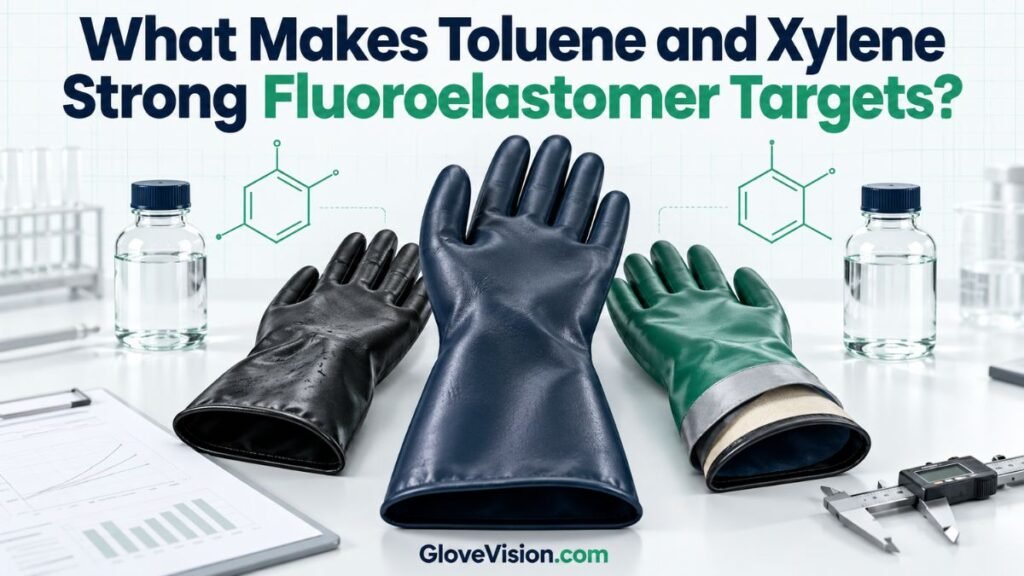
What Makes Toluene and Xylene Strong Fluoroelastomer Targets?
Toluene and xylene are important Fluoroelastomer Gloves candidates because selected finished fluoroelastomer constructions are specifically designed for aromatic-hydrocarbon handling. Current SHOWA 892 product information names both toluene and xylene as intended aromatic applications for its fluoroelastomer-over-Butyl construction.
Candidate status is not automatic approval. Toluene and xylene require separate chemical-specific evidence, and xylene may mean an individual isomer or a commercial mixture. Glove model, formulation, thickness, temperature, concentration, contact duration, and other mixture ingredients determine whether supporting evidence applies.
What Determines Whether Toluene and Xylene Match Fluoroelastomer Gloves?
Toluene or xylene is a strong match for Fluoroelastomer Gloves only when the exact finished product has relevant chemical-resistance evidence for the actual solvent or formulation and that evidence adequately matches the workplace exposure.
Why does aromatic-hydrocarbon identity matter?
Toluene is a specific aromatic hydrocarbon identified as CAS 108-88-3. [PubChem] Xylene is not one single composition: mixed xylenes are commonly identified as CAS 1330-20-7, while o-xylene, m-xylene, and p-xylene have separate identifiers. [PubChem] The fact that both are aromatic solvents is only a screening clue; selection must resolve the exact chemical that will contact the glove.
What makes Fluoroelastomer Gloves strong candidates?
A candidate glove needs favorable evidence for permeation, degradation, physical integrity, relevant contact duration, relevant temperature, and its exact finished construction. SHOWA’s current 892 page identifies a fluoroelastomer over Butyl Rubber construction, names toluene and xylene among the aromatic hydrocarbons for which its Viton coating is designed, and lists a 0.30 mm thickness for that product configuration. [SHOWA] That establishes a concrete finished-product candidate, not a universal result for every FKM glove.
Why must toluene and xylene be evaluated separately?
Toluene and xylene have different molecular identities, and xylene contains an additional methyl substituent relative to toluene. Different chemicals can interact differently with the same polymer, so a toluene result must not be assigned to xylene and a xylene result must not be assigned to toluene without relevant evidence.
Why must xylene composition be identified?
Distinguish o-xylene, m-xylene, p-xylene, and commercial mixed xylenes. The workplace formulation and the chemical used in the supporting test should be compared directly. A report labeled only “xylene” should not automatically be assumed to represent every individual isomer or every commercial xylene-containing product.
Why must the finished Fluoroelastomer Gloves construction be identified?
Verify manufacturer, exact model, FKM formulation where available, homogeneous or composite construction, thickness, underlying polymer, liner, cuff, seams, and interfaces. The broader glove materials explained guide helps separate material-family screening from exact finished-product evidence.
How does contact severity affect the match?
Incidental splash, repeated splash, continuous contact, and immersion create different chemical challenges. Use test evidence that is relevant to the actual contact pattern; a general named-use statement or splash-oriented decision should not be converted into prolonged-immersion approval.
| Factor | Why It Matters | Required Evidence |
|---|---|---|
| Solvent identity | Toluene and xylene are different chemicals. | Exact chemical data |
| Xylene composition | Isomers and commercial mixtures are not automatically interchangeable. | Actual formulation |
| Glove construction | Composite and homogeneous products differ. | Exact model specification |
| Thickness | Changes the tested diffusion path. | Exact tested construction |
| Permeation | Measures molecular transport through intact barrier. | Relevant test results |
| Degradation | Identifies chemical-induced material change. | Chemical-specific evidence |
| Temperature | Can alter barrier behavior. | Relevant test temperature |
| Contact pattern | Splash and immersion differ. | Matching test/contact mode |
| Duration | Sets required protection margin. | Task-specific assessment |
Mobile: scroll horizontally inside this table to view every column.
Why Does Aromatic-Solvent Chemistry Favor Toluene and Xylene in Fluoroelastomer Gloves?
Toluene and xylene are relevant Fluoroelastomer Gloves candidates because fluorinated polymer formulations can provide favorable resistance to selected aromatic hydrocarbons, but actual barrier behavior depends on solvent-specific uptake, diffusion, formulation, and complete glove construction.
How does fluorinated polymer structure contribute?
Fluorinated polymer chemistry can support resistance in selected chemical environments, and strong carbon–fluorine bonding contributes to chemical stability. The complete formulation still controls actual interaction with a solvent, so chemical stability must not be translated into universal impermeability.
Why does polymer–solvent affinity matter?
When toluene or xylene contacts a glove, formulation-dependent sorption can occur before swelling, molecular diffusion, and permeation are measured. The exact solvent and the exact polymer formulation must therefore be considered together rather than inferred from the general label “aromatic solvent.”
How can limited solvent uptake support glove integrity?
Lower solvent uptake can help preserve dimensions and physical properties, while excessive swelling can soften, distort, harden, or weaken the barrier. Limited visible swelling is useful degradation information, but it is not evidence that permeation is absent.
Why does molecular diffusion still need measurement?
Permeation can occur through material that still looks intact. OSHA distinguishes permeation from degradation and penetration and explains that concentration, temperature, material thickness, construction, and other conditions can influence protective performance. [OSHA] Chemical-specific permeation evidence is therefore more informative than visual appearance or polymer reputation alone.
Why does SHOWA 892 demonstrate product-level candidate status?
SHOWA 892 illustrates why candidate status must remain product-level rather than material-level. Once a finished composite has been identified as relevant, its complete construction and chemical-specific evidence—not the generic labels Viton or FKM—must control the decision. Product positioning should not be treated as a universal breakthrough result, pure-FKM performance claim, or equal-resistance statement for every xylene formulation.
Why is the whole composite important?
A fluoroelastomer layer, Butyl substrate, product-specific thickness, and complete glove construction together form the finished barrier. Performance attributed to the whole composite must not be transferred to either constituent polymer or to a different layer configuration unless separate evidence supports that transfer.
Alternative pathway: unfavorable uptake, unsupported formulation, damaged construction, or unsuitable exposure conditions → reduced barrier margin → compare another verified product.
How Should Toluene and Xylene Be Matched Separately With Fluoroelastomer Gloves?
Toluene and xylene should be treated as separate Fluoroelastomer Gloves selection problems: both justify evaluation of selected products, but each requires its own chemical identity, test evidence, and exposure match.
Why is toluene a relevant candidate?
Toluene is an aromatic hydrocarbon with CAS 108-88-3. [PubChem] SHOWA specifically names toluene among the aromatic hydrocarbons for which its 892 fluoroelastomer-over-Butyl glove is designed. [SHOWA] Together, those sources establish chemical identity and finished-product candidate status—not universal compatibility or a numerical breakthrough value.
Which toluene data must be reviewed?
Check the exact finished glove, test chemical and concentration, test temperature, breakthrough endpoint, permeation rate where available, material thickness and construction, degradation results, and the relevant contact mode. Do not invent a breakthrough value when an original chemical-resistance report has not been verified.
Why does pure toluene differ from a toluene-containing product?
Thinners, adhesives, coatings, cleaning formulations, and process fluids can contain multiple solvents and additives. A result for pure toluene cannot automatically approve the full commercial formulation; every relevant ingredient and the complete mixture need to be considered.
Why is xylene a relevant candidate?
SHOWA likewise names xylene among the aromatic applications for the same 892 composite glove. This supports screening of that exact product while leaving the xylene composition, chemical-specific test evidence, and task conditions to be verified separately.
Why must xylene identity be confirmed?
o-Xylene is CAS 95-47-6, m-xylene is CAS 108-38-3, p-xylene is CAS 106-42-3, and mixed xylenes are commonly identified as CAS 1330-20-7. A workplace label that says only “xylene” does not establish which composition a test result represents.
Can mixed-xylene data be applied automatically to individual isomers?
No. Verify whether the report used a single isomer, defined mixed xylenes, or another commercial xylene formulation. Do not claim that the isomers necessarily produce materially different breakthrough values unless appropriate test evidence demonstrates that difference.
Why can paints, coatings, and thinners containing xylene require another assessment?
Other ingredients may include ketones, esters, alcohols, other aromatics, other organic solvents, and additives. The glove must address the complete formulation rather than xylene alone.
How does repeated toluene or xylene contact change the decision?
Repeated exposure requires evidence relevant to contact duration, repetition, prior glove exposure, mechanical stress, and continuous versus intermittent contact. A general named-use claim must not be treated as proof of prolonged immersion suitability.
| Exposure | Candidate Evidence | What Must Still Be Verified | Decision Status |
|---|---|---|---|
| Pure toluene | Explicitly named application of a documented composite product | Toluene-specific permeation/degradation and task conditions | Product-specific candidate |
| o-Xylene | Aromatic/xylene screening candidate | Exact isomer or applicable mixture data | Conditional |
| m-Xylene | Aromatic/xylene screening candidate | Exact isomer or applicable mixture data | Conditional |
| p-Xylene | Aromatic/xylene screening candidate | Exact isomer or applicable mixture data | Conditional |
| Defined mixed xylenes | Xylene named as product application | Tested composition and workplace match | Mixture-specific |
| Commercial xylene product | Family/name supports screening | Complete commercial formulation | Formulation-specific |
| Toluene–xylene blend | Both chemicals are named aromatic candidates | Exact blend/product evidence | Mixture-specific |
| Aromatic + ketone/ester formulation | Aromatic data alone are insufficient | Complete chemical compatibility | Escalate if unsupported |
Mobile: scroll horizontally inside this table to view every column.
Manufacturer named-use evidence and exact permeation testing are different evidence levels. Never display a product-description claim as though it were a measured breakthrough result.
Which Conditions Weaken Toluene and Xylene Protection in Fluoroelastomer Gloves?
Toluene or xylene candidate status weakens when workplace temperature, concentration, duration, formulation, glove thickness, or physical condition differs materially from the evidence supporting the Fluoroelastomer Gloves selection.
How can higher temperature change resistance?
Higher temperature can increase molecular transport and alter the chemical/material response. Relevant-temperature data should therefore be used instead of assuming that room-temperature results remain valid for heated handling.
Why does prolonged immersion require stronger evidence?
Brief splash creates a shorter chemical challenge, while continuous immersion creates sustained sorption and cumulative permeation demand. Continuous-contact suitability therefore requires evidence generated under a contact mode and duration relevant to the intended task. A general handling or application statement is not immersion approval.
How can concentration and complete formulation change the result?
Record the actual solvent concentration, purity, commercial formulation, and all significant co-solvents or additives. A diluted product is not automatically easier to resist, and a mixture of individually favorable ingredients is not automatically compatible.
Why does glove thickness matter?
Greater thickness creates a longer molecular diffusion path under otherwise comparable conditions, but a different thickness may also mean a different glove model, formulation, or layer construction. Use exact-product evidence rather than treating thickness as a cure for chemical incompatibility.
How can repeated use and damage reduce reliability?
Review prior chemical contact, swelling, softening, cracking, tackiness, abrasion, punctures, damaged cuffs, and layer separation. A visually intact glove is not proof of zero permeation, while visible damage is a clear reason to stop, remove the glove safely, and reassess according to product and workplace procedures.
When does broader exposure require controls beyond Fluoroelastomer Gloves?
Gloves protect covered skin; they do not control airborne solvent concentration or protect uncovered body areas. Engineering controls, ventilation, protective clothing, or respiratory protection may be required by the hazard assessment. For the broader decision about when specialist resistance is actually worth selecting, see Fluoroelastomer resistance use justification.
| Boundary Condition | Why Candidate Evidence May Be Insufficient | Required Response |
|---|---|---|
| Elevated temperature | Permeation/degradation may change | Obtain relevant-temperature evidence |
| Different concentration | Chemical driving conditions differ | Match actual challenge conditions |
| Prolonged immersion | Sustained chemical loading | Verify continuous-contact performance |
| Unknown xylene composition | Test chemical may not match workplace material | Identify exact formulation |
| Toluene/xylene mixture | Combined behavior may differ | Review complete-mixture evidence |
| Additional solvent ingredients | Another component may control compatibility | Evaluate all relevant ingredients |
| Different glove thickness | Tested diffusion path/product differs | Use exact-model evidence |
| Prior exposure or physical damage | Integrity and barrier properties may change | Follow product inspection/replacement criteria |
| Airborne solvent hazard | Gloves address only covered skin | Apply separate exposure controls |
Mobile: scroll horizontally inside this table to view every column.
How Should Fluoroelastomer Gloves Be Compared and Verified for Toluene or Xylene?
Fluoroelastomer Gloves should be compared at exact-product level. First establish adequate protection against the actual toluene, xylene, or complete formulation; then compare construction, fit, grip, durability, coverage, and other whole-task requirements.
Why must Fluoroelastomer Gloves be compared at product level?
SHOWA 892 is a useful illustration because its relevant barrier is a Viton/fluoroelastomer-over-Butyl composite. That product must not be used to represent every FKM glove, every Viton product, pure FKM construction, another coating thickness, or another composite system.
When should Butyl Rubber be considered?
Compare an exact Butyl product only when its chemical-specific evidence supports the complete exposure. The Butyl substrate inside a composite product does not prove that a standalone Butyl glove is suitable for toluene or xylene. See Butyl selection trade-offs for the relevant material-selection boundary.
When should neoprene be compared?
An exact neoprene product may be worth comparing where product-level chemical data support the actual solvent or formulation and the glove provides appropriate physical performance. Use Neoprene specialization trade-offs for a qualified comparison rather than a generic material ranking.
When should PVA be compared?
An exact PVA product may be evaluated for appropriate organic-solvent tasks where chemical evidence supports its use and the complete environmental exposure is compatible with the product. Because moisture is a defining limitation for many PVA barriers, review the exact PVA Gloves construction and water-related limits before using it as an alternative.
When should a multilayer barrier be considered?
Consider a verified multilayer construction when the complete solvent mixture falls outside the candidate Fluoroelastomer Gloves evidence, multiple chemicals require broader barrier coverage, another exact product has better applicable data, and the physical task can still be performed safely. Multilayer construction is not automatically superior.
What chemical information must be recorded?
Confirm toluene or xylene identity, CAS number, xylene isomer or mixed formulation, concentration, complete mixture, additional solvents or additives, and current SDS information.
Which exposure conditions must be defined?
Document temperature, splash or continuous contact, immersion where relevant, duration, frequency, quantity, mechanical stress, and required hand or forearm coverage. OSHA’s hand-protection guidance specifically calls for evaluation of chemical hazards, mixtures, exposure duration and frequency, dexterity, and physical stresses, together with relevant manufacturer documentation. [OSHA]
Which product details must match the evidence?
Verify manufacturer, exact model, FKM or fluoroelastomer formulation where available, homogeneous or composite construction, thickness, underlying layers, lining, cuff, seams, and interfaces. Evidence from another construction should not be treated as equivalent.
How should permeation results be interpreted?
Review the exact test chemical, concentration, temperature, tested specimen, breakthrough detection time, standardized breakthrough time, permeation rate, cumulative permeation where available, and degradation results. ASTM F739 defines these permeation measures for continuous-contact testing and states that the resulting data do not by themselves establish safe exposure levels. [ASTM] Interpret the test endpoint and conditions first, compare them with the actual task, and then establish a product- and workplace-specific procedure. Breakthrough time is not an automatic safe glove-wear time.
How should practical performance be evaluated?
After chemical adequacy is established, assess fit, grip, dexterity, flexibility, abrasion, puncture resistance, cuff coverage, compatibility with other PPE, and safe removal. Handling convenience should never be used to compensate for inadequate chemical protection.
When is the evidence insufficient?
Escalate or reject when toluene evidence is being transferred to xylene, xylene data are being transferred to toluene, xylene composition is unclear, the commercial formulation is unresolved, exact-glove chemical data are unavailable, test conditions differ materially from actual exposure, the glove is damaged, or the task cannot be performed safely.
Fluoroelastomer Gloves Selection Verification Checklist
Chemical identity
- Exact toluene or xylene exposure identified.
- CAS or xylene composition confirmed.
- Xylene isomer or mixture identified where applicable.
- Concentration known.
- Complete formulation reviewed.
- Other solvents and additives identified.
Exposure conditions
- Temperature defined.
- Splash, repeated contact, continuous contact, or immersion established.
- Duration and frequency known.
- Required coverage identified.
- Mechanical demands documented.
Exact product
- Manufacturer and model confirmed.
- Polymer or composite construction understood.
- Thickness confirmed.
- Liner, cuff, seams, and interfaces reviewed.
- Supporting evidence applies to this exact finished product.
Chemical performance
- Toluene or relevant xylene data reviewed.
- Test chemical or composition understood.
- Breakthrough endpoint understood.
- Permeation rate reviewed where available.
- Degradation reviewed.
- Test temperature and concentration sufficiently match use.
- No safe-wear time inferred directly from laboratory breakthrough.
Task performance
- Fit and grip adequate.
- Dexterity adequate.
- Physical integrity adequate.
- Coverage adequate.
- Safe removal procedures considered.
Exact-product evidence supports the complete solvent exposure and task.
Evidence supports only narrower documented conditions.
Another verified product may better match the complete task.
Chemical identity, formulation, exposure, or evidence remains uncertain.
Aromatic-family reputation or manufacturer named-use wording is the primary evidence without adequate supporting product data.
Final decision rule: exact toluene or xylene identity → complete formulation → temperature + concentration + contact pattern → exact finished-glove construction → permeation + degradation evidence → task performance → use, limit, compare, escalate, or reject.
What Should Readers Remember About Toluene and Xylene in Fluoroelastomer Gloves?
Toluene and xylene are important Fluoroelastomer Gloves candidates because a current commercial fluoroelastomer-over-Butyl glove specifically names both chemicals among its intended aromatic-hydrocarbon applications. This demonstrates practical product relevance without establishing universal resistance across every Fluoroelastomer Glove or exposure condition.
Toluene and xylene must still be evaluated separately. Xylene identity or mixture composition, complete commercial formulation, glove construction, temperature, contact duration, permeation, degradation, and physical-task performance determine whether the candidate glove is actually suitable. Treat toluene and xylene as named Fluoroelastomer Gloves candidates—not interchangeable solvents or automatic approvals.
Which Questions Clarify Toluene and Xylene Compatibility With Fluoroelastomer Gloves?
Are Fluoroelastomer Gloves Suitable for Toluene?
Selected products can be candidates. SHOWA 892 specifically names toluene among the aromatic hydrocarbons for which its fluoroelastomer-over-Butyl construction is designed. Actual use still requires applicable toluene-specific barrier evidence and exposure-condition matching.
Are Fluoroelastomer Gloves Suitable for Xylene?
Selected products can be candidates, and SHOWA 892 specifically names xylene. Verify what xylene composition was tested and whether it sufficiently represents the actual isomer, mixed xylenes, or commercial formulation being handled.
Can Toluene Breakthrough Data Be Used for Xylene in Fluoroelastomer Gloves?
No. Toluene and xylene are different chemicals, so toluene breakthrough data should not be assigned to xylene. Use evidence generated for the relevant xylene chemical or adequately defined formulation.
Do All Xylene Isomers Behave Identically in Fluoroelastomer Gloves?
Do not assume so. o-, m-, and p-xylene are distinct chemical identities, while commercial mixed xylenes can contain multiple isomers and other components. Confirm which composition was tested before applying the evidence.
When Should Fluoroelastomer Gloves Be Rejected for Toluene or Xylene Work?
Reject or escalate when exact chemical identity or mixture composition is unresolved, relevant exact-product permeation or degradation evidence is inadequate, workplace conditions exceed the supporting data, the glove is damaged, or its construction cannot provide the required chemical and physical task protection.