
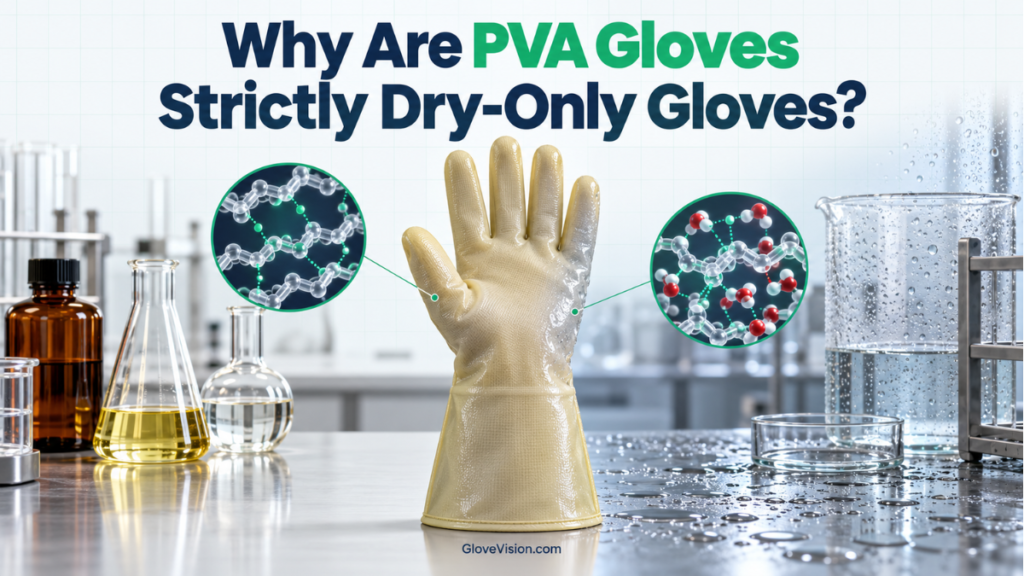
Why Are PVA Gloves Strictly Dry-Only Gloves?
PVA Gloves are treated as dry-only gloves because polyvinyl alcohol interacts strongly with water. The same hydroxyl-rich chemistry that helps create a cohesive barrier against many dry organic solvents also makes the polymer water-sensitive, so meaningful moisture can reduce the stability of the protective PVA layer.
Dry-only does not mean every trace of moisture instantly destroys every product. It is a conservative selection rule because water, relevant high humidity, condensation, wet surfaces, rinse residues, moisture pathways, and aqueous solvent mixtures can reduce barrier confidence depending on the exact glove and exposure; the decision therefore moves from the dry-only boundary through PVA-water chemistry, hidden moisture, dry-solvent fit, and exact-product verification.
What Defines the Dry-Only Boundary of PVA Gloves?
The dry-only boundary of PVA Gloves is crossed whenever meaningful water, aqueous contamination, condensation, or relevant humidity can reach the protective PVA layer and the exact product lacks evidence supporting those conditions.
What Counts as a Dry Exposure for PVA Gloves?
A dry exposure is one in which the protective PVA layer can remain effectively free from meaningful water or aqueous contamination for the full task. Potential candidate situations include dry aromatic, chlorinated, aliphatic, ester, ether, and selected ketone exposures, but the exact chemical and glove still require verification. OSHA describes PVA as a specialty glove material for organic solvents and lists aliphatics, aromatics, chlorinated solvents, ketones except acetone, esters, and ethers among its generic use areas. [OSHA] For the broader chemistry behind that specialization, see PVA chemistry and solvent resistance.
What Counts as a Wet Exposure for PVA Gloves?
Wet exposure includes direct liquid water, aqueous solutions, solvent-water blends, wet surfaces, condensation, rinse or washdown residue, water leaks, and other routes that bring meaningful moisture to the protective layer. OSHA specifically identifies water sensitivity as a disadvantage of PVA glove material. [OSHA]
Why Is “No Water Immersion” Too Narrow for PVA Gloves?
Full immersion is not required for moisture to matter. A localized wet spot, condensed water film, damp tool, or aqueous residue can bring water into direct contact with part of the PVA coating even when the main process is described as a dry-solvent task.
Why Is Dryness a Material Requirement for PVA Gloves?
Dryness helps preserve the polymer state associated with PVA’s dry-solvent specialization. Moisture is different because it can interact directly with the hydroxyl-rich polymer rather than acting only as an external process condition.
What Is the First Screening Question for PVA Gloves?
Can the PVA coating remain reliably dry for the full task? If that cannot be established, PVA should move from an uncomplicated candidate to verify, compare, or escalate status.
The visual gate and table form one proof asset: the first question is whether the protective PVA layer can remain sufficiently dry throughout the actual task.
| Exposure Factor | PVA Direction | Main Concern |
|---|---|---|
| Pure dry compatible solvent | Often favorable | Exact chemical still required |
| Dry equipment | Favorable condition | Confirm no hidden moisture |
| Liquid water | Unfavorable | Hydration / material change |
| Aqueous formulation | Poor generic fit | Water-sensitive polymer |
| High humidity | Product-specific concern | Moisture exposure |
| Condensation | High concern | Localized liquid-water contact |
| Wet equipment | High concern | Direct coating contact |
| Unknown water content | Uncertain | Escalate / compare |
Why Do Water and Humidity Undermine PVA Gloves?
Water undermines PVA Gloves because PVA’s abundant hydroxyl groups can hydrogen-bond with water as well as with neighboring polymer chains, allowing moisture to alter the intermolecular structure that supports dry-state barrier performance.
Why Are Hydroxyl Groups Central to PVA Gloves?
PVA contains abundant hydroxyl groups that make the polymer polar and support strong inter- and intramolecular hydrogen bonding. Polymer literature describes this hydrogen-bonded structure as an important feature of PVA, while its exact behavior depends on grade and processing. [PVA Review]
What Happens When Water Reaches PVA Gloves?
Water can form hydrogen-bonding interactions with PVA hydroxyl groups and change the balance of polymer–polymer interactions. Water is also documented as an effective PVA plasticizer; plasticization can increase free volume and molecular-chain movement while reducing inter- and intramolecular PVA hydrogen bonding. [PVA Review]
Why Is Water Stability a Known Material Limitation for PVA Gloves?
Water response is fundamental to PVA chemistry, but its practical extent is not identical for every PVA material. Degree of hydrolysis, molecular weight, crystallinity, processing, coating thickness, and finished glove construction can influence how a particular PVA barrier responds.
Why Should “Water-Soluble” Not Be Oversimplified for PVA Gloves?
Water sensitivity does not justify claiming that any trace of water instantly dissolves every PVA glove. The rate and extent of hydration, swelling, plasticization, loss of mechanical integrity, or dissolution depend on the material grade, finished construction, exposure amount, duration, and temperature.
Why Can High Humidity Matter for PVA Gloves?
For AlphaTec 15-554 specifically, Ansell states that contact with water or use in high-humidity environments greatly decreases chemical protection. The same manufacturer identifies the product as a supported PVA-coated glove with a cotton liner, so the presence of a liner should not be interpreted as removing that model’s moisture restriction. [Ansell]
Why Can Duration Matter in Humid Conditions for PVA Gloves?
Longer exposure creates more opportunity for moisture to interact with a water-sensitive barrier. Where a manufacturer identifies humidity as a limitation, longer humid tasks therefore deserve more conservative product-specific evaluation rather than an assumed universal humidity threshold.
Why Can Temperature Compound Moisture Concerns for PVA Gloves?
Temperature can affect molecular mobility and moisture behavior, while warmer work may also increase perspiration. The relevant temperature and humidity should therefore be matched to product guidance rather than converted into an unsupported universal PVA threshold.
Which Hidden Moisture and Aqueous Exposures Defeat the Dry-Only Rule for PVA Gloves?
PVA Gloves can leave their dry-use zone even when the main process chemical is nominally organic, because condensation, rinse water, wet surfaces, aqueous residues, moisture pathways, or water-containing formulations can expose the PVA layer to moisture.
Why Can Condensation Matter for PVA Gloves?
Condensation can form localized water films on drums, valves, pipework, cold vessels, tools, and container exteriors. The process chemical itself may be dry while the surface touched by the glove is not.
Why Can Recently Washed Equipment Be a Problem for PVA Gloves?
Residual water can remain on handles, hoses, joints, valves, lids, and container surfaces after cleaning. A nominally dry-solvent operation therefore does not guarantee a dry glove-contact environment.
Why Do Cleaning Residues Matter for PVA Gloves?
A process may use a dry organic solvent while the workstation still contains water-based cleaner, rinse residue, wet-wipe residue, or aqueous detergent. Those secondary contacts can change the actual exposure experienced by the PVA coating.
Can Perspiration Reach the PVA Coating?
Potential moisture transfer depends on the liner, coating layout, glove construction, duration, heat, and condition. A liner can improve comfort or absorb perspiration, but it should not be assumed to make the external PVA barrier wet-compatible. For example, AlphaTec 15-554 has an interlock cotton liner while its manufacturer still warns against water contact and high-humidity use. [Ansell]
Why Can Nearby Water Processes Matter for PVA Gloves?
Adjacent splash, leaking water lines, washdown, steam or condensation, and damp work surfaces can create moisture routes that are not obvious from the main chemical inventory.
Why Can Dry Toluene and Water-Containing Toluene Require Different Decisions for PVA Gloves?
A dry aromatic solvent can fall within PVA’s generic specialist candidate zone, but adding water introduces PVA’s defining material limitation. Dry-solvent compatibility therefore cannot automatically be transferred to the water-containing formulation. For more detail on the dry aromatic zone, see PVA aromatic-solvent resistance.
Why Do Complete Formulations Matter for PVA Gloves?
Commercial products may contain water, alcohol, surfactants, acids or bases, stabilizers, and multiple co-solvents. “Mostly organic” is not equivalent to “dry,” so the complete formulation should be reviewed rather than selecting from the dominant ingredient alone.
Why Can Limited Water Content Still Matter for PVA Gloves?
No universal water-percentage threshold should be assumed. Water is chemically relevant because it interacts directly with PVA’s defining hydroxyl chemistry, so limited but meaningful water content still requires exact-product evaluation rather than automatic dismissal.
Why Are Emulsions Important for PVA Gloves?
An apparently organic formulation may contain a continuous or dispersed aqueous phase. Either condition can invalidate the assumption that dry-solvent performance applies unchanged.
What Should Happen When Water Content Is Unknown for PVA Gloves?
Unknown moisture content → unresolved PVA suitability → obtain complete formulation data or compare another verified barrier.
The moisture-route map and matrix form one proof asset, showing how a nominally dry process can cross into PVA’s wet-use boundary through secondary exposure routes.
| Exposure | Generic PVA Direction | Main Reason |
|---|---|---|
| Dry toluene | Strong candidate | Aromatic specialty; exact product required |
| Dry TCE / PCE | Strong candidate | Chlorinated-solvent specialty; exact product required |
| Dry aliphatic solvent | Candidate | Exact chemical required |
| Dry ester / ether | Candidate | Product-specific |
| Solvent + water | High concern | PVA hydration |
| Solvent emulsion | Poor generic basis | Aqueous phase |
| Alcohol-water blend | Weak / conditional | Moisture plus generic light-alcohol weakness |
| High-humidity work | Product-specific concern | Moisture exposure |
| Condensation / wet equipment | High concern | Direct water contact |
| Unknown formulation | Uncertain | Composition not verified |
Which Dry Solvent Tasks Best Fit PVA Gloves?
PVA Gloves fit best where a validated dry organic-solvent process can keep the protective PVA layer free from meaningful water exposure for the full task.
When Do Dry Aromatic Solvents Fit PVA Gloves?
Benzene, toluene, and xylene fall within OSHA’s generic aromatic candidate category for PVA, but this is screening guidance rather than automatic finished-glove approval. Exact chemical, concentration, temperature, contact mode, duration, and product evidence still control. [OSHA]
When Do Dry Chlorinated Solvents Fit PVA Gloves?
OSHA also places chlorinated solvents within PVA’s generic use area. Trichloroethylene, tetrachloroethylene, chlorobenzene, or another chlorinated solvent should still be treated as exact-solvent verification questions rather than transferable family approvals. See PVA chlorinated-solvent resistance.
When Can Dry Aliphatic Solvents Fit PVA Gloves?
Aliphatics are another generic OSHA candidate category for PVA. The category is useful for screening, but it does not replace exact chemical-barrier data for the proposed glove.
When Can Dry Esters and Ethers Fit PVA Gloves?
OSHA includes esters and ethers among generic PVA use areas. Treat both as broad candidate classes that require exact-product confirmation rather than universal approvals.
What About Ketones and PVA Gloves?
The generic OSHA table includes ketones but explicitly excludes acetone. That exception should remain chemical-specific: it does not establish that every other ketone is suitable, nor that every ketone behaves like acetone. [OSHA]
Why Must Dryness Be Confirmed Even When the Solvent Looks Ideal for PVA Gloves?
Strong chemical-family fit cannot override PVA’s moisture sensitivity. Dryness is therefore part of the compatibility decision itself, not merely a housekeeping preference.
Which Process Characteristics Strengthen the Fit of PVA Gloves?
Confidence is stronger when the solvent and complete formulation are known, equipment is dry, moisture is controlled, contact duration and temperature are defined, exact manufacturer data are applicable, and the selected glove construction can withstand the task’s mechanical demands.
How Should PVA Gloves Be Compared and Verified When Dryness Is Uncertain?
PVA Gloves should remain in use only when the exact glove and process can maintain a supported dry condition; when moisture cannot be controlled, degradation appears, or wet-condition evidence is missing, another verified barrier should be evaluated.
Which Degradation Signs Matter for PVA Gloves?
Watch for softening, swelling, tackiness, surface change, loss of strength, cracking, abrasion, thinning, or coating damage. These observations do not identify a universal failure time, but they are reasons to remove the glove and reassess the exposure.
Why Do Softening and Swelling Matter for PVA Gloves?
Softening may accompany hydration, solvent uptake, or plasticization, while swelling indicates dimensional change in the polymer matrix. Either can reduce confidence in the barrier because the original material state has changed.
Why Can Tackiness or Surface Change Matter for PVA Gloves?
Tackiness or visible surface alteration can indicate polymer or coating change. Significant change should trigger removal rather than continued reliance on generic PVA solvent reputation.
Why Is Visual Inspection Alone Insufficient for PVA Gloves?
Permeation is molecular transport through a protective material and may occur without dramatic visible damage. ASTM F739 measures permeation under defined continuous-contact conditions and identifies breakthrough detection time, standardized breakthrough time, permeation rate, and cumulative permeation as barrier-performance measures. [ASTM]
What Should Happen After Significant Material Change in PVA Gloves?
Use a conservative sequence: remove → replace → investigate → reassess the exact product and exposure → compare another verified barrier where needed.
When Can Fluoroelastomer Be More Appropriate Than PVA Gloves?
A fluoroelastomer product can be compared when strong organic-solvent resistance remains necessary but PVA’s water sensitivity makes the actual environment impractical, provided the exact fluoroelastomer data support the chemical. See fluoroelastomer adoption limits.
When Can Butyl Be More Appropriate Than PVA Gloves?
Butyl can enter the comparison for selected ketones, glycol ethers, and esters where exact product evidence supports the complete wet or mixed exposure. See Butyl selection trade-offs.
When Can Nitrile Be More Practical Than PVA Gloves?
Nitrile can be evaluated where the exact chemical supports it and the task also needs wet compatibility, puncture resistance, physical durability, or dexterity. It should not be treated as universal solvent protection.
When Can Neoprene Be More Appropriate Than PVA Gloves?
An exact neoprene product can be evaluated for selected aqueous chemicals, acids or bases, wet processes, and mixed environments when its chemical evidence better matches the task. See the neoprene specialization trade-off.
When Should a Multilayer Barrier Be Evaluated Instead of PVA Gloves?
A verified multilayer barrier can become relevant when water and an aggressive solvent coexist, the formulation is complex, the consequence of breakthrough is high, or no single conventional polymer has adequate complete-formulation evidence.
The branching route and matrix form one proof asset. Alternatives are comparison candidates only; the exact chemical, formulation, product, and exposure determine the final choice.
| Exposure Condition | PVA Direction | Alternative Direction |
|---|---|---|
| Dry aromatic | Strong candidate | PVA may remain appropriate with exact evidence |
| Dry chlorinated solvent | Strong candidate | Exact fluoroelastomer may also qualify |
| Aqueous chemical | Poor generic PVA fit | Exact nitrile, neoprene, butyl, multilayer, or other barrier as chemistry dictates |
| Wet organic-solvent task | High concern | Wet-compatible specialist barrier with exact evidence |
| Ketone + water | Weak PVA basis | Butyl or another exact candidate where supported |
| Complex wet mixture | Uncertain | Mixture-tested product |
| High humidity | Product-specific / high concern | Wet-compatible exact alternative where needed |
| Visible PVA degradation | Replace | Reassess material and exact product |
What Chemical Information Must Be Confirmed for PVA Gloves?
Record the exact chemical, CAS number, concentration, complete formulation, and solvent purity. Do not select PVA solely from a chemical-family name.
What Moisture Questions Must Be Answered for PVA Gloves?
Determine whether water is intentionally present, whether an aqueous phase exists, whether humidity is relevant, whether condensation can occur, whether surfaces or equipment are wet, whether rinse residue remains, and whether nearby water processes can contaminate the glove.
Which Environmental Conditions Matter for PVA Gloves?
Document temperature, relevant humidity, contact mode, contact duration, and frequency. Splash, intermittent contact, continuous contact, and immersion should not be treated as interchangeable.
Which Product Details Must Match for PVA Gloves?
Verify the manufacturer, exact model, PVA coating or material, thickness where available, liner or support, cuff, manufacturer instructions, and moisture restrictions. Product-specific claims should remain attached to the exact glove that generated them.
Which Barrier Data Must Be Reviewed for PVA Gloves?
Review chemical-specific permeation, breakthrough endpoint, degradation, test concentration, temperature, specimen thickness, test method, and relevant contact mode. ASTM F739 data are useful for comparing barrier materials under defined test conditions; they should not be converted automatically into a workplace safe-wear interval. [ASTM]
When Should PVA Gloves Be Rejected or Escalated Before Use?
Reject or escalate the proposal when dryness cannot be maintained, water content is unknown, an unsupported aqueous phase is present, applicable manufacturer moisture restrictions are exceeded, exact chemical data are missing, the real exposure falls outside relevant evidence, or another barrier has stronger complete-task support.
Chemical Gate
- Exact chemical identified.
- CAS number confirmed.
- Concentration known.
- Complete formulation reviewed.
- Solvent purity known.
Moisture Gate
- No intentional unsupported water contact.
- No unresolved aqueous phase.
- Water content known.
- Condensation controlled.
- Wet surfaces excluded or addressed.
- Rinse residues excluded or addressed.
- Humidity acceptable under exact-product guidance.
Environment Gate
- Temperature known.
- Humidity known where relevant.
- Splash, intermittent, continuous, or immersion contact defined.
- Contact duration defined.
- Frequency defined.
Product Gate
- Exact manufacturer and model confirmed.
- PVA coating and construction match the evidence.
- Thickness known where available.
- Support and liner known.
- Cuff and coverage adequate.
- Manufacturer moisture warnings reviewed.
Performance Gate
- Chemical-specific permeation reviewed.
- Breakthrough endpoint understood.
- Degradation reviewed.
- Test temperature relevant.
- Test concentration relevant.
- Test duration and contact conditions relevant.
- Mechanical demands addressed.
- No automatic safe-wear time inferred.
Condition Gate
- No unacceptable swelling.
- No unacceptable softening.
- No tackiness or surface breakdown.
- No cracking or thinning.
- No unresolved moisture-related coating concern.
- Visual condition not treated as proof of zero permeation.
Final Decision
What Should Readers Remember About the Dry-Only Rule for PVA Gloves?
PVA Gloves are valuable because they occupy a specialized dry-organic-solvent niche. Their usefulness can be strong for selected dry aromatic, chlorinated, aliphatic, ester, ether, and supported ketone exposures, but that chemical strength depends on maintaining an exposure environment that does not undermine the water-sensitive PVA barrier. Choose PVA Gloves for verified dry-solvent tasks where their specialist resistance is valuable; move away from PVA whenever meaningful water exposure cannot be excluded or controlled.
The dry-only rule exists because moisture interacts directly with PVA’s hydroxyl-rich polymer structure. Water, aqueous formulations, condensation, wet surfaces, relevant high humidity, or uncontrolled moisture can reduce confidence in chemical and mechanical protection, so PVA should be selected only when the exact product can remain suitably dry for the full task.
Which Questions Clarify Why PVA Gloves Must Stay Dry?
Can PVA Gloves Be Used in Water?
Not generically. PVA is inherently water-sensitive, so direct water or aqueous exposure can alter the polymer and reduce confidence in the barrier. Exact product guidance should control any claimed exception.
Can High Humidity Reduce PVA Gloves Protection?
It can, particularly where the exact manufacturer identifies high humidity as a limitation. Humidity does not equal immersion, but both introduce moisture to a water-sensitive polymer.
Can PVA Gloves Handle a Dry Solvent That Contains Some Water?
Do not assume so. Water content, formulation, temperature, duration, and the exact glove must be evaluated because dry-solvent compatibility may not transfer once an aqueous component is introduced.
Does a Liner Make PVA Gloves Safe for Wet Work?
Not automatically. A liner may improve comfort or moisture management, but it does not change the inherent water sensitivity of the external PVA barrier. Exact construction and manufacturer instructions govern.
When Should Another Material Replace PVA Gloves?
Compare another exact barrier when water, condensation, aqueous contamination, relevant high humidity, wet surfaces, unsupported mixtures, visible degradation, or missing product-specific evidence make it impossible to keep the PVA barrier reliably within its dry-use conditions.