
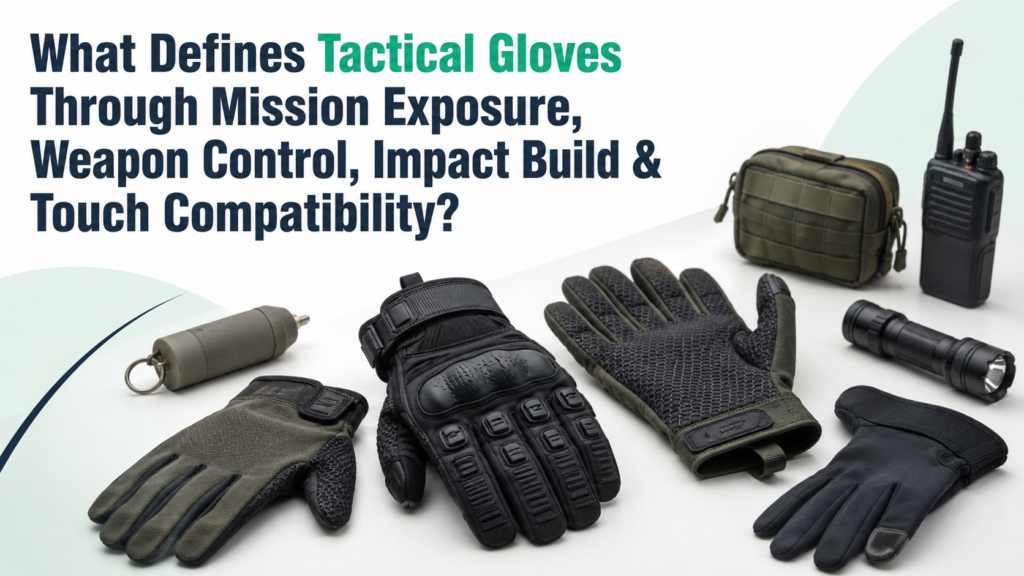
What Defines Tactical Gloves Through Mission Exposure, Weapon Control, Impact Build & Touch Compatibility?
Tactical gloves are defined by the mission or service environment, documented protection needs, palm and finger control, impact construction, equipment compatibility, touchscreen performance, and whether the glove remains reliable in use. Tactical appearance alone does not prove protection or suitability.
This page explains tactical glove categories, mission and service environments, hazard and rating interpretation, materials and impact construction, fit and controlled handling, touchscreen and utility features, replacement triggers, and final verification.
This article provides educational tactical glove-selection guidance and does not replace manufacturer specifications, organizational procedures, approved training, hazard assessments, or professional PPE evaluation. Firearms, sharps, impact, flame, extreme temperatures, chemicals, electricity, breaching, and rope operations require task-specific equipment and qualified instruction before a glove is relied upon for protection.
What are tactical gloves, and how do they differ from work, sport, and general protective gloves?
Tactical gloves are close-fitting protective gloves designed for military, law-enforcement, security, shooting, patrol, and related field tasks where protection must be balanced with controlled movement and equipment interaction.
They emphasize finger isolation, palm stability, access to approved equipment, cuff compatibility, grip, and localized protective zones.
Work gloves may prioritize trade-specific mechanical protection and durability, while sports gloves may prioritize athletic grip, padding, warmth, or repetitive movement.
General protective gloves may provide a barrier or mechanical feature without the low-bulk fit and equipment interaction expected from a tactical build.
Tactical styling does not establish cut, impact, puncture, needle, flame, chemical, electrical, or thermal protection.
For occupational tasks, hand-protection selection should be based on the glove’s performance characteristics relative to the task, conditions, duration of use, and identified hazards. [OSHA]
| Glove Context | Typical Role | Main Protection Need | Main Control Need | Main Limitation | Deeper Route |
|---|---|---|---|---|---|
| Tactical glove | Military, police, security, shooting, patrol | Task-specific abrasion, impact, grip, and selected hazard protection | Finger isolation, palm stability, equipment compatibility | Tactical styling does not prove ratings | Tactical child page or product verification |
| Military glove | Field movement, equipment, vehicles, environmental exposure | Durability, impact, abrasion, selected thermal or flame properties | Control across changing environments | Specialist missions require dedicated systems | Military Gloves |
| Shooting glove | Approved range or shooting task | Grip, abrasion, selected environmental protection | Low bulk and isolated finger movement | Not automatically impact, cut, flame, or field rated | Shooting Gloves |
| Police-duty glove | Patrol, searches, vehicle, public contact, duty equipment | Abrasion, grip, selected sharps or impact protection | Balanced handling and discreet fit | Standard models may lack needle or chemical protection | Police Duty Gloves |
| Work glove | Construction, mechanics, rigging, industrial handling | Mechanical and trade-specific protection | Tool control | May be too bulky or lack tactical equipment fit | Work Gloves |
| Sports glove | Athletics, cycling, lifting, skiing | Activity-specific grip, padding, or warmth | Sport movement | Does not establish duty or PPE suitability | Sports Gloves |
| Chemical glove | Chemical handling | Chemical-specific barrier | Safe manipulation within compatibility limits | Often reduces tactility and requires strict verification | Chemical specialist guidance |
| Electrical glove system | Voltage-rated work | Electrical insulation and protector system | Controlled electrical task movement | Standard tactical gloves provide no voltage protection | Electrical PPE guidance |
| Thermal specialist glove | Extreme cold, heat, or flame | Rated thermal protection | Task-specific handling | Tactical materials alone are insufficient | Thermal PPE guidance |
How do military, shooting, and police-duty tactical gloves differ?
Military, shooting, and police-duty gloves differ because field durability, low-bulk equipment control, and patrol or search protection create different construction and fit priorities.
Military gloves support changing field, vehicle, equipment, terrain, abrasion, impact, and weather demands. Field requirements vary because military glove materials must match the mission environment.
Shooting gloves emphasize low palm bulk, stable fingertips, isolated finger movement, repeatable grip, and minimal interference during approved non-operational fit checks. These demands are explored through shooting control gloves without turning fit guidance into firearm instruction.
Police-duty gloves balance patrol, vehicle, public-contact, equipment, abrasion, snag, contamination, and selected sharps concerns. The parent category can route deeper questions to police-duty handling.
No category automatically covers extreme cold, flame, chemicals, breaching, rope operations, or needle exposure.
| Category | Main Environment | Main Hand Demand | Typical Build Priority | Main Limitation | Child Page |
|---|---|---|---|---|---|
| Military gloves | Field, vehicle, equipment, rough terrain, changing weather | Durable control across mixed environments | Abrasion-aware palm, flexible armor, secure cuff, reinforcement | Extreme cold, flame, chemical, breaching, and rope tasks may need specialist systems | Military Gloves |
| Shooting gloves | Approved range or shooting task | Low-bulk palm and isolated finger movement | Close fit, stable fingertips, minimal bunching, consistent grip | Not automatically impact-, cut-, flame-, or mission-rated | Shooting Gloves |
| Police-duty gloves | Patrol, search, vehicle, public contact, duty equipment | Balanced protection, grip, and controlled handling | Close fit, durable seams, discreet protection, selected sharps-aware construction | Standard gloves do not guarantee needle, pathogen, blade, or chemical protection | Police Duty Gloves |
How do mission and service environments change tactical glove requirements?
Mission and service environments change tactical glove requirements because dust, water, vehicles, searches, impacts, temperature extremes, chemicals, and electricity create different protection and control demands.
Dry and dusty environments increase abrasion, debris entry, interior contamination, and grip variability, which makes cuff security, breathable construction, and surface-specific palm behavior important.
Wet or maritime conditions can reduce grip, soften materials, slow drying, and create interior moisture, so wet-surface control and product-directed drying require verification.
Vehicle and mounted environments reward low palm bulk, thumb durability, flexible dorsal zones, and cuff compatibility, but standard tactical construction does not establish crash, fire, electrical, or chemical protection.
Patrol and search environments may involve rough surfaces, unknown objects, bags, pockets, equipment, and contamination. A standard puncture claim must not be treated as needle protection.
ISO 374-1:2024 specifies requirements and terminology for gloves intended to protect against dangerous chemicals. [ISO 374-1]
Extreme cold, heat, flame, chemical contact, electricity, breaching, and rope operations require separately verified specialist systems; tactical appearance or ordinary tactical materials do not establish suitability for those hazards.
| Environment | Main Exposure | Broad Glove Need | What Standard Tactical Gloves May Not Cover | Deeper Route |
|---|---|---|---|---|
| Dry and dusty | Abrasion, dust entry, dry grip, contamination | Secure cuff, breathable build, abrasion-aware palm | Fine particles, chemical dust, extreme heat | Product and hazard verification |
| Wet or maritime | Rain, spray, wet equipment, prolonged dampness | Wet grip, secure fit, quick drying | Immersion, cold injury, chemical water contamination | Maritime or cold specialist system |
| Vehicle or mounted | Controls, frames, cables, tools, repeated entry | Low palm bulk, thumb durability, flexible impact zones | Electrical, chemical, crash, or fire exposure | Organization-approved vehicle PPE |
| Patrol or public contact | Abrasion, contamination, equipment handling | Balanced fit, grip, durable seams | Pathogens, chemicals, blades, needles | Police Duty Gloves and barrier guidance |
| Search environment | Unknown objects, pockets, bags, rough surfaces | Close fit and verified sharps protection where required | Needle and blade hazards without specific testing | Needle-specific or sharps system |
| High-impact environment | Structures, debris, hard surfaces, tools | Rated dorsal impact protection and articulation | Crushing, severe impact, breaching hazards | Specialist impact or breaching PPE |
| Extreme cold | Low temperature, moisture, reduced dexterity | Rated cold protection and equipment compatibility | Standard tactical insulation | Cold-weather specialist gloves |
| Heat or flame | Hot surfaces, flame, radiant or convective heat | Finished-glove thermal or flame evidence | Firefighting, welding, prolonged heat | Specialist thermal PPE |
| Chemical or electrical | Chemical contact or voltage exposure | Hazard-specific glove system | Standard tactical materials | Chemical or electrical specialist PPE |
How should impact, abrasion, cut, heat, and puncture claims be interpreted for tactical gloves?
Impact, abrasion, cut, heat, and puncture claims should be interpreted by the exact standard, test method, product zone, rating, and limitation rather than by marketing language.
ANSI/ISEA 138-2019 establishes testing, classification, and labeling requirements for back-of-hand impact protection. [ISEA 138]
An impact classification does not approve a glove for a mission or prove palm, cut, puncture, thermal, or chemical protection; verify the exact level, protected zones, tested construction, and product limitations.
ANSI/ISEA 105-2024 classifies selected hand-protection properties and standardizes labeling for abrasion, cut, and puncture ratings. [ISEA 105]
Read the exact finished-glove label and technical documentation, and refer to the full designation and year rather than treating a rating as mission approval.
BS EN 388:2016+A1:2018 addresses protective gloves against mechanical risks, including abrasion, blade cut, tear, puncture, and impact where applicable. [BSI]
Do not convert BS EN 388 and ANSI/ISEA rating values directly unless a qualified source explicitly validates the relevant test methods, properties, and scales.
ASTM F2878-19(2024) measures the force required for specified hypodermic needles to penetrate protective clothing material and does not attempt to simulate every use condition. [ASTM]
Standard puncture resistance and hypodermic-needle resistance are different concepts, and a needle-specific result does not make a glove needle-proof or prove equal resistance across the palm, fingers, sides, and back of the hand.
Cut-resistant linings require exact method, level, zone, and finished-glove evidence because cut-resistant linings may support selected slash-risk reduction without proving cut-proof or needle-resistant protection.
ISO 23407:2021 specifies requirements, test methods, marking, and information for protective gloves against selected heat and fire risks, and it excludes firefighter and welding gloves that have separate standards. [ISO 23407]
A thermal or flame result still applies only to the tested finished glove, hazard category, zones, layers, seams, closures, and exposure limits; it does not automatically approve a tactical glove for flash, prolonged heat, or specialist operations.
| Hazard | Possible Test or Rating | What It Helps Compare | What It Does Not Prove | Deeper Verification |
|---|---|---|---|---|
| Dorsal impact | ANSI/ISEA 138-2019 | Defined back-of-hand impact performance | Mission approval, palm protection, cut or puncture protection | Exact level, dorsal/finger/knuckle coverage, whole-glove or component test, manufacturer limits, fit |
| Cut | ANSI/ISEA 105-2024 or BS EN 388 | Resistance under a defined cut method | Cut-proof protection or needle resistance | Exact method, level, zone, manufacturer limits |
| Abrasion | ANSI/ISEA 105-2024 or BS EN 388 | Resistance to defined rubbing or wear | Durability in every environment or chemical compatibility | Tested material and real surface |
| Standard puncture | ANSI/ISEA 105-2024 or BS EN 388 method | Resistance to a defined puncture probe | Hypodermic-needle or blade resistance | Probe type, zone, product construction |
| Hypodermic needle | ASTM F2878-19(2024) | Resistance to specified needle penetration through tested material | Needle-proof protection or identical resistance across the glove | Needle gauge, force result where appropriate, tested material/zone, coverage map, manufacturer limits |
| Heat or flame | ISO 23407 or another applicable finished-glove standard | Defined thermal or burning-behavior performance | Firefighting, welding, flash, or prolonged heat suitability | Exact hazard, level, duration, full glove |
| Chemical | ISO 374-1 or product-specific chemical data | Defined chemical-glove requirements | Suitability of a standard tactical glove | Exact chemical, concentration, duration, product |
How do tactical glove materials, palm builds, reinforcements, and impact zones affect performance?
Tactical glove materials and protective builds affect durability, grip, impact coverage, flexibility, moisture response, and handling control, but each feature introduces trade-offs.
Synthetic suede and engineered palms may provide consistent thickness and flexible handling, but wet grip, abrasion life, heat response, coatings, and wear vary by finished product.
Natural leather may conform to the hand and support abrasion resistance in selected tasks, but moisture can change stiffness, dimensions, grip, and care requirements.
Segmented TPR or foam may support selected dorsal impact management, but poor alignment, excess stiffness, pressure, heat buildup, or snagging can reduce movement.
More armor is not automatically better because hard-knuckle trade-offs can change hand control, comfort, protected-zone alignment, and equipment interaction.
Palm overlays and thumb-saddle reinforcement may extend wear in selected friction zones, but additional layers can reduce pinch sensitivity and palm feel.
Aramid, HPPE, flame-resistant textile, and other engineered fiber names do not establish whole-glove protection; verify the finished glove, seams, protected zones, and hazard-specific evidence.
ISO 21420:2020, read together with Amendment 1:2022 where applicable, addresses general glove design and construction, innocuousness, comfort and efficiency, marking, and manufacturer information, but it does not establish hazard-specific protection by itself. [ISO 21420] [Amd 1]
| Component | Intended Function | Potential Strength | Main Trade-Off | Exact Verification Question |
|---|---|---|---|---|
| Synthetic suede palm | Low-bulk grip and repeatable construction | Flexible handling and consistent thickness | Variable abrasion, wet grip, heat response, and wear | How does the exact palm perform in the intended environment? |
| Natural leather palm | Grip, abrasion support, conforming fit | Flexibility and durable feel in selected tasks | Moisture absorption, stiffness, shrinkage, care needs | What leather, finish, construction, and care limits apply? |
| Palm overlay | Reinforce high-wear surface | Increased durability in selected zones | Added bulk and reduced palm feel | Does overlay placement match the real wear zone? |
| Thumb-saddle reinforcement | Protect high-friction thumb-index area | Longer wear during repeated gripping | Reduced pinch sensitivity or seam pressure | Does it preserve thumb movement and small-item handling? |
| Segmented TPR armor | Dorsal impact protection | Flexible impact zones where correctly designed | Pressure, heat buildup, snagging, misalignment | Is the finished glove rated, aligned, and articulated? |
| Foam impact panel | Cushion selected impact | Lower-profile protection | Compression, moisture retention, limited rating | What impact evidence and coverage apply? |
| Cut-resistant lining | Selected cut or slash resistance | Additional barrier within protected zones | Heat, bulk, reduced tactility, incomplete coverage | What cut method, level, and zones were tested? |
| Flame-resistant textile | Selected heat or flame behavior | Reduced ignition or flame spread where documented | Does not prove whole-glove thermal protection | Was the finished glove tested for the actual hazard? |
| Conductive fingertip material | Touchscreen interaction | Device access without removal | Wear, misalignment, dirt, moisture, limited fingers | Which zones work on the actual approved device? |
How should tactical glove fit, grip, finger control, and cuff style be checked?
Tactical glove fit should preserve palm stability, isolated finger movement, thumb mobility, protective-zone alignment, cuff compatibility, and reliable grip without excessive pressure or loose material.
Palm fit should resist twisting and bunching while the hand opens, closes, pinches, and grips an approved inert training object.
Fingertip length should avoid slack, collapse, and painful compression because excess material can snag while excessive tightness can increase fatigue and seam stress.
Finger construction must avoid unwanted interference because isolated finger control depends on the pattern rather than on an operational drill.
Any equipment-interaction check must use inert, unloaded, deactivated, or organization-approved training equipment under applicable procedures. The page does not teach loading, firing, aiming, trigger technique, drawing, or weapon manipulation.
Knuckle armor should remain aligned through normal opening, closing, gripping, and flexion without pressing joints or separating from the claimed protection zone.
Elastic, slip-on, hook-and-loop, and extended cuffs create different closure, coverage, equipment-interaction, and snag trade-offs. The selected cuff should remain secure around sleeves, watches, and approved wrist equipment without gaps, pressure, or exposed snag features.
Grip should be verified on the expected approved dry, wet, dusty, oily, or smooth surface where safe and permitted.
| Fit Area | Good Sign | Failure Sign | Safe Task Test | Safer Adjustment |
|---|---|---|---|---|
| Palm | Stable without folding or rotation | Bunching, sliding, pressure points | Grip approved inert equipment or a training object | Reassess size, palm pattern, or overlay |
| Fingertips | Material ends near fingertips without compression | Excess slack, collapse, painful tightness | Pick up small objects and operate approved inert controls | Adjust size or finger pattern |
| Finger isolation | Each finger moves independently | Neighboring pull or material interference | Flex fingers independently in a non-operational setup | Select better finger construction |
| Thumb | Smooth pinching and rotation | Web strain, seam pull, limited reach | Handle straps, clips, and small items | Reassess thumb saddle and size |
| Knuckle armor | Remains aligned through movement | Shifts, presses joints, separates from protection zone | Open hand, close hand, grip, and flex | Select better articulation or fit |
| Cuff | Secure and compatible with worn equipment | Gaps, interference, snagging, pressure | Check sleeves, watch, wrist equipment, and closure | Change cuff type or configuration |
| Grip | Stable on intended approved surfaces | Sliding, polishing, contamination-related loss | Test dry and expected environmental surface | Select suitable palm and texture |
| Overall bulk | Allows movement without compromising required protection | Blocked access, fatigue, loss of feel | Perform approved non-operational hand movements | Reduce bulk only if hazard needs remain met |
How do touchscreen and utility features affect tactical glove usability?
Touchscreen and utility features improve tactical glove usability only when they work reliably on the actual approved device and do not create fit, durability, or snagging problems.
Conductive fingertips can support maps, communication tools, identification devices, mobile screens, and field tablets, but dirt, sweat, water, screen protectors, coatings, wear, and poor fit can reduce response.
Device use depends on material placement because conductive touchscreen materials must align with the user’s actual contact point.
Some gloves provide touch response on only one or two fingers, so every claimed zone should be tested on the approved device before the task begins.
Thumb-saddle reinforcement can improve durability while reducing pinch sensitivity if the overlay is bulky or poorly positioned.
Pull tabs and attachment loops can help donning and storage, but exposed or damaged features can snag, detach, or interfere with equipment and should be secured when unused.
Identification colors, labels, or team details may support organization, but they have no protective meaning.
| Feature | Intended Function | Potential Benefit | Common Failure | Practical Verification | Backup Method |
|---|---|---|---|---|---|
| Conductive index fingertip | Tap and select | Device access without glove removal | Wear, dirt, misalignment, fingertip slack | Test tap, swipe, and short text on approved device | Stylus or approved alternate input |
| Conductive thumb | Pinch and two-point control | Supports common gestures | Zone does not align with thumb pad | Test normal gestures | Alternate finger or device control |
| Multi-finger touch zones | Flexible device use | More interaction options | Inconsistent response across fingers | Test each claimed finger | Identify reliable finger before task |
| Pull tab | Assisted donning | Helps seat the glove | Tear or snag | Pull only as manufacturer directs | Don without excessive force |
| Attachment loop | Storage | Keeps gloves paired or attached | Snagging, detachment, interference | Check placement and secure unused loop | Approved pouch or storage method |
| Identification detail | Size or team recognition | Easier organization | Fading or misidentification | Confirm label remains readable | Written inventory or approved marking |
| Palm reinforcement | Utility durability | Supports repeated equipment grip | Bulk or reduced pinch sensitivity | Test straps, clips, and small approved items | Select lower-bulk reinforcement |
When should tactical gloves be replaced?
Tactical gloves should be replaced when seams, palms, protective zones, fit, grip, material flexibility, cuff security, or essential utility features no longer perform reliably.
Split seams, worn palms, peeling overlays, cracked armor, detached protective zones, fingertip collapse, grip loss, and closure failure can make continued protective use unreliable.
Leather stiffness, shrinkage, cracking, synthetic-material breakdown, damp interiors, contamination, and persistent odor require product-directed care and replacement when safe condition cannot be restored.
Touchscreen failure can require replacement when device access is an essential approved function and cleaning or retesting does not restore reliable response.
Persistent or worsening burning, blistering, swelling, numbness, pain, rash, or skin breakdown requires stopping the suspected glove and seeking qualified medical or occupational evaluation rather than self-diagnosis.
Improvised repairs should not be used to return a glove to protective service, and no universal time-based replacement interval applies across products or environments.
| Failure Signal | Possible Cause | Control or Protection Concern | Immediate Action | Replacement Decision |
|---|---|---|---|---|
| Split fingertip, palm, thumb, or cuff seam | Stress, poor fit, abrasion, weak stitching | Skin exposure, snagging, loss of control | Remove from use and inspect | Replace when structural or control integrity is affected |
| Smooth, worn, peeled, or worn-through palm | Friction, surface mismatch, aging | Grip loss and abrasion exposure | Stop protective use | Replace |
| Cracked, detached, or shifted impact armor | Impact, adhesive failure, heat, poor fit | Protection zone no longer reliable | Remove from impact service | Replace |
| Fingertip slack or collapse | Stretching, wrong size, material fatigue | Reduced fine control and snag risk | Reassess fit | Replace or resize |
| Cuff or closure failure | Wear, contamination, closure failure | Glove movement, debris entry, equipment interference | Stop use where cuff security matters | Replace |
| Touchscreen failure | Conductive-zone wear, dirt, moisture, misalignment | Delayed device use | Clean only as directed and retest | Replace if touch function is essential |
| Leather stiffness, shrinkage, or cracking | Moisture, heat, poor drying, aging | Restricted movement and grip | Follow approved care instructions | Replace if performance or integrity does not recover |
| Synthetic palm peeling or material breakdown | Abrasion, heat, chemical contact, age | Grip and durability failure | Stop use and identify cause | Replace |
| Damp, contaminated, or persistently odorous interior | Sweat, water, poor drying, contamination | Discomfort, skin irritation, hygiene concern | Clean and dry only as directed | Replace if clean and dry condition cannot be restored |
| Recurring skin symptoms | Friction, sweat, textile treatment, accelerators, cleaner residue | Possible irritation or sensitivity | Stop suspected glove | Seek guidance and change material where appropriate |
| Task hazard exceeds product claim | Changed assignment or environment | Protection mismatch | Do not continue with current glove | Route to specialist PPE |
Which checklist helps verify tactical glove selection before use or purchase?
A tactical glove verification checklist should confirm the category, environment, hazards, control needs, materials, protective construction, ratings, fit, utility features, replacement plan, and specialist routing.
- ☐ Identify whether the glove is intended for military field use, approved shooting activity, police duty, security, patrol, vehicle work, or another defined environment.
- ☐ Define dry, dusty, wet, maritime, vehicle, patrol, search, impact, cold, heat, flame, chemical, electrical, or confined conditions.
- ☐ Identify abrasion, impact, cut, standard puncture, hypodermic needle, heat, flame, moisture, contamination, chemical, electrical, and snag hazards.
- ☐ Define the required palm stability, finger isolation, thumb movement, grip, tactile feedback, cuff interaction, and approved device use.
- ☐ Identify the exact manufacturer, model, product code, revision, glove category, materials, palm construction, protected zones, seams, cuffs, and touchscreen areas.
- ☐ Obtain the exact technical sheet or test report covering intended use, exclusions, test method, rating, protected zones, size and fit information, care instructions, inspection requirements, and replacement conditions.
- ☐ Review exact ratings for impact, cut, abrasion, puncture, needle puncture, heat, flame, or chemical protection where relevant.
- ☐ Confirm the standard edition, tested zone, performance level, and manufacturer limitation.
- ☐ Refer to ANSI/ISEA 105-2024 by designation and year when its subtitle is unnecessary.
- ☐ Do not infer needle protection from standard puncture ratings.
- ☐ Do not infer full-glove flame or thermal protection from a fiber name.
- ☐ Check palm bunching, fingertip slack, finger isolation, thumb mobility, armor alignment, pressure points, cuff security, and snag risk.
- ☐ Use inert, unloaded, deactivated, or organization-approved training equipment for any equipment-interaction fit check.
- ☐ Test grip only on expected approved surfaces where safe and permitted.
- ☐ Test all claimed touchscreen fingers on the actual approved device.
- ☐ Inspect seams, palms, overlays, armor, closures, loops, linings, and conductive zones before use.
- ☐ Define replacement triggers for seam failure, palm wear, armor movement, fit loss, grip failure, closure failure, technology failure, contamination, or skin symptoms.
- ☐ Route chemical, electrical, thermal, extreme-cold, needle, severe-impact, breaching, rope, or other specialist hazards to separately approved equipment.
- ☐ Follow manufacturer specifications, organizational PPE policies, approved training, and inspection procedures.
Pre-use verification: Tactical glove selection is only one part of a wider equipment and safety system. Verify the exact task, environment, hazards, protective ratings, glove fit, approved equipment interaction, utility features, inspection requirements, replacement conditions, and organizational procedures before relying on the glove.
Conclusion
Tactical gloves perform reliably only when military, shooting, or police-duty priorities, the mission environment, documented hazards, protective ratings, materials, impact builds, fit, task control, touchscreen features, and replacement triggers are evaluated together.
Tactical appearance does not prove protection, and ratings remain property-, method-, zone-, and product-specific. Manufacturer data, organizational procedures, approved training, and task-specific assessment remain controlling when specialist hazards or regulated duties are involved.
Frequently Asked Questions
Are hard-knuckle tactical gloves automatically impact-rated?
Hard-knuckle tactical gloves are not automatically impact-rated because visible armor does not establish a tested level, protected zone, or finished-glove performance. Verify the exact standard, rating, coverage, and manufacturer documentation.
Are tactical gloves cut-proof or puncture-proof?
Tactical gloves are not cut-proof or puncture-proof because resistance applies only to defined tests, materials, zones, and performance levels. Keep cut, standard puncture, and needle-puncture claims separate.
Does a standard puncture rating protect against hypodermic needles?
A standard puncture rating does not automatically establish hypodermic-needle resistance because needle testing uses different sharp probes and test conditions. Require needle-specific evidence where that hazard exists.
Are thin tactical gloves always better for shooting tasks?
Thin tactical gloves are not always better because reduced bulk may improve feel while reducing durability, protection, or environmental suitability. Fit checks must remain non-operational and use approved inert or deactivated training equipment.
Why do touchscreen tactical gloves stop working?
Touchscreen tactical gloves may stop working when conductive zones wear, become dirty or wet, misalign with the fingertip, or interact poorly with the device or screen protector. Test the actual approved device and keep an approved backup input method.
When should tactical gloves be replaced?
Tactical gloves should be replaced when seams, palms, protective zones, closures, fit, grip, flexibility, or essential device features no longer perform reliably. Do not rely on a universal replacement timetable.