
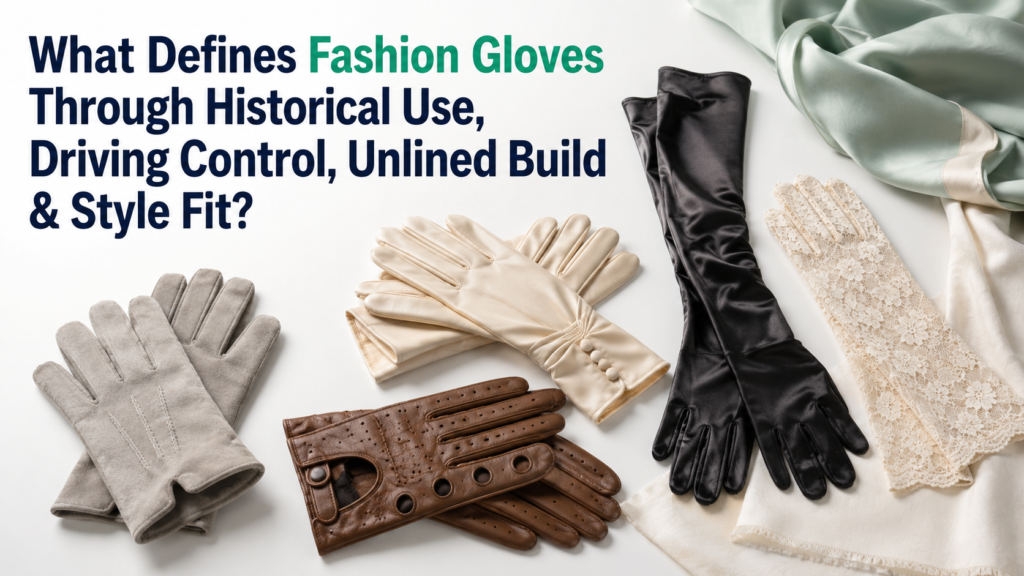
What Defines Fashion Gloves Through Historical Use, Driving Control, Unlined Build & Style Fit?
Fashion gloves are defined by their styling role, historical influence, material and lining, hand contour, glove length, movement needs, occasion, and preservation requirements. Appearance, price, a material name, or visible stitching alone does not prove quality, authenticity, fit, value, or protective performance.
This page explains fashion-glove classification, historical design influence, lined and unlined construction, leather and textile materials, traditional driving features, hand and arm fit, glove and sleeve length, care, retirement, and final verification.
This article provides educational fashion-glove guidance and does not replace manufacturer sizing, material, care, or use instructions. Fashion gloves are apparel accessories and should not be relied upon for industrial, chemical, electrical, medical, impact, flame, or extreme-temperature protection unless the finished product is separately tested and rated for that purpose.
What are fashion gloves, and how do they differ from protective glove categories?
Fashion gloves are apparel accessories designed primarily around silhouette, material appearance, hand contour, tactility, occasion, seasonal comfort, and personal styling.
They prioritize appearance, drape, light warmth, donning feel, and coordination with clothing rather than certified control of industrial, clinical, chemical, electrical, impact, flame, or extreme-temperature hazards.
Work gloves prioritize occupational hazards, tactical gloves prioritize duty environments, sports gloves prioritize athletic contact, and medical or laboratory gloves support controlled barrier roles.
A fashion material, lining, thickness, or leather type does not prove cut, puncture, chemical, electrical, thermal, impact, or medical-barrier performance.
Dents states that its own gloves are fashion items rather than personal protective equipment, which is a maker-specific example of why intended use must be checked rather than inferred from appearance. [Dents FAQ]
Protective tasks therefore require separately verified gloves whose finished construction, labeling, rating, and intended use match the actual hazard.
How do day, opera, and driving gloves differ as the primary fashion-glove classifications?
Day, opera, and driving gloves differ because everyday dress, formal arm coverage, and steering-wheel interaction create different length, material, lining, movement, and fit priorities.
Day or dress gloves usually use wrist or moderate forearm lengths for everyday dress, ceremonies, tailored outfits, seasonal comfort, and coat or sleeve compatibility.
Opera or evening gloves extend farther along the forearm, elbow, or upper arm to create a continuous formal silhouette, but exact length, material, upper-arm fit, and the presence of a mousquetaire opening remain maker- and design-specific.
Driving gloves usually use a short cuff, close palm fit, flexible wrist construction, and optional ventilation or cutout details; full-finger, fingerless, and string-back variants serve different style and coverage preferences.
The category has a distinct functional history because driving-glove history connects early vehicle needs with hand control.
Bridal, seasonal, ceremonial, costume, and theatrical gloves sit beside the primary classification spine and require their own material, fit, styling, and preservation decisions.
| Category | Typical Silhouette | Main Occasion or Use | Core Construction Priority | Main Limitation | Deeper Route |
|---|---|---|---|---|---|
| Day or dress gloves | Wrist to moderate forearm | Everyday dress, ceremonies, tailored outfits, seasonal wear | Clean hand contour, comfort, sleeve compatibility | Does not define one period, region, or dress code | Day or Dress Gloves |
| Opera or evening gloves | Forearm, elbow, or upper arm | Formal, evening, bridal, theatrical, statement styling | Continuous drape, stable arm fit, occasion-appropriate material | Length and etiquette vary by maker and context | Opera Gloves |
| Driving gloves | Usually wrist length or short cuff | Steering-wheel contact and automotive styling | Palm stability, wrist movement, low bulk, optional ventilation | Does not guarantee safer driving or protective performance | Driving Gloves |
| Bridal gloves | Variable from wrist to upper arm | Wedding or ceremonial styling | Dress coordination, delicate materials, photography, fit | Material may be delicate and occasion-specific | Bridal guidance |
| Seasonal fashion gloves | Wrist to forearm | Transitional or cold-weather styling | Warmth, lining, coat compatibility | Fashion construction may not provide extreme-cold protection | Seasonal fashion guidance |
| Costume or theatrical gloves | Highly variable | Performance, costume, historical interpretation | Visual impact and character accuracy | May prioritize appearance over durability or comfort | Costume specialist |
How does historical use influence modern fashion-glove length, construction, and styling?
Historical glove use influences modern fashion through inherited lengths, materials, seams, ornament, closures, and occasion-based styling, but these conventions vary by period, culture, and maker.
A Metropolitan Museum of Art record for French leather gloves dated 1900–1909 describes varied lengths and particular day and evening activities, showing surviving evidence from one place and period rather than a universal rule. [Met 1900–1909]
A separate Met record for British gloves from the 1620s documents leather, satin, silk and metal thread, spangles, lace, ribbons, and embroidered gauntlet motifs, illustrating how ornament and symbolism appeared in specific surviving objects. [Met 1620s]
Cornelia James defines button or bouton length as a traditional measure for the arm or sleeve portion of the glove, but that maker terminology should not be treated as hand size or assumed to transfer identically to every brand. [CJ Glossary]
The same maker’s glove-length page measures its styles from the thumb seam and gives its own wrist, bracelet, twelve-inch, and opera-length descriptions, which demonstrates why the actual maker measurement must control rather than a universal conversion. [CJ Lengths]
A mousquetaire opening is an optional closable wrist opening that can allow the hand to be withdrawn while the long sleeve remains on the arm; it is not required on every opera glove. [CJ Glossary]
Maker editorials may describe longer gloves with shorter sleeves or selected day-to-evening material traditions, but these are styling references rather than mandatory modern etiquette. [CJ Evening][CJ Opera]
Early vehicle design shaped accessory use because early automobile driving gloves served practical roles before modern vehicle cabins.
Seam terms such as inseam, piqué, half-piqué, outseam, or prix should be attributed to the maker or source because execution and terminology can vary.
| Historical Function | Design Convention | Modern Styling Effect | What Remains Optional or Maker-Specific |
|---|---|---|---|
| Social or ceremonial dress | Fine materials, ornament, tailored fit | Formal and statement gloves | Meaning varies by period and culture |
| Day and evening distinction | Shorter practical styles versus longer formal styles | Day, dress, and opera classification | Modern wearers can mix conventions |
| Sleeve coordination | Longer gloves with shorter formal sleeves | Balanced arm coverage and visual proportion | Styling principle, not mandatory rule |
| Buttoned glove sleeves | Button or bouton length terminology | Formal glove-length descriptions | Measurement systems vary by maker |
| Mousquetaire construction | Closable wrist opening | Allows hand withdrawal while sleeve remains | Not present on every long glove |
| Glove-making seams | Inseam, piqué, half-piqué, outseam, prix | Clean, tailored, decorative, or handcrafted appearance | Terminology and execution vary |
| Ornament and embroidery | Motifs, lace, buttons, beadwork, perforation | Historical reference and visual identity | Ornament does not prove age or authenticity |
| Early automotive use | Close palm, short cuff, ventilation details | Modern driving-glove styling | Features are traditional options, not requirements |
How do lined and unlined fashion gloves differ in drape, warmth, and hand feel?
Lined and unlined fashion gloves differ mainly in warmth, bulk, donning feel, palm sensitivity, finger definition, and how closely the outer material follows the hand.
Unlined leather may provide a slimmer silhouette and more direct material contact, but it offers less insulation and makes interior finish, seam placement, fit, and climate more noticeable.
Construction changes hand feel because unlined driving gloves reduce bulk at the steering-hand interface.
Silk lining may ease donning and add light insulation with limited bulk, but the lining can snag, fray, separate, or shift and must be checked against the maker’s care instructions.
Wool or cashmere lining may increase warmth and softness, but added volume can change finger definition, palm feel, overall size, and the clean silhouette expected from a close dress glove.
Synthetic textile linings vary widely in smoothness, warmth, breathability, stretch, and durability, so the exact material declaration and finished construction matter more than the generic label.
Unlined silk, satin, lace, tulle, or mesh can create a light or fluid evening silhouette, but these materials offer little warmth and may be vulnerable to snags, stains, abrasion, or shape loss.
No lining type is universally superior; the correct choice depends on occasion, climate, outer material, desired drape, hand proportions, and maker pattern.
| Construction | Hand Feel | Warmth | Silhouette Effect | Main Limitation | Typical Styling Context |
|---|---|---|---|---|---|
| Unlined leather | Direct material contact and low bulk | Low | Close finger and palm contour | Less insulation; interior finish affects comfort | Driving, mild weather, slim day styles |
| Silk-lined leather | Smooth donning and light insulation | Light | Refined with limited added bulk | Silk may snag, fray, or shift | Dress gloves and transitional weather |
| Cashmere-lined leather | Soft and insulating | Higher | Fuller fingers and palm | Added bulk may reduce close hand feel | Cold-weather fashion gloves |
| Wool-lined leather | Warm and resilient depending on knit | Moderate to high | More volume than unlined styles | Texture and bulk vary | Daywear and winter outfits |
| Synthetic textile lining | Variable smoothness and warmth | Variable | Depends on thickness and construction | Breathability and durability vary | Everyday seasonal gloves |
| Unlined silk, satin, lace, or mesh | Lightweight and visually fluid | Minimal | Sheer, smooth, or decorative drape | Limited warmth and higher snag risk | Evening and formal styling |
| Lined evening textile | Smoother interior and more structure | Variable | May reduce transparency or fluid drape | Extra layers can change fit | Structured formal gloves |
How do leather, suede, silk, satin, velvet, lace, and synthetic materials change fashion-glove drape and appearance?
Fashion-glove materials change surface texture, drape, stretch, sheen, warmth, durability, fit, and care demands, so the finished construction matters more than the material name alone.
Fine smooth leather may follow the hand closely and create a refined surface, but flexibility, grain, thickness, finish, moisture response, lining, and care vary among products.
Textured leather can create a more visible grain or casual character, but pore or grain appearance alone cannot authenticate hairsheep, lambskin, kidskin, deerskin, peccary, carpincho, or another leather.
Peccary and carpincho are separate material declarations and should not be treated as synonyms; disputed or high-value claims require maker documentation, provenance, or specialist evaluation.
Suede provides a matte napped surface and soft visual texture, but moisture, abrasion, pressure, and unsuitable treatment can flatten, mark, or alter the nap.
Silk and satin can provide fluid drape and sheen for evening or bridal styles, but their fine surfaces can snag, stain, crease, or pull under rough handling.
Velvet provides a deeper pile and more body, but pressure, crushing, moisture, and storage can change the direction or appearance of the pile.
Lace, tulle, and mesh create openwork, transparency, and light visual structure, but snagging, overstretching, jewelry contact, and seam stress can produce tears or shape loss.
Synthetic textiles range from highly stretchable to structured and from matte to glossy, so product labels, lining declarations, construction, and care instructions must control the assessment.
A material name does not prove authenticity, craftsmanship, financial value, warmth, durability, or suitability for a specific occasion.
| Material Family | Visual Texture | Drape or Stretch Character | Warmth | Care Demand | Typical Styling Context |
|---|---|---|---|---|---|
| Fine smooth leather | Smooth, refined, lightly grained | Close contour and flexible drape depending on finish | Low to moderate, higher with lining | Material-specific leather care | Dress, day, formal, driving |
| Textured leather | Visible grain and more casual character | Varies by thickness and tanning | Low to moderate | Specialist care may be needed | Daywear and statement gloves |
| Peccary | Distinctive textured grain | Often associated with softness and flexibility | Variable | High-value specialist care | Luxury day or driving styles |
| Carpincho | Distinct material and grain character | Product-dependent | Variable | Verify maker and care instructions | Specialized leather styles |
| Suede | Matte, napped, soft surface | Soft and flexible | Moderate depending on thickness and lining | Marks and moisture require caution | Day, autumn, winter, casual formal |
| Silk | Smooth, light, subtle sheen | Fluid and fine | Minimal unless lined | Snag and stain sensitive | Formal, bridal, evening |
| Satin | High sheen and smooth surface | Fluid but structure varies | Minimal | Snag, crease, and stain sensitive | Opera, bridal, evening |
| Velvet | Deep pile and visual richness | Soft with more body | Light to moderate | Pile crushing and marking risk | Evening and statement styles |
| Lace | Openwork and decorative | Flexible but structurally delicate | Minimal | Snag and tear sensitive | Bridal, evening, ceremonial |
| Tulle or mesh | Sheer and lightweight | Light, flexible, and transparent | Minimal | High snag risk | Opera and evening |
| Synthetic textile | Variable sheen, stretch, and texture | Highly product-dependent | Variable | Follow product label | Everyday, costume, evening, budget styles |
How do traditional driving-glove features affect steering feel, ventilation, and wrist movement?
Traditional driving-glove features affect palm stability, wrist movement, coverage, ventilation, and steering-wheel contact, but no single construction is required for every driver or vehicle.
A close palm fit may reduce material movement at the wheel, but excessive tension can restrict hand motion, distort seams, or create pressure.
Unlined construction may reduce bulk and make the leather or textile interface more direct, but warmth, interior finish, moisture response, and personal comfort remain product-specific.
Traditional openings require closer evaluation through perforated knuckles and keyhole backs.
Knuckle openings, keyhole backs, perforations, string backs, and fingerless cuts may increase openness or flexibility, but they reduce coverage and can introduce gaping, stretching, edge wear, pinching, or structural stress.
Dents product pages provide maker-specific examples of fingerless and touchscreen leather driving-glove designs, but one product does not define all driving gloves. [Dents Driving 1][Dents Driving 2]
Short cuffs may reduce sleeve and wrist interference, while snap closures may secure the opening, but limited coverage, hardware pressure, closure failure, and fit variation must be checked.
Material transfer and hand contact also matter when considering steering-wheel surface protection.
Driving gloves do not improve driving skill, prevent crashes, guarantee steering control, or provide vehicle-impact protection.
Every fit and movement check should be completed while the vehicle is safely parked.
| Feature | Intended Role | Good Fit Sign | Main Trade-Off | Parked-Vehicle Check |
|---|---|---|---|---|
| Close palm fit | Limit material movement at the wheel | Palm remains smooth without painful tension | Too tight can restrict movement and stress seams | Hold and turn the wheel slightly while parked |
| Unlined construction | Reduce bulk and increase direct material feel | Interior feels smooth and stable | Less warmth and maker-dependent comfort | Check palm and fingertip stability |
| Knuckle opening | Reduce tension during hand flexion | Opening aligns without pinching | Reduced coverage from sun, cold, and dirt | Flex fingers and rotate wrist |
| Perforation | Styling and potential airflow | Holes remain flat and cleanly finished | Reduced coverage and possible structural weakness | Check flex zones and seams |
| Keyhole back | Add movement and traditional styling | Opening remains centered | May gap or pull depending on fit | Open and close the hand |
| Short cuff | Reduce wrist and sleeve interference | Cuff stays clear during movement | Less wrist coverage and warmth | Rotate wrist while wearing normal sleeves |
| Snap closure | Secure wrist opening | Closure holds without pressure | Hardware can press or fail | Fasten and move wrist |
| Fingerless cut | Increase fingertip contact and ventilation | Cut edges remain stable | Reduced coverage and warmth | Check wheel contact and finger movement |
| String back | Increase openness and vintage styling | Back remains aligned | Lower coverage and possible stretching | Check hand flexion |
| Full-finger design | Increase coverage and complete silhouette | Fingertips seat correctly | More material can reduce direct feel | Check fingertip slack and wheel control |
How should hand size, glove length, upper-arm fit, and sleeve coordination be evaluated?
Fashion-glove fit should be evaluated through hand circumference, finger and thumb alignment, palm tension, glove length, upper-arm fit, material stretch, and the maker’s pattern rather than one measurement alone.
Dents instructs users to measure the dominant hand around its widest part while excluding the thumb and then use that maker’s size chart; this method remains maker-specific rather than universal. [Dents Size]
Finger length should be checked for empty tips or painful compression, because hand circumference alone cannot show whether the finger stalls match the wearer.
Thumb position should align near the natural hinge without pulling, twisting, webbing pressure, or glove rotation.
Palm tension should be smooth enough for the intended silhouette without unstable bunching, painful stretch, or seam distortion.
Wrist fit should remain secure without gaping, constriction, closure pressure, or conflict with the intended coat or dress sleeve.
Finished glove length is separate from hand size and should be compared with the maker’s stated measurement point and the wearer’s actual arm.
Button or bouton length is a traditional arm- or sleeve-length designation, not a palm or finger size, and the same designation can stop at different places on different wearers or across different makers.
Upper-arm circumference matters for long gloves because excess tension can cause constriction or downward rolling, while excess ease can create slipping, wrinkling, or unstable drape.
Lining bulk and material stretch can change the final fit, so a single wrinkle or tight seam should not trigger automatic sizing down or up without checking the whole hand and arm.
Sleeve coordination is optional styling guidance: longer gloves may complement shorter sleeves in some looks, but the relationship is not a mandatory etiquette rule.
| Measurement or Designation | What It Controls | Practical Check | Maker Variation | Styling Consideration |
|---|---|---|---|---|
| Hand circumference | Base glove size | Measure dominant hand around widest point, excluding thumb | Size charts and ease vary | Does not determine glove length |
| Finger length | Fingertip seating and dexterity | Check for empty tips or painful compression | Finger proportions vary by pattern | Smooth finger line affects appearance |
| Thumb position | Thumb movement and glove rotation | Check hinge alignment and pulling | Thumb angle varies by cut | Poor alignment distorts drape |
| Webbing position | Finger seating | Check that glove reaches finger bases without pressure | Material and seam affect depth | Gaps can create loose appearance |
| Palm tension | Smoothness and comfort | Check wrinkling, bunching, or painful stretch | Leather and textiles stretch differently | Close fit may suit tailored styles |
| Wrist fit | Security and sleeve interaction | Check gaping, constriction, and closure | Cuff designs vary | Important for day and driving gloves |
| Finished glove length | Where glove ends on wrist or arm | Compare actual maker measurement with wearer’s arm | Measurement points differ | Coordinate with sleeve and occasion |
| Button or bouton length | Traditional arm or sleeve designation | Use maker definition and actual measurement | Not universal across makers | Common in formal-glove descriptions |
| Upper-arm circumference | Stability of long gloves | Measure where glove will end | Stretch and elastic finishes differ | Avoid rolling, slipping, or constriction |
| Lining bulk | Interior volume and warmth | Check finger and palm comfort | Lining thickness varies | Changes silhouette and seasonal use |
| Sleeve relationship | Visual proportion and overlap | Try glove with intended outfit | Styling conventions vary | Longer gloves may complement shorter sleeves |
When should fashion gloves be cleaned, professionally repaired, stored, or retired?
Fashion gloves should be cleaned, repaired, stored, or retired according to their exact material and condition because unsuitable treatment can permanently change color, drape, fit, seams, or lining.
Light surface dirt may be addressed only with a maker-approved process and an inconspicuous spot test where permitted, while heavy staining or valuable leather may require a specialist cleaner.
Dents advises assessing the degree of soiling, spot testing for light cleaning, and considering professional leather cleaning for more serious soil; those instructions apply to its guidance and should not be generalized to every material or finish. [Dents Care]
Damp leather should be dried naturally at room temperature when the maker permits it and kept away from radiators, heaters, tumble dryers, direct sunlight, and other heat that can harden, discolor, crack, or shrink the leather. [Dents Care]
Leather conditioner, soap, detergent, immersion, machine washing, or another treatment should not be recommended unless the exact maker and finish permit it.
Suede, silk, satin, velvet, lace, mesh, wool, cashmere, and synthetic textiles require their own care instructions because one leather process cannot be transferred safely to a different material.
Seam opening, lining separation, delicate-textile tears, damaged closures, stretched shape, or torn leather may justify professional repair when the work can restore the glove without visible or structural distortion.
Dents recommends preparing leather gloves clean and dry, using breathable storage, keeping them away from direct sunlight, heat, moisture, and staining products, and laying them flat to reduce creasing; exact maker instructions should still control. [Dents Storage]
Fashion gloves should be retired when fit, drape, material, seams, lining, closure, shape, appearance, or hygiene cannot be restored acceptably.
| Condition | Possible Cause | Effect on Fit or Drape | Safe Care Direction | Repair or Retirement Threshold |
|---|---|---|---|---|
| Damp leather | Rain, perspiration, unsuitable storage | Stiffness, shrinkage, color change | Dry naturally as maker directs, away from direct heat | Retire if severe cracking or distortion remains |
| Light surface dirt | Wear, dust, surface contact | Dullness and possible staining | Use maker-approved gentle cleaning and spot test | Specialist cleaning if mark persists |
| Heavy or greasy stain | Food, cosmetics, oils, vehicle surfaces | Permanent discoloration or finish damage | Use a specialist cleaner | Retire if treatment would destroy finish or color |
| Leather stiffness | Age, heat, moisture loss, unsuitable care | Reduced flexibility and altered fit | Condition only if maker permits | Retire when flexibility cannot be restored |
| Suede nap flattened or stained | Moisture, pressure, abrasion | Changed texture and appearance | Use suede-specific professional guidance | Retire if surface cannot be restored acceptably |
| Silk or satin snagged | Jewelry, rough surfaces, storage | Pulled threads and lost drape | Use textile repair specialist | Retire if repair remains visually disruptive |
| Lace or mesh torn | Snagging, overstretching, age | Structural opening and shape loss | Delicate textile repair where practical | Retire if damage continues spreading |
| Lining frayed or detached | Wear, seam stress, moisture | Bunching, discomfort, altered fit | Professional relining or repair | Retire if outer glove would be distorted |
| Seam opening | Poor fit, rough removal, age | Shape loss and further tearing | Repair before further wear | Retire if seam allowance or material is too damaged |
| Leather torn | Stress, sharp contact, degradation | Structural failure | Specialist repair assessment | Retire if repair weakens or visibly distorts glove |
| Glove permanently stretched | Wear, moisture, improper storage | Loose palm, slipping, altered silhouette | Reshaping only as maker permits | Retire when fit cannot be recovered |
| Persistent odor or dampness | Sweat, poor drying, storage | Hygiene and material concern | Clean and dry according to instructions | Retire when clean condition cannot be restored |
| Seasonal storage | Long periods without use | Creasing, mildew, fading, sticking | Store clean, dry, flat or supported, away from heat and light | Reassess condition before next wear |
Which checklist helps verify fashion-glove style, construction, fit, and care?
A fashion-glove verification checklist should confirm the category, occasion, construction, material documentation, hand fit, glove length, closures, movement, care requirements, and protective-use limits.
The decision should begin by identifying whether the glove is day, dress, opera, evening, driving, bridal, seasonal, ceremonial, theatrical, or another fashion category.
The intended outfit, environment, season, movement demand, desired wrist or arm length, and need for lined or unlined construction should be defined before comparing materials.
The exact outer material, lining, finish, seam construction, closure, opening, and maker documentation should be confirmed without using appearance as an authentication test.
Hand circumference, fingertip seating, thumb position, webbing, palm tension, wrist fit, finished glove length, button-length terminology, and upper-arm stability should be assessed separately.
Driving features should be checked only where relevant and only while the vehicle is safely parked.
Cleaning, drying, repair, storage, and retirement instructions should be confirmed before wear, while any industrial, medical, chemical, electrical, impact, flame, sports, or extreme-temperature task should route to separately verified protective gloves.
- ✓Identify whether the glove is day, dress, opera, evening, driving, bridal, seasonal, or another fashion category.
- ✓Define the intended occasion, outfit, environment, and season.
- ✓Decide whether the silhouette requires a wrist, forearm, elbow, or upper-arm length.
- ✓Decide whether the glove should be lined or unlined.
- ✓Match lining type to warmth, bulk, donning feel, and desired silhouette.
- ✓Identify the exact declared outer material and lining material.
- ✓Do not authenticate leather or textile from appearance alone.
- ✓Check hand circumference against the maker’s chart.
- ✓Check fingertip seating, thumb position, webbing, palm tension, and wrist fit.
- ✓For long gloves, check upper-arm circumference where the glove ends.
- ✓Verify the maker’s actual finished glove length.
- ✓Treat button or bouton length as a maker-specific sleeve designation, not hand size.
- ✓Check seam placement, stitch consistency, lining attachment, closures, openings, and symmetry.
- ✓Treat seam style as a design and construction feature, not automatic proof of quality.
- ✓Coordinate glove and sleeve length as optional styling guidance.
- ✓For driving gloves, check palm stability, finger movement, wrist freedom, openings, perforations, and closures while the vehicle is parked.
- ✓Confirm that the material and lining suit the expected weather.
- ✓Read exact cleaning, drying, storage, and repair instructions before use.
- ✓Inspect for stains, stiffness, shrinkage, seam opening, lining damage, snags, stretching, or lost drape.
- ✓Use specialist cleaning or repair for valuable, delicate, or heavily damaged gloves.
- ✓Retire gloves when fit, drape, seams, lining, material, or appearance cannot be restored acceptably.
- ✓Route industrial, chemical, electrical, medical, impact, flame, sports, or extreme-temperature tasks to separately verified protective gloves.
Final verification: Completing the checklist does not prove authenticity, financial value, perfect fit, protective performance, or compliance with a particular dress code.
Conclusion
Fashion gloves work best when category, occasion, historical influence, material, lining, hand fit, glove length, movement, care, and remaining condition are evaluated together. Day, opera, and driving classifications create different silhouettes and movement priorities, while historical references, lined and unlined construction, material drape, upper-arm fit, and sleeve coordination remain context-dependent.
Historical conventions are optional guidance, material names do not prove authenticity or quality, and maker sizing and care instructions control the final decision. Fashion gloves remain apparel accessories and do not replace separately verified protective gloves for hazardous tasks.
Frequently Asked Questions
Are fashion gloves protective gloves?
Fashion gloves are primarily apparel accessories and should not be assumed to provide occupational, medical, chemical, electrical, impact, flame, or extreme-temperature protection.
Are opera gloves required to have a mousquetaire opening?
Opera gloves are not required to have a mousquetaire opening because the opening is an optional construction found on selected long-glove designs.
Does button length determine glove size?
Button length does not determine hand size because it describes the arm or sleeve portion of certain gloves rather than palm circumference or finger dimensions.
Can leather type be identified by pore patterns alone?
Leather type should not be authenticated by pore appearance alone because finishing, grain variation, imitation, photography, and construction can make visual identification unreliable.
When should fashion gloves be retired?
Fashion gloves should be retired when material, seams, lining, shape, fit, drape, or hygiene can no longer be restored without compromising appearance or usability.