
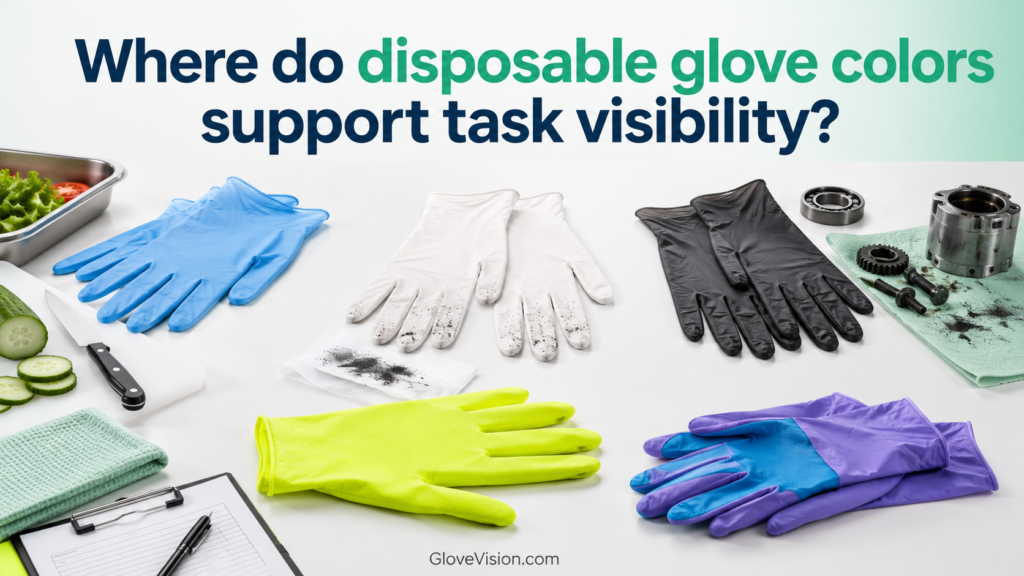
Where do disposable glove colors support task visibility?
Disposable Gloves colors support task visibility where contrast helps workers notice contamination, glove fragments, tears, wrong-zone use, and workflow transitions. Color alone does not prove safety, medical suitability, food-contact suitability, chemical compatibility, chemotherapy protection, puncture resistance, or sterile suitability.
This page covers color contrast, task-setting conventions, high-visibility and indicator systems, color-zone workflows, contamination and failure response, and a final color, compatibility, and safety checklist.
This article is educational only. Disposable Gloves colors must be evaluated by exact glove model, material, labeling, task, lighting, food-contact documentation, medical category, chemical compatibility data, facility SOP, hand hygiene procedure, and exposure-response policy—not by color alone.
How can color contrast in standard Disposable Gloves support visual detection of contamination or damage?
Color contrast in standard Disposable Gloves can support visual detection by making some contamination, residue, glove fragments, tears, punctures, or workflow errors easier to notice under the right lighting and inspection conditions.
Color visibility fits within broader short-use glove selection because Disposable Gloves vary by material choice, thickness, color signals, and task limits.
What does glove color do?
Disposable Gloves may use colorants or pigments to create a visible glove surface. Color can help workers visually separate task zones, glove types, contamination patterns, glove fragments, residue or powder, tears, clean and dirty areas, and under-glove or outer-glove contrast in some systems.
Pigment system and color stability are product-specific.
How can contrast help?
Contrast may make certain contaminants easier to notice. Light residue may show more clearly on darker gloves, dark residue may show more clearly on lighter gloves, and blue may contrast with many foods.
Bright colors may be easier to see in some busy or low-light workflows, while contrasting inner and outer glove colors may help some users notice a breach under inspection.
What limits visual detection?
Color does not guarantee detection. Visibility depends on lighting, glove color, contaminant color, glove texture, material, worker attention, task speed, background surface, product design, and inspection habits.
What should the article avoid saying?
The article should not say that color instantly reveals every contaminant, proves a glove is safe, proves chemical compatibility, proves chemotherapy protection, proves food-contact suitability, proves medical-grade status, or replaces inspection or hand hygiene.
Use this matrix to keep each color cue tied to a visibility benefit, unsupported claim, documentation need, and safer wording rule.
| Color Cue | Possible Visibility Benefit | What It Does Not Prove | Documentation Needed | Safer Wording Rule |
|---|---|---|---|---|
| Blue glove | May contrast with many foods | Food-contact suitability | Food-contact documentation | May support food visibility |
| Black glove | May hide grease or look professional | Chemical compatibility | Compatibility data | May suit some workflows |
| Bright glove | May improve hand visibility | Puncture resistance | Product testing | May improve recognition |
| White glove | May show darker residue | Medical suitability | Medical labeling | May support visual contrast |
| Purple/special color | May support supply recognition | Chemotherapy suitability | Chemo/hazardous-drug documentation | Only if labeled/tested |
| Dual-color layers | May improve breach visibility | Immediate detection | Product system documentation | May help under inspection |
Color helps recognition only when contrast, lighting, inspection, and documentation support the workflow.
How do color-coding systems for Disposable Gloves vary across clinical, food-service, and industrial environments?
Color-coding systems for Disposable Gloves vary by facility, task, environment, and policy, so color should be treated as a workflow cue rather than a universal safety standard.
How may food-service teams use colored Disposable Gloves?
Food-service teams may choose blue or other high-contrast gloves because the color can stand out against many foods and may make glove fragments easier to notice.
Food-service suitability is not proven by color. Verify food-contact documentation, product labeling, food type, contact duration, temperature conditions, facility food-safety policy, and local food rules. Food Handling Gloves should be selected by food-contact task discipline and short-duration barrier needs, not color alone.
How may healthcare teams use colored Disposable Gloves?
Healthcare teams may use color to support glove type recognition, department preference, double-gloving contrast, high-risk task identification, patient-care workflow, and supply differentiation.
Medical suitability is not proven by color. The glove must be labeled for the required medical use. FDA describes medical gloves as including examination, surgical, and chemotherapy glove categories. [FDA]
Medical Gloves and Examination Gloves require category and labeling checks beyond color.
How should chemotherapy-related color claims be handled?
Some gloves tested or marketed for chemotherapy handling may be sold in distinctive colors, but color does not prove chemotherapy suitability.
Verify chemotherapy or hazardous-drug suitability through product labeling, relevant permeation testing, manufacturer documentation, and facility policy. FDA medical glove guidance supports labeling boundaries, not color-only chemotherapy claims. [FDA]
How may industrial or automotive teams use colored Disposable Gloves?
Industrial, maintenance, and automotive teams may use dark, bright, or contrasting gloves for visibility, workflow, or professional appearance.
Dark gloves may hide grease or grime, bright gloves may make hands more visible, and contrasting under-gloves may help some users notice outer-glove damage. Dark colors may also make some contamination harder to see.
What is the safe color rule?
Color should be treated as a workflow cue. It does not replace product documentation, compatibility data, medical labeling, food-contact documentation, or facility procedures.
Use this workflow table once to define the color purpose and prevent universal color assumptions.
| Workflow Step | Verification Question | Safe Action | Documentation Needed |
|---|---|---|---|
| Identify Setting | Is the workflow food, clinical, lab, cleaning, industrial, or EMS? | Separate the environment first | Facility SOP |
| Define Color Purpose | Is color used for zone, role, contamination, or glove type recognition? | Write the purpose clearly | Color-code policy |
| Check Product Labeling | Is the glove labeled for the task? | Use documented products only | Product label/spec |
| Verify Material and Compatibility | Are chemicals, food, medical use, or hazardous drugs involved? | Confirm suitability separately from color | SDS / compatibility / labeling |
| Assign Facility Code | Which color belongs to which zone or task? | Use facility-specific code only | SOP / training material |
| Train Users | Do workers know color is only a cue? | Train against color assumptions | Training record |
| Monitor Errors | Are wrong-color or zone mistakes occurring? | Correct workflow and retrain | Incident/error log |
This workflow is facility-specific; it is not a universal color standard.
Which highly visible Disposable Gloves may support rapid hazard recognition in high-stress emergency procedures?
Highly visible Disposable Gloves may support rapid hazard recognition in some emergency, roadside, clinical, industrial, or fast-moving workflows when color contrast improves hand visibility, role recognition, or breach inspection.
When may high-visibility Disposable Gloves help?
High-visibility gloves may help in emergency response settings, roadside work, low-light environments, crowded clinical areas, industrial inspection tasks, fast-moving workflows, and high-noise or high-distraction zones.
Use depends on agency policy, task risk, glove labeling, and product availability.
How can high-visibility colors support workflow?
Bright or high-contrast colors may make hands easier to see, support role identification, reinforce task-zone rules, make glove fragments easier to notice, support quick visual inspection, and distinguish glove layers in some systems.
How should dual-color or indicator systems be described?
Some double-gloving or indicator systems use contrasting inner and outer glove colors so a breach may be easier to notice.
Do not say the inner color “bleeds through” or that punctures are always detected immediately. Safer wording: contrasting colors may improve breach visibility when the glove system, lighting, and inspection conditions support detection.
What does color not prove?
High-visibility color does not prove higher puncture resistance, better chemical resistance, medical-grade status, chemotherapy protection, sterile-procedure suitability, food-contact suitability, or individual glove defect-free status.
What should still be verified?
Always verify glove material, glove category, medical labeling if needed, chemical compatibility, food-contact documentation if needed, task duration, thickness, fit, and facility policy. Sterile procedures should route to Surgical Gloves, not color-only selection.
Use this table to connect visibility use with benefit, limit, documentation, and inspection rule.
| Visibility Use | Possible Benefit | Limit | Product Documentation Needed | Inspection Rule |
|---|---|---|---|---|
| Bright EMS-style color | May improve hand visibility | Not universal EMS approval | Product category and agency policy | Inspect under actual lighting |
| Blue food glove | May contrast with foods | Not automatic food-safe proof | Food-contact documentation | Check fragments and contamination |
| Dark industrial glove | May hide grease | May hide some contamination | Chemical/task documentation | Inspect deliberately |
| Dual-color glove system | May improve breach visibility | Not instant detection | System documentation | Inspect glove layers |
| High-contrast lab glove | May support task recognition | Not chemical proof | Compatibility data | Check chemical exposure limits |
High-visibility color supports recognition only when inspection conditions support it.
How should operations utilize colored Disposable Gloves to implement a multi-zone cross-contamination protocol?
Operations should use colored Disposable Gloves in a multi-zone protocol by defining the color purpose, assigning facility-specific colors, verifying product suitability, training users, and changing gloves at zone boundaries.
Step 1: Define the color purpose
Possible purposes include raw vs. ready-to-eat separation, allergen area separation, cleaning vs. food handling, patient-care task separation, laboratory task separation, chemical-use zones, maintenance vs. inspection work, and department supply control.
Step 2: Assign colors by facility policy
Facilities may assign colors by zone, product line, department, hazard category, task type, workflow stage, contamination risk, or internal SOP. Examples should remain examples only, not universal standards.
Step 3: Verify product suitability separately
Before using a glove color for a task, confirm material, size, thickness, medical labeling if needed, food-contact documentation if needed, chemical compatibility if needed, intended use, contact duration, and facility-approved product list.
Chemical color assumptions should route to product data and, when relevant, Chemical-Resistant Lab Gloves context.
Step 4: Use setting-specific hand hygiene
Disposable Gloves do not replace hand hygiene.
Workers should follow the relevant healthcare, food-service, laboratory, industrial, or workplace hand hygiene procedure before donning when required and after glove removal. [CDC]
Step 5: Use hygienic glove removal and zone transition
When leaving a color-coded zone, workers should remove gloves safely, discard single-use gloves, clean hands according to procedure, avoid touching shared surfaces with used gloves, and don a new glove pair if entering another task zone.
Step 6: Train against color confusion
Teams should understand that color is a cue, not proof of safety. Training should prevent assumptions such as blue means food-safe, purple means chemotherapy-safe, black means chemical-safe, bright colors mean puncture-resistant, or color replaces product labeling.
What immediate corrective steps address compromised Disposable Gloves when punctures, contamination, or chemical softening occur?
Immediate corrective steps for compromised Disposable Gloves should stop the task safely, remove the glove, follow hygiene or exposure response, assess contamination risk, and restart with the correct documented glove.
Cleaning-agent degradation needs separate task review because Cleaning Gloves are shaped by chemical exposure, lining, reuse care, and task fit.
What should happen after a tear or puncture?
If Disposable Gloves tear, puncture, split, or visibly fail, stop safely, maintain control of tools or materials, remove the compromised glove, perform hand hygiene or exposure response, check for contamination, injury, or exposure, replace with a suitable glove, and reassess whether the glove matched the task.
Disposable gloves should be changed when contaminated, torn, punctured, or when barrier function is compromised. [OSHA]
What should happen after possible contamination?
If colored Disposable Gloves contact the wrong surface, wrong zone, raw food, ready-to-eat food, patient-care area, chemical area, or shared equipment, the worker should stop safely, remove and discard the gloves, perform hand hygiene, clean or replace affected materials if required, follow facility policy, and restart with the correct glove.
What should happen after chemical swelling, softening, or discoloration?
If solvents, disinfectants, cleaning agents, oils, clinical reagents, or task chemicals cause swelling, softening, cracking, stickiness, discoloration, or integrity loss, stop exposure safely and remove the glove.
Then reduce skin exposure risk, perform hygiene or exposure response, check manufacturer compatibility or permeation data, and replace with a glove documented for that chemical and contact duration.
What should happen after wrong-color use?
If a worker uses the wrong glove color for a facility-coded task, stop and correct the workflow, remove the incorrect gloves, perform hand hygiene if required, replace with the correct facility-approved glove, assess whether cross-contamination occurred, and retrain if the mistake repeats.
What should the article avoid saying?
Do not say color prevents contamination or guarantees exposure control. Color can support recognition and workflow discipline, but safety still depends on correct glove selection, hand hygiene, product compatibility, task behavior, and facility procedures.
Use this response matrix to connect color or glove failure problems with immediate action and prevention.
| Problem | Possible Cause | Immediate Action | Documentation Check | Future Prevention |
|---|---|---|---|---|
| Tear or puncture | Task stress, sharp edge, wrong glove | Stop, remove, hygiene, replace | Product suitability | Better task-matched glove |
| Wrong-zone contact | Zone transition error | Remove, discard, clean hands | Facility SOP | Retrain color-code rule |
| Wrong-color use | Supply or training error | Stop, replace with correct glove | Color-code policy | Label stations clearly |
| Chemical softening | Incompatible chemical | Remove, reduce exposure, check data | SDS / compatibility data | Use compatible glove |
| Discoloration/integrity loss | Chemical or material issue | Stop use and replace | Product/chemical documentation | Review product choice |
| Possible contamination | Food, patient, lab, or shared equipment contact | Follow protocol | Incident/task record | Workflow correction |
This response matrix supports workflow correction; it does not replace exposure-control procedure.
Which multi-point audit checklist verifies that alternative Disposable Gloves satisfy color-based workflow and safety needs?
A multi-point audit checklist verifies that alternative Disposable Gloves satisfy color-based workflow and safety needs by checking color assignment, product suitability, food-contact documentation, medical category, chemical compatibility, AQL meaning, fit, hand hygiene, zone transitions, and failure response.
Disposable Gloves color, compatibility, and safety checklist
This checklist matrix verifies that a colored glove choice is documented for both workflow visibility and task safety needs.
AQL should be treated as lot-sampling or leak-quality context in relevant medical glove settings, not as color-safety, puncture, chemical, or individual-glove proof. [eCFR]
Use this checklist matrix as the final audit before relying on glove color in a workflow.
| Checklist Category | Verification Question | Tactical Action | Documentation Needed |
|---|---|---|---|
| Color Match | Does glove color match the facility-coded task or zone? | Use designated color only as a workflow cue | Facility color-code SOP |
| Product Suitability | Is the exact glove documented for the actual task? | Verify model, material, thickness, and intended use | Product label/spec |
| Food Contact | Is food handling involved? | Confirm food-contact suitability separately from color | Food-contact documentation |
| Medical Category | Is patient care involved? | Confirm exam, surgical, chemo-tested, or specialty category | Product labeling |
| Chemical Compatibility | Are disinfectants, solvents, oils, cleaners, or reagents involved? | Verify exact chemical, concentration, duration, and glove model | SDS / compatibility data |
| AQL Meaning | Is AQL interpreted correctly? | Treat AQL as lot-sampling/leak-quality only | Product info / eCFR |
| Fit and Visibility | Does the glove fit securely and support visibility? | Select best-fitting approved model/color | Facility-approved list |
| Hand Hygiene | Are hands cleaned before/after use as required? | Reinforce gloves do not replace hygiene | CDC / facility procedure |
| Zone Transition | Are gloves changed between incompatible zones/tasks? | Remove, discard, clean hands, don correct glove | SOP / workflow rule |
| Failure Response | Can workers respond to tear, puncture, swelling, discoloration, or wrong-zone use? | Stop, remove, respond, document if required | Facility exposure protocol |
This checklist verifies workflow readiness; it does not make color a safety approval.
Conclusion
Disposable Gloves colors can support visibility and workflow recognition by improving contrast for contamination awareness, glove fragments, tears, zone separation, task coding, high-visibility use, and failure response.
Blue, black, orange, purple, green, yellow, white, or any other color does not automatically prove food-contact suitability, chemotherapy protection, chemical compatibility, puncture resistance, medical-grade status, sterile suitability, regulatory approval, or user safety. Suitability still depends on documentation, compatibility checks, hand hygiene, task behavior, and facility procedure.
Frequently Asked Questions
Do Disposable Gloves colors prove safety?
No. Disposable Gloves colors can support visibility and workflow recognition, but color does not prove safety, chemical compatibility, medical suitability, or food-contact suitability.
Why are some food-service gloves blue?
Some food-service teams use blue gloves because blue may contrast with many foods, but food-contact suitability must still be verified through documentation and facility policy.
Do purple gloves always mean chemotherapy-safe?
No. Purple or any distinctive color does not prove chemotherapy suitability; hazardous-drug use requires product labeling, testing, manufacturer documentation, and facility policy.
Can black Disposable Gloves protect against chemicals?
Black color does not prove chemical protection. Chemical compatibility depends on the exact glove model, material, chemical, concentration, contact duration, and manufacturer data.
Do high-visibility Disposable Gloves prevent contamination?
No. High-visibility colors may support recognition and inspection, but they do not prevent contamination by themselves.
What should workers do after wrong-color glove use?
Workers should stop the task, remove the incorrect gloves, perform hand hygiene if required, replace them with the correct facility-approved glove, and assess whether cross-contamination occurred.