
What Short-Use Limits Define Food Handling Gloves?
Single-use food-handling gloves do not have one universal safe wear time. The primary limit is the controlled task for which the gloves were donned, and the pair must be replaced when that task ends or when hygiene, integrity, fit, grip, or safe handling is compromised earlier.
Exact-product and task conditions can affect how quickly a food-handling glove loses usable performance. Product instructions, fit, food type, temperature, moisture, friction, task stress, and manufacturer restrictions can shorten use, but none creates a material-wide duration for every glove, worker, food, or station.
This article provides general food-glove guidance and does not replace adopted food-code requirements, establishment procedures, manufacturer food-contact instructions, or professional safety evaluation. Verify the exact glove product, assigned task, local rules, and incident controls before use.
What events define the short-use limit of food-handling gloves?
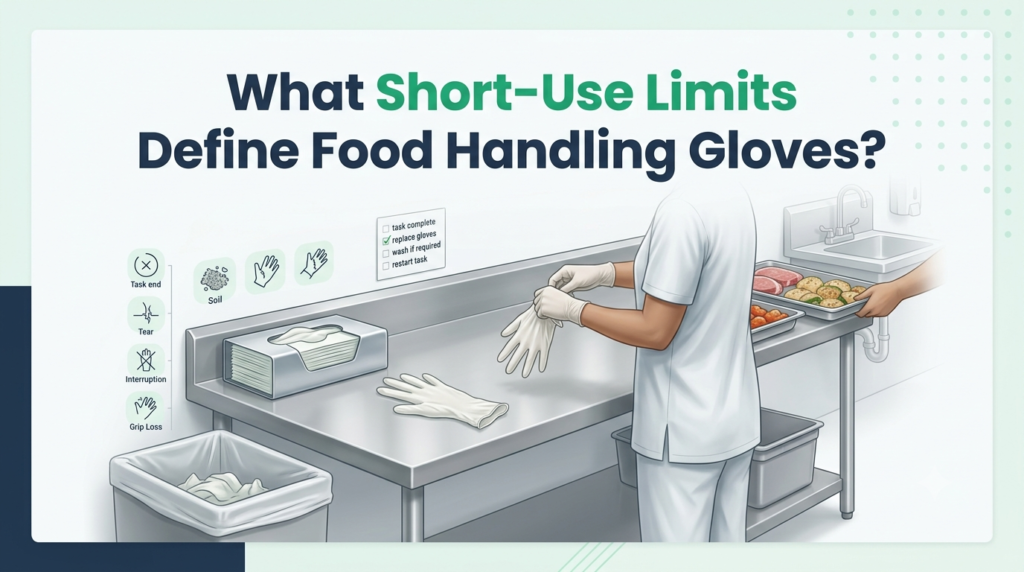
The short-use limit of a single-use food-handling glove is defined primarily by the assigned task and by events such as task completion, contamination, damage, soil, interruption, loss of fit, or loss of safe control—not by one universal number of minutes.
The FDA Food Code is a model offered for adoption, and FDA lists the 2022 Food Code page as current with a December 2024 update. [FC] FDA adoption reporting also confirms that adoption and oversight vary by jurisdiction. [AD] The model glove provision describes single-use gloves as one-task items used for no other purpose and discarded when damaged, soiled, or when interruptions occur; that provision does not create a universal glove-wear timer. [GLV] The replacement rule belongs under food-handling gloves, where task match and hygiene procedure matter more than a universal barrier idea.
How does one-task use set the primary glove boundary?
One-task use means that a glove pair belongs only to the controlled food activity or uninterrupted work sequence for which it was donned. A controlled task may be one raw-food activity, one ready-to-eat-food activity, one preparation stage, one allergen assignment, one uninterrupted sequence, or another category defined by establishment procedure.
Which task and contamination events require replacement?
A task or contamination event requires replacement when the current pair crosses into another food, hygiene, allergen, or work-control category. Raw-to-ready-to-eat movement requires task-change discipline, because hands, gloves, tools, and work areas may need separate reset decisions.
Which glove-condition changes require immediate replacement?
A food-handling glove requires immediate replacement when damage, soil, fit loss, grip loss, or another observable condition prevents controlled use. Examples include tear, puncture, seam damage, cuff damage, excessive stretching, shape loss, slippage, loose fingertips, bunching, grip loss, heavy soil, grease buildup, tackiness, possible fragment, internal contamination, or moisture interfering with performance.
What counts as an operational interruption?
An operational interruption is any pause or unrelated activity that breaks the controlled sequence for which the gloves were donned. Leaving the station, answering a phone, taking a break, changing work areas, receiving a delivery, handling waste, touching personal belongings, or responding to cleaning needs can end the current pair’s controlled use.
Can a facility use an additional timed interval?
A facility may use a documented timed interval as a secondary internal control, but the interval must never delay replacement after an immediate task, contamination, damage, soil, fit, grip, or interruption trigger. The December 2024 supplement should be checked as part of current-version review, but it does not replace the full Food Code for the operative glove-use rule. [SUP]
Table 1. The replacement matrix separates immediate glove action from the handwashing, food, tool, and surface decisions that may follow.
| Replacement Trigger | Required Glove Action | Handwashing Decision | Food or Surface Action | Evidence Status |
|---|---|---|---|---|
| Task completed | Remove and discard | Wash before the next task where required | Assess based on what was touched | Food Code model / local rule |
| Raw-to-ready-to-eat transition | Stop, remove, and discard | Wash before the new task | Clean affected surfaces as required | Food Code model / local rule |
| Tear, puncture, or seam failure | Stop and remove immediately | Wash and inspect where exposure may have occurred | Assess food, tools, surfaces, injury, and fragments | Observable condition / facility procedure |
| Heavy soil or grease buildup | Remove and discard | Wash where required | Clean affected tools or surfaces | Food Code model / facility procedure |
| Potentially contaminating object | Remove and discard | Wash according to the applicable trigger | Assess exposed food and surfaces | Adopted local rule / facility procedure |
| Operational interruption | Remove and discard before resuming | Wash where required | Base action on what occurred | Food Code model / facility procedure |
| Allergen changeover | Remove and discard | Follow approved procedure | Follow allergen-control procedure | Facility procedure |
| Loss of fit or grip | Stop and replace | Wash if another trigger occurred | Correct product, size, or task issue | Observable condition |
There is no time column, material ranking, automatic batch-disposal instruction, or automatic workstation-sanitizing instruction.
How do product and task conditions affect usable glove performance?
The exact glove product, worker fit, food condition, temperature, moisture, friction, and task stress can affect usable performance, but none establishes one universal material-based wear time.
Product suitability also needs material-risk verification, because formulation, food type, temperature, and contact conditions can change the decision.
How does fit affect safe glove use?
Correct fit supports controlled food handling because loose and overstretched gloves can interfere with grip, movement, tactile feedback, integrity, and removal. Loose fingertips, bunching, excessive stretching, slippage, restricted movement, or difficult removal can justify replacement or a product-size review.
How can food, moisture, and task stress affect performance?
Food residues, moisture, friction, repeated movement, and rough contact can change observable glove performance and may require replacement before the task would otherwise end. Observation does not prove a universal chemical mechanism, and thick disposable food gloves are not cut or puncture protection merely because they look stronger.
Which exact-product restrictions should workers follow?
Workers and supervisors should follow the documented restrictions of the exact glove product assigned to the food task. Verify manufacturer, product name, code, intended food-contact use, single-use status, food type, temperature, contact conditions, storage, sizes, and current document revision date.
Why should material name not determine a standard duration?
Material name cannot determine a standard food-glove duration because performance and permitted use depend on the exact product, formulation, fit, food, temperature, moisture, friction, task, and documented restrictions. Event-driven replacement applies across material categories, and material comparison belongs elsewhere.
How should workers remove and replace food-handling gloves?
A controlled glove change requires the worker to stop the task, remove and discard the used gloves without unnecessary exterior contact, complete required handwashing, dry thoroughly, and don a fresh approved pair.
Replacement becomes operational only when the glove-change procedure is integrated with handwashing and task control.
What should happen before and during glove removal?
Before removing food-handling gloves, the worker should stop the task, secure tools, control exposed food where necessary, avoid touching clean supplies, and identify whether food, tools, or surfaces require assessment. A peel-off removal sequence may reduce unnecessary exterior contact, but it does not guarantee clean hands and remains subordinate to establishment procedures.
When is handwashing required?
Handwashing is required when an adopted rule, contamination event, task transition, glove failure, or establishment procedure creates a handwashing trigger. The Food Code model requires handwashing before food preparation, before donning gloves to initiate a food task, after specified contamination events, and during task changes where necessary to prevent cross-contamination. [HW]
How should workers dry and redon gloves?
Hands should be dried thoroughly using an approved method before a fresh pair is donned. Wet hands can make donning difficult and can interfere with glove fit, control, and removal.
Does every glove change require workstation sanitizing?
No. Workstation action depends on the event. The Food Code model requires food-contact surfaces and utensils to be clean to sight and touch and identifies cleaning triggers such as raw-to-ready-to-eat changes or times when contamination may have occurred. [SF] Surface action depends on task-separation rules, because clean and contaminated work need different reset decisions.
Pathway 1. This pathway moves from detecting a trigger to beginning the next controlled task without promising zero exposure, automatic sanitizing, a timer, or a material recommendation.
- Detect the replacement trigger.
- Stop the controlled task.
- Secure knives, utensils, or tools.
- Control or isolate exposed food where needed.
- Remove and discard the used gloves.
- Determine whether handwashing is required.
- Wash and dry thoroughly where required.
- Assess food, tools, and surfaces.
- Clean and sanitize where required.
- Select the approved product and size.
- Don a fresh pair.
- Begin the next controlled task.
The pathway separates glove action, handwashing, food assessment, and surface action so a fresh pair is not mistaken for a complete reset.
What should workers do when a glove tears, leaks, or may leave fragments?
When a glove tears, leaks, or may have missing material, the worker should stop the task, remove the glove, inspect the hand, isolate affected food where needed, and assess tools and surfaces before work resumes.
What should happen immediately after glove failure?
Stop the task, secure tools, control the food, remove and discard the glove, wash hands where required, inspect the hand, identify product and lot, isolate affected food if needed, and check the glove for missing material. Single-use and single-service items are not reused under the Food Code model. [NR]
How should affected food and possible fragments be assessed?
Assess whether direct hand contact occurred, whether the hand was injured, whether blood or bodily fluid was involved, whether glove material is missing, whether the food is ready-to-eat, whether another validated processing step exists, which tools and surfaces were involved, and what the approved procedure requires. Do not automatically release or discard an entire batch.
How should contaminated tools and surfaces be reset?
Cleaning removes soil and grease; sanitizing follows cleaning where required. Food-contact surfaces should be restored according to the actual event, the facility procedure, and the adopted requirement.
How should repeated glove failures be investigated?
Repeated failures should be investigated by manufacturer, product name, code, lot, worker size, task, food, temperature, storage, packaging edges, glove tension, donning method, and documented restrictions. Repeated failures may indicate a product, size, task, storage, or procedure mismatch.
Table 2. This workflow prevents premature food release and automatic over-disposal by separating exposure questions from food-disposition decisions.
| Decision Point | What to Check | Do Not Assume | Required Response |
|---|---|---|---|
| Direct hand contact | Whether exposed hand contacted food or clean surfaces | That gloves prevented all transfer | Isolate and assess |
| Hand injury | Cut, bleeding, bodily fluid, or pain report | That the worker can continue without review | Escalate under procedure |
| Missing glove material | Finger, palm, cuff, seam, or torn edge | That food is clear because no fragment is visible | Follow foreign-material procedure |
| Food category | Ready-to-eat status and later validated process | One universal food-disposition action | Hold, discard, or reprocess as approved |
| Tools and surfaces | Utensils, boards, trays, counters, and containers | Every glove change requires full sanitizing | Clean and sanitize where required |
| Uncertainty remains | Unknown exposure, fragment, or procedure gap | Automatic release | Hold and escalate |
This workflow does not assign a numerical risk score or provide medical treatment instructions.
Which shift-start checks support timely glove replacement?
Before service begins, supervisors should confirm that workers can replace gloves immediately without stretching a used pair because stock, sinks, drying supplies, waste controls, or procedures are unavailable.
Replacement stock should match the operating environment, because food service and food processing can use different task-control systems. CDC restaurant food-safety research also notes that resources such as easy-access sinks, soap, gloves, and adequate equipment can support safer food-handling practices. [CDC]
Checklist 1. This readiness check confirms workers can replace gloves immediately; it does not prove compliance, set stock quantities, compare brands, or replace supervision.
- Approved Products and Sizes: exact products, sizes, and instructions match the station.
- Replacement Stock: enough approved gloves are available without forcing extended use.
- Handwashing Readiness: sink access, soap, drying supplies, and waste controls are ready.
- Incident Readiness: food-isolation, fragment, injury, and surface-reset procedures are known.
- Worker Knowledge: workers can identify task completion, contamination, damage, soil, interruption, fit loss, and grip loss.
Use bold labels, exact product checks, worker knowledge, and replacement readiness—not brand, price, or universal stock quantity.
- FDA — Food Code 2022 Landing Page — used for current edition page, model-code status, and December 2024 update context.
- FDA — Food Code 2022 Full Document, §3-304.15 — used for one-task glove-use rule and discard triggers.
- FDA — Food Code 2022 Full Document, §§2-301.12 and 2-301.14 — used for handwashing and drying provisions.
- FDA — Food Code 2022 Full Document, §4-502.13 — used for single-use and single-service non-reuse boundary.
- FDA — Food Code 2022 Full Document, §§4-601.11 and 4-602.11 — used for clean-to-sight-and-touch and cleaning-trigger boundaries.
- FDA — Supplement to the 2022 Food Code, December 2024 — used for current supplement verification context.
- FDA — Food Code Adoption Report — used for adoption and jurisdictional variation context.
- CDC — Safe Food Preparation in Restaurants — used for operational readiness and resource-access context.
Frequently Asked Questions
Is There a Universal Food-Glove Time Limit?
No. A single-use food-handling glove reaches its limit by task boundary and replacement events such as damage, soil, contamination, interruption, fit loss, or grip loss.
Should Gloves Be Changed Between Raw and Ready-To-Eat Food?
Yes. Raw-to-ready-to-eat movement requires a new controlled task decision, and handwashing or surface action may also be required depending on what occurred.
Can a Facility Use a Glove-Change Timer?
A facility may use a documented timer as a secondary internal control, but it must never delay replacement after an immediate trigger.
Must Workers Wash Hands Every Time Gloves Are Replaced?
Handwashing depends on adopted rules, contamination events, task changes, glove failure, and establishment procedures; fresh gloves are not a substitute for required handwashing.
What Should Happen if a Glove Tears?
Stop the task, remove and discard the glove, wash and inspect as required, isolate affected food if needed, check for fragments, assess tools and surfaces, and restart only after controls are restored.
What should food businesses remember about short-use glove limits?
Food-handling gloves have no universal safe wear time. Their short-use limit is defined by the controlled task and by observable events that end hygienic, intact, well-fitted, and controlled use. Task completion, raw-to-ready-to-eat movement, contaminating contact, damage, soil, interruption, fit loss, grip loss, or possible fragments should end the current pair’s use immediately.
Glove replacement is only one part of the response. Workers may also need to wash and dry hands, isolate affected food, assess tools and food-contact surfaces, investigate repeated failures, and select a fresh approved product and size before starting the next controlled task. A facility timer can support discipline, but it must never override immediate replacement triggers.