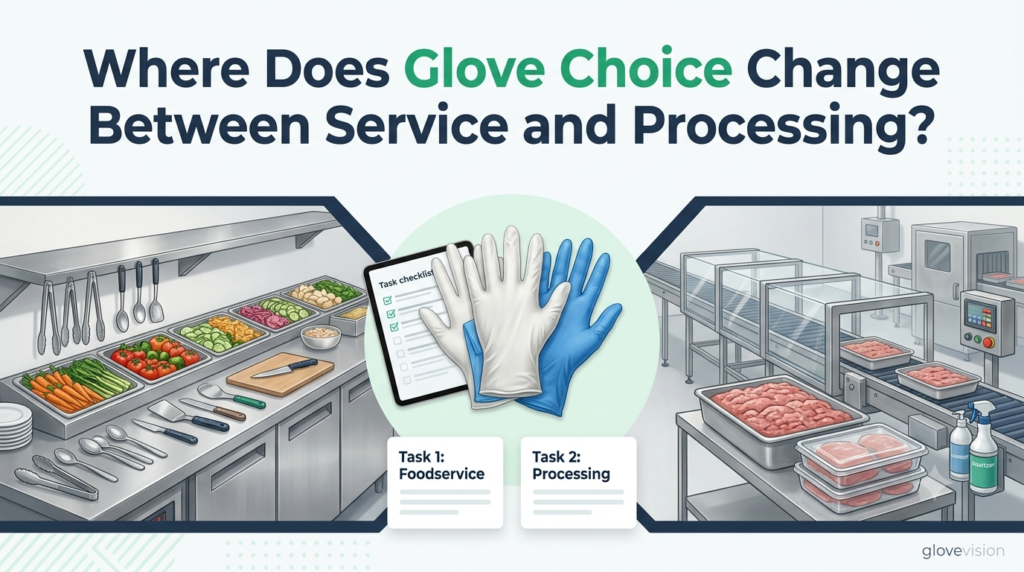
Where Does Glove Choice Change Between Service and Processing?
Food-handling glove selection changes between foodservice and food manufacturing or processing only when the actual task, food contact, sanitation system, equipment interaction, exposure pattern, worker requirement, or hazard-control need changes.
A demanding foodservice task may require controls similar to a comparable processing task, while an automated or low-contact processing task may require less direct hand protection. This article covers operational differences, shared task factors, product and control decisions, equivalent-task comparison, environment-specific systems, and final verification.
This article provides general food-glove comparison and task-screening guidance. It does not replace adopted food-safety rules, workplace hazard assessments, machine-guarding requirements, facility procedures, SDS instructions, or exact-product documentation. Verify the task, jurisdiction, product, equipment rules, and separate controls before use.
Which operational differences affect food-handling glove selection between foodservice and processing?
Foodservice and food manufacturing or processing may differ in workflow, sanitation organization, production structure, equipment use, and process control, but those differences affect glove selection only when they alter the task or its control requirements.
The comparison should stay grounded in how food-handling gloves support food contact, task discipline, and controlled use rather than assumptions about the environment. FDA describes the Food Code as a model for food offered at retail and in foodservice and as a model offered for adoption by jurisdictions, not a rule automatically binding every operation. [FDA]
How can workflow structure affect food-handling glove selection?
Workflow structure affects glove selection when task frequency, role changes, production stages, or worker specialization changes the required fit, replacement process, or control method. Foodservice may include frequent transitions, mixed raw and ready-to-eat duties, made-to-order preparation, variable daily volume, and multiple duties per worker. Manufacturing or processing may include standardized production stages, repeated assignments, dedicated zones, controlled product flow, larger batches, automated systems, and specialized roles.
These patterns are possible examples, not universal definitions. Frequent transitions may increase the importance of replacement access, while repeated assignments may increase the importance of fit, grip, and task performance. Neither workflow pattern prescribes one glove material.
How can sanitation systems affect food-handling glove selection?
Sanitation systems affect glove selection when they impose different task boundaries, hygiene zones, changeover rules, storage methods, or contamination controls. The same product can sometimes remain acceptable while the replacement, storage, color, traceability, or sanitation procedure changes.
Foodservice systems may emphasize task-based glove changes, handwashing, workstation resets, utensil separation, and raw-to-ready-to-eat controls. Processing systems may use written sanitation procedures, hygiene zones, production records, foreign-material procedures, and allergen segregation. Covered manufacturing operations must evaluate sanitation under the applicable manufacturing system rather than simply importing the retail Food Code model.
How can equipment interaction affect food-handling glove selection?
Equipment interaction changes the decision when guards, danger zones, entanglement risks, shutdown procedures, tools, or no-hand-contact methods alter how the task may be performed. Either environment may include manual utensils, knives, slicers, mixers, conveyors, fillers, grinders, packaging equipment, inspection stations, or automated handling systems.
Some procedures may prohibit particular glove use, require tools rather than hands, or move the task away from direct handling. Machine guarding takes priority over general glove recommendations because gloves do not become machine controls. OSHA machine-guarding requirements address points of operation and other danger zones, and special hand tools supplement rather than replace required guarding. [Guarding]
The context table shows how operating systems may differ without treating either environment as automatically lighter or heavier.
| Operational Factor | Foodservice May Include | Manufacturing or Processing May Include | Selection Implication | Verification Needed |
|---|---|---|---|---|
| Workflow | Frequent transitions and mixed duties | Standardized stages and repeated assignments | Product or replacement procedure may differ | Actual worker sequence |
| Production volume | Low, moderate, or high volume | Small-batch to continuous production | Volume alone does not determine the glove | Repetition, duration, and failure history |
| Food contact | Raw, cooked, and ready-to-eat food | Raw material, in-process food, and finished product | Verify exact contact conditions | Food, temperature, and restrictions |
| Sanitation | Local resets and task changes | Line, zone, or plant procedures | Procedure may change even when product does not | Approved sanitation system |
| Equipment | Manual tools and foodservice machinery | Manual, automated, or powered systems | Equipment rules may override glove assumptions | Guarding and task procedure |
| Worker roles | One worker may perform many tasks | Roles may be specialized | Fit, training, and replacement workflow may differ | Worker and task observation |
The table does not assign materials, thicknesses, risk scores, or “service-grade” and “processing-grade” categories.
Which task factors should guide food-handling glove selection in either environment?
The same core task factors should guide selection in both environments: food contact, contamination boundaries, allergen controls, physical demands, equipment interaction, worker fit, task repetition, and exact-product limitations.
Use one shared assessment framework, not separate lists that quietly imply different standards for foodservice and processing. The question is whether the work differs enough to change the product, procedure, protective system, tool, or process control.
Which food-contact factors guide food-handling glove selection?
Food-contact selection begins with what the glove will touch, how the contact occurs, and whether a utensil or no-hand-contact method is more appropriate. Assess direct or indirect contact, raw or ready-to-eat food, moisture, fat, oil, acidity, temperature, contact duration, repeated contact, product restrictions, and whether a utensil or automated method reduces direct handling.
Food Code §3-301.11 identifies suitable utensils, deli tissue, spatulas, tongs, single-use gloves, or dispensing equipment as possible controls for exposed ready-to-eat food under the model provision, so gloves should not be treated as the only option. Exact-product review remains necessary because food-contact material risks vary with formulation, food type, temperature, and contact conditions. [Food Code]
Which hygiene factors guide food-handling glove selection?
Hygiene factors guide the procedure when task transitions, allergen boundaries, contaminated contact, interruptions, or zone movement changes the permitted use of the current glove. Frequent role changes matter because food-task change discipline determines when gloves, hands, tools, and work areas must be reset.
Under the Food Code model, single-use gloves are limited to one task and are discarded when damaged, soiled, or interrupted; covered manufacturing procedures may instead be driven by Part 117 and the facility’s controls. The point is not that one environment changes gloves more often, but that each boundary needs its own procedure.
Which physical factors guide food-handling glove selection?
Physical factors guide selection when grip, dexterity, friction, repetition, rough contact, or previous failures affect reliable task performance. A glove approach may need to change when tactile feedback and grip control no longer support reliable handling.
Thickness is only one product attribute. Previous failure requires root-cause review, because storage, size, fit, food condition, tools, edges, movement, and procedure may all contribute. Worker control matters more than familiarity with one glove.
Which hazard and equipment factors guide food-handling glove selection?
Hazard and equipment factors determine when the decision must move beyond an ordinary disposable food glove to PPE, guarding, tools, or another work method. Assess knife or blade exposure, sharp bones or shells, heat, concentrated cleaning chemicals, powered equipment, entanglement risks, machine guards, tool requirements, and no-hand-contact alternatives.
For covered U.S. workplaces, OSHA requires employers to assess hazards, select PPE for identified hazards, communicate selections, and ensure proper fit; hand protection must match the task, conditions, duration, and identified hazards rather than an environment label or product thickness alone. [PPE] [Hand]
Which worker and workflow factors guide food-handling glove selection?
Worker and workflow factors matter when fit, tactile control, training, stock availability, replacement burden, or repeated failure changes the practical adequacy of the glove approach. Where tasks change frequently, food-preparation glove changes must be coordinated with handwashing and contamination controls.
Do not diagnose discomfort or irritation on this page, and do not select the cheapest product automatically. Total task performance can include unit price, replacement frequency, waste, worker control, interruptions, training, and failure patterns, but numerical cost claims need operation-specific data.
The task-factor matrix gathers the information needed before selecting a glove, separate protective system, or non-glove control.
| Task Factor | Assessment Question | Selection Consideration | Verification Needed | Better Owner Where Applicable |
|---|---|---|---|---|
| Ready-to-eat contact | Is direct hand contact necessary? | Hygienic barrier or no-hand-contact method | Applicable procedure | Food-Handling Gloves |
| Raw-food handling | Which food and conditions apply? | Exact-product suitability | Product documentation | Food Contact Material Risks |
| Frequent task changes | How often are boundaries crossed? | Easy hygienic replacement | Stock, sizes, and sink access | Food Prep Glove Changes |
| Wet or oily handling | Does grip remain controlled? | Fit, texture, and documented conditions | Representative task performance | Tactile Feedback page |
| Repetitive work | Does the glove maintain control? | Fit and ordinary durability | Observation and failure history | Recommendation Engine |
| Knife, bone, or shell | Is there an injury hazard? | Separate cut-control system | Hazard assessment | Hazard Match Tool |
| Heat | What temperature and contact apply? | Thermal protection | PPE documentation | Hazard Match Tool |
| Cleaning chemical | What exact chemical is used? | Chemical-specific protection | SDS and compatibility data | Hazard Match Tool |
| Powered equipment | Can hands enter a danger zone? | Guarding and equipment procedure | Machinery assessment | Workplace machinery program |
| Repeated glove failure | Why does failure recur? | Product, fit, tool, or process review | Root-cause evidence | Recommendation Engine |
The matrix keeps food-contact factors separate from worker hazards and does not prescribe a product prematurely.
How should task and hazard factors change food-handling glove selection?
Businesses should select the control that adequately addresses the food task, sanitation requirements, worker needs, and hazards without under-protection or unnecessary complexity.
A change may be as small as a different replacement workflow or as large as moving from direct glove use to utensils, separate PPE, machine guarding, automation, or process redesign. The decision should not begin with thickness, material name, color, familiarity, or lowest unit price.
When should food-handling glove selection move to another single-use product?
Another exact single-use product may be appropriate when the difference concerns food-contact suitability, fit, grip, dexterity, ordinary durability, replacement convenience, or product-specific restrictions. The decision still requires manufacturer, product name, product code, intended use, restrictions, available sizes, and representative performance.
Do not select another product by material alone, thickness alone, color, familiarity, lowest unit price, or marketing language. A different product is justified only when the exact work and documentation support the change.
When may food-handling glove selection include a reusable system?
A reusable glove system may be considered only when the exact product permits reuse and the operation can control cleaning, sanitation, inspection, storage, replacement, and cross-contamination. A product labelled single-use should not be converted into a reusable system.
For covered manufacturing facilities, Part 117 includes personnel hygiene provisions requiring gloves, when used in food handling, to be maintained in an intact, clean, and sanitary condition. Reusable use therefore needs a product and facility system that can maintain that condition rather than a cost or waste assumption alone. [Personnel]
When must food-handling glove selection move to a separate protective system?
Selection must move to a separate protective system when the task presents cut, puncture, thermal, chemical, or other worker hazards outside the ordinary food-contact glove’s intended purpose. Ordinary disposable food gloves should not be presented as cut, heat, chemical, puncture, or machinery protection.
The page can route hazards to a proper assessment, but it should not assign cut levels, heat ratings, chemical compatibility, or exact PPE. Food fats, oils, acids, and moisture should not be automatically reframed as hazardous chemical exposure without exact chemical data.
When should a tool or process replace direct glove use?
A tool, guard, automated method, or redesigned process should replace direct glove use when it controls contamination, allergen transfer, machinery access, repeated glove failure, waste, or direct hand contact more effectively. Tongs, scoops, deli tissue, dispensing equipment, task separation, and restricted access can be better controls than gloved hands for some work.
Food-contact tools do not replace required guards, and automation does not remove all hygiene or equipment risk. Gloves should support the selected control system, not distract from it.
- Foodservice automatically means light-duty glove use.
- Processing automatically requires thicker gloves.
- One product fits every task in one facility.
- Every processing task requires gloves.
- Every foodservice task requires direct gloved-hand contact.
- Disposable gloves replace cut, heat, chemical, or machine controls.
- Glove color establishes food-contact suitability.
- Lowest unit price creates the lowest total task cost.
When can foodservice and processing use the same food-handling glove approach?
The same glove approach may work in both environments when food-contact conditions, physical demands, sanitation controls, worker requirements, replacement expectations, and hazard boundaries are materially equivalent.
Both environments must respect short-use limits such as task, contamination, damage, soil, interruption, fit, and grip replacement boundaries. Equivalence must be verified through the work and control system, not through job titles or facility names.
Which task similarities support the same food-handling glove approach?
Equivalent tasks may use the same approach when they share materially similar food contact, temperature, repetition, grip, hygiene, replacement, and hazard conditions. Comparable production volume is not required, and different facility names do not defeat equivalence.
The exact product must still be suitable for both uses. Same product and same procedure are different conclusions: the product may remain the same while the procedure differs, and the procedure may remain similar while the product differs.
What must still be verified before using the same glove approach?
Even when tasks appear equivalent, the exact product, procedures, equipment, allergens, worker fit, storage, and local requirements must still be verified in each operation. Approval at one site does not automatically transfer to another site.
Verify facility procedures, local requirements, product restrictions, storage and dispensing, worker size, failure history, allergen controls, and equipment interaction. Similar job titles do not prove task equivalence.
The equivalence matrix separates environment labels from the task and system differences that actually control the decision.
| Comparison Result | Same Approach Possible? | What May Still Differ | Remaining Verification | Decision Direction |
|---|---|---|---|---|
| Equivalent food contact, physical demand, sanitation, and hazard profile | Yes | Stocking or documentation | Exact product and local procedure | Consider the same approach |
| Same environment but different tasks | Not automatically | Product, PPE, or procedure | Task-specific assessment | Select separately |
| Different environments but equivalent tasks | Yes | Facility documentation | Product and procedure compatibility | Do not change from label alone |
| Similar task but different equipment | Maybe | Guarding and access rules | Equipment procedure | Equipment may change the decision |
| Similar task but different allergen zone | Maybe | Color, changeover, and sanitation | Allergen-control program | Procedure may change |
| Failure occurs at one location only | Not yet | Storage, lot, tools, or training | Root-cause investigation | Do not generalize the failure |
Different environments do not automatically require different gloves, and the same environment does not prove tasks are equivalent.
When should environment-specific systems change food-handling glove requirements?
Environment-specific requirements are justified when hygiene zoning, sanitation systems, allergen controls, equipment procedures, foreign-material programs, or production controls impose requirements absent from the comparison environment.
For covered manufacturing facilities, Part 117 sanitary-operations provisions address sanitation and protection against contamination and allergen cross-contact, while preventive-control provisions may include process, allergen, sanitation, supply-chain controls, and a recall plan where appropriate to the facility and food. [Sanitation] [Controls]
How can hygiene zoning change food-handling glove requirements?
Hygiene zoning can change glove requirements when controlled entry, raw-versus-finished-product separation, dedicated tools, or zone-specific change procedures create additional boundaries. Some processing operations may use raw-product zones, finished-product zones, high-care areas, color-coded PPE, zone-specific glove changes, and dedicated tools. Some foodservice operations may use task-based replacement, workstation separation, raw-to-ready-to-eat controls, local cleaning, and dedicated utensils.
These are possible systems, not universal patterns. Zoning may change procedure without requiring a different material, and color coding may support control but does not establish protection or suitability.
How can allergen controls change food-handling glove requirements?
Allergen controls can change glove requirements when the facility uses dedicated tasks, controlled changeovers, line clearance, color coding, dedicated utensils, or documented sanitation to prevent cross-contact. Fresh gloves alone do not complete an allergen changeover.
Facilities may require dedicated gloves, task-specific changes, controlled changeovers, line clearance, label verification, production sequencing, and documented cleaning. Do not prescribe one allergen procedure for every operation, and do not imply glove color proves allergen control.
How can equipment procedures change food-handling glove requirements?
Equipment procedures can change glove requirements when shutdown rules, guards, tools, entanglement controls, access restrictions, or task-specific PPE determine how hands may interact with the equipment. Equipment-specific rules take priority over general glove recommendations.
Procedures may prohibit certain glove use, require a controlled equipment state, require guards, require tools rather than hands, address entanglement, restrict access, or require separate PPE. Do not write machine-specific operating instructions or create a universal no-glove rule.
How can foreign-material programs change food-handling glove requirements?
Foreign-material programs can change glove requirements when visible color, traceability, lot control, failure reporting, or fragment-response procedures support detection and investigation. Programs may require visible glove colors, product traceability, lot control, failure reporting, missing-material response, food isolation, investigation records, and approved replacement stock.
Color can support visibility or a facility control system, but it does not establish food-contact suitability, chemical protection, cut protection, heat protection, or puncture protection. Detectability claims need exact-product and system evidence.
What should businesses verify before approving a food-handling glove approach?
Before approving a food-handling glove approach, businesses should verify the operational context, food and hygiene requirements, exact product, worker needs, equipment rules, hazard controls, and observed task performance.
The checklist helps supervisors approve, restrict, reject, or escalate a proposed glove approach without relying on the environment label alone.
- Operational Context: The operation is identified accurately as foodservice, manufacturing, processing, or mixed. The decision is based on the task rather than the environment label. Workflow, sanitation-system, and equipment differences are documented. Equivalent tasks across environments have been compared directly. Assumptions about volume or task intensity have been tested.
- Food and Hygiene Requirements: Direct and indirect food contact are identified. Raw, cooked, and ready-to-eat boundaries are identified. Food type, temperature, contact pattern, and allergen controls are known. Replacement, handwashing, storage, and dispensing controls are documented. No-hand-contact methods have been considered.
- Exact Product: Manufacturer, product name, product code, and intended food-contact use are known. Food, temperature, contact, and single-use or reusable restrictions are reviewed. Correct worker sizes are available. Grip and dexterity are adequate under representative conditions. The product was not selected only by material, thickness, color, price, or marketing language.
- Hazard Controls: Knife, puncture, heat, and chemical hazards have separate assessed controls. Powered-equipment procedures and required machine guards are reviewed. Gloves do not interfere with equipment controls. Entanglement risks are addressed. Tools, utensils, automation, or process redesign are used where more effective.
- Operational Performance: Replacement stock and required sizes remain available. Workers understand task boundaries and replacement triggers. Repeated failures are investigated. Product lots and substitutions are traceable. Waste, replacement frequency, worker feedback, grip, and total task cost are considered.
- Final Decision: Approve for the defined task and conditions. Approve with a different procedure. Approve with additional hazard controls. Restrict to narrower conditions. Reject for the task. Escalate for product, PPE, sanitation, equipment, or process review.
Checklist completion does not prove full regulatory compliance, universal product safety, suitability for every worker, suitability for another task, suitability after operating conditions change, or suitability in another jurisdiction.
- FDA — Food Code 2022 Landing Page — used for current model-code status and retail/foodservice scope.
- FDA — Food Code 2022 Full Document — used for ready-to-eat contact methods, one-task glove use, and cleaning boundaries.
- eCFR — 21 CFR §117.10 Personnel — used for covered manufacturing personnel and glove hygiene context.
- eCFR — 21 CFR §117.35 Sanitary Operations — used for sanitation and allergen cross-contact boundaries.
- eCFR — 21 CFR §117.135 Preventive Controls — used for appropriate preventive-control categories.
- OSHA — 29 CFR 1910.132 General PPE Requirements — used for hazard assessment, PPE selection, fit, and training.
- OSHA — 29 CFR 1910.138 Hand Protection — used for task-, condition-, duration-, and hazard-based hand protection.
- OSHA — 29 CFR 1910.212 Machine Guarding — used for machine-guarding boundaries and tool limitations.
Frequently Asked Questions
Does food processing always require thicker gloves than foodservice?
No. Food processing does not automatically require thicker gloves than foodservice. Selection follows the actual task, exact product, food-contact conditions, sanitation system, equipment interaction, worker needs, and hazard controls. Thickness is only one product attribute, and a demanding foodservice task may exceed a low-contact processing task.
Can the same glove work in foodservice and food processing?
Yes. The same exact glove may be suitable in both environments when the tasks and control requirements are materially equivalent. Food contact, temperature, physical demand, sanitation, replacement expectations, worker fit, equipment rules, hazards, and product restrictions must still be verified separately in each operation.
Are service-grade and processing-grade official glove categories?
No universal technical selection classes called service-grade and processing-grade determine which food glove should be used. Manufacturers may use marketing or product-family wording, but that language does not replace exact-product evidence, intended use, restrictions, and task suitability.
Does glove material determine whether a product belongs in foodservice or processing?
No. Material name alone does not determine whether a finished glove belongs in foodservice or processing. Formulation, finished design, fit, intended use, food-contact restrictions, temperature restrictions, and documented performance all matter. This page does not rank nitrile, vinyl, polyethylene, latex, or another material.
When should a tool or separate control replace direct glove use?
A tool, guard, protective system, automation, or redesigned process should replace direct glove use when it controls contamination, allergens, cutting, heat, chemicals, machinery, or repeated glove failure more effectively. Utensils may be appropriate for some food-contact tasks, separate PPE may be required for assessed hazards, and tools do not replace required machine guards.
What should businesses remember about food-handling glove selection across both environments?
Foodservice and food manufacturing or processing do not require different gloves merely because they have different operational labels. Environment provides context, but the actual task determines whether the same glove approach, a different procedure, another exact product, a reusable system, separate PPE, a tool, a guard, automation, or process redesign is appropriate.
Foodservice may include demanding high-volume work, and processing may include brief, automated, or low-contact work. Equivalent tasks may justify the same approach, while different tasks inside one facility may require different products or controls. Material, thickness, color, and price do not independently prove suitability, and exact-product verification remains necessary in both environments.