
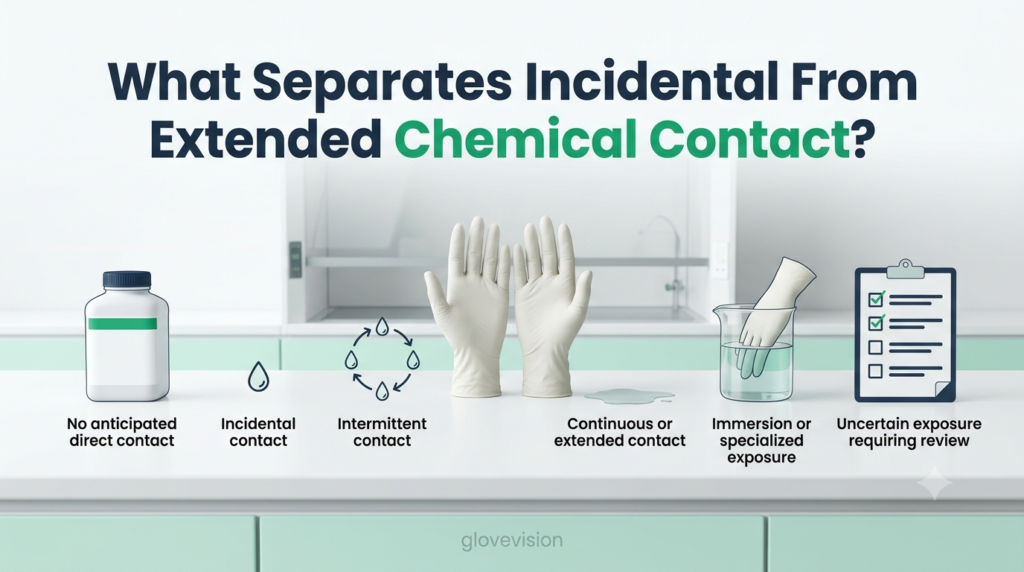
What Separates Incidental From Extended Chemical Contact?
Incidental vs extended chemical contact is separated by contact pattern, repetition, persistence, and task context—not by one universal time cutoff. Incidental contact is brief, limited, and not intended to continue, while extended contact involves sustained or persistent exposure; intermittent and immersion exposure must also be classified because the system is not binary.
Duration alone cannot determine protection because chemical identity, concentration, toxicity, temperature, pressure, contaminated surfaces, repetition, and maximum credible exposure also matter. This article explains why classification matters, how the full spectrum works, which task factors control the category, where glove and PPE planning begins, which mistakes weaken classification, and what must be verified before approval.
Why does chemical contact classification matter for glove and PPE decisions?
Chemical contact classification matters because incidental, intermittent, continuous, and immersion exposures may require different evidence, work practices, change procedures, and protective controls. A task that only handles clean, sealed containers is not the same as repeated dipping, persistent wetting, or a credible pressurized spray.
Classification should remain grounded in how laboratory gloves match the actual hazard and contact pattern, not in a generic label such as “incidental-rated” or “extended-rated.” OSHA’s hand-protection rule bases selection on performance relative to the task, present conditions, duration of use, and identified hazards; it does not create universal incidental or extended glove classes. [HP]
How can chemical contact classification affect glove evidence?
Contact classification affects glove evidence because intermittent and continuous exposure patterns are tested differently, and splash guidance does not automatically support immersion. Intermittent contact may require intermittent evidence, while persistent wetting or sustained contact requires continuous-contact evidence. ASTM F1383-20 addresses intermittent contact, and ASTM F739-20 addresses continuous contact; those results should not be treated as interchangeable or as safe-wear approvals. [F1383] [F739]
How can chemical contact classification affect work practices?
The contact category can affect whether direct contact should be eliminated, whether PPE must be replaced after an event, and whether additional body or engineering controls are needed. A task may need closed handling, remote tools, splash shielding, secondary containment, cuff and arm coverage, eye and face protection, or emergency equipment review before gloves are considered sufficient.
Why is chemical contact classification not a risk rating?
A contact category describes the pattern of exposure, not the severity of the chemical hazard. It does not independently determine toxicity, corrosivity, sensitization, skin absorption, injury severity, glove material, safe wear duration, or adequacy of engineering controls.
How does chemical contact classification distinguish incidental, intermittent, continuous, and immersion exposure?
Chemical contact should be classified across the full spectrum from no anticipated direct contact through incidental, intermittent, continuous, immersion, specialized, and uncertain exposure. The purpose is to describe how chemical contact can realistically occur before evidence, controls, and procedures are selected.
What qualifies as no anticipated direct chemical contact?
No anticipated direct contact applies when the chemical remains enclosed, outer surfaces are clean, and the normal task does not require opening, transfer, or handling contaminated objects. The category should be reclassified if leakage is credible, exterior contamination exists, opening is required, transfer occurs, splash is possible, or contaminated tools are handled.
What qualifies as incidental chemical contact?
Incidental contact is a brief, limited, isolated event that is not intended to continue and is followed by prompt control under the approved procedure. A small droplet or momentary transfer deviation may fit this category, but incidental does not mean low risk, and repeated splash is not one incidental event.
What qualifies as intermittent chemical contact?
Intermittent contact consists of repeated chemical-contact periods separated by genuine periods in which direct contact stops. Repeated dipping, sampling, transfer, splash, or contaminated-item handling can be intermittent only when the non-contact intervals are real and contamination is controlled.
What qualifies as continuous or extended chemical contact?
Once the category is established, laboratories must separately determine how the exact glove product matches chemical contact duration and relevant resistance data.
What qualifies as immersion or specialized chemical contact?
Immersion or specialized exposure applies when part or all of the glove enters the chemical or when pressure, vapor, temperature, toxicity, or physical stress exceeds routine splash or surface-contact conditions. Immersion, pressurized contact, vapor exposure, or severe chemical hazards may require specialized materials and a more complete protective system.
| Working category | Defining pattern | Practical example | Main boundary | Critical verification | Planning direction |
|---|---|---|---|---|---|
| No anticipated direct contact | Chemical remains enclosed and outer surfaces are clean. | Moving a sealed, uncontaminated container. | No realistic direct contact during normal work. | Container integrity, cleanliness, and deviation plan. | Plan for foreseeable leakage, opening, or contamination. |
| Incidental contact | One brief, limited, isolated event that is not intended to continue. | Small accidental droplet during transfer. | Not a repeated or persistent contact pattern. | Chemical severity and prompt-control procedure. | Use splash evidence and a replacement or response rule. |
| Intermittent contact | Repeated contact periods separated by genuine non-contact periods. | Repeated dipping, sampling, or recurrent splash. | Cycles repeat and may accumulate. | Frequency, remaining contamination, and relevant intermittent evidence. | Review intermittent-contact evidence and replacement triggers. |
| Continuous or extended contact | Chemical remains on PPE or contact persists without an effective clean interval. | Handling continuously wetted parts. | No effective clean interval exists. | Continuous-contact evidence and change planning. | Use sustained-contact protection and engineering controls. |
| Immersion or specialized exposure | High-contact, pressure, vapor, heat, severe dermal hazard, or protected area entering chemical. | Hand enters liquid or spray is credible. | Beyond routine splash or surface contact. | Coverage, compatibility, source control, and EHS review. | Escalate to a complete protective system. |
| Uncertain | Contact pattern cannot be predicted defensibly. | Changing, uncontrolled, or poorly described task. | Evidence is insufficient. | Maximum credible exposure and missing data. | Pause and reassess before approval. |
Which task factors determine the correct chemical contact classification?
The correct chemical contact category is determined by the realistic exposure pattern, not by the procedure name, intended duration, or worker assumption. Duration is important, but it must be evaluated with direct-contact potential, repetition, persistence, chemical severity, and physical conditions.
Is direct chemical contact expected?
Start by asking whether the chemical is enclosed, whether the container exterior is clean, whether the closure must be opened, and whether the worker pours, pipettes, wipes, dips, samples, or handles contaminated tools. A task described as “handling only” may still involve direct contact if leakage, splash, or contaminated surfaces are credible.
Is the contact isolated, repeated, or persistent?
One isolated event can differ from repeated splashes or chemical remaining on the glove. Repetition may create intermittent exposure; persistent wetting may become continuous or extended exposure; and repeated contact with no genuine clean interval may be functionally continuous.
What is the maximum credible contact duration?
Maximum credible exposure includes the expected task duration plus foreseeable delay, interruption, leakage, splash, repeated contact, unnoticed contamination, and difficult emergency removal. It is not an imaginary worst case, but it also is not the ideal minimum written into the procedure.
How severe is the chemical hazard?
Chemical severity can change how cautiously a category should be handled. Toxicity, skin absorption, corrosivity, irritation, sensitization, concentration, temperature, physical form, and mixture status should be reviewed through the SDS, hazard assessment, and qualified safety review. OSHA’s mandatory SDS format includes sections for identification, composition, first aid, handling, exposure controls, and PPE information. [SDS]
What physical conditions modify the classification?
Pressure, flexing, gripping, abrasion, puncture, contaminated surfaces, vapor, mist, heat, wrist and forearm coverage, eye and face exposure, and emergency-removal difficulty can all change the working category or trigger escalation.
| Task observation | Likely working category | Why | What must be verified | Escalation trigger |
|---|---|---|---|---|
| Clean sealed container with no credible leakage | No anticipated direct contact | Chemical remains enclosed. | Exterior cleanliness and closure integrity. | Contamination, opening, or transfer is required. |
| One accidental droplet followed by prompt control | Incidental | Isolated event. | Chemical severity and response procedure. | Serious dermal hazard or repeated event. |
| Repeated transfers with separate contact cycles | Intermittent | Contact repeats. | Frequency and accumulated wetting. | No genuine clean interval. |
| Glove remains wetted during work | Continuous or extended | Chemical persists on protective material. | Continuous evidence and change control. | Exact data unavailable. |
| Fingers or hand enter the chemical | Immersion | Protected area enters liquid. | Coverage and compatibility. | Routine splash glove proposed. |
| Pressurized leak, vapor, or hot chemical is credible | Specialized exposure | Exposure exceeds routine surface contact. | Engineering and complete PPE assessment. | No source control. |
| Pattern cannot be predicted | Uncertain | Classification is unsupported. | Conservative review and maximum credible exposure. | Work proposed before qualified approval. |
How should chemical contact classification guide glove and PPE planning?
Chemical contact classification should guide which evidence and controls are evaluated, but it does not independently select a glove or establish a safe wear time. After the exposure pattern is classified, laboratory chemical glove material families can be screened without assuming that a polymer name proves compatibility.
How should no anticipated contact influence protection planning?
No anticipated contact planning should confirm a closed system, clean exteriors, intact containers, a deviation-response plan, and PPE availability for foreseeable changes. It should not be used to claim PPE is never required.
How should incidental contact influence protection planning?
Incidental contact planning should require exact-chemical splash evidence where available, prompt glove removal or replacement, exposure-control capability, a chemical-specific response procedure, worker training, and reclassification after repeated events.
How should intermittent contact influence protection planning?
Intermittent contact planning should assess cycle frequency, cycle duration, remaining contamination, glove changes, genuine clean intervals, accumulation, and functional continuity. Air exposure should not be treated as decontamination, and protection should not automatically reset between cycles.
How should continuous or extended contact influence protection planning?
Continuous or extended contact planning should require exact chemical and concentration data, continuous-contact evidence, permeation review, degradation review, penetration review, a change procedure, body coverage review, and engineering controls. ISO 6529:2026 addresses continuous-contact permeation context; it should not be used as an intermittent-contact category system. [ISO]
What should happen when classification remains uncertain?
Uncertain classification should pause the task, define the uncertainty, review the exact chemical and task conditions, seek exact-product evidence, contact the manufacturer where necessary, consult EHS or the Chemical Hygiene Officer, reduce or eliminate direct contact, and approve the revised procedure before work begins.
Hazard assessment, fit, PPE selection, written certification, and worker training belong to the broader PPE program, while nonmandatory OSHA Appendix B guidance keeps PPE connected to engineering controls and sound work practices. [PPE] [AB]
Which mistakes lead to chemical contact misclassification?
Chemical contact is commonly misclassified when duration is treated as the only variable, repeated contact is collapsed into one event, severe chemical hazards are minimized, or a contact category is mistaken for glove approval.
Which duration mistakes cause misclassification?
A task may be misclassified when brief contact is treated as harmless, several minutes are treated as automatically extended, long task duration is confused with continuous glove contact, or breakthrough time is used to define the contact category. None of those shortcuts describes how chemical actually reaches or remains on protective material.
Which pattern mistakes cause misclassification?
Pattern mistakes include ignoring repeated splash, ignoring chemical remaining on PPE, treating contaminated tools as clean handling, failing to distinguish genuine contact-free intervals, classifying immersion as splash, or ignoring pressure and vapor. The corrective rule is to classify the realistic exposure pattern, not the preferred task label.
Which hazard mistakes cause misclassification?
Hazard mistakes occur when brief is treated as low risk, or when toxicity, skin absorption, corrosivity, sensitization, concentration, temperature, mixtures, or physical form are ignored. A brief severe exposure may require escalation even when the contact pattern looks limited.
Which protection-planning mistakes follow misclassification?
Misclassification can lead to selecting by material name, using continuous data for intermittent work without review, using intermittent data for immersion, using splash guidance for immersion, relying on generic charts, treating categories as product ratings, failing to reclassify after changes, or allowing gloves to replace engineering controls.
What should workplaces verify before approving a chemical contact classification?
Before approving a chemical contact classification, the workplace should verify the chemical, direct-contact potential, complete task pattern, maximum credible exposure, physical conditions, supporting evidence, and approval procedure. Where OSHA’s Laboratory Standard applies, the Chemical Hygiene Plan must address laboratory procedures, criteria for control measures, PPE, hygiene practices, training, prior approvals, medical arrangements, and additional protections for particularly hazardous substances. [CHP]
- Exact chemical name and concentration are known.
- Physical form, mixture status, carrier or solvent, and temperature are recorded.
- Toxicity, corrosivity, irritation, sensitization, and skin-absorption hazards are reviewed.
- Current SDS is available for identification and emergency routing.
- Task has been checked for opening, transfer, pouring, pipetting, wiping, dipping, or sampling.
- Closed containers are clean and intact.
- Splash, leakage, contaminated tools, and contaminated surfaces are assessed.
- Written intent of no contact is checked against foreseeable deviation.
- Category is recorded as no anticipated, incidental, intermittent, continuous or extended, immersion, specialized, or uncertain.
- Classification is not based on a fixed time cutoff.
- One event, repeated contact, genuine clean intervals, and persistent contamination are distinguished.
- Functionally continuous contact is considered when no effective clean interval exists.
- Expected duration, delay, task interruption, splash, leakage, and unnoticed contamination are included.
- Emergency-removal difficulty is considered.
- Classification reflects realistic maximum exposure, not the ideal minimum.
- Pressure, flexing, gripping, abrasion, puncture, vapor, mist, and heat are assessed.
- Hand, wrist, forearm, eye, face, and body coverage needs are considered.
- Engineering controls and work-practice options are reviewed before relying on gloves.
- Intermittent-contact and continuous-contact evidence are routed separately.
- Splash guidance is not used as immersion evidence.
- Breakthrough is not treated as safe wear.
- Exact-product evidence is required separately from the contact category.
- Classification, replacement triggers, exposure-response routing, and review date are documented.
- Final glove or PPE approval is handled separately.
- Applicable PPE program or Chemical Hygiene Plan is followed where relevant.
- Approval authority is recorded.
- Approved for the defined category and conditions.
- Revised after additional controls.
- Escalated as immersion, specialized, or uncertain exposure.
- Rejected or paused because evidence is insufficient.
Checklist completion does not prove chemical compatibility, safe wear duration, zero exposure, final glove suitability, or full regulatory compliance.
Frequently Asked Questions
Is there a universal time cutoff separating incidental from extended chemical contact?
No. Incidental and extended chemical contact cannot be separated by one fixed number of seconds or minutes. Classification should consider contact pattern, repetition, persistence, chemical severity, task conditions, and maximum credible exposure.
Can repeated brief contact still be incidental?
Usually no. One isolated splash may be incidental, but repeated splashes, repeated dipping, recurring transfer contact, or contaminated-object handling usually move the task toward intermittent contact. If chemical remains on PPE without a clean interval, it may become continuous or extended.
Is handling a closed chemical container direct chemical contact?
Not always. A clean, sealed, intact container may fit no anticipated direct contact. Reclassify the task if exterior contamination, leakage, opening, transfer, splash, or contaminated tools are credible.
Does incidental chemical contact mean the task is low risk?
No. Incidental describes the exposure pattern, not chemical severity. Brief contact with a corrosive, toxic, sensitizing, hot, or skin-absorbed chemical may still require strict controls and qualified safety review.
What should happen when breakthrough data or task details do not clearly support the category?
Do not guess. Breakthrough time does not define whether contact is incidental, intermittent, extended, or immersion. Pause the task, review the exact chemical and realistic exposure pattern, check exact-product evidence, and escalate to the qualified safety or EHS reviewer.
Conclusion
Incidental and extended chemical contact are useful working concepts, but they are not a complete binary PPE system. No anticipated contact differs from incidental contact, repeated brief contact may be intermittent, persistent contact may be continuous or extended, and immersion, pressure, vapor, heat, or severe dermal hazards require escalation.
The category does not select the glove, prove compatibility, or define safe wear duration. Final protection follows the realistic exposure pattern, maximum credible exposure, chemical severity, relevant evidence, engineering controls, and the applicable hazard assessment or safety program.