
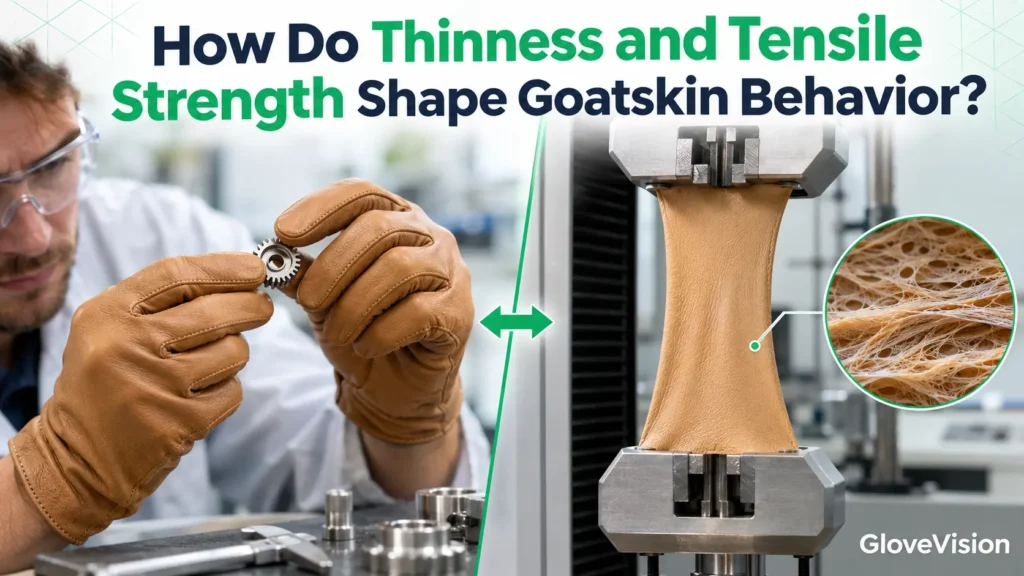
Goatskin leather can combine relatively thin construction with useful tensile strength and flexible handling, but thinness and strength describe different material properties. A thin specimen may develop substantial tensile stress while carrying less total force than a thicker, otherwise comparable specimen. Thin material is therefore not automatically weak—or sufficiently protective.
This guide explains how thickness affects bending, how goatskin responds to pulling, and why collagen-fiber direction and leather processing alter measured properties. It also shows how buyers can interpret ISO material tests, evaluate finished-glove construction and verify protection for actual workplace tasks.
What Makes Goatskin Leather Distinct in Thickness and Tensile Performance?
Selected goatskin leathers can provide useful tensile performance at relatively low thickness, but their characteristics vary by hide origin, sampling location, specimen direction and processing. No universal claim that goatskin is stronger, softer or safer than cowhide follows from the material name alone.
What Is Goatskin Leather?
Goatskin leather is processed goat hide containing a collagen-fiber framework. Tanning and subsequent processing stabilize and modify that material for applications including glove panels.
The broader guide to goatskin glove structure and supple handling covers the complete goatskin glove category.
Why Can Goatskin Support Lightweight Gloves?
Suitable goatskin leather may be prepared in relatively thin panels that reduce bulk and allow bending around the hand. The finished glove’s weight and movement also depend on seams, linings, reinforcements and fit.
Which Mechanical Properties Matter?
Thickness measures depth; tensile strength measures maximum nominal stress; maximum force measures the peak applied load; breaking force refers to rupture loading; and elongation describes extension at a defined test point. These are distinct properties.
Why Do Goatskin Properties Vary?
A published study of different goat populations reported variation associated with sex, age, hide region and specimen direction. Its findings apply to the studied materials; they do not provide a universal tensile rating for commercial goatskin gloves.
Does Thin Goatskin Guarantee Protection?
No. Useful material tensile behavior does not establish an assembled glove’s abrasion, cut, tear, puncture or impact protection. The exact glove’s ratings must match the workplace hazard.
How Do Goatskin Leather Thickness and Tensile Strength Measure Different Properties?
Thickness is a dimension, tensile strength is the peak nominal stress during a specified test, breaking force is a rupture load, and elongation is relative extension. Comparing them without their units, test definitions or specimen dimensions risks misinterpreting leather performance.
What Does Leather Thickness Measure?
Leather thickness is the distance between its surfaces, commonly expressed in millimeters. ISO 2589:2016 specifies how to determine the thickness of leather and leather specimens.
What Is Tensile Strength?
For a suitable rectangular specimen, nominal tensile strength is the highest applied test force divided by the original cross-sectional area. The result is expressed as stress in N/mm², equivalent to MPa.
How Does Breaking Force Differ?
Breaking force is the force associated with specimen rupture and is measured in newtons. The peak force observed during testing can differ from the force at rupture. Reports must follow their stated test definitions.
What Does Elongation Describe?
Elongation expresses extension relative to the original gauge length at a defined test point. ISO 3376:2020 specifies elongation at a specified load and elongation at maximum force. Neither should automatically be relabeled elongation at break.
Is Tensile Strength the Same as Stiffness?
No. Tensile strength concerns the peak stress developed under pulling; stiffness describes resistance to deformation. A material can have useful tensile performance and still bend relatively easily.
Can Thin Leather Have High Tensile Strength?
Yes. A thin specimen can develop high nominal stress, yet carry less total force than a thicker otherwise comparable specimen. Cross-sectional area and normalized strength must be evaluated separately.
Stress = Force ÷ Original Area Force in N; area in mm²; stress in N/mm².Area = Width × Thickness Use the original dimensions of a suitable rectangular specimen.Elongation (%) = Extension ÷ Initial Gauge Length × 100 Specify whether extension is measured at the stated load or maximum force.1 N/mm² = 1 MPa Stress units must not be confused with the unit of force, N.| Property | Unit | Test Method | Physical Meaning | Glove Implication | Limitation |
|---|---|---|---|---|---|
| Thickness | mm | ISO 2589 | Distance between surfaces. | May affect bulk and bending. | Not a protective rating. |
| Tensile strength | N/mm² or MPa | ISO 3376 | Peak nominal tensile stress. | Describes a material under pulling. | Not equivalent to tear or cut protection. |
| Maximum force | N | ISO 3376 | Highest recorded applied load. | Depends in part on specimen dimensions. | May differ from force at rupture. |
| Breaking force | N | Applicable rupture-load definition. | Force associated with rupture. | Describes a material specimen’s failure load. | Not normalized tensile strength. |
| Elongation | % | ISO 3376: specified load or maximum force. | Measured relative extension. | Characterizes stretching. | Not equivalent to hand dexterity. |
| Bending stiffness | Method-specific | Appropriate bending procedure. | Resistance to bending. | Relevant to suppleness. | Not tensile strength. |
| Tear resistance | Method-specific | Applicable tear test. | Resistance to tear propagation. | Relevant to tear hazards. | Different from tensile strength. |
How Does Thin Goatskin Leather Improve Flexibility and Hand Movement?
Under comparable material and construction conditions, reduced goatskin thickness may lower bending resistance and bulk, potentially supporting finger movement. The actual result depends on the assembled glove, not thickness alone.
Why Does Reduced Thickness Affect Bending?
A bent material experiences deformation across its thickness. Less material depth can lower resistance to bending when the remaining mechanical properties and conditions are comparable. Leather variability prevents predicting every specimen with a single simplified model.
How Can Thinness Support Finger Movement?
Lower bulk can reduce interference near finger joints and make grasping easier in a suitable construction. Finger shape and proper glove sizing remain essential.
Can Thin Goatskin Improve Tactile Handling?
Thin leather may allow more contact feedback in some gloves. Better tactile feedback, however, is not the same as certified protection or guaranteed precision.
What Else Influences Glove Mobility?
Tanning, fatliquoring, lining, seams, finger geometry, reinforcement and fit all affect handling. Thin leather cannot compensate for every construction or sizing problem.
What Is the Flexibility–Durability Trade-Off?
Lower thickness can help bending but may change the amount of material available in contact and wear zones. The correct choice requires the task’s hazards and verified complete-glove performance.
How Does Goatskin Tensile Strength Affect Resistance to Pulling and Stretching?
Goatskin tensile testing measures a specimen’s behavior under controlled pulling, including load and extension. Maximum nominal stress, force at rupture and elongation describe different aspects of its response, and none alone certifies a finished protective glove.
What Happens During Tensile Loading?
A prepared specimen is secured in grips and pulled under a specified procedure. Applied load and extension are measured, with results interpreted using original dimensions and the appropriate definitions.
How Do Collagen Fibers Contribute to Tensile Behavior?
The collagen-fiber network carries and redistributes tensile loads as leather deforms. Fiber structure and orientation influence the response. The related guide to collagen-fiber structure and leather mechanical durability explains the broader structural mechanism.
What Separates Recoverable From Permanent Extension?
Recoverable extension can reverse after a load is removed, whereas permanent extension remains. The percentage elongation recorded at maximum force does not by itself establish the recovered proportion.
Why Does Elongation Matter?
It describes measured extension at a defined loading point. Greater elongation does not automatically mean higher tensile strength, tear resistance or hand dexterity.
How Does Specimen Direction Change Results?
Cutting direction can alter the test response. In a published goat-skin study, specimens sampled parallel to the backbone showed higher measured tensile strength and breaking force, but lower percentage extension, than perpendicular specimens in that study. This is not a universal ranking.
Why Is Material Rupture Different From Tearing?
Rupture in a tensile test and propagation of a tear use different specimen and loading conditions. An ISO material tensile result is not an EN 388 finished-glove tear rating.
Why Can Glove Seams Fail Separately?
Stitching, thread, needle holes and seam geometry can influence failure independently of panel strength. Strong leather does not guarantee strong joints.
| Loading Condition | Applied Force | Calculated Stress | Elongation | Failure Mode | Product Implication |
|---|---|---|---|---|---|
| Initial loading | Increasing force. | Current force divided by original area. | Initial extension. | No failure assumed. | Material response only. |
| Specified load | Defined test load. | Can be calculated if original area is known. | At the specified load. | Not necessarily rupture. | Preserve the test-point definition. |
| Maximum force | Peak recorded load. | Maximum nominal tensile stress. | At maximum force. | Rupture may coincide or occur later. | Do not relabel as rupture without evidence. |
| Rupture | Rupture load if reported. | Not necessarily peak stress. | Rupture extension only if separately measured. | Specimen failure. | Do not confuse breaking load with peak force. |
| Different orientations | May vary. | May vary. | May vary. | Sample-dependent. | Document specimen direction. |
| Glove seam | Construction-dependent. | Panel strength alone insufficient. | Different joining response. | Stitch or seam separation. | Inspect the finished construction. |
Why Does the Goatskin Thickness–Strength Relationship Matter for Durability?
Thickness affects cross-sectional area, while tensile strength describes peak nominal stress relative to that area. Under otherwise comparable conditions, less area can reduce total maximum force without necessarily reducing normalized tensile strength. Neither quantity alone predicts workplace glove service life.
Why Does Cross-Sectional Area Matter?
For a rectangular specimen, original width multiplied by original thickness gives the original area used for calculating nominal tensile stress.
Can Reduced Thickness Lower Breaking Force Without Lowering Tensile Strength?
It may reduce maximum load capacity if comparable specimens have similar tensile strength. Force at rupture must still be measured or correctly reported separately when it differs from maximum force.
Does Greater Thickness Guarantee Higher Strength Per Unit Area?
No. Fiber structure, location, condition and processing affect strength. A thicker unrelated specimen might have higher, lower or similar normalized strength.
Why Must Test Specimens Be Comparable?
Width, thickness, test direction, preparation, moisture conditioning and test procedure all influence valid comparison. A numerical result without sufficient context may be misleading.
How Does Thickness Influence Handling?
Thickness can affect bulk and bending resistance, while seams, lining, shape, material finish and fit also determine actual movement.
Does Tensile Strength Establish Overall Durability?
No. Abrasion, cut, tear, puncture, repeated flexing and seam integrity involve different conditions. The article on abrasion resistance and surface wear in leather explains a separate property.
| Scenario | Cross-Sectional Area | Force Implication | Tensile Interpretation | Bending Trade-Off |
|---|---|---|---|---|
| Comparable thin specimen | Smaller at equal width. | Lower peak force possible at equal strength. | Normalized strength can be similar. | Potentially less bending resistance. |
| Comparable thick specimen | Larger at equal width. | Higher peak force possible at equal strength. | Not automatically higher normalized strength. | Potentially more bending resistance. |
| Different hide regions | May differ. | Measured force may differ. | Local fiber organization matters. | Region-dependent. |
| Different orientations | Can be controlled. | May differ by direction. | Directional response must be recorded. | Material-dependent. |
| Different processing | Can be similar. | Mechanical response may differ. | Processing can affect tensile behavior. | Suppleness can vary. |
How Do Processing and Fiber Orientation Change Goatskin Leather Strength and Flexibility?
Fiber direction, hide region and leather processing affect how goatskin carries tension, extends and bends. Similar thickness measurements do not guarantee identical strength or suppleness.
How Does Hide Region Affect Properties?
Hide regions may differ in local thickness, fiber arrangement and tensile properties. In the published goat-skin study cited above, the sampled shoulder, hip and rib regions did not have identical mechanical results. Those findings are specific to its material and methods.
Why Does Fiber Orientation Influence Tensile Results?
The interconnected collagen network is not necessarily mechanically identical in all directions. Cutting direction must therefore be documented to make comparisons meaningful.
What Changes During Tanning and Retanning?
Tanning stabilizes hides; retanning can change physical properties. A 2024 study on snow-white goatskin glove leather compared several retanning agents and found differences in characteristics including softness and mechanical behavior. Those laboratory observations do not certify protective-glove performance.
How Can Fatliquoring Affect Suppleness?
Fatliquoring can modify fiber lubrication and the material’s bending feel. Effects depend on formulation, processing and the resulting leather properties.
Why Can Surface Finishing Change Feel?
Surface finishing can influence texture, friction and contact feedback. Smooth appearance does not establish tensile strength or protection.
Does Equal Thickness Guarantee Equal Strength?
No. Two specimens with the same thickness can differ in structure, orientation, defects and processing. Their tensile values must be established by comparable testing.
Can Garment or Footwear Research Prove Glove Protection?
No. Findings from other leather products may inform material science, but cannot establish the protective ratings of an assembled work glove.
How Can Poor Goatskin Glove Thickness or Strength Selection Cause Failure?
Incorrect thickness selection, unsupported strength claims and unsuitable glove construction can contribute to wear, seam damage or poor handling. The likely cause must be investigated rather than blamed on thinness alone.
Why Might Excessively Thin Construction Be Unsuitable?
Low material depth may be unsuitable for demanding contact zones if the selected glove lacks the protection or reinforcement required by the work.
Why Is Tensile Strength Alone Insufficient?
A high material tensile value does not establish the finished glove’s abrasion, cut, tear, puncture or impact performance.
How Does Material Placement Affect Weak Points?
Different glove regions experience different contact patterns. Panel arrangement and reinforcement should match the intended protected areas.
Why Can Strong Leather Have Weak Seams?
Stitches, needle holes, thread and seam construction create joining behavior not described by a separate leather tensile specimen.
When Is Excessive Thickness Counterproductive?
Bulk or stiffness may prevent secure closure and accurate manipulation without adding needed protective performance.
Which Warning Signs Require Inspection or Removal?
Cuts, holes, worn contact zones, separated seams, damaged reinforcement or loss of reliable grip require inspection. Remove compromised gloves from service according to manufacturer instructions and workplace procedures.
When Should Another Protective Design Be Selected?
Choose another suitably tested glove when goatskin cannot meet the hazards or required movements. Unapproved repairs cannot be assumed to restore protective performance.
| Incorrect Assumption | Observed Problem | Possible Cause | Safety Concern | Corrective Decision |
|---|---|---|---|---|
| Thin contact panels always suffice | Rapid wear. | Workload or material mismatch. | Reduced coverage. | Reassess hazards and protection. |
| High tensile strength proves every rating | No relevant product ratings. | Material/PPE confusion. | Unsupported protection. | Request exact-glove documentation. |
| Strong leather ensures strong seams | Separation. | Stitching or joint failure. | Compromised integrity. | Remove damaged gloves and investigate. |
| Thinness guarantees correct fit | Bunching or slipping. | Size/pattern mismatch. | Reduced control. | Correct fit and reassess. |
| Thicker is always better | Poor closure. | Excess bulk. | Unsafe handling. | Compare adequately protective designs. |
| Tensile strength prevents all tearing | Localized tear. | Different damage mechanism. | Loss of material integrity. | Inspect and replace when necessary. |
| Soft leather cannot wear through | Palm thinning. | Repeated abrasion. | Wear-through. | Verify abrasion suitability. |
| Leather data certify a glove | Missing finished-glove evidence. | Unsupported product claim. | Unverified hazard protection. | No-Go pending relevant evidence. |
How Can Buyers Verify Goatskin Glove Tensile Performance and Practical Suitability?
Buyers should inspect properly identified material-test information, independently confirm the exact glove’s protective results and evaluate fit and safe handling. Leather tensile measurements are supplementary data, not replacements for finished-glove ratings.
What Hazards and Hand Movements Must Be Identified?
Record the materials handled, abrasion and sharp-object exposure, required grip, manipulation and other relevant chemical, thermal or equipment hazards.
Which Goatskin Specifications Should Buyers Request?
Request the exact manufacturer and model, thickness, panel locations, reinforcement, stitching, lining, intended use and material-test information where available.
How Should ISO 3376 Data Be Interpreted?
Confirm sample dimensions and orientation, maximum force, normalized tensile strength and the specified load or maximum-force point used for elongation. Never silently mix methods or test-point definitions.
How Can ISO 2589 Thickness Measurements Be Checked?
Confirm the stated leather thickness method and sampled location. An advertised nominal thickness may not describe every part of the leather or glove.
What Does EN 388 Test—and What Does It Not Test?
EN 388 assesses mechanical risk categories including abrasion, blade cutting, tearing, puncture and, when relevant, impact. It does not establish one general finished-glove tensile-strength rating. A glove’s tear result is not interchangeable with ISO 3376 tensile strength.
Why Must Seams and Reinforcement Be Examined?
A complete glove includes multiple joins, materials and protected areas that may respond differently from a standalone leather test piece. The broader leather glove construction and protective limitations guide covers these distinctions.
How Should Grip and Dexterity Be Assessed?
Evaluate size, closure, finger control and grip through safe, nonhazardous representative tasks. Handling trials cannot independently certify mechanical protection.
When Should a Product Be Rejected?
Reject a product when required protection or safe control fails. When evidence is missing or contradictory, request clarification rather than assuming compliance.
- Define actual task and hazards.
- Confirm the exact manufacturer and model.
- Obtain goatskin specifications.
- Verify the thickness test method.
- Review ISO 3376 data where available.
- Separate stress from force.
- Confirm direction and specimen comparability.
- Verify relevant EN 388 categories.
- Inspect seams, panels and reinforcement.
- Assess safe fit, grip and finger movement.
- Review manufacturer restrictions.
- Record accept, reject or request-more-evidence.
Which Goatskin Glove Designs Best Balance Thinness, Tensile Strength, and Dexterity?
The suitable design is the one that meets required protective performance and provides adequate grip, fit and movement. Thinness can help precision in some constructions, while reinforcement or specialized protection may be more appropriate for other tasks.
When Does Thin Goatskin Support Precision?
When a suitably protective glove’s low bulk, finger shape and fit allow small-object manipulation without compromising safe handling.
When Should Reinforcement Be Considered?
When repeated wear occurs in identified regions and appropriately constructed reinforcement can address those regions without reducing necessary movement.
How Can Seam Placement Affect Handling?
Seams may change contact feel, pressure and movement around fingertips, thumbs and palms. Complete-glove trials are needed.
When May Greater Material Thickness Be Useful?
When added material is appropriate to the construction and workload, with separately verified protection and acceptable dexterity.
Why Does Fit Matter Independently of Thickness?
Tight gloves may restrict movement and loose gloves may bunch or slip, regardless of their thickness. Correct sizing is a separate requirement.
What Mechanical Ratings Are Required?
Only a workplace hazard assessment can determine which abrasion, cut, tear, puncture or impact protection is necessary. No material tensile number substitutes for those ratings.
When Is a Specialized Alternative Better?
Select specialized protection whenever goatskin lacks necessary hazard coverage or suitable handling. Chemical, electrical and heat protection cannot be inferred from leather strength.
| Work Requirement | Thickness Consideration | Tensile Evidence | Dexterity Trade-Off | Finished-Glove Rating | Decision |
|---|---|---|---|---|---|
| Fine assembly | Lower bulk may help. | Material integrity information. | Precise motion. | All identified hazards. | Thin design if suitable. |
| Tool repositioning | Avoid unnecessary bulk. | Review when applicable. | Controlled closure. | Required protection. | Flexible tested design. |
| Repeated gripping | Contact zones matter. | Can inform panel material. | Stable grasp. | Relevant ratings. | Balanced design. |
| Moderate rough handling | Check contact coverage. | Not abrasion evidence. | Secure grip. | Mechanical hazards. | Task-suitable construction. |
| High-friction handling | Reinforcement may help. | Cannot predict wear life. | Control must remain safe. | Applicable abrasion evidence. | Suitable reinforced or alternative design. |
| Sharp-edge work | Thickness alone is insufficient. | Not a cut test. | Task-dependent. | Relevant cut rating. | Rated protection. |
| Repeated pulling | Panel and seam integrity. | Comparable material data useful. | Grip needed. | All identified hazards. | Verify construction. |
| Specialized hazards | No universal thickness rule. | Not sufficient. | Protection first. | Hazard-specific evidence. | Specialist PPE or No-Go. |
What Goatskin Thickness and Tensile Strength Checks Confirm Suitable Glove Performance?
Acceptance requires material information interpreted correctly, exact-glove protective evidence, construction integrity, correct fit and safe handling for the actual task. If any essential requirement is not met, a goatskin glove should not be approved for that use.
Does the Product Match the Task?
Compare the declared intended use with the actual work, exposures and required movements.
Is Thickness Documented?
Use the stated material thickness and appropriate measurement method, not visual estimates.
Are Strength, Force and Elongation Interpreted Correctly?
Check stress versus force, units, sample dimensions, direction and the precise elongation definition.
Are the Relevant Glove Ratings Available?
Confirm applicable protective results for the exact model and required workplace hazards.
Is the Construction Suitable?
Review material panels, protected areas, seams, lining and reinforcement.
Is Dexterity Adequate?
Confirm safe finger movement, secure grip, correct sizing and essential task control.
Is the Glove Intact?
Inspect for holes, cuts, worn panels, split seams and other damage affecting protection.
Should the Product Be Accepted, Rejected or Reassessed?
Accept only sufficient evidence and safe performance; reject failed requirements; reassess incomplete documentation.
- Actual work task identified.
- Thickness documented.
- Material test method known.
- Force versus stress distinguished.
- Elongation definition checked.
- Specimen orientation considered.
- Finished-glove ratings verified.
- Seams and reinforcement suitable.
- Fit and dexterity acceptable.
- No compromised areas or damage.
- Manufacturer limitations checked.
- Final decision recorded.
Protection and functional requirements are supported by evidence.
Mandatory protection or safe control is not met.
Documentation is missing or inconsistent with the exact product.
What Ultimately Determines Whether Thin Goatskin Is Strong Enough for Work Gloves?
Thin goatskin can combine useful tensile behavior with flexibility, but thickness, maximum force, tensile strength and elongation are different measurements. Their relationship depends on original specimen geometry, hide region, fiber orientation, processing and test conditions. Reduced thickness may lower total load capacity without necessarily reducing normalized tensile strength.
A goatskin work glove is suitable only when its verified protective ratings, construction integrity, fit, grip and movement match the workplace hazards. Material tensile data help explain leather behavior but cannot replace finished-glove testing or task-specific safety assessment.
Frequently Asked Questions
Is Thin Goatskin Leather Strong?
It can be. Some thin goatskin specimens show useful tensile properties, but performance depends on hide structure, direction, processing and comparable testing. Thinness alone does not prove work-glove protection.
Is Tensile Strength the Same as Breaking Force?
No. Tensile strength is maximum nominal stress normalized by original area, while breaking force is a load measured in newtons. Maximum force and force at rupture may also differ.
Does Thinner Goatskin Make Gloves More Flexible?
It can reduce bulk and bending resistance under comparable conditions, but fit, seams, finger geometry, tanning and reinforcement also affect finished-glove mobility.
Does High Goatskin Tensile Strength Guarantee Cut Resistance?
No. Tensile strength measures material behavior under pulling; cut resistance requires the relevant protective test evidence for the exact glove.
How Should Buyers Choose the Right Goatskin Glove Thickness?
Compare the actual tasks and hazards with comparable thickness and tensile data, construction, fit and exact finished-glove protective ratings. Choose only a design that supports safe handling and mandatory protection.