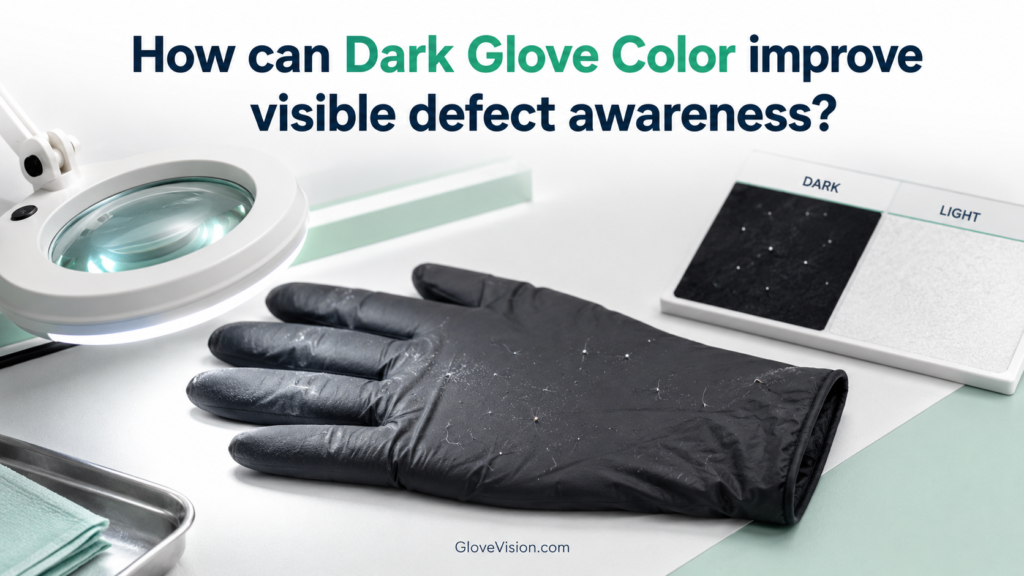
How can dark glove color improve visible defect awareness?
Dark glove color can improve visible defect awareness when the glove surface contrasts with the target material, such as light dust, white powder, pale fibers, lint, dry residue, or reflective specks. Dark color does not guarantee detection, contamination control, pinhole detection, chemical compatibility, medical suitability, cleanroom suitability, food-contact suitability, or quality compliance.
This article covers color contrast, dark-vs-light glove comparison, layer-contrast breach awareness, lighting and surface finish, fit and inspection consistency, failure response, and a final visibility, fit, and safety checklist.
This article provides educational guidance about Dark-Colored Gloves, visible defect awareness, contrast checks, inspection consistency, lighting, fit, hand hygiene, and glove failure response. It does not replace product documentation, manufacturer testing, cleanroom or contamination-control procedures, chemical compatibility data, Safety Data Sheets, medical glove category requirements, food-contact documentation, facility quality systems, or workplace policy.
How can standard Dark-Colored Gloves support visual detection of light-colored particles?
Standard Dark-Colored Gloves can support visual detection of light-colored particles when the dark glove surface creates contrast against pale dust, white powder, lint, fibers, dry residue, or reflective specks.
This page treats dark color as a visibility cue within the broader Disposable Gloves category, not as a universal approval signal.
What does dark glove color do?
Standard Dark-Colored Gloves may use colorants or pigments to create a darker glove surface. The exact pigment type, color stability, surface behavior, and material interaction are product-specific.
How can dark color support visual contrast?
A darker glove surface may create stronger contrast against some pale or light-colored materials, such as light dust, white powder, pale fibers, lint, dry residue, light particles, and reflective specks.
Contrast depends on lighting, inspection distance, glove surface finish, contaminant color, particle size, task speed, and worker attention.
What can dark color not guarantee?
Dark color does not guarantee that every particle, defect, tear, residue, or contaminant will be seen. Dark color also does not replace validated quality-control procedures, cleanroom protocols, product inspection systems, facility contamination-control rules, chemical compatibility review, hand hygiene, or glove change procedures.
How should quality-assurance wording be handled?
Dark-Colored Gloves may support inspection workflows by making some pale contaminants easier to notice under suitable conditions, but they do not prove contamination control or product release safety by themselves.
Use this matrix to separate possible visibility support from unsupported safety or compliance claims.
| Target Contaminant | Possible Dark-Color Benefit | Visibility Limit | Inspection Condition Needed | Safety Boundary |
|---|---|---|---|---|
| Light dust | May stand out on dark surface | Small particles can still be missed | Adequate lighting and inspection distance | Not contamination-control proof |
| White powder | May contrast clearly | Texture and residue spread matter | Actual task lighting | Not chemical compatibility proof |
| Pale fibers or lint | May be easier to notice | Similar background can reduce contrast | Background and glove finish review | Not cleanroom suitability proof |
| Dry residue | May be more visible | Residue color may vary | Defined inspection workflow | Not product release approval |
| Reflective specks | May catch attention | Glare may interfere | Lighting-angle check | Not defect-free guarantee |
Dark color helps only when contrast exists and inspection conditions support it.
How can industrial Dark-Colored Gloves compare with light-colored alternatives for visible breach awareness?
Industrial Dark-Colored Gloves and light-colored alternatives support different inspection goals, so the better color depends on the target contaminant, surface background, lighting, and workflow.
How can Dark-Colored Gloves compare with light-colored gloves?
Dark-Colored Gloves may make pale dust, light fibers, and white residue easier to notice in some settings. Light-colored gloves may make dark fluids, dark grease, dark ink, soot, or dark residue easier to notice in other settings.
The better color depends on the inspection target.
When may Dark-Colored Gloves support breach awareness?
Dark-Colored Gloves may help workers notice certain tears, cuts, or surface disruptions when the damaged area creates visible contrast. Color does not guarantee detection of small perforations, pinholes, or hidden damage.
How can contrasting glove layers help?
Approved contrasting inner and outer glove layers may help some tears or perforations become easier to notice when the glove system is designed for contrast, the layers have a clear color difference, lighting supports visual checks, the worker inspects the glove, the products are approved for the task, and the user allergy profile is considered.
How should AQL be placed?
If Dark-Colored Gloves are used in patient-care contexts, medical-glove AQL should be interpreted correctly. AQL is lot-sampling or leak-quality evidence for patient examination and surgeons’ gloves; it is not an individual-glove guarantee, pinhole-detection guarantee, puncture-resistance score, or visibility standard. [eCFR — 21 CFR 800.20]
If the gloves are used in manufacturing, packaging, cleanroom, inspection, or industrial work, follow applicable product-quality, contamination-control, or facility standards instead of forcing medical AQL into the wrong context. Patient-care boundaries may require Medical Gloves or Examination Gloves context. [FDA — Medical Gloves]
Use this workflow table to choose color and layering based on the inspection target and actual work conditions.
| Workflow Step | Verification Question | Safe Action | Documentation Needed |
|---|---|---|---|
| Identify Inspection Target | Is the target pale dust, dark fluid, residue, tear, or breach? | Choose color based on the target | Inspection SOP |
| Choose Dark or Light Contrast | Does dark or light glove color show the target better? | Test under real work conditions | Facility inspection notes |
| Check Layering Need | Would contrasting inner/outer layers help? | Use only approved layer systems | Product documentation |
| Verify Product Approval | Are both glove layers approved for the task? | Confirm material, labeling, and allergy profile | Product spec / facility SOP |
| Inspect Under Actual Lighting | Does lighting support detection? | Adjust light, angle, finish, or glove choice | Lighting/workflow check |
| Replace If Compromised | Is tear, puncture, residue, or hidden damage suspected? | Remove and replace according to procedure | Facility response rule |
Layer contrast can support awareness, but it does not replace product testing or facility inspection standards.
Which specialty Dark-Colored Gloves may support defect awareness under different workspace lighting?
Specialty Dark-Colored Gloves may support defect awareness under different workspace lighting when their color, surface finish, texture, and material are matched to the inspection target and lighting conditions.
How can lighting affect Dark-Colored Gloves?
Workspace lighting may affect how well Dark-Colored Gloves support inspection. Important lighting factors include intensity, direction, glare, color temperature, shadows, inspection distance, background surface, and reflection from tools or parts.
When may matte or textured finishes help?
Matte or textured Dark-Colored Gloves may reduce glare in some lighting conditions. Inspection consistency depends on lighting angle, surface finish, glove texture, task distance, contaminant color, operator vision, workspace background, and task duration.
When may gloss or smooth surfaces be less suitable?
Glossy or smooth dark surfaces may create reflections under direct light. That does not make them unsafe by default, but the glove should be tested under actual work lighting before being used for inspection-heavy tasks.
What documentation should be checked?
Before selecting specialty Dark-Colored Gloves, confirm exact glove model, material, surface finish, thickness information, intended use, chemical compatibility if chemicals are present, cleanroom or contamination-control documentation if needed, and facility approval. Chemical review may require a documented Chemical-Resistant Lab Gloves approach when exact chemical exposure is present.
Use this table to match finish and lighting checks to the inspection condition.
| Lighting Condition | Possible Surface Issue | Dark-Glove Finish Option | Verification Needed | Use Limit |
|---|---|---|---|---|
| Bright LED | Glare or sharp reflection | Matte or textured finish | Test under actual LED lighting | Not universal glare solution |
| Direct overhead light | Shadows or bright spots | Low-glare finish | Check inspection angle | May still obscure particles |
| Low-light workspace | Poor contrast | High-contrast dark shade if suitable | Lighting adequacy check | Not replacement for proper lighting |
| Reflective tools/parts | Visual noise | Matte glove surface | Tool/background review | Does not prove defect detection |
| Close inspection task | Small visual targets | Finish matched to contaminant color | Inspection distance validation | Not quality-release proof |
Finish choice should be tested in the actual lighting setup, not assumed from product color alone.
How should quality control inspectors don and fit protective Dark-Colored Gloves to support inspection consistency?
Quality control inspectors should don and fit protective Dark-Colored Gloves by following hand hygiene procedure, choosing the best-fitting approved size, reducing wrinkles or trapped air, and replacing gloves when inspection consistency drops.
Step 1: Follow setting-specific hand hygiene
Follow the relevant workplace, cleanroom, manufacturing, laboratory, healthcare, or food-service hand hygiene procedure before donning when required and after glove removal. Dark-Colored Gloves do not replace hand hygiene, and CDC hand-hygiene guidance notes that gloves are not a substitute for hand hygiene. [CDC — Hand Hygiene]
Step 2: Select the best-fitting approved size
Choose Dark-Colored Gloves that fit securely without loose fingertips, palm bunching, severe webbing tension, restricted thumb movement, reduced circulation, excess slack, overstretched material, or poor tactile control. Avoid sizing too small or too large.
Step 3: Reduce wrinkles and trapped air
After donning, reduce wrinkles, bunching, or trapped air where they interfere with fit, tactile control, grip, surface inspection, visual checks, or material integrity. Do not claim wrinkles can always be eliminated.
Step 4: Monitor inspection consistency during use
Replace or reassess the glove if material becomes overstretched, fingertips bunch, the glove slips, surface glare interferes with inspection, residue cannot be visually assessed, glove damage is suspected, or tactile control decreases.
Use this checklist matrix to connect fit quality with inspection consistency.
| Checklist Item | What to Verify | Safe Action | Inspection Benefit |
|---|---|---|---|
| Hand Hygiene | Are hands cleaned as required? | Follow setting-specific procedure | Reduces false security from gloves |
| Size | Does the glove fit without slack or restriction? | Choose approved size/model | Supports consistent inspection |
| Fingertip Fit | Are fingertips controlled? | Avoid extra fingertip material | Improves touch and visual checks |
| Palm Fit | Is the palm smooth? | Reduce bunching where possible | Reduces visual interference |
| Wrinkles / Air | Are wrinkles or trapped air interfering? | Adjust or replace glove | Supports surface inspection |
| Surface Visibility | Does the glove surface show target particles? | Test under actual lighting | Improves contrast confidence |
| Tactile Control | Is grip or touch reduced? | Reassess fit/material | Prevents handling error |
| Replacement Trigger | Is damage, glare, residue, or fit loss present? | Replace or change workflow | Maintains inspection consistency |
Consistent fit supports consistent inspection; it does not prove the glove is compliant for the task.
What immediate steps address compromised Dark-Colored Gloves when tearing or surface degradation occurs?
Immediate steps for compromised Dark-Colored Gloves should stop the task safely, remove the glove according to procedure, follow hand hygiene or exposure response, check documentation, and replace the glove with a task-matched option.
What should happen after a puncture or tear?
If a sharp edge, wire, tool, part, instrument, or rough surface breaches Dark-Colored Gloves, stop safely, maintain control of tools or materials, remove the compromised glove according to procedure, perform hand hygiene or exposure response according to the situation, inspect for injury, contamination, or product-contact risk, replace with a glove documented for the task, and reassess whether the selected glove matched the exposure.
OSHA bloodborne-pathogen requirements frame disposable glove replacement in bloodborne pathogen contexts when gloves are contaminated, torn, punctured, or barrier-compromised. [OSHA — Bloodborne Pathogens]
What should happen after chemical swelling or discoloration?
If solvents, cleaning agents, lubricants, oils, disinfectants, or task chemicals cause Dark-Colored Gloves to soften, swell, crack, fade, discolor, become sticky, or lose integrity, stop exposure safely, remove the degrading glove, reduce skin exposure risk, perform hand hygiene or exposure response, consult compatibility or permeation data where chemical exposure is expected, and select a glove documented for the chemical, contact duration, material need, and task.
What should happen if inspection visibility is compromised?
If Dark-Colored Gloves no longer support the inspection goal because of glare, residue buildup, color distortion, surface wear, or contamination, pause the inspection workflow safely, remove or replace the glove if needed, check the work surface or product-contact area, verify whether contamination-control steps are required, and adjust glove color, finish, lighting, or workflow if repeat issues occur.
What wording should be avoided?
Avoid saying barrier bypass, guaranteed detection, reliable pinhole detection, contamination prevention by color, instant defect recognition, or AQL proves every glove is defect-free. Use safer wording such as reduce skin exposure risk, support inspection consistency, improve visibility under suitable conditions, product-documented task suitability, and facility-approved response procedure.
This response matrix sits inside the failure-response section. It is not a sixth proof asset.
| Failure Type | Possible Cause | Immediate Safe Action | Documentation Check | Future Prevention |
|---|---|---|---|---|
| Tear or puncture | Sharp edge, wire, tool, poor fit | Stop, remove, hygiene/response, replace | Product/task suitability | Better task-matched glove |
| Chemical swelling | Incompatible chemical | Stop exposure and remove glove | SDS / compatibility data | Chemical-compatible glove |
| Discoloration or fading | Chemical contact or material issue | Remove if integrity is uncertain | Product/chemical documentation | Review glove choice |
| Sticky or cracked surface | Material degradation | Stop use and replace | Contact duration and chemical data | Update SOP or glove selection |
| Visibility loss | Glare, residue buildup, color distortion | Pause inspection and replace/adjust | Inspection SOP | Change finish, lighting, or workflow |
| Suspected contamination | Product-contact or surface concern | Follow facility protocol | Incident/task record | Workflow correction |
Failure and degradation require a response process; dark color is not a corrective control by itself.
Which checklist verifies that alternative Dark-Colored Gloves support task-specific visibility and safety requirements?
A checklist verifies that alternative Dark-Colored Gloves support task-specific visibility and safety requirements by checking contrast target, dark-vs-light color choice, glare, layer contrast, fit, documentation, AQL context, hand hygiene, chemical compatibility, and failure response.
Dark-Colored Gloves visibility, fit, and safety checklist
Use a checklist matrix, not a checkbox box. For industrial or mechanical hazards, OSHA hand-protection requirements support selecting hand protection appropriate to hazards such as cuts, abrasions, punctures, chemical burns, and harmful substances, but they do not prove dark-color visibility or product-specific performance. [OSHA — Hand Protection] For reusable or higher mechanical-risk contexts, the broader Work Gloves category is a better owner page than a dark-color visibility article.
Cleanroom and particle-control claims should be verified through exact product documentation and applicable facility procedures; the broader Cleanroom Gloves and Particle-Control Cleanroom Gloves pages are better owner pages for cleanroom suitability boundaries.
Use this checklist matrix before selecting or substituting dark gloves for inspection-heavy work.
| Checklist Category | Core Verification | Tactical Action | Documentation Needed |
|---|---|---|---|
| Contrast Target | Is the target pale, light-colored, reflective, or powder-like? | Test dark glove contrast under actual conditions | Inspection SOP |
| Dark-vs-Light Choice | Would dark or light gloves show the target better? | Select color based on target contaminant | Facility color/inspection rule |
| Glare and Finish | Does lighting create glare or reflections? | Consider matte/textured finish if useful | Lighting validation |
| Layer Contrast | Are inner/outer glove layers used? | Use only approved layer systems | Product docs / allergy review |
| Fit Consistency | Are wrinkles, slack, trapped air, or overstretching present? | Choose best-fitting approved model | Facility-approved product list |
| Product Documentation | Is glove documented for intended task? | Confirm model, material, finish, thickness, use | Product specification |
| AQL Context | Is patient care involved? | Use medical AQL only in medical glove context | eCFR / product info |
| Hand Hygiene | Are users following procedure? | Clean hands before/after use when required | CDC / facility procedure |
| Chemical Compatibility | Are solvents, oils, disinfectants, or cleaners involved? | Verify exact compatibility/permeation data | SDS / manufacturer data |
| Failure Response | Are users ready for tears, swelling, discoloration, or visibility loss? | Stop, remove, respond, replace, reassess | Facility response SOP |
This checklist supports selection discipline; it does not convert dark color into a compliance claim.
Conclusion
Dark-Colored Gloves can support visible defect awareness when their color creates useful contrast with the inspection target and the workplace lighting supports visual checks.
Dark color does not guarantee particle detection, pinhole detection, contamination control, chemical compatibility, medical suitability, cleanroom suitability, food-contact suitability, or quality compliance. Final selection still depends on the exact glove model, material, surface finish, lighting, fit, inspection workflow, chemical exposure, task conditions, and facility procedure.
Frequently Asked Questions
Do Dark-Colored Gloves guarantee visible defect detection?
No. Dark-Colored Gloves may improve contrast for some light-colored particles, but they do not guarantee detection of every particle, defect, tear, or contaminant.
Are Dark-Colored Gloves better than light-colored gloves?
Not always. Dark gloves may show pale dust or white residue better, while light gloves may show dark fluids, grease, soot, or ink better.
Can Dark-Colored Gloves detect pinholes?
No. Dark color does not reliably detect pinholes. Pinhole or leakage claims require appropriate product testing, inspection methods, or category-specific standards.
Does dark glove color prove cleanroom suitability?
No. Cleanroom suitability requires product documentation, contamination-control requirements, packaging, particle-control data where applicable, and facility approval.
Is AQL a visible defect awareness standard?
No. AQL is lot-sampling or leak-quality evidence in medical glove contexts, not a visible defect awareness, pinhole detection, or industrial inspection standard.
What should workers do if Dark-Colored Gloves tear, swell, or lose visibility?
Workers should stop safely, remove the glove according to procedure, follow hand hygiene or exposure response, check documentation, and replace the glove with a task-matched option.