
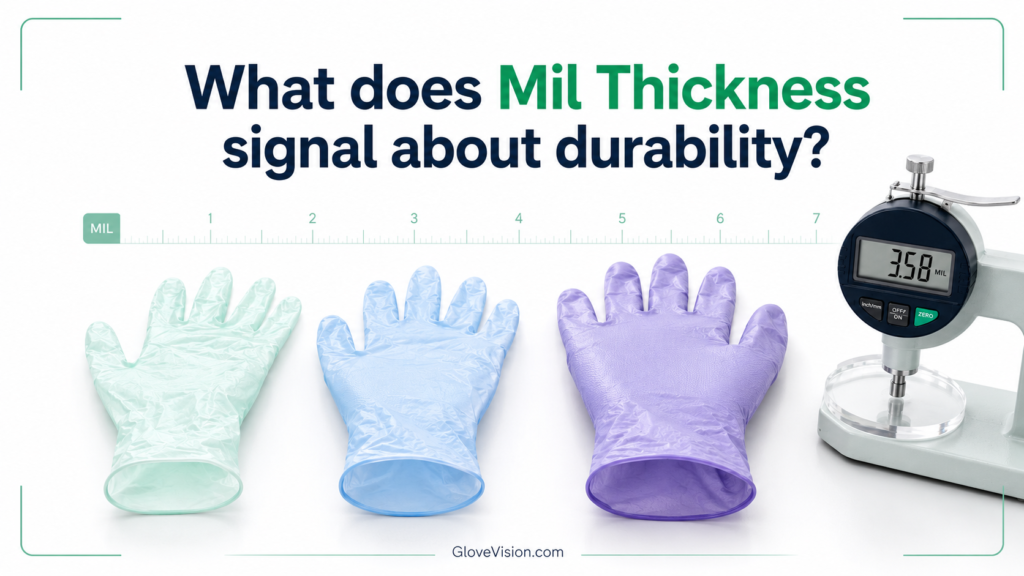
What does mil thickness signal about durability?
Mil thickness signals how thick Disposable Gloves are at a measured location, but it does not prove durability or safety by itself. It can help users understand part of a glove’s durability profile, tactile feel, stiffness, and barrier expectations, while real performance still depends on material, formulation, measurement location, glove design, fit, task stress, chemical exposure, contact duration, manufacturer testing, product labeling, and facility policy.
This page explains mil thickness meaning, measurement location, durability limits, material differences, medical glove selection, AQL interpretation, sizing and donning controls, failure response, and a final compliance checklist for comparing Disposable Gloves without relying on mil thickness alone.
This article provides educational guidance about Disposable Gloves mil thickness, durability signals, material differences, task selection, fit, donning, hand hygiene, and failure response and does not replace product labeling, manufacturer testing, chemical compatibility data, Safety Data Sheets, medical glove category requirements, sterile procedure protocols, food-safety rules, facility policy, hand hygiene procedures, or exposure-response protocols. The exact glove material, mil thickness, measurement location, formulation, fit, task, chemical, contact duration, medical category, food-contact condition, and local procedure must determine which Disposable Gloves are suitable.
Why does mil thickness influence the mechanical durability of standard Disposable Gloves?
Mil thickness influences the mechanical durability of standard Disposable Gloves because a thicker material layer may affect tear resistance, puncture behavior, abrasion tolerance, tactile feel, stiffness, and fatigue, but only alongside material and product design.
Mil thickness belongs inside the broader category because Disposable Gloves differ by material choice, thickness, color signals, and short-use limits.
What does mil thickness mean?
Mil thickness means the measured thickness of glove material at a specified glove location.
One mil equals 0.001 inches, which also equals 0.0254 millimeters. For Disposable Gloves, that value usually describes how thick the material is at a measured location such as the palm, finger, fingertip, cuff, or another named zone.
Why does measurement location matter?
Measurement location matters because thickness can vary across the glove.
A Disposable Glove may list different values for fingertip thickness, palm thickness, cuff thickness, textured areas, reinforced zones, or thin stretch zones. A palm value from one glove should not be treated as equivalent to a fingertip value from another glove unless the location and product category are clear.
How can mil thickness influence durability?
Mil thickness can influence durability when a thicker material layer works together with material, formulation, design, and testing.
Thickness may affect tear resistance, puncture resistance, abrasion tolerance, chemical breakthrough behavior, tactile sensitivity, stiffness, and hand fatigue, but it is still only one factor in a product-specific durability profile.
What else affects Disposable Gloves durability?
Disposable Gloves durability also depends on material, polymer formulation, manufacturing quality, design, texture, elasticity, fit, task stress, chemical exposure, contact duration, storage, and manufacturer testing.
A glove with more material at one location can still fail if the formulation, glove design, sizing, storage, chemical exposure, or work task is not supported by product documentation.
What should the article avoid saying?
The article should avoid saying that mil thickness determines durability by itself or proves that Disposable Gloves are safer, chemical-resistant, puncture-resistant, medical-suitable, or defect-free.
It should also avoid saying that thicker gloves are always safer, thicker gloves are automatically chemical-resistant, thicker gloves are automatically puncture-resistant, thinner gloves are always weaker, or mil thickness proves medical suitability.
| Mil Factor | Can Signal | Cannot Prove | Verify |
|---|---|---|---|
| Palm mil | Material at palm | Whole-glove durability | Location and product spec |
| Fingertip mil | Fingertip feel and wear signal | Palm or cuff thickness | Spec and task location |
| Higher value | More material at measured point | Puncture or chemical safety | Material, formula, test data |
| Lower value | Possible tactile sensitivity | Automatic weakness | Task stress and labeling |
| Reinforced zone | Local grip or thickness | Whole-glove protection | Zone location and testing |
| Chemical task | Thickness may matter | Breakthrough time | Chemical, duration, permeation data |
| Medical task | Category may include AQL | Medical suitability by thickness | Category labeling and policy |
Use this matrix as a signal map, not as a universal mil ranking or safety approval.
How does material formulation modify the relationship between thickness and durability in protective Disposable Gloves?
Material formulation modifies the relationship between thickness and durability because different glove materials can stretch, tear, fatigue, resist chemicals, and fit differently even at similar mil thicknesses.
Food-service thickness choice should stay task-based because Food Handling Gloves focus on food contact, task discipline, and short-duration barrier needs.
How does nitrile affect thickness interpretation?
Nitrile affects thickness interpretation because nitrile Disposable Gloves may offer useful durability, stretch, and chemical resistance in some products, but performance still depends on the exact formulation and testing.
Accelerator profile, texture, glove design, intended use, chemical compatibility, and manufacturer testing should be reviewed before treating any nitrile mil value as a task-suitability claim.
How does latex affect thickness interpretation?
Latex affects thickness interpretation because natural rubber latex Disposable Gloves may offer strong elasticity and tactile feel in some products, but latex also has important allergy, policy, and compatibility limits.
Latex should not be treated as universally better because of elasticity; product labeling, facility latex policy, clinical requirements, and chemical compatibility still control use.
How does vinyl affect thickness interpretation?
Vinyl affects thickness interpretation because many vinyl Disposable Gloves are less elastic than nitrile or latex, so fit, stretching, tear risk, and task stress need careful review.
Vinyl thickness should be interpreted with formulation, plasticizer system, food-contact or medical documentation, intended use, and contact conditions rather than as a universal strength answer.
How does polyethylene affect thickness interpretation?
Polyethylene affects thickness interpretation because Polyethylene Disposable Gloves are often light-duty film gloves intended for short-duration, low-stress tasks.
Polyethylene Disposable Gloves should not be treated as puncture-resistant, heat-resistant, medical-grade, or chemical-resistant unless documentation supports that exact use.
What is the correct comparison rule?
The correct comparison rule is to compare Disposable Gloves by material, formulation, test data, labeling, task risk, contact duration, and manufacturer documentation—not by mil thickness alone.
Similar mil values can behave differently across materials, so the safer comparison is product-to-product, same-location, same-category, same-task, and documentation-backed.
| Material | Thickness Meaning | Possible Strength | Main Limit | Verify |
|---|---|---|---|---|
| Nitrile | Durability signal | Stretch and chemical resistance in some products | Formula and chemical-specific limits | Spec and compatibility data |
| Latex | Works with elasticity | Tactile feel and stretch | Allergy and policy restrictions | Labeling and facility policy |
| Vinyl | Adds material, elasticity differs | Some low-stress tasks | Tear, fit, contact limits | Documentation and use |
| Polyethylene | Film-thickness signal | Simple short-task barrier | Low elasticity, light-duty limits | Task documentation |
| Neoprene | Product-specific signal | Potential chemical or elasticity advantages | Not universal across chemicals | Compatibility and labeling |
| Polyisoprene | Category-specific signal | Latex-like feel in some products | Category and chemical limits | Medical/category documentation |
This table compares interpretation factors, not universal material rankings.
Which mil thickness signals should guide task selection for medical Disposable Gloves?
Mil thickness signals can guide task selection for medical Disposable Gloves only when they are interpreted with glove category, measurement location, AQL meaning, hazardous-drug data, product labeling, and facility policy.
Medical use needs category control because Medical Gloves differ through clinical contact, sterile barrier needs, and precision fit. FDA medical glove context also treats examination gloves, surgical gloves, and chemotherapy gloves as category-specific products rather than thickness-only choices. [FDA]
How should thin medical Disposable Gloves be discussed?
Thin medical Disposable Gloves should be discussed as options that may support tactile sensitivity and dexterity only when product labeling and task conditions support their use.
Patient-care use may require category-specific products because Examination Gloves are built for routine clinical contact, ambidextrous use, and standard fit.
How should thicker medical Disposable Gloves be discussed?
Thicker medical Disposable Gloves should be discussed as options that may support durability or barrier confidence in some tasks, but only when the exact glove category, labeling, testing, and facility policy support that use.
Thickness should not be treated as proof of suitability for surgery, chemotherapy handling, sterile fields, high-puncture-risk procedures, chemical exposure, or sharp-instrument tasks.
How should surgical or high-risk medical tasks be handled?
Surgical or high-risk medical tasks should be handled through procedure-specific glove category, sterile requirements, facility protocol, and product documentation rather than a universal mil thickness number.
Sterile procedures require a different glove category because Surgical Gloves are shaped by sterile exposure, anatomical shaping, and precision fit.
How should hazardous drugs or chemotherapy be handled?
Hazardous drugs or chemotherapy should be handled with gloves specifically tested, labeled, or documented for that exposure, not by relying on thickness alone.
Chemotherapy or hazardous-drug claims should be tied to product-specific labeling, appropriate testing support, manufacturer data, and facility policy; thickness alone is not enough. [FDA]
Chemical selection should not rely on mil thickness alone because Chemical-Resistant Lab Gloves require material matching and handling-fit verification.
How should AQL be explained?
AQL should be explained as lot-sampling or leak-quality information in medical glove contexts, not as a durability score.
AQL should not be used as a puncture-resistance, tensile-strength, durability, individual-glove guarantee, or chemical-resistance rating. [eCFR]
Define exam, sterile, hazardous-drug, chemical, or higher-risk use.
Check examination, sterile surgical, chemotherapy-tested, or specialty need.
Confirm palm, fingertip, cuff, or measured zone.
Treat AQL as sampling or leak-quality context only.
Use compatibility, permeation, hazardous-drug, or chemotherapy documentation.
Choose a documented glove that matches category, fit, and policy.
Select the best-fitting approved model.
Confirm movement, fingertip control, and cuff position.
Avoid overstretching, twisting, or fingernail damage.
Watch stiffness, numbness, bunching, or grip loss.
Remove torn, punctured, softened, or compromised gloves.
Follow procedure after removal.
This workflow prevents thickness from becoming the only selection factor.
How should operators manage donning and physical usage limits to preserve Disposable Gloves?
Operators should preserve Disposable Gloves by choosing the best-fitting approved size, avoiding default sizing down, donning gently, monitoring fatigue and control, and following hand hygiene procedure.
Step 1: Select the best-fitting approved size
The best-fitting approved size is the Disposable Glove size that stays secure without loose fingertips, palm bunching, cuff slippage, webbing tension, restricted motion, reduced control, or increased fatigue.
The goal is controlled fit, not maximum tightness. Sizing should support circulation, thumb movement, fingertip control, palm fit, cuff position, and safe task performance.
Step 2: Avoid sizing down as a default fix
Sizing down should not be used as a default fix because a smaller glove can increase material stress, hand fatigue, tearing risk, reduced circulation, and reduced dexterity.
If the approved size does not control fingertips, palm bunching, or cuff slippage, the safer fix may be a different model, material, or approved product—not simply a smaller size.
Step 3: Don Disposable Gloves without overstretching
Disposable Gloves should be donned without overstretching because aggressive pulling, fingernail pressure, twisting, or wet-hand donning can weaken the glove before use.
Users should avoid excessive cuff pulling, fingernail pressure at the fingertip, palm or webbing overstretching, and twisting. Any glove visibly damaged during donning should be replaced.
Step 4: Monitor fatigue and control during use
Fatigue and control should be monitored during use because hand fatigue, numbness, stiffness, bunching, or grip loss can signal a mismatch between glove size, mil thickness, material, and task.
Loss of tactile control or grip stability should trigger a task review, product review, or supervisor review under facility procedure rather than continued use of a poorly matched glove.
Step 5: Use correct hand hygiene
Disposable Gloves do not replace hand hygiene.
Hands should be cleaned before donning and after glove removal according to the relevant healthcare, food-service, laboratory, or workplace procedure, and gloves should be removed carefully to reduce hand contamination risk. [CDC]
What corrective actions resolve premature tearing or degradation in compromised Disposable Gloves?
Corrective actions for premature tearing or degradation in compromised Disposable Gloves should stop the task safely, remove the glove without worsening exposure, follow hygiene or exposure protocol, and reassess glove selection.
Cleaning-agent contact needs separate review because Cleaning Gloves are shaped by household chemical exposure, lining, reuse care, and task fit.
What should happen after a physical tear or puncture?
After a physical tear or puncture, Disposable Gloves should be removed and replaced because the barrier may no longer separate the user, task, or surface as intended.
Disposable gloves should be changed when torn, punctured, contaminated, or when barrier function is compromised, while the setting-specific procedure controls exact response. [OSHA]
What should happen if a glove catches on a tool or sharp object?
If a glove catches on a tool or sharp object, the user should stop movement safely and avoid pulling forcefully against the caught material.
The glove should be inspected and replaced if the material tears, stretches, punctures, or becomes uncertain. Repeated catching suggests task stress, glove fit, or product selection should be reassessed.
What should happen after chemical swelling or softening?
After chemical swelling or softening, Disposable Gloves should be removed because swelling, softening, cracking, stickiness, or integrity loss may signal chemical incompatibility.
Chemical suitability requires exact glove model, material, thickness, chemical, concentration, contact duration, compatibility or permeation data, SDS review, and facility protocol; general thickness is not enough. [ACS]
What should happen after possible exposure?
After possible exposure, users should follow the relevant workplace protocol for the setting, substance, and exposure type.
Blood or body-fluid exposure, chemical exposure, hazardous-drug exposure, or food-contamination events should be handled through the site’s exposure or contamination procedure, not through general article advice. [OSHA]
How can repeat failures be prevented?
Repeat failures can be prevented by reviewing material type, mil thickness, measurement location, glove size, task stress, chemical compatibility, contact duration, change timing, user training, and the facility-approved product list.
OSHA hand-protection context supports matching hand protection to hazards such as cuts, abrasions, punctures, chemical burns, thermal burns, and harmful temperatures, but product-specific documentation still controls Disposable Gloves selection. [OSHA]
| Failure Type | Possible Cause | Immediate Action | Check | Prevention |
|---|---|---|---|---|
| Tear, puncture, split | Sharp edge, stress, poor fit | Stop, remove, clean, replace | Durability and intended use | Better documented glove or system |
| Caught glove | Tool, bone, rough surface | Stop; do not pull hard | Task stress and fit | Safer handling method |
| Swelling or softening | Chemical incompatibility | Stop exposure and remove | Compatibility data | Chemical-compatible glove |
| Sticky or cracked | Material breakdown | Remove immediately | Chemical and duration | Update product and SOP |
| Possible exposure | Fluid, chemical, food event | Follow protocol | Exposure report and review | Train or change workflow |
| Repeat failures | Product-task mismatch | Pause and reassess | Spec and policy | Update approved list |
Do not keep using compromised Disposable Gloves.
Which compliance checklist verifies that selected mil specifications of Disposable Gloves match operational risks?
A compliance checklist verifies that selected mil specifications of Disposable Gloves match operational risks by checking measurement location, hazards, material, chemical compatibility, medical category, AQL meaning, fit, donning, hand hygiene, and failure response.
Mil specification and safety compliance checklist
Selected Disposable Gloves match operational risks only when mil location, mechanical hazards, material, chemical compatibility, medical category, AQL meaning, fit, donning, hygiene, and failure-response checks align with product documentation.
A completed checklist supports review, but it does not replace product labeling, manufacturer testing, chemical compatibility data, SDS, medical category requirements, facility policy, or exposure protocol.
Palm, fingertip, cuff, or other measurement location is identified.
Sharp hardware, bones, rough surfaces, tools, packaging, abrasion, or repeated grip are checked.
Material and formulation are verified against product documentation.
Exact glove model, material, chemical, concentration, and duration are reviewed.
Examination, sterile surgical, chemotherapy-tested, or other specialty category is checked when needed.
AQL is treated as lot-sampling or leak-quality context, not strength proof.
Motion, circulation, fingertip control, webbing tension, and fatigue are reviewed.
Users avoid excessive pulling, fingernail pressure, cuff overstretching, and twisting.
Hand cleaning before donning and after removal follows procedure.
Tear, puncture, catching, swelling, softening, or degradation response is clear.
This checklist supports safer selection, but it does not create product approval.
Conclusion
Mil thickness signals part of a Disposable Gloves durability profile, but it does not prove safety by itself. It tells users how much material is present at a measured location, but durability still depends on measurement location, material, formulation, glove design, task stress, fit, donning, storage, manufacturer testing, and product labeling.
Mil thickness alone does not prove puncture resistance, chemical resistance, medical suitability, chemotherapy protection, or sterile-procedure suitability. AQL is not a durability or puncture-strength score, gloves do not replace hand hygiene, and torn, punctured, swollen, softened, caught, degraded, or unsupported gloves should be replaced or substituted with a documented task-matched option.
Frequently Asked Questions
Does higher mil thickness always mean stronger Disposable Gloves?
No. Higher mil thickness does not always mean stronger Disposable Gloves because material, formulation, design, measurement location, fit, task stress, and manufacturer testing also affect durability.
What does one mil mean, and why does location matter?
One mil means 0.001 inches, or 0.0254 millimeters, at the measured glove location. Location matters because fingertip, palm, cuff, textured, reinforced, and stretch zones can have different values.
Can mil thickness prove chemical resistance?
No. Mil thickness alone cannot prove chemical resistance; chemical suitability requires exact glove model, material, chemical, concentration, contact duration, and manufacturer compatibility or permeation data.
Can mil thickness prove medical, surgical, or chemotherapy suitability?
No. Mil thickness alone cannot prove medical, surgical, sterile, or chemotherapy suitability; those uses depend on product category, labeling, testing, AQL context, documentation, and facility policy.
Is AQL a durability score for Disposable Gloves?
No. AQL is not a durability score; it is lot-sampling or leak-quality information in medical glove contexts and should not be used as puncture, tensile, or chemical-resistance evidence.