
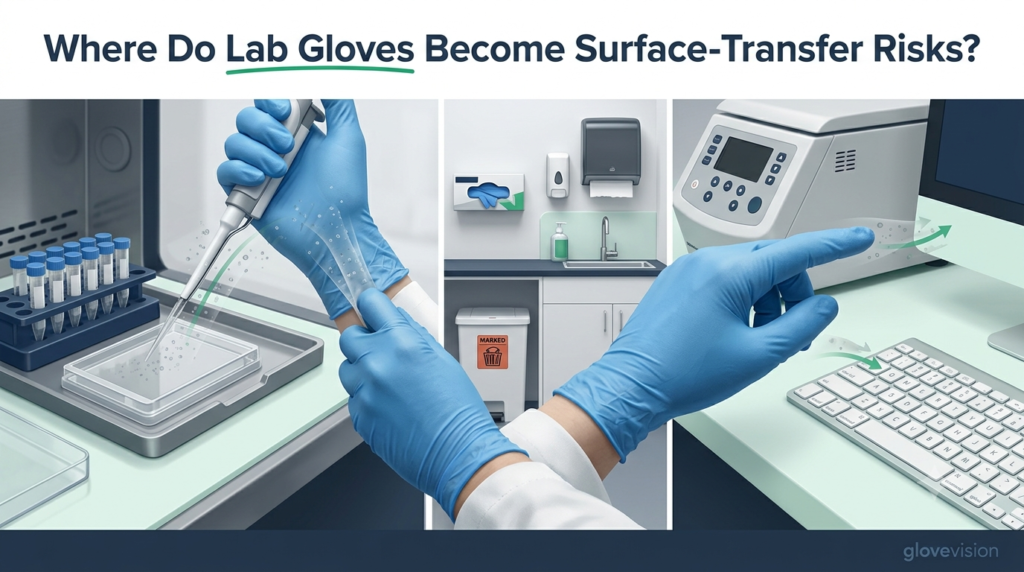
Where Do Lab Gloves Become Surface-Transfer Risks?
Lab Gloves become surface-transfer risks when their exterior contacts a contaminated or uncertain source and later touches another surface, person, sample, product, or clean task without the required interruption. Each contact creates an opportunity for pickup or release, but it does not prove that every contaminant was collected or transferred.
Preventing transfer requires more than changing gloves. Laboratories must define task and zone boundaries, control shared touchpoints, separate biological and chemical responses, use controlled doffing, perform appropriate hand hygiene, manage surfaces already contacted, and design workflows that do not depend on memory alone.
Why Can Lab Gloves Become Contamination-Transfer Surfaces?
Lab Gloves can protect the hands from direct contact while simultaneously becoming external surfaces that may pick up and later redistribute unwanted material. Hand protection therefore does not establish exterior cleanliness. This distinction belongs within the broader rule that laboratory-glove selection.
How can Lab Gloves pick up contamination?
Possible sources include samples, chemical-container exteriors, used tools, waste, work surfaces, equipment controls, and another contaminated glove. Pickup varies with contaminant type, quantity, wetness, glove material, pressure, duration, repeated contact, and surface texture.
How can Lab Gloves create a later transfer opportunity?
A later touch may expose a shared keyboard, clean sample, reagent bottle, colleague, personal item, public surface, or the worker’s face, glasses, hair, and clothing. The correct claim is that transfer may occur—not that every later touch releases all material present.
Why can Lab Gloves look clean while their state is uncertain?
Biological material, chemical residue, sample material, and fine particles may be invisible. Inspection can identify visible soil, tears, punctures, swelling, or other degradation, but appearance alone cannot establish an uncontaminated exterior.
Why do Lab Gloves not replace hand hygiene?
Hands may become contaminated through small defects, cuff contact, incorrect removal, or contact after removal. CDC states that gloves are not a substitute for hand hygiene, hands should be cleaned after removal, and dirty glove exteriors can soil the hands during removal. [CDC-HH]
Which Contamination Pathways Turn Lab Gloves Into Transfer Risks?
Lab Gloves become transfer risks through specific pathways connecting a source to a possible receiver and consequence. The pathway must be reconstructed rather than inferred from the surface name alone.
What is a source-to-equipment pathway involving Lab Gloves?
A contaminated sample may contact Lab Gloves, followed by a centrifuge control and then another worker. WHO laboratory guidance identifies contaminated gloves used on equipment such as centrifuges or telephones as potential infection sources in biological laboratory work. [WHO-7.3]
What is a contaminated-to-clean task pathway involving Lab Gloves?
A used specimen container may be followed by contact with a clean reagent bottle or clean procedure. The interruption point must be placed before the clean task, not after the receiving item has already been touched.
What is a laboratory-to-public pathway involving Lab Gloves?
A laboratory hazard may move through gloved contact to a public telephone or door control and expose an unprotected user. OSHA identifies contaminated-glove use of a public telephone as unacceptable within its Bloodborne Pathogens enforcement context. [OSHA-CPL]
What is a glove-to-body or doffing pathway?
Lab Gloves may touch the face, glasses, hair, clothing, bare fingers, or wrist. During removal, the contaminated exterior should be rolled inward and kept away from bare skin and clean surfaces. WHO describes inside-out removal that contains the exterior. [WHO-DOFF]
What is a glove-to-sample pathway?
Material from Sample A may reach Sample B, a control, reagent, sterile tool, culture vessel, or analytical instrument. The consequence may be cross-contamination, an unreliable result, or a deviation requiring quality review; sample rejection must follow the applicable procedure rather than a universal rule.
Which Touchpoints and Task Transitions Create Transfer Opportunities for Lab Gloves?
The importance of a touchpoint depends on what contacted the Lab Gloves, who or what will touch the surface next, and the possible consequence. A keyboard is not inherently assigned one fixed risk level; its status depends on whether it is dedicated, covered, shared, cleanable, and included in the workflow.
Which shared touchpoints should be mapped?
Map keyboards, touchscreens, telephones, door controls, light switches, drawer handles, centrifuge and microscope controls, pipettes, refrigerators, freezers, label printers, pens, and notebooks. CDC diagnostic-laboratory guidance advises removing gloves before telephones and common computers and cleaning items touched with used gloves. [CDC-LAB]
Which personal contacts should be prohibited?
Potentially contaminated Lab Gloves should not touch the face, eyes, mouth, hair, glasses, personal phone, clothing adjustments, food, drink, or personal belongings. These contacts bypass controlled cleaning routes and may move material directly to the worker or outside the laboratory.
Which task transitions require explicit rules?
Rules should define movement from contaminated to clean tasks, between connected controlled rooms, into public or glove-free areas, during data entry, after interruptions, and before laboratory exit. Movement into higher-control work should follow the defined clean-area boundaries.
| Workflow stage | Expected touchpoints | Prohibited or controlled touchpoints | Designed alternative | Verification |
|---|---|---|---|---|
| Sample handling | Assigned sample, rack, dedicated tools | Keyboard, phone, clean reagent exterior | Separate data-entry point or glove change | Observe sequence |
| Chemical dispensing | Container, closure, dedicated tools | Personal items, public controls | Hands-free or dedicated controls | Review bench layout |
| Waste handling | Approved waste opening | Clean stock and reusable controls | Foot-operated or touchless bin | Check waste route |
| Data entry | Dedicated or covered interface | Unmanaged shared keyboard | Clean operator, washable cover, or planned change | Cleaning record |
| Zone transition | Approved transfer items | Public door and hallway surfaces | Removal point before boundary | Boundary audit |
| Laboratory exit | Waste and removal station | Phone, bag, lift control, public door | Doff, hand hygiene, then exit | Exit observation |
How Should Biological, Chemical, and Sample Events Involving Lab Gloves Be Distinguished?
Biological contamination, chemical residue, sample-integrity contamination, mixed hazards, and unknown events require different evidence and controls. One disinfectant, glove-change rule, or waste route cannot safely resolve every branch.
| Event type | Main concern | Required information | Glove action | Surface or workflow action | Escalation trigger |
|---|---|---|---|---|---|
| Biological | Infectious-material transfer | Agent, material, zone, exposure route | Remove, replace, or validated biological disinfection | Approved biological disinfection and biohazard waste | Possible worker or area exposure |
| Chemical | Residue, skin exposure, reaction, spread | Exact chemical, concentration, SDS, contact condition | Prompt removal or chemical-specific action | Isolate and use chemical-specific decontamination | Unknown chemical, spill, symptoms, uncontrolled source |
| Sample integrity | Cross-contamination or unreliable result | Source sample, receiver, method sensitivity | Replace before clean work | Clean tools and assess sample impact | Quality or deviation criterion met |
| Mixed | More than one hazard | All known components and incompatibilities | Stop and remove safely | Use coordinated biosafety, chemical-safety, and quality response | Controls conflict or exposure is possible |
| Unknown | Uncertain glove and surface state | Contact history, integrity, surfaces touched | Conservative removal or replacement | Stop clean work; assess and isolate as needed | Information cannot be reconstructed |
Why can biological disinfection not automatically manage chemical residue?
An agent selected to reduce microorganisms may not remove or deactivate a chemical. In hazardous-drug work, OSHA notes that alcohol used for microbial disinfection does not deactivate hazardous drugs and may spread residue; this warning is specific to that context and is not a universal chemical rule. [OSHA-HD]
How should unknown events involving Lab Gloves be handled?
Stop clean work, treat the glove state as uncertain, remove or replace according to SOP, perform the required hand hygiene, identify surfaces already touched, assess worker, sample, product, and public impact, and record or escalate the deviation where required.
How Should Laboratories Design Workflows That Reduce Contact by Lab Gloves?
The strongest controls reduce unnecessary touches before they occur. Laboratories should prefer dedicated equipment, physical zoning, cleanable covers, hands-free controls, one-direction workflow, planned glove-change points, and accessible hand-hygiene facilities over slogans that rely on perfect memory.
Which equipment controls reduce contact by Lab Gloves?
Use dedicated keyboards, washable covers, foot pedals, elbow controls, voice input, automatic doors, hands-free waste openings, separated label printers, and task-positioned supplies. Equipment should be placed so the worker does not cross a clean boundary to continue a contaminated task.
When may clean-hand/dirty-hand techniques be used?
Only when formally designed, task-tested, supported by equipment layout, documented in the SOP, trained, observed, and backed by failure-response rules. Informally reserving fingers as “clean” is too fragile to serve as a reliable control.
Why should paper towels not be routine intermediaries?
Paper towels, tissues, sleeves, and disposable scraps may become contaminated, tear, lack chemical resistance, transfer residue, or spread material during disposal. They are not substitutes for an approved touch-control method.
Where should removal and replacement supplies be placed?
Place correctly sized replacement gloves, waste containers, hand-hygiene facilities, and surface-control supplies at the actual interruption point. A glove-change rule fails when workers must touch multiple uncontrolled surfaces to reach the supplies.
When Should Lab Gloves Be Removed, Changed, Disinfected, or Escalated?
The action depends on the hazard, current glove state, integrity, defined zone, next task, contacted surfaces, and the approved procedure. “Remove,” “replace,” “disinfect,” and “escalate” are not interchangeable instructions.
When should Lab Gloves be removed?
Remove them before leaving the permitted zone, entering a glove-free or public area, performing controlled doffing after contamination, or when the SOP assigns removal at the end of a task. Removal ends wear; it does not by itself authorize a new task.
When should Lab Gloves be changed?
Change them when contamination, damage, compromised fit, uncontrolled contact, task transition, sample-integrity concern, or the validated wear boundary requires a fresh pair. Documented removal and replacement criteria should define these triggers.
When may Lab Gloves be disinfected during use?
Only through a Lab Glove disinfection covering the exact glove, contaminant, agent, concentration, application, coverage, compatibility, frequency, and replacement boundary. Disinfection must not repair damage, treat unknown chemicals, permit indefinite reuse, or clean equipment already touched.
When should Lab Gloves be escalated rather than simply changed?
Escalate when there is possible skin, eye, face, clothing, or public exposure; an uncontrolled spill or leak; an unknown or mixed hazard; significant sample or product impact; incompatible cleaning requirements; or uncertainty that cannot be resolved at the workstation.
| Contact event | Glove condition | Next task | Required action | Surface action | Escalation trigger |
|---|---|---|---|---|---|
| Approved touchpoint in defined workflow | Intact; known state | Same controlled task | Continue only if SOP allows | Follow scheduled control | State becomes uncertain |
| Contaminated or uncontrolled surface | Intact but contaminated or suspected | Any clean task | Stop, remove or replace | Assess surface immediately | Exposure or spread beyond zone |
| Tear, puncture, degradation, loss of fit | Compromised | Any task | Remove and replace | Assess exposure and source | Skin contact or hazardous material |
| Validated biological disinfection point | Compatible and intact | Defined continued task | Disinfect within procedure limits | Continue equipment controls | Exceeded frequency or compatibility limit |
| Unknown contact history | Uncertain | Clean or high-consequence task | Remove or replace conservatively | Trace and assess contacted surfaces | History cannot be reconstructed |
How Should Controlled Doffing and Hand Hygiene Interrupt Transfer From Lab Gloves?
Controlled doffing should keep the contaminated exterior away from bare fingers, wrists, clothing, clean surfaces, and waste-container controls. The removed gloves should be contained and discarded through the correct route, followed by hazard-appropriate hand hygiene.
How should Lab Gloves be removed?
Grasp the first glove at or beneath the cuff without touching bare skin, peel it away so the exterior rolls inward, hold it in the still-gloved hand, slide bare fingers beneath the remaining cuff, and peel the second glove over the first. Avoid snapping cuffs or allowing the exterior to brush clothing or nearby surfaces.
Which hand-hygiene method should follow Lab Gloves?
Use the method assigned by the hazard and procedure. Alcohol-based hand rub may support biological hand hygiene in defined conditions, but CDC notes that sanitizer may not remove harmful chemicals such as pesticides and heavy metals. It must not be presented as universal chemical skin cleaning. [CDC-SAN]
What should happen if bare skin is contaminated during removal?
Stop the ordinary workflow and follow the chemical-specific, biological-exposure, or mixed-hazard response. Do not continue merely because the gloves have been discarded or because no symptoms are present.
How Should Surfaces and Equipment Touched by Lab Gloves Be Managed?
Changing Lab Gloves does not clean a keyboard, phone, centrifuge control, bottle exterior, notebook, or instrument already touched. The surface remains an open part of the pathway until it has been assessed and managed through the correct biological, chemical, quality, or unknown-state process.
Shared interfaces should follow a documented shared-equipment decontamination.
Which surfaces require immediate assessment?
Assess shared controls, clean-area surfaces, personal items, public surfaces, container exteriors, waste controls, reusable tools, sample-contact items, and anything touched after the glove state became contaminated or uncertain.
How should biological contamination be managed?
Use the approved organism- and surface-appropriate cleaning and disinfection process, required contact conditions, waste route, and exposure evaluation. CDC diagnostic-laboratory guidance recommends decontaminating work surfaces after work and after spills or splashes of potentially infectious material. [CDC-LAB]
How should chemical residue be managed?
Identify the exact chemical or mixture, review the SDS and equipment compatibility, isolate the area where necessary, use the approved chemical-specific decontamination method, and manage waste and exposure through the chemical-safety procedure.
When should equipment be isolated?
Isolate or remove equipment from service when the contaminant is unknown, cleaning compatibility is uncertain, internal components may have been affected, the surface cannot be cleaned safely in place, or release criteria require specialist verification.
| Contacted surface | Hazard question | Required management | Verification | Return-to-service boundary |
|---|---|---|---|---|
| Keyboard or touchscreen | Biological, chemical, sample, or unknown? | Clean/disinfect, decontaminate, replace cover, or isolate | Procedure record or visual/technical check | Approved process completed |
| Instrument control | Can agent enter seams or internal components? | Use manufacturer-compatible process; isolate if uncertain | Equipment owner or safety release | Function and cleanliness confirmed |
| Container exterior | Will it enter a clean zone or be handled ungloved? | Decontaminate, overpack, relabel, or segregate | Clean-transfer check | Exterior status controlled |
| Personal item | Can it be safely cleaned? | Stop use, isolate, assess exposure and cleaning | Supervisor or safety decision | Item released or discarded |
| Sample or reagent | Could result integrity be affected? | Quarantine and apply quality procedure | Quality review | Use, retest, or rejection decision documented |
Which Mistakes Make Lab Gloves More Likely to Spread Contamination?
Weak controls usually combine an inaccurate assumption with a workflow that makes the wrong touch easy. Correcting worker behavior without correcting equipment location, zone design, and supply placement leaves the same failure path open.
Which transfer assumptions affect Lab Gloves?
Common errors include believing every touch guarantees transfer, believing visually clean means uncontaminated, assuming glove thickness proves chemical protection, or treating new gloves as a reset for every surface already touched.
Which workflow and behavioral shortcuts affect Lab Gloves?
Examples include unplanned movement between clean and contaminated tasks, using personal phones, touching the face, reserving “clean fingers,” using paper towels as barriers, carrying pens or notebooks across zones, and placing removal supplies far from the decision point.
Which disinfection mistakes affect Lab Gloves?
Do not spray an unknown residue, use biological disinfectant as chemical decontamination, disinfect damaged gloves, ignore glove–agent compatibility, extend wear indefinitely, or wash disposable gloves for reuse. OSHA’s Bloodborne Pathogens Standard states that disposable single-use gloves must not be washed or decontaminated for reuse, while reusable utility gloves are managed separately. [OSHA-BBP]
Which surface-management mistakes affect Lab Gloves?
Cleaning only the gloves, cleaning only the obvious surface, forgetting waste controls and container exteriors, returning uncertain equipment to service, and failing to assess sample or product impact all leave the pathway incomplete.
What Should Laboratories Verify About Surface Transfer From Lab Gloves?
Verification should show that the laboratory can identify the source, assign the glove state, interrupt the pathway, manage the receiver, and learn from deviations. Training completion alone is not evidence that the workflow is functioning.
- Identify biological, chemical, sample, mixed, or unknown branch.
- Record likely source, receiving surface, and consequence.
- Use “possible pickup” and “transfer opportunity” accurately.
- Mark controlled, clean, public, and glove-free boundaries.
- Define connected-area movement rules.
- Place exit and interruption controls at the boundary.
- Verify product, material, integrity, and intended function.
- Distinguish disposable from reusable utility gloves.
- Confirm disinfectant compatibility where applicable.
- List equipment, keyboards, phones, doors, and personal items.
- Classify each as expected, controlled, or prohibited.
- Define who or what touches each surface next.
- Use dedicated, covered, cleanable, or hands-free controls.
- Separate clean and contaminated supplies.
- Reduce dependence on memory and improvised barriers.
- Document removal, replacement, disinfection, and escalation triggers.
- Replace damaged gloves; never disinfect damage.
- Stop clean work when glove state is unknown.
- Train inside-out removal without exterior-to-skin contact.
- Provide correct waste routes.
- Use hazard-appropriate hand hygiene after removal.
- Trace surfaces touched after the state changed.
- Separate biological disinfection from chemical decontamination.
- Define isolation and return-to-service criteria.
- Assess worker, colleague, public, sample, and product impact.
- Apply exposure, spill, waste, and quality procedures.
- Record deviations and unresolved uncertainty.
- Observe actual work rather than relying on training records.
- Audit touchpoints, glove-change points, and cleaning records.
- Redesign repeated failure paths.
Completion rule: the event is not closed merely because new Lab Gloves were donned. Worker controls, surface controls, downstream impact, and required documentation must also be complete.
Conclusion
Lab Gloves become surface-transfer risks when a contaminated or uncertain exterior enters a later contact without the required interruption. The correct response depends on the source, current glove state, receiving surface, next task, downstream consequence, and hazard-specific procedure—not on appearance or surface name alone.
Reliable prevention combines controlled touchpoints, planned glove actions, careful doffing, appropriate hand hygiene, surface management, and workflow design. Changing gloves is one control step; it is not the whole contamination-control system.
Frequently Asked Questions About Lab Gloves and Surface-Transfer Risk
Does every touch by Lab Gloves transfer contamination?
No. Contact creates a transfer opportunity, but pickup and release vary with the contaminant, quantity, wetness, glove material, pressure, duration, repeated contact, and the receiving surface.
Can Lab Gloves look clean but still be contaminated?
Yes. Biological material, chemical residue, sample material, and fine particles may be invisible. Visual inspection can identify visible soil or damage, but it cannot prove that the exterior is uncontaminated.
When should Lab Gloves be changed?
Lab Gloves should be changed when contamination, damage, uncontrolled contact, a clean-task transition, uncertain contact history, or the approved SOP requires replacement.
Can Lab Gloves be disinfected during use?
Only when a validated procedure covers the exact glove product, contaminant, disinfectant, application method, compatibility, frequency, and replacement boundary. Disinfection does not repair damaged gloves or remove every chemical.
Does changing Lab Gloves clean equipment already touched?
No. Contacted keyboards, phones, instrument controls, containers, and work surfaces still require hazard-appropriate assessment and surface management.