
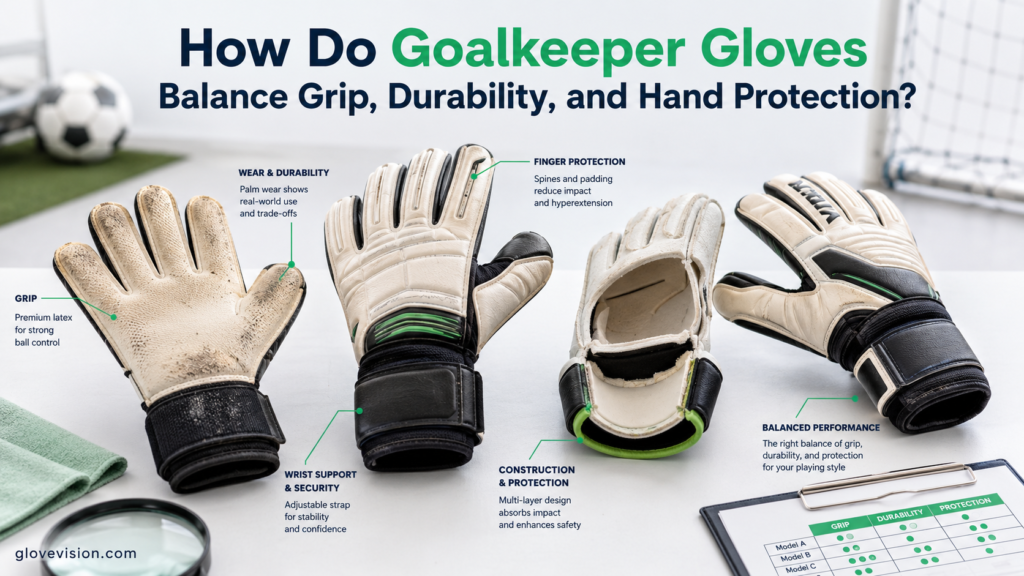
How Do Goalkeeper Gloves Balance Grip, Durability, and Hand Protection?
Goalkeeper Gloves are a performance system that combines ball-contact grip, palm durability, cushioning, finger movement, wrist stability, and anatomical fit. The useful balance comes from the complete glove rather than from one palm compound, cut, support feature, or thickness.
No Goalkeeper Gloves maximize every characteristic equally. Match or training role, playing surface, weather, hand shape, protection needs, handling preference, care burden, and current condition can shift which trade-offs are acceptable.
Educational and safety notice: Goalkeeper Gloves can provide cushioning, grip, abrasion management, and selected finger-support functions, but they cannot prevent every hand, wrist, or finger injury. Follow the exact glove manufacturer’s sizing, preparation, use, care, and replacement guidance. Persistent or worsening pain, swelling, weakness, deformity, numbness, or reduced hand movement should be assessed appropriately rather than managed through glove selection alone.
Why Must Goalkeeper Gloves Balance Grip, Durability, and Hand Protection?
Goalkeeper Gloves require a performance balance because the same materials and structures that influence ball grip also affect palm wear, cushioning, finger mobility, tactile feedback, fit, and long-term usability.
Under the current IFAB Law 4, gloves are permitted as non-dangerous protective equipment and goalkeeper gloves are optional rather than compulsory; that rule establishes equipment status, not grip, sizing, durability, or protective performance. [IFAB]
Which goalkeeping functions place demands on Goalkeeper Gloves?
Catching, holding, parrying, punching, throwing, and rolling or distribution all place demands on the glove’s ball-contact surface, palm alignment, finger movement, cushioning, and wrist security. These are glove requirements only; they do not establish or teach goalkeeper technique.
Why can high-grip palms involve durability trade-offs?
Palm formulation, softness or tack, ground exposure, use frequency, weather, and care can affect both usable grip and wear. A high-grip construction may wear differently or require a different care burden, but “soft equals fragile” and “firm equals durable” are not universal rules.
Why can added protection affect handling?
Extra foam, backhand structures, supports, or wrist systems may cushion selected contact or limit selected movement, but they can also add bulk, weight, flexion resistance, pressure, or reduced tactile feedback.
What defines the best balance?
Start with playing role, surface, weather, use frequency, hand shape, grip priority, durability priority, protection need, and realistic care budget. The broader framework for sports glove grip, padding, and fit reinforces why goalkeeper equipment should be judged around its actual contact interface rather than generic glove features.
| Priority | Supporting Feature | Possible Benefit | Possible Trade-Off | Verification |
|---|---|---|---|---|
| Grip | Palm compound, contact area, thumb/fingertip wrap | More usable palm–ball friction in documented conditions | May demand more care or wear differently | Exact palm, surface/weather claim, current condition |
| Durability | Wear-oriented palm, reinforcement, surface match | Longer usable palm life under the intended use | May change feel, tack, flexibility, or bulk | Manufacturer surface/use guidance + wear inspection |
| Protection | Palm/backhand cushioning, optional finger support, wrist system | May cushion selected contact or limit selected backward movement | Bulk, pressure, stiffness, less tactile feedback | Exact construction + anatomical fit |
| Handling | Glove cut, seams, finger-box volume, thumb geometry | Stable palm, natural opening/closure, direct feel | Close cuts can pressure some hands; wider cuts can add volume | Actual wearer fit and safe ball-contact check |
| Fit | Manufacturer size, hand shape, support alignment | Keeps contact and protective zones aligned | Wrong size can cause bunching, rotation, pressure | Manufacturer chart + physical fit test |
How Do Goalkeeper Gloves Create Grip While Managing Palm Wear?
Goalkeeper Gloves create usable grip through the finished palm–ball interface, where palm formulation, conformity, contact area, moisture, dirt, fit, weather, wear, and ball condition interact.
uhlsport’s current grip documentation differentiates its own palm foams by grip, abrasion resistance, weather, and surface use, including abrasion-oriented RESIST constructions for artificial turf, hard pitches, dirt fields, or indoor use. These are manufacturer-specific examples, not universal latex rules. [uhlsport]
How does latex contribute?
Latex-based or manufacturer-specific palm foams can provide conformity, friction or tack, a broad ball-contact surface, and cushioning, but “latex” is not one uniform performance category and should never be treated as a universal quality ranking.
Why do palms wear?
Ground abrasion, fingertip contact, palm-heel contact, use frequency, debris, surface type, care, and the product’s exact formulation can all contribute. Wear should be read from the actual glove rather than predicted from a fixed match count.
How do palm thickness and reinforcement matter?
More material depth can change cushioning, direct feedback, and wear distribution, while reinforcement can target high-contact zones. No universal palm thickness or reinforcement pattern is best for all players or surfaces.
How do weather and surface affect palms?
Dry grass, wet grass, mud, artificial turf, harder surfaces, cold, and heat can change the palm–ball interface and wear environment. Product-specific wet or surface claims should stay attached to the exact palm construction.
How can unnecessary wear be reduced?
Limit avoidable palm-ground abrasion where practical, remove abrasive debris using approved care, consider separate match and training use when useful, select a palm documented for the expected surface, and follow the exact product care instructions.
| Condition | Grip Effect | Wear Effect | Verification | Decision |
|---|---|---|---|---|
| High-contact palm | May prioritize tack/conformity | Wear rate remains product/use specific | Exact palm documentation | Use when role and care burden fit |
| Wear-oriented palm | May trade some feel or tack for abrasion focus | May support longer use on abrasive surfaces | Exact product/surface claim | Useful for high-use or abrasive contexts when documented |
| Wet condition | Grip can change with palm formulation and water management | Drying and contamination burden may increase | Wet-performance claim for exact palm | Test exact glove in expected condition |
| Abrasive surface | Grip may remain usable while palm surface wears faster | Heel/fingertips often become important wear zones | Surface guidance + inspection | Consider abrasion-oriented palm or separate training pair |
| Contamination | Dirt/residue can reduce usable friction | Embedded debris can accelerate surface damage | Manufacturer cleaning guidance | Clean as approved, then reassess |
| Palm damage | Surface may become inconsistent or unreliable | Cracking/smoothing/tears indicate material loss | Current glove inspection | Replace when reliable function cannot be verified |
How Do Goalkeeper Gloves Provide Hand Protection Without Unnecessarily Restricting Handling?
Goalkeeper Gloves provide selected cushioning and structural support through palm foam, backhand construction, finger zones, wrist systems, and optional support components, but added protection must remain compatible with natural hand movement.
Reusch documents goalkeeper technologies as separate elements—cuts, palms, backhand systems, thumb constructions, and finger-support designs—showing why protection should be evaluated as a complete construction rather than inferred from one feature. [Reusch]
How does padding manage ball contact?
Palm foam, backhand foam, finger padding, and layered constructions may cushion or redistribute selected contact. Padding should not be described as impact-proof or as preventing fractures, dislocations, sprains, or other injuries.
How do finger-support systems affect Goalkeeper Gloves?
No-support, flexible, fixed, removable, and more rigid support architectures can alter backward movement, flexion, bulk, weight, pressure, and handling. Detailed goalkeeper finger-spine protection should be evaluated separately because support alignment and movement trade-offs vary by glove.
A prospective cohort of male professional soccer found a substantially higher hand/wrist/forearm injury incidence among goalkeepers than outfield players; this supports cautious protection language but does not prove that any specific support glove prevents injury. [Study]
How does backhand construction matter?
Padding, flexible zones, rebound or punch zones, breathable panels, weight, and closure design can change cushioning, hand opening, heat, and feel. Their value remains model-specific.
How does wrist construction matter?
Elastic entries, strapless designs, wrap straps, and extended cuffs create different retention, pressure, movement, ventilation, and donning trade-offs. Wrist construction should be judged for secure glove fit rather than treatment of wrist injury.
Where does glove protection end?
Goalkeeper Gloves cannot guarantee prevention of fracture, dislocation, sprain, hyperextension, wrist injury, cut, or crush injury. Symptoms or suspected injury belong to appropriate medical assessment, not glove selection alone.
How Does Goalkeeper Gloves Construction Affect Ball Handling?
Goalkeeper Gloves construction affects handling by changing finger-box volume, palm presentation, seam pressure, thumb contact, glove stability, hand closure, and tactile feedback.
uhlsport’s cut documentation distinguishes close and wider goalkeeper cuts with different fit and catching-surface characteristics, while manufacturer terminology remains model-specific. This supports comparing cut architecture without ranking one pattern universally. [uhlsport]
How do cuts change fit?
Negative, roll-finger, flat/classic, and hybrid constructions can create different finger volume, seam location, palm wrapping, and contact geometry. The name of a cut cannot determine fit without the exact model and wearer.
How do seams and gussets matter?
Internal seams, external seams, textile or latex gussets, and sidewall construction can change pressure, ventilation, flexibility, finger-box volume, and how the glove closes around the hand.
How does palm thickness affect handling?
Lower bulk may increase direct feedback in some gloves, while more material may change cushioning and feel. Neither thin nor thick should be treated as automatically superior.
How do thumb and fingertip wraps matter?
Wraps can change contact area, seam position, flexibility, and wear concentration. The useful result depends on how the finished pattern aligns with the goalkeeper’s thumb and fingertips.
How does fit affect Goalkeeper Gloves ball control?
Poor fit can produce palm bunching, rotation, fingertip folds, support misalignment, and restricted closure. The wider relationship between palm grip and glove fit reinforces that friction cannot compensate for an unstable contact surface.
| Construction | Fit / Handling Character | Possible Benefit | Possible Trade-Off | Verification |
|---|---|---|---|---|
| Negative cut | Closer internal-seam finger fit in many models | Low-volume feel, close finger contact | May feel tight or create seam pressure on some hands | Exact maker terminology + wearer fit |
| Roll finger | Palm material wraps around finger sides | Large contact surface and rounded finger feel | More material volume in some designs | Exact model and hand shape |
| Flat / classic cut | External seams and generally roomier pattern | Wider interior volume | Can create excess material for narrow hands | Actual finger-box fit |
| Hybrid cut | Combines features from more than one pattern | Targeted balance of wrap, contact, and fit | Name alone does not predict fit | Exact manufacturer geometry |
| Lower-bulk palm | Less material between hand and ball | May increase direct feedback | May provide less cushioning in that exact build | Finished-glove feel and role |
| Cushioned palm | More foam/material depth | May cushion selected ball contact | Can reduce direct feedback or add bulk | Exact construction + hand closure |
| Finger support | Fixed/removable/flexible support architecture | May limit selected backward movement | Can add stiffness, pressure, weight, fit constraints | Alignment, movement, manufacturer design |
Which Goalkeeper Gloves Match Different Players, Surfaces, and Conditions?
Goalkeeper Gloves should be matched to playing role, surface, weather, hand shape, grip priority, wear expectations, protection needs, and the goalkeeper’s preferred handling feel.
Which Goalkeeper Gloves suit competitive matches?
Prioritize reliable palm performance for expected conditions, stable fit, usable handling, suitable cushioning or support, and realistic care. Do not automatically prescribe the softest or tackiest palm.
Which Goalkeeper Gloves suit frequent training?
Evaluate use volume, surface abrasion, reinforcement, care burden, replacement cost, and whether the chosen palm maintains enough grip and structure for repeated sessions.
Which Goalkeeper Gloves suit abrasive surfaces?
Look for product-documented abrasion-oriented palms, then inspect the palm heel, fingertips, high-contact zones, and use frequency rather than assuming any material survives artificial turf or hard ground equally well.
Which Goalkeeper Gloves suit wet or cold conditions?
Assess wet-performance documentation, palm preparation requirements, moisture, liner stability, insulation, bulk, cuff design, and finger mobility. Where cold becomes the dominant issue, cold-weather glove warmth and dexterity explains why warmth and dexterity must be balanced as a separate system.
Which Goalkeeper Gloves suit players needing finger support?
Define the actual support need, then compare architecture, removability, alignment, flexion, pressure, and fit. Support should remain anatomically positioned without creating painful restriction.
Which Goalkeeper Gloves suit different hand shapes?
Check palm width, finger length and width, thumb position, preferred interior volume, and the exact cut rather than selecting from a size number alone.
| Use Context | Grip Priority | Durability Priority | Protection / Fit Check | Best Evidence |
|---|---|---|---|---|
| Competitive match | Reliable palm performance for expected weather | Usable condition through match role | Stable fit, appropriate cushioning/support | Exact palm + cut + weather guidance |
| Frequent training | Consistent handling | Higher wear tolerance often matters | Comfort, movement, replacement cost | Surface/use documentation + inspection |
| Abrasive surface | Grip must remain usable on intended surface | High priority | Palm heel/fingertip wear, fit stability | Product-documented abrasive-surface suitability |
| Wet weather | Wet-performance compatibility | Drying/care burden matters | Liner stability and wrist security | Exact wet-condition claim + care instructions |
| Cold weather | Usable grip with cold/moisture context | Material remains serviceable | Finger mobility, bulk, cuff, insulation | Exact glove + cold/weather guidance |
| Finger-support need | Grip still role appropriate | Support must remain intact | Architecture, removability, alignment, pressure | Manufacturer support design + wearer check |
| Different hand shapes | Palm remains aligned | Fit should not create early wear | Width, finger length, thumb, cut volume | Manufacturer sizing + physical fit |
How Should Goalkeeper Gloves Be Fitted and Function-Checked?
Goalkeeper Gloves should fit closely enough to keep the palm, fingers, thumb, support components, and wrist stable while still allowing comfortable hand opening, functional closure, and natural finger movement.
Nike’s current goalkeeper-glove size chart is one example of manufacturer-specific sizing based on hand width; its dimensions should not be applied to other manufacturers. [Nike]
Glove-design research found that finger segment proportions change with hand posture and that inaccurate finger-region proportioning can contribute to glove displacement and poor fit, supporting a functional movement check rather than static sizing alone. [Study]
How should size be checked?
Use the exact manufacturer chart and model guidance, then verify hand width, hand length where specified, finger length, and the specific cut. Never assume size 8, 9, or 10 is equivalent across brands.
How should palm and fingers fit?
Check palm alignment, fingertip seating, thumb position, seam pressure, palm bunching, and painful compression. A secure fit should not require numbness, pressure, or excessive stretch.
How should movement be checked?
Open and close the hand, flex the fingers, move the thumb and wrist, and confirm any support stays aligned. The glove should move with the hand rather than shift independently.
How should ball interaction be checked?
In a controlled practice setting, confirm that the palm stays stable, the glove does not rotate, bunching does not disrupt the contact surface, excessive pressure is absent, and natural closure remains possible. This is a glove fit check, not catching instruction.
Which fit problems require rejection?
Excessive fingertip folds, palm bunching, internal slipping, numbness, pain, support misalignment, or restricted closure call for resizing or a different cut/construction rather than trying to “break in” a poor fit through discomfort.
| Check | What to Verify | Good Sign | Failure Sign | Decision |
|---|---|---|---|---|
| Product size | Use exact manufacturer chart/model | Hand sits securely without painful compression | Numeric size assumed universal | Resize/recheck model |
| Palm alignment | Palm stays flat through opening/closure | No rotation or bunching | Wrinkles, migration, folds | Try another size/cut |
| Finger length | Fingertips seated | Minimal excess without compression | Slack folds or painful tips | Reject/resize |
| Thumb | Natural hinge and wrap alignment | Thumb moves without pulling glove | Twist/web pressure | Change cut/model |
| Finger support | Support follows intended finger zones | No pressure or misalignment | Spine presses joint or shifts | Reassess support system |
| Wrist | Entry/cuff/closure remains secure | Stable without constriction | Slippage or excessive pressure | Adjust or change closure |
| Hand opening | Full comfortable opening | No material block | Tight backhand/support | Change construction |
| Hand closure | Functional closure without bunching | Palm remains stable | Excess bulk or resistance | Reassess size/cut/padding |
| Interior stability | Liner and palm do not slide independently | Stable contact surface | Internal slipping | Change fit/model |
| Ball-contact feel | Controlled practice confirms stable interface | No disruptive folds/rotation/pressure | Unstable feel or discomfort | Reject/reassess |
How Should Goalkeeper Gloves Be Prepared, Cleaned, Dried, and Stored?
Goalkeeper Gloves should be prepared and maintained according to the exact manufacturer’s instructions because latex compounds, palm treatments, finger-support systems, textiles, closures, and adhesives do not share one universal care routine.
Reusch publishes goalkeeper-specific first-use, moistening, cleaning, air-drying, storage, and surface-selection guidance for its own gloves. Those instructions demonstrate why care must remain product-specific rather than being generalized across all Goalkeeper Gloves. [Reusch]
How should Goalkeeper Gloves be prepared before first use?
Check the exact instructions for prewashing, protective film, palm activation, moistening, support setup, and closure. Do not prescribe one universal preparation sequence.
How should Goalkeeper Gloves be cleaned?
Verify the permitted cleaning agent, water temperature, hand or machine method, rinsing, and whether removable supports should be taken out. Use only what the exact manufacturer allows.
How should Goalkeeper Gloves be dried?
Follow the product directions for air drying, heat exposure, reshaping, and support placement. Do not recommend a radiator, tumble dryer, direct heat, or direct sun unless the exact product instructions permit it.
How should Goalkeeper Gloves be stored?
Keep the glove in the dry, ventilated, shape-preserving conditions specified by the maker, protecting the palm and avoiding prolonged compression where relevant.
Should match and training Goalkeeper Gloves be separated?
Separate pairs can be an optional wear-management strategy when match palm performance is prioritized, training volume is high, surfaces are abrasive, or replacement cost matters. It is not a universal requirement.
| Area | Verification | Care Boundary | Retirement Signal |
|---|---|---|---|
| Exact instructions | Preparation, washing, drying, storage match the product | Do not import another brand’s routine | Unknown/unsupported care history when function matters |
| Palm | Clean, flexible, usable contact surface | Use only approved cleaning/prep | Deep wear, cracks, smoothing, unreliable grip |
| Seams | Closed and stable | No unapproved stitching/glue | Opening or separation changes structure/fit |
| Backhand | Padding/flexible zones intact | Follow material-specific care | Tear, delamination, permanent damage |
| Supports | Aligned, intact, correctly installed | Remove/adjust only if permitted | Cracked, displaced, pressure-causing support |
| Closure | Retains wrist securely | Keep contamination out as directed | Strap/elastic no longer holds |
| Interior | Dry, stable, not permanently distorted | Dry/store as product directs | Persistent dampness, instability, deterioration |
| Storage | Shape and palm protected | Avoid conditions prohibited by manufacturer | Compression/heat/UV damage that changes function |
| Replacement | Condition-based, not match-count based | No universal service interval | Reliable grip, fit, cushioning, support, or closure cannot be verified |
What Problems and Mistakes Reduce Goalkeeper Gloves Performance?
Goalkeeper Gloves can lose usable performance because of palm wear, contamination, poor fit, unsuitable construction, weather mismatch, care errors, support damage, seam failure, or unstable wrist retention.
Why do Goalkeeper Gloves lose grip?
Possible causes include palm wear, residue, incorrect product-specific preparation, weather, ball condition, surface exposure, fit, and material deterioration. Diagnose the whole interface before blaming the palm name alone.
Why do palms wear quickly?
Abrasive surfaces, palm-ground contact, fingertip wear, high training volume, dirt, storage, care, and palm formulation can all contribute. A short lifespan is not explained by “soft latex” alone.
Why can hand movement become restricted?
Check size, cut, padding, finger supports, seam pressure, palm bunching, and closure tension. A glove that blocks natural opening or closure should be reassessed rather than forced.
Which buying mistakes should be avoided?
Do not buy by tackiness, cut name, thickness, or price alone; do not oversize for “more catching area”; do not maximize padding without checking fit; and do not ignore weather, surface, manufacturer sizing, care burden, or support alignment.
Which problems indicate replacement?
Unreliable palm performance, deep deterioration, seam separation, backhand tears, broken supports, failed closures, unstable interior fit, or permanent structural distortion are replacement signals when reliable function cannot be restored.
| Symptom | Possible Cause | What to Check | Corrective Path | Replacement Trigger |
|---|---|---|---|---|
| Weak grip | Palm wear, residue, wrong prep, weather, ball condition | Exact palm, care, surface, fit | Clean/prepare only as directed; retest | Grip remains unreliable |
| Rapid wear | Abrasive surface, ground contact, high volume, debris | Heel, fingertips, surface match | Use more wear-oriented construction if documented | Deep deterioration or unreliable palm |
| Palm bunching | Wrong size/cut, internal movement | Palm tension, finger length, closure | Resize or change cut | Persistent instability |
| Fingertip slack | Excess finger-stall length | Finger seating and cut volume | Resize/change model | Folds disrupt handling |
| Internal slipping | Moisture, liner movement, poor fit | Interior, palm alignment, cuff | Dry/clean as directed; resize | Cannot restore stable fit |
| Restricted closure | Too-tight size, bulk, padding, support, seams | Hand closure, pressure zones | Change size/construction/support | Pain or movement remains limited |
| Support pressure | Misalignment, wrong finger box, rigid system | Support location and removability | Adjust only as manufacturer allows | Damage or persistent pressure |
| Wrist instability | Closure wear, wrong cuff, poor size | Strap/elastic/entry | Adjust or change system | Closure cannot secure glove |
| Wet-condition mismatch | Palm not suited, saturation, settings/care mismatch | Palm claim, water management, liner | Use documented wet option; dry as directed | Function remains unreliable |
How Should Goalkeeper Gloves Be Chosen for the Best Grip, Durability, and Protection Balance?
Goalkeeper Gloves should be chosen by defining the actual playing role and conditions first, then selecting the palm, cut, protection, fit, and care requirements that create the best complete-glove balance.
Which questions should be answered?
Define match versus training use, surface, expected weather, grip priority, palm longevity priority, cushioning preference, finger-support need, glove cut, hand opening and closure, palm and wrist stability, realistic care burden, and current condition before deciding.
What final rule should guide selection?
Select the best overall Goalkeeper Gloves system—not the glove that maximizes one isolated specification. If grip, durability, protection, fit, handling, care, or condition cannot be reconciled for the actual role, choose another construction.
Conclusion
Goalkeeper Gloves perform best when palm grip, usable durability, hand protection, anatomical fit, and freedom of movement are balanced for the goalkeeper’s actual playing conditions rather than maximized independently.
Palm material alone does not determine quality; softer does not universally mean better grip; firmer does not universally mean longer life; thicker does not universally mean more protection; finger supports do not guarantee injury prevention; cuts cannot be universally ranked; surface and weather change use conditions; care is product-specific; and replacement should follow functional condition.
Frequently Asked Questions
Do Goalkeeper Gloves Lose Grip as Their Palms Wear?
They can. Palm wear can alter the contact surface and usable grip, but the effect depends on the exact palm, wear location, contamination, weather, ball condition, and complete glove.
Are Thicker Goalkeeper Gloves More Protective?
Not automatically. Additional material may increase cushioning in some constructions, but thickness alone does not establish protection and excess bulk can change tactile feedback and hand movement.
Which Goalkeeper Gloves Are Better for Artificial Turf?
There is no universal best glove. Look for product-documented suitability for the expected surface while considering grip, palm durability, fit, training volume, wear zones, and care.
Do Finger Supports Make Goalkeeper Gloves Safer?
Not automatically. Finger supports may limit selected backward movement, but their practical value depends on architecture, alignment, fit, movement, and the wearer’s needs. They do not guarantee injury prevention.
When Should Goalkeeper Gloves Be Replaced?
Replace Goalkeeper Gloves when palm deterioration, seam failure, damaged support components, failed closures, unstable fit, or another structural problem prevents reliable handling or the glove from fulfilling its intended role.