
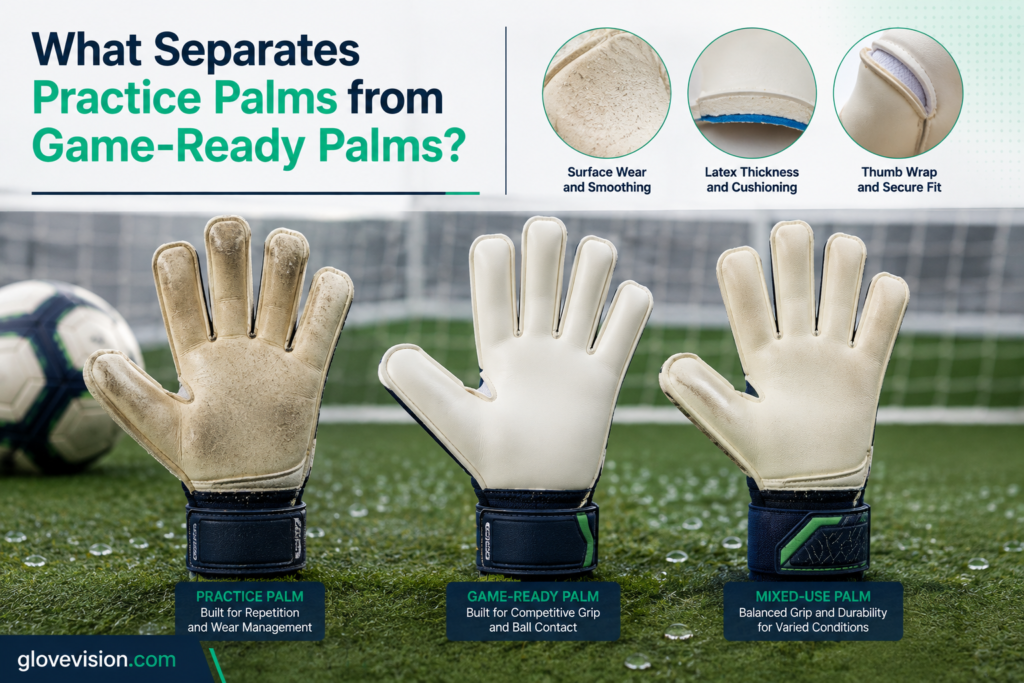
What Separates Practice Palms from Game-Ready Palms?
Goalkeeper Glove Palms are the primary ball-contact zone of a goalkeeper glove, where grip, wear, cushioning, feedback, weather response, fit, and maintenance demands come together. Their practical role depends on the exact palm formulation and the complete glove rather than on a single latex name or marketing label.
Practice and game-ready labels are functional descriptions, not universal technical palm grades. Exact performance still depends on the manufacturer, playing surface, weather, glove cut, fit, care requirements, use history, and current palm condition.
Educational and performance notice: Goalkeeper Glove Palms should be selected and maintained according to the exact glove manufacturer’s intended use, playing-surface guidance, preparation instructions, care requirements, and current condition. Grip, durability, cushioning, and weather performance vary between products, and no palm is abrasion-proof, permanently grippy, or universally suitable for every surface or playing condition.
What Separates Practice-Oriented Goalkeeper Glove Palms from Game-Ready Designs?
Practice-oriented Goalkeeper Glove Palms usually emphasize repeat-use practicality and wear management, while game-ready palms usually emphasize competitive grip and ball response, but neither category has a universal material specification.
Reusch organizes goalkeeper palm systems across different playing levels, surface uses, wet-condition needs, and grip/durability priorities, supporting the idea that “practice” and “game-ready” are product-specific performance roles rather than formal palm grades. [Reusch]
What does “practice palm” mean?
It is a functional description for a palm selected around repeated use, wear management, practical grip, manageable care, surface tolerance, and cost per useful wear. It is not a standardized latex category.
What does “game-ready palm” mean?
It describes a palm selected primarily for competitive ball contact, desired grip, conformity, feedback, fit, and expected match conditions. It does not establish one universal foam chemistry or performance threshold.
Why are these labels not standards?
Manufacturers use different palm names, formulations, playing-level labels, surface guidance, weather claims, and care routines. The wider framework for sports glove grip and contact systems shows why goalkeeper palms should be classified around their actual ball-contact role rather than treated like generic glove grip surfaces.
Can one palm serve both roles?
Yes. Reusch’s RE:GRIP system is one manufacturer-specific example of a dual-layer palm presented for both matches and training, showing that practice and game roles can overlap inside one engineered system. [RE:GRIP] The construction should not be generalized to unrelated palms.
| Evaluation Area | Practice-Oriented Priority | Game-Ready Priority | Mixed-Use Possibility | Required Qualification |
|---|---|---|---|---|
| Primary role | Repeat-use practicality and wear management | Competitive ball contact and desired response | One palm may serve both roles | Roles are functional, not standardized palm grades |
| Grip | Practical, repeatable grip over frequent sessions | Grip/feedback prioritized for competitive use | Balanced contact performance may be sufficient | Exact palm and condition control the result |
| Wear | Greater attention to abrasion exposure and cost per useful wear | Acceptable wear in exchange for desired match response | Possible when formulation balances both | Surface, frequency, care and contact zones matter |
| Cushioning | Enough material for repeat handling and comfort | Chosen around desired contact feel and handling | Can be balanced | Thickness alone does not establish cushioning outcome |
| Care burden | Often important because use frequency is high | Can be higher when exact palm requires preparation/care | Depends on product | Follow exact manufacturer instructions |
| Condition | May remain suitable despite cosmetic wear if function remains acceptable | Match use requires the user’s competitive performance threshold | A worn game palm may move to practice use | Do not downgrade if structure, fit or grip is unreliable |
How Do High-Contact Goalkeeper Glove Palms Generate Usable Grip?
High-contact Goalkeeper Glove Palms generate usable grip through the interaction of palm material, surface texture, conformity, contact area, ball condition, moisture, fit, and remaining palm condition.
uhlsport’s goalkeeper palm documentation separates multiple grip compounds by intended playing conditions, abrasion behavior, and surface use, which supports treating grip as a palm-family property rather than a universal consequence of “latex.” [UHL]
How does latex or palm foam contribute?
Depending on the exact formulation, the palm may conform to the ball, create useful surface friction or tack, provide cushioning, and shape the contact area. Those effects remain product-specific.
How do softness and tack matter?
Softness or tack may influence the contact interface, but neither property proves sustained grip, match suitability, or durability. New-glove tack should not be treated as a complete performance test.
How do thickness and cushioning matter?
Material depth can change cushioning, flexibility, and the amount of direct feedback felt through the palm. More thickness is not automatically more protective, and less thickness is not automatically better for control.
How do finger and thumb wraps matter?
Wraps can extend contact coverage around fingertips or the thumb, but they also change seam position, flex, and local wear. Their value should be judged inside the exact glove construction.
Why does fit matter?
Poor fit can create palm bunching, folds, rotation, internal movement, and contact-zone misalignment. The broader relationship between palm grip and fit stability reinforces that surface friction cannot compensate for an unstable palm inside the glove.
| Property | Possible Benefit | Possible Trade-Off | Evidence Needed |
|---|---|---|---|
| Conformity | May help the palm follow ball and hand geometry | Can change with wear, fit and material condition | Exact palm construction and product claims |
| Tack | May support surface interaction | New-glove tack does not prove sustained match suitability | Exact palm family and real condition |
| Thickness | May change material depth and cushioning | More bulk can alter feedback and flexibility | Documented construction; no universal thickness rule |
| Cushioning | May soften selected ball-contact loads | Can reduce direct feedback or increase bulk | Complete palm/glove construction |
| Reinforcement | May protect a local wear zone | Can change flex, feel and local contact | Exact reinforcement location and product evidence |
| Finger wrap | May increase contact coverage | Seams, flex and local wear can change | Exact glove geometry |
| Thumb wrap | May increase thumb contact coverage | May alter seam position or feel | Exact model |
| Fit | Stable palm alignment supports predictable contact | Poor fit can bunch or rotate even with a high-friction palm | Manufacturer sizing and actual fit check |
Why Do Wear-Oriented Goalkeeper Glove Palms Differ in Durability?
Wear-oriented Goalkeeper Glove Palms differ because abrasion resistance depends on the exact foam formulation, reinforcement, exposed wear zones, playing surface, usage frequency, palm-to-ground contact, care, and current condition.
uhlsport’s RESIST family explicitly differentiates grip-to-abrasion priorities and includes palms aimed at more abrasive surfaces, demonstrating that wear management can be engineered differently within one manufacturer’s own range. [RESIST]
Which factors drive palm wear?
Surface abrasiveness, use frequency, palm-to-ground exposure, fingertip and palm-heel contact, dirt, weather, care, and the exact product formulation can all influence wear.
How does formulation matter?
Palm formulations can differ in grip, elasticity, resilience, abrasion behavior, moisture response, and intended surface. There is no universal rule that softer always wears faster or firmer always lasts longer.
How does reinforcement matter?
Reinforcement may target high-stress zones such as the palm heel, fingertips, thumb, or local overlays. Reusch’s DuraGuard is one product-specific example of added latex over a high-wear zone. [Reusch] Local reinforcement does not prove longer overall palm life.
Why is wear uneven?
Different hand positions and surface contacts expose fingertips, the palm heel, edges, thumb areas, or wraps to different levels of abrasion. A single overall “wear percentage” would hide those local differences and should not be invented.
When does wear affect function?
Material loss, glazing, cracking, detachment, or inconsistent surface contact can change whether the palm still meets its intended role. The broader relationship between goalkeeper glove grip and durability also depends on complete-glove construction, playing conditions, fit, palm wear, and maintenance rather than the palm material alone.
How Does the Complete Construction of Goalkeeper Glove Palms Affect Performance?
Goalkeeper Glove Palms cannot be assessed independently from glove cut, finger geometry, thumb construction, seams, gussets, liners, backhand flexibility, wrist retention, and anatomical fit.
Reusch documents palm foams, glove cuts, thumb constructions, closures, internal grip systems, and extended grip zones as separate but interacting design elements, which supports evaluating the palm as part of the complete glove. [Reusch]
How do cuts position the palm?
Negative, roll, flat/classic, and hybrid cuts change finger-box volume, palm presentation, seam location, and how closely the material follows the hand. Cut names should not be ranked universally.
How do seams and gussets matter?
Internal or external seams and different gusset materials can change palm tension, pressure, interior volume, ventilation, and movement. Those construction effects can alter how stable the palm feels during ordinary ball contact.
How do liners affect palm stability?
Liners influence internal slipping, moisture, bunching, and palm alignment. Some exact constructions add internal traction features, but that should remain a product-specific example rather than a universal requirement.
How do backhand and wrist systems influence palm behavior?
The backhand and wrist closure can influence hand position, palm tension, interior stability, and how naturally the hand opens and closes. They should be evaluated as part of the same glove system.
Why does the complete glove matter?
Palm material alone cannot establish fit, handling, cushioning, stability, weather response, or finger support. Where the glove also includes goalkeeper finger-support construction, that system should be assessed separately because finger mobility, alignment, and support are different performance questions.
How Do Surfaces and Weather Change Goalkeeper Glove Palms?
Surfaces and weather change Goalkeeper Glove Palms by altering abrasion exposure, moisture, contamination, ball contact, material feel, drying requirements, and the condition in which the palm must perform.
Manufacturer portfolios from both Reusch and uhlsport distinguish palms for natural grass, artificial turf or harder surfaces, and wet conditions, supporting surface- and weather-specific selection without implying one universal rule. [Reusch] [UHL]
How does natural grass affect the palm?
Dry grass, wet grass, mud, and debris change the glove–ball and glove–ground interface. Natural grass should not be treated as automatically gentle on every palm.
How does artificial turf affect the palm?
Artificial turf can increase attention to abrasion at the palm heel, fingertips, and other high-contact zones. The exact product’s surface guidance matters more than a generic “training” label.
How do hard or indoor surfaces affect the palm?
Hard and indoor surfaces can create dry friction, repeated abrasive contact, and debris exposure. No one palm compound should be prescribed universally for every hard surface.
How does rain affect the palm?
Wet-ball interaction, palm moisture, preparation, contamination, and the manufacturer’s wet-performance documentation all matter. A wet-condition claim should not be extended to palms that were not designed or documented that way.
How do cold and heat affect the palm?
Temperature can change material feel, moisture behavior, comfort, flexibility, and interior stability. No universal temperature threshold should be assigned. When cold becomes a broader glove-performance factor, cold-weather glove warmth and dexterity help explain why flexibility, moisture, bulk, and hand movement should be assessed together.
| Condition | Main Palm Demand | Wear / Grip Factor | Verification | Warning |
|---|---|---|---|---|
| Natural grass | Balance contact, moisture and ground exposure | Dry, wet, mud and debris change the interface | Exact palm/surface guidance | Do not assume grass preserves every palm |
| Artificial turf | Higher attention to abrasion and high-wear zones | Palm heel and fingertips may see repeated abrasive contact | Manufacturer surface claim | Do not claim turf destroys every match palm |
| Hard / indoor | Abrasion and dry-surface friction | Frequent hard-surface contact can accelerate wear | Exact product guidance | No universal compound rule |
| Wet | Wet-ball interaction and stable palm condition | Moisture may help or hurt depending on the palm | Exact wet-condition documentation | All-weather ≠ identical wet/dry grip |
| Cold | Material feel, moisture and hand comfort | Flexibility and interior stability can change | Product/environment guidance | No universal temperature threshold |
| Hot | Heat, drying and material feel | Condition and care history matter | Exact product guidance | Do not infer universal heat behavior |
Which Goalkeeper Glove Palms Best Match Practice and Competitive Use?
Goalkeeper Glove Palms should be matched to actual use frequency, playing surface, weather, grip priority, wear tolerance, cushioning preference, fit, care burden, and replacement budget rather than selected solely by a practice or match label.
Which palms suit frequent practice?
Prioritize repeat-use practicality, surface suitability, wear management, care burden, and cost per useful wear. The palm still needs enough usable grip and stable fit for the intended session demands.
Which palms suit competitive games?
Prioritize the level of grip, response, conformity, weather suitability, and fit needed by the wearer for competition. Do not assume the softest or most expensive palm is automatically the correct match choice.
Which palms suit mixed use?
Look for an acceptable balance of grip, wear tolerance, maintenance, condition stability, and cost. A mixed-use palm can be a rational choice when it meets both training and competitive requirements.
When are separate pairs useful?
Separate training and match pairs can be useful when training volume is high, surfaces are abrasive, a match-oriented palm is worth preserving, or drying and care logistics favor rotation. The approach is optional rather than mandatory.
Which evidence should be verified?
Confirm the exact model, palm family, intended use, surface guidance, weather claims, preparation steps, care requirements, limitations, and current condition before deciding whether the palm is practice-oriented, game-ready, or mixed-use.
| Use Case | Primary Priority | Palm Question | Fit / Care Check | Decision |
|---|---|---|---|---|
| Frequent practice | Repeat use + wear management | Does the exact palm tolerate expected frequency and surface? | Can it be cleaned, dried and rotated realistically? | Practice-oriented or balanced palm |
| Competitive match | Required ball-contact response | Does the exact palm meet the wearer’s match grip/feedback needs? | Fit must remain stable in expected weather | Game-ready only if product + condition support it |
| Mixed use | Balanced grip and wear | Is the palm explicitly or practically suitable for both roles? | Care burden and cost remain acceptable | One pair may be enough |
| Abrasive surface | Wear tolerance | Is the palm documented for the surface or abrasion-oriented use? | Inspect palm heel/fingertips often | Prefer evidence over label |
| Wet match | Wet-condition response | Is wet performance documented for this palm? | Follow exact preparation and care | Select by exact wet claim |
| Limited budget | Useful performance per cost | Can one mixed-use construction meet both roles? | Rotation and care may extend practical utility | Avoid paying for labels alone |
How Should Goalkeeper Glove Palms Be Compared and Function-Checked?
Goalkeeper Glove Palms should be compared by exact product evidence, physical condition, complete-glove fit, palm stability, and controlled ball interaction rather than by packaged tackiness or price.
Which product details matter?
Verify the exact model, palm family, intended use, surface and weather guidance, reinforcement, glove construction, and care instructions. A generic material description is not enough.
Which palm areas should be inspected?
Inspect the main palm, fingertips, thumb, palm heel, edges, wraps, seams, and any local reinforcement. These zones can age differently and may change the palm’s practical role.
How should fit be checked?
Confirm palm alignment, sensible finger space, thumb position, low bunching, stable wrist retention, and minimal internal sliding. A high-contact palm cannot compensate for unstable contact geometry.
How should palm performance be function-checked?
Use ordinary controlled ball interaction to assess consistency, palm stability, natural hand closure, and feedback without turning the check into catching or goalkeeper-technique instruction.
When should a palm be rejected?
Reject or reassess a palm that is structurally damaged, persistently bunched, unstable, painful, poorly fitted, or whose intended role cannot be verified from the product and present condition.
| Check | What to Verify | Why It Matters | Failure Sign |
|---|---|---|---|
| Role | Practice, match or mixed use | Sets the performance priority | Label chosen without actual role |
| Product identity | Exact model and palm family | Manufacturer claims are palm-specific | Generic latex name only |
| Palm | Grip/wear/cushioning construction | Defines the contact surface | No product-level evidence |
| Surface | Natural grass, turf, hard/indoor | Changes abrasion and contamination exposure | Surface guidance ignored |
| Weather | Dry, wet, cold, heat | Changes moisture and material behavior | Weather claim assumed universal |
| Fit | Palm alignment, finger space, thumb, internal stability | Poor fit changes contact geometry | Bunching or rotation |
| Condition | Fingertips, thumb, palm heel, glazing, cracking, detachment | Original specification may no longer describe the worn palm | Unreliable contact or structural damage |
| Care | Preparation, cleaning, drying, storage | Can materially change condition | Universal routine substituted for product instructions |
How Should Goalkeeper Glove Palms Be Prepared and Maintained?
Goalkeeper Glove Palms should be prepared and maintained according to the exact product instructions because palm compounds and manufacturers do not share one universal prewash, moistening, detergent, drying, or storage routine.
Reusch provides goalkeeper-specific first-use, cleaning, drying, storage, and surface/weather guidance, illustrating why care must remain manufacturer- and product-specific rather than becoming one universal routine. [Care]
How should the palm be prepared?
Check the exact instructions for protective film, prewash, moistening, soaking, or initial-use steps. Do not assume every palm needs the same activation or preparation process.
How should the palm be cleaned?
Verify the permitted cleaning agent, water conditions, hand or machine method where specified, rinsing process, and whether removable components require separate handling.
How should the palm be dried?
Follow the exact product directions. Avoid universal claims about radiators, tumble dryers, sunlight, room temperature, or drying time unless the manufacturer specifically states them for that glove.
How should the gloves be stored?
Check manufacturer guidance for dryness, ventilation, palm protection, shape, compression, and heat/light exposure. Storage requirements can differ with materials and construction.
When can pair rotation help?
Rotation can be useful when separating training and match use, managing drying time, protecting a higher-priority palm, or monitoring wear. It is an optional management strategy rather than a requirement.
| Area | Check | Rule | Retirement Trigger |
|---|---|---|---|
| Preparation | Film, prewash, moistening or initial-use steps | Follow exact product instructions | Do not improvise a universal routine |
| Cleaning | Approved agent, water and method | Use product-specific instructions | Residue/contamination remains unresolved |
| Drying | Approved drying process | Avoid assuming one method suits all palms | Heat/material damage suspected |
| Storage | Dryness, ventilation, compression and palm condition | Use exact manufacturer guidance | Persistent dampness or structural distortion |
| Rotation | Separate training/match pairs where useful | Optional wear-management tool | Not required if one palm remains suitable |
| Palm condition | Glazing, material loss, cracks, detachment | Inspect high-wear zones | Reliable role performance cannot be verified |
| Fit | Palm alignment and internal stability | Condition changes can alter fit | Persistent bunching/slipping |
| Replacement | Whole glove remains structurally usable | Condition-based, not match-count based | Grip, fit, structure or integrity unreliable |
What Problems Indicate That Goalkeeper Glove Palms Are Mismatched or Worn?
Goalkeeper Glove Palms can become unsuitable because of contamination, abrasion, glazing, cracking, material loss, poor fit, wrong playing conditions, incorrect care, or a mismatch between the palm’s priorities and the intended role.
Why does grip decline?
Investigate wear, residue, wrong preparation for that product, weather, ball condition, palm moisture, fit, and material deterioration before assuming the palm is simply “bad.”
Why does wear occur faster than expected?
Check the surface, frequency, palm-ground contact, product role, care history, high-wear zones, and whether the palm was actually intended for the abrasive environment.
Why does the palm bunch?
Size, glove cut, liner construction, wrist fit, internal volume, and material condition can all create bunching or rotation that destabilizes the contact area.
Which buying mistakes matter?
Avoid choosing by tackiness, softness, price, “training” wording, “professional” wording, or endorsements alone. None of those substitutes for exact palm evidence, fit, surface, weather, and condition.
When should palm role change or replacement occur?
A game-ready palm may move to practice use only when it remains structurally sound, fits securely, and still performs reliably enough for that lower-priority role. If grip, fit, structure, or palm integrity is unreliable, replace rather than downgrade.
| Symptom | Possible Causes | What to Check | Next Decision |
|---|---|---|---|
| Weak grip | Wear, contamination, wrong preparation, weather, ball condition, poor fit | Exact palm, surface condition, fit, care history | Clean/reassess or change role/glove |
| Rapid wear | Abrasive surface, high frequency, palm-ground contact, wrong product role | Palm heel, fingertips, surface guidance | Use another palm or reduce role expectations |
| Glazing | Surface smoothing from use/condition | Contact zones and remaining usable response | Reassess match readiness |
| Cracking | Age, drying, material deterioration, care history | Depth/location and structural integrity | Replace if reliable function is uncertain |
| Bunching | Size, cut, liner, wrist fit, internal volume | Palm alignment during hand closure | Resize/change construction |
| Wet inconsistency | Palm not intended for wet use, wrong preparation, contamination, wear | Exact wet claim and care guidance | Select another palm if needed |
| Detachment | Material/seam/adhesive failure | Edges, wraps, palm zones, structure | Replace when integrity is compromised |
How Should Goalkeeper Glove Palms Be Chosen for Practice or Games?
Goalkeeper Glove Palms should be chosen by defining role and conditions first, then verifying the exact palm construction, grip-versus-wear balance, fit, care burden, and current condition.
Which final questions should be answered?
Confirm practice, game, or mixed use; expected frequency; surface; weather; grip priority; wear priority; cushioning and feedback preference; exact palm identity; intended-use evidence; complete-glove fit; palm alignment; practical care burden; present condition; and replacement cost.
Which final rule should guide selection?
Choose the Goalkeeper Glove Palm whose documented role, construction, fit, conditions, maintenance burden, and current state provide the best practical balance—not the palm with the strongest marketing label.
Conclusion
Practice-oriented Goalkeeper Glove Palms usually emphasize repeat-use practicality and wear management, while game-ready palms usually emphasize competitive grip and ball response, but neither label establishes performance without exact product and condition evidence.
Grip and durability remain separate priorities; softness, firmness, thickness, price, or latex terminology cannot define the correct role alone. Surface, weather, complete-glove fit, care, and current condition determine whether a palm should remain match-ready, serve training, work for both roles, be reassessed, or be replaced.
Frequently Asked Questions
Are Practice Goalkeeper Glove Palms Always More Durable?
No. Practice-oriented palms may emphasize repeated use or wear management, but actual durability remains dependent on the exact formulation, construction, playing surface, frequency, care, and condition.
Do Game-Ready Goalkeeper Glove Palms Always Provide Better Grip?
No. Match-oriented palms may prioritize competitive contact, but usable grip depends on the exact palm, fit, preparation, weather, ball condition, contamination, and wear.
Can the Same Goalkeeper Glove Palms Be Used for Training and Matches?
Yes. Some palm systems are suitable for both roles when their grip, wear tolerance, fit, cushioning, weather behavior, and care demands remain acceptable.
Should Goalkeepers Keep Separate Goalkeeper Glove Palms for Practice and Games?
Not necessarily. Separate pairs can help manage wear or preserve a match-oriented palm, but the decision depends on training frequency, surfaces, budget, care, and performance priorities.
When Should Game-Ready Goalkeeper Glove Palms Be Downgraded to Practice Use?
Only when they remain structurally sound, fit securely, and still provide reliable practice-level function but no longer meet the wearer’s competitive performance requirements. If grip, fit, structure, or palm integrity is unreliable, replace rather than downgrade.