
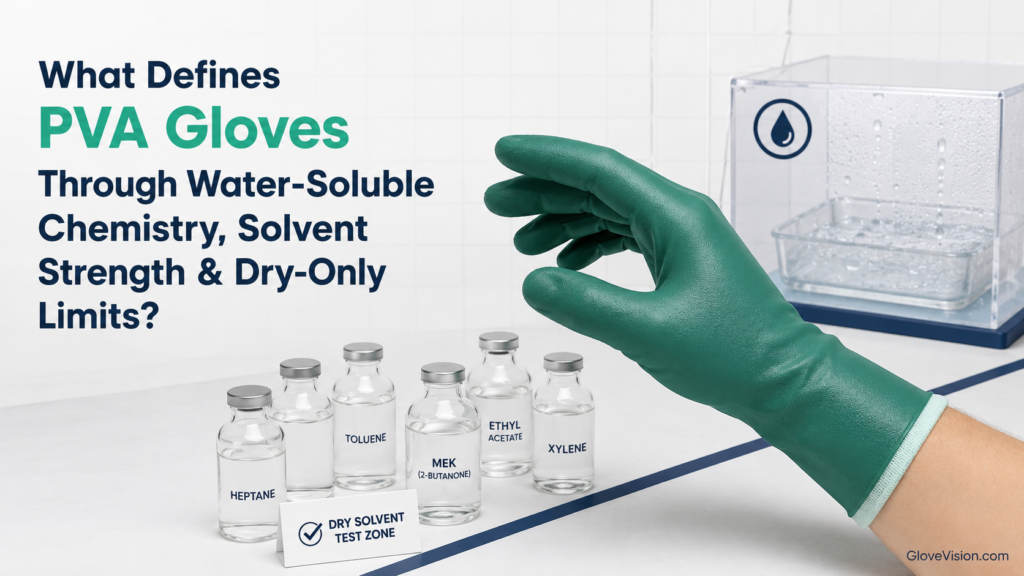
What Defines PVA Gloves Through Water-Soluble Chemistry, Solvent Strength & Dry-Only Limits?
PVA Gloves use water-soluble polyvinyl alcohol chemistry, commonly applied as a barrier over a supporting liner, to provide strong product-specific resistance to selected nonaqueous aromatic, aliphatic, and chlorinated solvents.
Their defining limit is moisture: water can reduce or destroy protection, while aqueous formulations, high humidity, condensation, perspiration, damp surfaces, and a merely dry-looking task can challenge the barrier. Suitability depends on the exact glove, chemical or mixture, concentration, temperature, contact duration, moisture exposure, compatibility evidence, and current condition.
What Are PVA Gloves, and How Does Their Water-Soluble Polyvinyl Alcohol Construction Behave?
PVA Gloves generally use a polyvinyl alcohol coating or barrier over a supporting glove structure, combining strength against selected solvents with product-dependent stiffness, fit, coverage, grip, and mechanical durability. Protection therefore belongs to the complete manufactured glove rather than to the polymer name by itself.
What Does PVA Mean in PVA Gloves?
PVA means polyvinyl alcohol, a synthetic polymer that can form a chemical-barrier coating or layer. It is not polyvinyl chloride (PVC), polyvinyl acetate, polyethylene, or a generic chemical-barrier laminate. NIOSH material terminology separately identifies PVA as polyvinyl alcohol and PVC as polyvinyl chloride, which prevents a similar acronym from becoming a false equivalence. [NIOSH]
The PVA name does not reveal the liner, coating continuity, seams, thickness, surface finish, cuff length, size range, intended use, or test history. Those finished-product attributes control how a glove behaves during actual work.
Why Is PVA Chemistry Described as Water-Soluble?
PVA chemistry is described as water-soluble because polyvinyl alcohol interacts strongly with water, which can alter the polymer barrier and make its intended chemical protection unreliable. Finished-glove behavior still depends on formulation, coating construction, contact duration, temperature, and the manufacturer’s documented moisture limits.
Water-soluble chemistry does not mean every finished PVA Glove dissolves immediately or responds identically. Visible dissolution is not required before protection becomes uncertain, and drying does not by itself prove that the original barrier has returned.
How Does PVA Chemistry Influence Solvent Resistance?
Polyvinyl alcohol chemistry may limit swelling or molecular transport for selected compatible nonaqueous solvents, while remaining strongly sensitive to moisture. Interaction varies with the solvent’s molecular structure, polarity, concentration, temperature, and contact pattern, together with the glove formulation and manufacturing process.
Material chemistry explains a general tendency, not approval for a specific substance. Formulation, thickness, manufacturing, finished-glove construction, and exact-model evidence control whether documented solvent strength applies.
How Are PVA Gloves Commonly Constructed?
Many PVA Gloves place the moisture-sensitive barrier over a textile or structural liner that supports the hand-shaped shell. The complete construction includes four fingers, one thumb, palm, cuff, surface finish, any seams or joined areas, and product-specific thickness. A manufacturer’s documentation for one supported PVA model describes a PVA coating, anatomical design, and two-piece knit liner, while also warning that water and high humidity greatly reduce that product’s chemical protection. Those details are product-specific and cannot be generalized to all PVA Gloves. [Ansell]
Why Do Some PVA Gloves Use Supporting Liners?
A supporting liner can add shape retention, physical support, donning comfort, and mechanical reinforcement without becoming the primary chemical barrier. It may help the outer coating remain usable during handling, but it also introduces limitations: the textile can retain perspiration, absorb contamination, reduce tactility, complicate decontamination, and hide internal moisture from view.
A liner should never be treated as evidence of chemical resistance. If the outer coating is breached, chemically incompatible liquid may reach and spread through the liner, increasing the importance of coating continuity, inspection, correct removal, and product-specific reuse instructions.
How Do Thickness, Fit, and Cuff Design Affect PVA Gloves?
Thickness, anatomical fit, finger alignment, surface finish, and cuff coverage influence the usable barrier system but cannot correct chemical incompatibility. Thickness can change the molecular pathway, stiffness, durability, dexterity, grip, and hand fatigue. A poorly sized glove can increase internal movement or reduce control, while an inadequate cuff may leave the wrist or forearm exposed or allow splash runoff to enter.
Coverage should match the exposure pathway and clothing overlap. The user must still verify the exact model’s compatibility evidence, because a thicker or longer PVA Glove is not automatically suitable for an incompatible chemical, aqueous formulation, or uncontrolled mechanical hazard.
| Component or Property | Practical Function | Critical Limitation |
|---|---|---|
| Polyvinyl alcohol barrier | May resist selected organic solvents | Highly moisture-sensitive |
| Supporting liner | Adds shape and physical support | May retain perspiration or contamination |
| Product-specific thickness | Influences barrier and durability | Does not prove compatibility |
| Extended cuff | Increases wrist or forearm coverage | Must match the exposure pathway |
| Anatomical construction | Supports fit and handling | Stiffness may reduce dexterity |
| Seams or joined areas | Complete the glove structure | May create penetration pathways |
Why Do PVA Gloves Have Strict Water, Humidity, and Perspiration Limits?
PVA Gloves have strict moisture limits because water can interact with the polyvinyl alcohol barrier, causing product-dependent swelling, softening, distortion, tackiness, dissolution, or loss of chemical resistance. Water-soluble chemistry does not mean every finished construction dissolves immediately or behaves identically.
What Can Happen When PVA Gloves Contact Water?
Water contact can change the coating’s physical structure and reduce confidence in the intended solvent barrier. Depending on the product and exposure, warning changes may include swelling, softening, tackiness, surface distortion, coating damage, loss of continuity, or exposure of the liner. OSHA’s general glove-material table identifies PVA as a specialty organic-solvent material that is water-sensitive and performs poorly against light alcohols; it does not turn that broad guidance into approval for a finished glove. [OSHA PVA]
No universal damage rate applies. Contact duration, water temperature, construction, coating condition, and manufacturer limits all matter, and absence of immediate visible damage does not establish continued chemical protection.
How Can High Humidity Affect PVA Gloves?
High humidity can expose PVA Gloves to moisture even when no liquid splash is visible. Moisture absorption can accumulate with time, and the effect depends on humidity level, duration, airflow, coating formulation, liner design, and the product’s documented environmental limits. Gradual change may weaken barrier confidence before a dramatic visual defect appears.
Humidity is therefore an exposure variable, not a comfort detail. A product approved for a controlled dry room should not be carried into a humid process area without confirming that its evidence and instructions still apply.
Why Can Perspiration Undermine PVA Gloves?
Perspiration can introduce moisture from inside a supported PVA Glove and may be retained by its textile liner. Warm conditions, exertion, long wear, poor ventilation, and an occlusive construction can increase internal moisture. The worker may not see that exposure from the outside, yet the coating–liner system can still be challenged.
Not every amount of perspiration produces immediate failure. The defensible question is whether the exact glove, wear duration, thermal environment, liner, and manufacturer limitations support the task. If internal moisture cannot remain within documented conditions, PVA should be reassessed.
Why Can a Dry-Looking Task Still Exceed PVA Gloves Limits?
A task can look dry while still containing direct or hidden moisture pathways. Water-containing solvent mixtures, damp tools, recently washed equipment, condensation on cool surfaces, humid rooms, steam, rain, perspiration, wet clothing overlap, and emergency water contact can all invalidate a dry-use assumption.
A practical PVA dry-only limits screening should examine the whole work cycle—not only the moment of chemical contact. Setup, transfer, cleanup, emergency response, storage, and removal can introduce moisture that the narrow process description misses.
Which Moisture Conditions Require Removal or Reassessment?
Direct water contact, an aqueous formulation, a wet liner, coating change, or uncertain moisture history requires the user to stop safely and reassess the glove. Other stop signals include swelling, softening, tackiness, distortion, loss of grip, liner exposure, or humidity outside documented limits.
Wiping or air-drying is not proof that the original barrier has returned. Continued use or reuse requires an exact-product procedure and evidence that the documented protection remains valid; otherwise the glove should be replaced or another tested material selected.
Where Do PVA Gloves Provide Solvent Strength, and Where Does Their Chemical Barrier End?
PVA Gloves may provide strong resistance to selected aromatic, aliphatic, and chlorinated solvents, together with certain esters, ethers, and ketones, but chemical-family membership alone never establishes suitability. Exact substance, complete formulation, concentration, temperature, contact pattern, test method, and finished-glove model must match the evidence used for selection.
Which Organic Solvents May PVA Gloves Resist?
PVA Gloves may remain candidates for selected dry aromatic hydrocarbons, aliphatic hydrocarbons, chlorinated solvents, esters, ethers, and certain ketones where exact-model data support use. The words “selected” and “where documented” are essential. Readers researching PVA and aromatic solvents or PVA and chlorinated solvents must still resolve the individual chemical and exposure conditions.
A family-level association is a screening clue, not an approval. Two chemicals placed in the same broad family can interact differently with the coating, and two PVA glove models can have different thicknesses, constructions, and test results.
Why Must Every Solvent Be Evaluated Individually?
Every solvent must be evaluated individually because molecular structure, polarity, concentration, temperature, permeation rate, degradation behavior, duration, and mixture interactions vary. Selection should record the chemical name, CAS number where available, concentration, temperature, splash or immersion pattern, expected contact time, and exact model to which the data apply.
OSHA explains that permeation is molecular movement through protective material and warns that temperature, pressure-related thinning, degradation, reuse, mixtures, and batch variability can make workplace performance differ from a laboratory breakthrough result. Mixture breakthrough may also be shorter than component data would predict. [OSHA OTM]
Are PVA Gloves Suitable for Ketones?
PVA Gloves are suitable for a ketone only when substance-specific compatibility data support the exact glove model and exposure. “Ketone-resistant” is too broad: ketones are not one uniform challenge, acetone is commonly treated as an important PVA limitation in general guidance, and a ketone-containing mixture may behave differently from its listed ingredients.
Do not infer approval from a family heading, a result for another ketone, or a result for another PVA model. If applicable data for the exact ketone, concentration, temperature, and contact pattern are unavailable, reassess the glove or screen another material.
Why Are Light Alcohols and Aqueous Chemicals Major PVA Gloves Limitations?
Light alcohols and aqueous chemicals are major limitations because general guidance associates PVA with poor performance against certain light alcohols, while water content can directly challenge the PVA barrier. Acids and alkalis are often supplied in water, and an organic-sounding ingredient does not make a formulation water-free.
The complete formulation controls the decision. A small water fraction, alcohol component, stabilizer, or cleaning residue may change the exposure meaningfully, so a material chart for one pure ingredient cannot approve a multi-component product.
How Do Permeation, Degradation, and Penetration Differ?
Permeation is molecular transport through apparently intact material; degradation is harmful physical change caused by a chemical; penetration is passage through holes, seams, pinholes, cuffs, or other discontinuities. A glove can permeate without visible damage, degrade before a hole forms, or allow penetration even when intact coating material is compatible.
ISO 374-1 establishes terminology and performance requirements for chemical-risk gloves. [ISO 374-1] ISO 374-2 specifies a test method for penetration resistance. [ISO 374-2] ISO 374-4 addresses resistance of glove materials to degradation under continuous chemical contact. [ISO 374-4] These distinct mechanisms explain why a complete PVA resistance failure assessment cannot rely on visual integrity alone.
How Do Concentration, Temperature, and Duration Affect PVA Gloves?
Concentration, temperature, and contact duration can change the rate and severity of polymer interaction. Higher temperature can accelerate permeation or degradation; concentration can alter solvent activity; longer contact increases cumulative challenge; and immersion is not equivalent to an incidental splash.
A laboratory breakthrough time marks a defined test threshold under defined conditions. It is not a universal safe-wear time, a replacement guarantee, or evidence for a different formulation. Workplace flexing, grip pressure, contamination pattern, humidity, and reuse history must be included in the final decision.
| Exposure | Possible PVA Performance | Required Decision |
|---|---|---|
| Verified compatible nonaqueous solvent | May provide strong resistance | Confirm exact-model evidence |
| Aromatic or chlorinated solvent | PVA may remain a candidate | Never approve by family alone |
| Acetone or unverified ketone | Compatibility may be poor | Require substance-specific evidence |
| Light alcohol | PVA may be unsuitable | Evaluate another tested material |
| Water-based formulation | Barrier may deteriorate | Reject unless exact evidence supports use |
| High humidity or perspiration | Protection may decline | Verify documented environmental limits |
| Unknown mixture | Performance is unpredictable | Obtain mixture-specific evidence |
| Mechanical and chemical exposure | Barrier may be damaged | Verify both protection categories |
Which PVA Gloves Match a Chemical Task, and When Is Another Material Required?
PVA Gloves should remain a candidate only when exact-model data support the complete chemical exposure, moisture can be controlled, coverage is sufficient, and the glove can withstand the task’s mechanical and handling demands. Selection begins with the hazard and operating conditions—not with a material reputation, occupation, or industry label.
Which Questions Must Be Answered Before Selecting PVA Gloves?
A defensible selection identifies the substance, exposure, environment, finished glove, and task demands before deciding whether PVA remains suitable. OSHA requires hand protection to be selected by its performance relative to the tasks, conditions, duration, hazards, and potential hazards. [OSHA 1910.138]
- What is the exact chemical, CAS number where available, and concentration?
- Is it a pure substance or a complete mixture, and does it contain water or light alcohol?
- What temperature, duration, contact frequency, splash pattern, or immersion potential is expected?
- Which permeation and degradation results apply to the exact glove model?
- Can humidity, condensation, and perspiration remain within documented limits?
- Are coverage, fit, grip, dexterity, and mechanical protection adequate?
Which Tasks May Be Candidates for PVA Gloves?
Controlled handling of selected dry organic solvents may be a candidate only where exact documentation supports the finished glove under the expected conditions. Possible contexts include defined solvent transfer, laboratory solvent handling, a controlled chemical-processing step, or maintenance involving a compatible nonaqueous chemical.
The task name does not approve the glove. “Laboratory,” “maintenance,” or “solvent transfer” can each contain wet cleaning, mixtures, sharps, heat, immersion, uncontrolled splash, or other hazards that change the selection. Exact exposure evidence remains the owner of the decision.
Which Conditions Commonly Rule Out PVA Gloves?
Credible water exposure, unknown chemistry, missing product data, inadequate tested performance, or uncontrolled physical hazards commonly rule out PVA Gloves. Wet cleaning, steam, rain, condensation, uncontrolled humidity, heavy perspiration, damp equipment, aqueous formulations, unknown mixtures, insufficient breakthrough evidence, severe cut or puncture exposure, poor grip, restricted dexterity, and inadequate coverage all require rejection or reassessment.
No single warning needs to be balanced against a material strength. If a critical condition falls outside the exact glove’s evidence, the selection is incomplete.
How Should Chemical Mixtures Be Evaluated?
Chemical mixtures must be evaluated as complete formulations with their water content, mixture-specific test evidence, matching conditions, and approved change plan. The correct pathway is: complete formulation → water content → mixture-specific data → matching test conditions → approved change plan → final decision.
Do not average component compatibility ratings, ignore a low-concentration ingredient, or use the shortest component result as proof that the whole mixture is compatible. Interaction among components can change breakthrough or degradation. If applicable mixture evidence is unavailable, reassess or reject the PVA selection.
When Should Another Glove Material Replace PVA Gloves?
Another tested material should be selected when PVA cannot meet the documented chemical, moisture, construction, fit, coverage, or mechanical requirements. This includes credible water exposure, incompatibility, absent exact-model evidence, test conditions that do not cover the task, uncontrolled perspiration, inadequate cuff coverage, or stiffness that prevents safe handling.
Use the PVA selection trade-offs to weigh barrier evidence against moisture and handling constraints, recognize PVA’s narrow exposure range, and interpret broader PVA solvent resistance only as a screening context. Alternative materials also require exact chemical and product evidence; changing materials does not remove the verification task.
| Selection Question | Proceed When | Reject or Reassess When |
|---|---|---|
| Is the chemical identified? | Identity and concentration are known | Substance or mixture is unknown |
| Is the exposure genuinely dry? | Moisture stays within documented limits | Water, condensation, or aqueous contact is credible |
| Does exact-model evidence support use? | Applicable test data exist | Only generic PVA claims are available |
| Is tested performance sufficient? | Evidence covers the exposure conditions | Data are missing or inadequate |
| Is coverage sufficient? | Hand, wrist, and forearm exposure are controlled | Chemical can enter through the cuff |
| Are mechanical demands controlled? | Required performance is documented | Cut, puncture, or abrasion exceeds capability |
| Can the task be performed safely? | Fit, grip, and dexterity are acceptable | Stiffness or poor fit reduces control |
How Should PVA Gloves Be Verified, Used, Inspected, and Replaced?
PVA Gloves should be used only after their exact compatibility, exposure conditions, construction, fit, coverage, and condition have been verified, and they should be removed whenever moisture, damage, contamination, or uncertain performance invalidates that verification. The operational pathway is verify → inspect → don → use → remove → reassess → replace.
What Must Be Verified Before PVA Gloves Are Used?
Before use, the worker must confirm the exact manufacturer and model, correct size, chemical identity, concentration, complete mixture, water content, temperature, contact pattern, duration, humidity, and relevant test data. The record should also cover permeation, degradation, mechanical demands, coverage, approved change points, donning and removal instructions, and any manufacturer limits.
A label such as “PVA chemical glove” is insufficient. If the CAS number, formulation, test conditions, model identity, or applicability of the data is uncertain, the selection remains unverified and use should not begin.
How Should PVA Gloves Be Inspected?
Inspection should examine the complete barrier, four fingers, thumb, palm, seams, cuff, liner, and interior before each use and whenever conditions change. Look for pinholes, punctures, cuts, cracking, abrasion, swelling, softening, tackiness, hardening, distortion, delamination, discoloration, liner exposure, wetness, prior contamination, or an unknown exposure history.
A visual check is necessary but incomplete: molecular permeation may occur without visible damage. Inspection therefore confirms obvious condition only and must remain paired with applicable compatibility evidence and the approved change plan.
How Should PVA Gloves Be Worn During Chemical Work?
PVA Gloves should be donned, positioned, and used according to the exact product instructions and workplace chemical-control procedure. Confirm cuff placement and clothing overlap, control splash direction, keep tools and contact surfaces dry, avoid cross-contamination, monitor exposure time, follow approved scheduled changes, and preserve the grip and dexterity needed for controlled handling.
Emergency removal must be planned before work begins. The wearer should know how to stop the process, avoid spreading contamination, remove the glove without contacting the outer surface, dispose of or isolate it correctly, and complete hand hygiene.
What Should Happen if PVA Gloves Contact Water?
If PVA Gloves contact water outside documented conditions, the worker should stop safely, control contamination, remove the glove correctly, follow workplace procedures, and replace or technically reassess the product. The same pathway applies to an aqueous mixture, wet liner, condensation exposure, or uncertain moisture event.
Do not continue because the coating still looks intact, and do not assume wiping or air-drying restores the original solvent barrier. A return to service requires an explicit product procedure and verifiable continued protection.
Which Changes Indicate PVA Gloves Degradation?
Softening, swelling, tackiness, cracking, hardening, distortion, discoloration, loss of flexibility, delamination, exposed liner, or loss of grip can indicate degradation. These changes may alter handling and barrier continuity and require safe removal under the workplace procedure.
The warning list is not a permeation detector. Chemical molecules may cross an apparently intact coating before a visible change appears, which is why test evidence and an approved change point remain necessary even when the glove looks normal.
Can PVA Gloves Be Cleaned and Reused?
PVA Gloves may be cleaned and reused only when the exact product is designed for reuse and the manufacturer provides an approved procedure compatible with its water-sensitive construction. The contaminant must be removable without unsafe exposure, the barrier condition must be verifiable, drying must follow the documented method, and workplace procedures must permit reuse.
Generic washing advice is unsafe for this category because water can be the defining limitation. If no product-specific decontamination and inspection method exists, do not improvise one or return an exposed glove to service.
When Should PVA Gloves Be Replaced?
PVA Gloves must be replaced or rejected when compatibility, moisture control, approved wear duration, integrity, contamination status, fit, grip, or exposure history cannot be verified. Replace after out-of-limit water contact, a reached change point, puncture, cut, cracking, swelling, softening, tackiness, delamination, wet or contaminated liner, failed seam or cuff, unreliable grip, or unknown history.
Replacement is not a repair decision. When the chemical, environment, or task changes, reassess the entire selection rather than simply issuing a fresh glove of the same model.
- Exact chemical or complete mixture is identified.
- Concentration and water content are known.
- Temperature and contact conditions are defined.
- Exact-model permeation and degradation evidence applies.
- A product-specific change plan is established.
- Humidity is within documented limits.
- No condensation is present.
- Tools and surfaces are dry.
- Perspiration risk has been assessed.
- Emergency water exposure is addressed.
- Barrier continuity is acceptable.
- No puncture, cut, swelling, softening, cracking, or delamination is present.
- Liner is dry and unexposed.
- Cuffs and seams remain functional.
- Exposure history is known.
- Coverage is sufficient.
- Fit is stable.
- Grip and dexterity are adequate.
- Mechanical hazards are separately controlled.
- Exposure remains within approved conditions.
- Use only when every required condition is verified.
- Replace after damage, moisture, contamination, or an approved change point.
- Reassess when the chemical, environment, or task changes.
- Select another material when PVA cannot meet the verified requirements.
- Do not use when compatibility, moisture control, or condition is uncertain.
Conclusion
PVA Gloves are specialized chemical-protective gloves whose water-soluble polyvinyl alcohol barriers may provide strong resistance to selected nonaqueous organic solvents but can lose protection through water, aqueous formulations, humidity, perspiration, physical damage, or incompatible chemical exposure. PVA means polyvinyl alcohol—not PVC—and solvent strength is selective rather than universal; dry-only describes an exposure boundary, not a certification.
Suitability depends on the exact chemical or mixture, concentration, water content, temperature, contact type and duration, exact glove model, applicable permeation and degradation evidence, moisture conditions, construction, coverage, fit, grip, mechanical demands, and current condition. Final protection belongs to the exact tested glove under the documented exposure conditions—not to the PVA material name or a general solvent-resistance reputation.
Frequently Asked Questions
Are PVA Gloves waterproof?
No. Water can weaken or degrade the PVA barrier and reduce chemical protection. The exact response depends on the finished glove, contact duration, humidity, and exposure conditions.
Which solvents can PVA Gloves resist?
PVA may resist selected aromatic, aliphatic, chlorinated, ester, ether, and ketone solvents. Every substance must still be checked against applicable compatibility data for the exact glove model.
Can PVA Gloves be used with acetone or alcohol?
Not without exact compatibility evidence. Acetone and light alcohols are important PVA limitations in general material guidance, so product- and substance-specific data must control the decision.
Can perspiration damage PVA Gloves?
Perspiration can reduce protection in some constructions or extended-wear conditions because it introduces moisture inside the glove. Evaluate the liner, wear duration, environment, and manufacturer limits.
Can PVA Gloves be reused after water or chemical exposure?
Do not assume so. Reuse is appropriate only when the exact product permits it, an approved decontamination procedure exists, and continued barrier performance can be verified.