
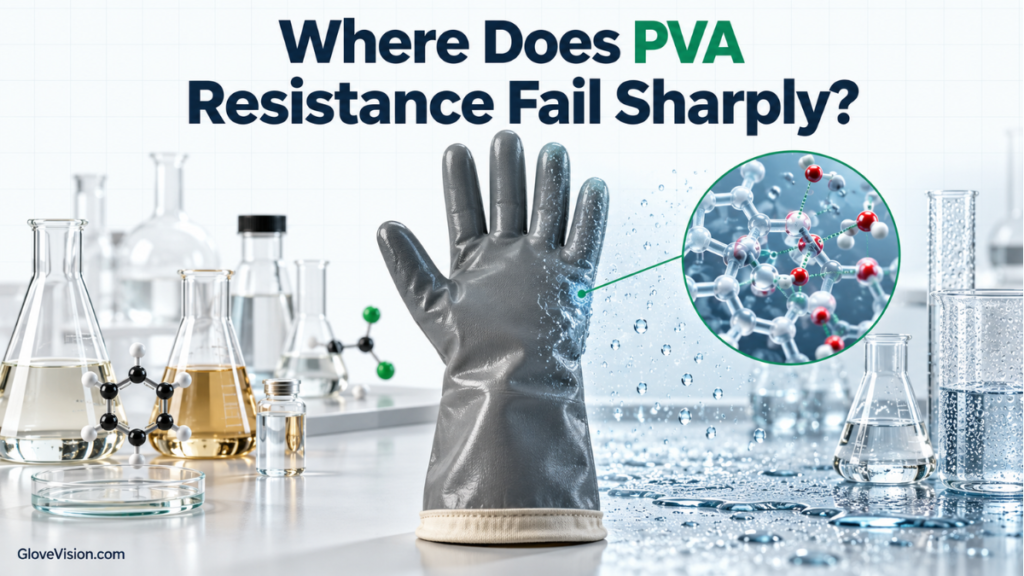
Where Does PVA Resistance Fail Sharply?
PVA Gloves fail most sharply when water or substantial moisture enters the exposure. Their hydroxyl-rich chemistry supports strong dry-organic-solvent specialization, but those same hydroxyl groups interact strongly with water, allowing hydration, plasticization, swelling, and loss of barrier stability under unfavorable conditions.
Water is not the only boundary. High humidity, light alcohols, acetone, aqueous mixtures, elevated temperature, prolonged contact, and material degradation can also move PVA Gloves outside their specialist range, so selection must progress from the sharp-failure boundary through moisture and chemical exceptions to severity, alternatives, and exact-product verification.
What Defines the Sharp-Failure Boundary of PVA Gloves?
The sharp-failure boundary of PVA Gloves is defined by exposures that interact strongly with the polymer itself—especially water and significant moisture—rather than by a gradual decline across every solvent family.
Where Are PVA Gloves Strongest Before the Boundary?
OSHA describes PVA as a specialty glove for organic solvents and lists aliphatics, aromatics, chlorinated solvents, ketones except acetone, esters, and ethers among its generic use areas. These are useful material-level candidate zones, not automatic approvals for an exact chemical or finished glove. [OSHA] For the molecular basis behind that specialization, see PVA chemistry and solvent resistance.
Which Conditions Define the Sharpest Weak Zone for PVA Gloves?
The generic boundary changes sharply around water and aqueous exposure. OSHA identifies PVA as water sensitive and poor versus light alcohols, while explicitly excluding acetone from its otherwise favorable generic ketone category. [OSHA]
Why Is the Water Boundary Especially Sharp for PVA Gloves?
A dry compatible solvent can leave the cohesive PVA network within its useful specialist range, whereas water directly interacts with the hydroxyl-rich polymer. That interaction can alter hydrogen bonding, chain mobility, hydration, swelling, and mechanical behavior rather than merely adding another solvent to a uniform compatibility scale.
Why Is “Organic Solvent Resistant” Too Broad for PVA Gloves?
Organic liquids differ in polarity, hydrogen-bonding behavior, molecular structure, molecular size, water content, and formulation. PVA therefore has a polarized resistance profile: strong generic zones coexist with abrupt exceptions, and the exact chemical still requires product-specific evidence.
What Is the First Screening Question for PVA Gloves?
Is water or significant moisture present anywhere in the exposure? If yes, PVA requires immediate re-evaluation rather than automatic transfer of dry-solvent compatibility.
The supporting boundary map and table form one proof asset: they distinguish the broad dry-solvent candidate zone from the conditions that sharply narrow PVA confidence.
| Exposure Factor | Generic PVA Direction | Boundary Severity |
|---|---|---|
| Dry aromatic solvent | Often strong candidate | Favorable generic zone |
| Dry chlorinated solvent | Often strong candidate | Favorable generic zone |
| Dry aliphatic solvent | Often strong candidate | Favorable generic zone |
| Dry ester / ether | Candidate | Product-specific |
| Water | Major weakness | Sharp boundary |
| Aqueous formulation | High concern | Sharp boundary |
| High humidity | Can reduce protection for affected products | High concern |
| Light alcohol | Weak generic zone | Significant limitation |
| Acetone | Explicit ketone exception | Weak / conditional |
| Unknown solvent blend | Uncertain | Escalate |
Why Do Water and Humidity Cause Sharp Failure in PVA Gloves?
Water is the defining weakness of PVA Gloves because the same hydroxyl groups that support strong dry-state intermolecular association can also form strong interactions with water molecules.
Why Do Hydroxyl Groups Make PVA Gloves Water-Sensitive?
PVA is a linear, semicrystalline polymer containing abundant hydroxyl groups. Those groups support strong intra- and intermolecular hydrogen bonding, while degree of hydrolysis and molecular weight influence water solubility and mechanical behavior. [PVA Review]
What Happens When Water Reaches PVA Gloves?
Water can interact with PVA hydroxyl groups and disturb the balance of polymer–polymer interactions. PVA research describes water as a plasticizer capable of interacting with hydroxyl groups and disrupting inter- and intramolecular hydrogen bonding, while the practical magnitude depends on formulation and material structure. [PVA Review]
Why Is Water Solubility Relevant Without Saying Every PVA Glove Instantly Dissolves?
PVA water behavior is grade-dependent. Degree of hydrolysis, molecular weight, crystallinity, processing, coating thickness, and finished construction can alter the rate and extent of water response. The defensible conclusion is strong water sensitivity—not identical or instantaneous failure for every PVA glove.
Why Can High Humidity Matter for PVA Gloves?
For AlphaTec 15-554 specifically, Ansell states that contact with water or use in high-humidity environments will greatly decrease chemical protection. This is model-specific evidence and should not be converted into a universal humidity threshold for every PVA product. [Ansell]
Which Hidden Moisture Sources Matter for PVA Gloves?
Check condensation, damp equipment, wet hoses or drums, rinse water, aqueous cleaning residue, humid process areas, outdoor moisture, and any other route by which water could reach the PVA barrier.
Can Perspiration Matter for PVA Gloves?
Potentially, if moisture can reach the protective PVA layer. Do not assume a support liner completely isolates the coating from moisture unless exact construction evidence supports that conclusion.
When Should Humidity Trigger Alternative Evaluation for PVA Gloves?
Alternative evaluation becomes more important when an exact manufacturer warning applies, exposure is prolonged, moisture cannot be reliably controlled, or consequences of breakthrough are high.
Which Alcohol, Acetone, and Mixture Exposures Create Weak Zones for PVA Gloves?
PVA Gloves have important chemical exceptions beyond water: light alcohols are a weak generic zone, acetone is an explicit exception within the otherwise favorable ketone category, and mixtures require stronger scrutiny when water or another poorly compatible component can control the exposure.
Why Do Light Alcohols Form a Weak Zone for PVA Gloves?
OSHA identifies PVA as poor versus light alcohols. Methanol, ethanol, isopropanol, and related light-alcohol exposures therefore should not inherit the favorable generic screening position assigned to dry aromatics or chlorinated solvents. [OSHA]
Why Can Alcohol–Water Mixtures Be More Problematic for PVA Gloves?
An alcohol–water formulation combines a generic light-alcohol weakness with direct moisture exposure. That removes the basis for transferring dry-solvent compatibility and makes complete-formulation or exact-product evidence more important.
Why Is Acetone a Critical Ketone Exception for PVA Gloves?
OSHA lists ketones among PVA’s generic use areas but explicitly adds “except acetone.” Acetone is therefore a useful reminder that a favorable chemical-family label cannot be transferred automatically to every family member. [OSHA]
Why Should Other Ketones Not Automatically Inherit the Acetone Weakness of PVA Gloves?
The inverse extrapolation is also unsafe. Acetone’s explicit exception does not prove every ketone behaves the same way. Each ketone still requires applicable evidence.
Why Can a Toluene–Water Mixture Behave Differently With PVA Gloves?
Dry toluene can sit inside a favorable generic PVA solvent zone, but adding water introduces PVA’s defining material weakness. The dry-solvent result therefore cannot simply be inherited by a water-containing formulation.
Why Are Commercial Cleaners and Degreasers Difficult for PVA Gloves?
A formulation may contain several solvents plus water, alcohols, ketones, detergents, stabilizers, or other additives. Selection should therefore account for the complete formulation rather than the marketing name or dominant ingredient alone.
Why Can the Limiting Component Control PVA Gloves Selection?
A poorly compatible component may permeate faster, promote swelling or hydration, or alter the chemical environment experienced by the polymer. This is why the dominant ingredient is not always the correct basis for selection.
When Should Generic PVA Gloves Data Be Rejected?
Escalate when the formulation is proprietary or unknown, water content is unresolved, light alcohol or acetone is present, only single-solvent data exist for a complex mixture, or the proposed glove differs from the tested product.
The chemical-zone spectrum and matrix form one proof asset and preserve the important distinction between candidate zones, exact-product verification, and sharp generic weak zones.
| Exposure | Generic PVA Direction | Main Failure Concern | Action |
|---|---|---|---|
| Dry aromatic | Strong candidate | Product-specific permeation | Verify |
| Dry chlorinated solvent | Strong candidate | Exact-solvent behavior | Verify |
| Dry ester / ether | Candidate | Product-specific behavior | Verify |
| Selected ketone | Candidate | Exact ketone required | Verify |
| Acetone | Explicit exception | Poor generic fit | Compare |
| Light alcohol | Weak generic zone | Unfavorable generic fit | Compare |
| Water | Major weakness | Hydration / swelling / plasticization | Avoid generic use |
| Alcohol–water blend | High concern | Alcohol + moisture boundary | Compare |
| Aqueous organic mixture | High concern | Water may dominate | Alternative evaluation |
| Unknown blend | Uncertain | Limiting component unknown | Escalate |
How Do Exposure Severity and Degradation Show That PVA Gloves Have Crossed Their Boundary?
PVA Gloves cross their practical resistance boundary more quickly when temperature, contact duration, immersion, or mechanical damage increases the intensity of an already marginal chemical exposure.
Why Does Higher Temperature Matter for PVA Gloves?
Temperature changes can alter polymer mobility, chemical diffusion, sorption, and water interaction. A room-temperature result therefore should not be assumed to establish heated-process suitability unless the evidence supports the actual use temperature.
Why Does Longer Contact Matter for PVA Gloves?
Longer contact provides more opportunity for sorption and diffusion through a barrier. Exposure duration must therefore be compared with the conditions represented by the exact product data.
Why Is Immersion More Demanding Than Splash for PVA Gloves?
Immersion can maintain continuous chemical contact over a larger area without meaningful recovery intervals. Splash evidence should not be silently transferred to prolonged or continuous immersion.
Why Is Hot Water Especially Unfavorable for PVA Gloves?
Water already targets PVA’s defining generic weakness, while increased temperature can further change polymer mobility and water interaction. Hot aqueous exposure therefore requires exact evidence.
Which Degradation Signs Matter for PVA Gloves?
Watch for softening, swelling, tackiness, dimensional change, loss of strength, cracking, scraping, thinning, discoloration, or other surface changes. These observations can indicate material change and should trigger removal and reassessment.
Why Does Softening or Swelling Matter for PVA Gloves?
Softening can reflect solvent uptake or plasticization, while swelling shows that the polymer matrix has expanded. Either can reduce confidence by changing chain spacing, mechanical integrity, or transport pathways.
Why Can Lack of Visible Damage Still Mislead With PVA Gloves?
Chemical permeation and visible degradation are different phenomena. ASTM F739 evaluates molecular permeation through protective clothing materials under defined continuous-contact conditions, so barrier performance cannot be judged from appearance alone. [ASTM]
What Should Happen After Significant Change in PVA Gloves?
Use the conservative sequence: remove → replace → investigate exposure and product evidence → compare another verified barrier if necessary.
How Should PVA Gloves Be Compared and Verified at Their Failure Limits?
PVA Gloves should remain in use only when the exact exposure stays inside their verified specialist zone. When water, light alcohols, acetone, complex mixtures, severe conditions, or degradation remove that advantage, another exact barrier should be evaluated.
When Can Butyl Be More Appropriate Than PVA Gloves?
Butyl can enter the comparison for selected ketones, glycol ethers, and esters when exact product evidence supports the exposure. See Butyl selection trade-offs.
When Can Fluoroelastomer Be More Appropriate Than PVA Gloves?
A fluoroelastomer product can be compared where strong organic-solvent resistance remains necessary but moisture makes the proposed PVA glove unsuitable, provided exact chemical evidence supports it. See fluoroelastomer adoption limits.
When Can Nitrile Be More Practical Than PVA Gloves?
Nitrile can be considered when the exact chemical supports it and the task benefits from wet compatibility, durability, puncture resistance, or dexterity. It is not universal solvent protection.
When Can Neoprene Be More Appropriate Than PVA Gloves?
An exact neoprene product can be evaluated for selected aqueous, alcohol-containing, acid/base, or mixed wet exposures when its evidence better matches the task. See the neoprene specialization trade-off.
When Does a Multilayer Barrier Make More Sense Than PVA Gloves?
A verified multilayer barrier can become useful when water and an aggressive solvent coexist, mixture complexity is high, consequences of breakthrough are serious, or no single conventional polymer adequately covers the formulation.
The decision-route visualization and matrix form one proof asset, translating moisture and exception checks into a conservative PVA-or-alternative decision.
| Exposure Condition | PVA Direction | Alternative Direction |
|---|---|---|
| Dry aromatic | Strong generic candidate | Alternative only if task requires it |
| Dry chlorinated solvent | Strong generic candidate | Exact fluoroelastomer may also qualify |
| Dry supported ester / ether | Candidate | Compare exact products |
| Water / aqueous chemical | Poor generic fit | Wet-compatible verified barrier |
| Light alcohol | Weak PVA zone | Chemical-specific alternative |
| Acetone | Explicit PVA exception | Butyl or another verified barrier |
| Wet solvent mixture | High concern | Wet-compatible specialist or multilayer |
| Complex unknown mixture | Insufficient basis | Mixture-tested product |
| High-temperature wet exposure | Very poor generic basis | Exact wet-compatible barrier |
What Chemical Information Must Be Confirmed for PVA Gloves?
Record the exact chemical, CAS number, concentration, solvent purity, and complete formulation. Do not select from a generic product name or a single highlighted ingredient.
Why Must Water Be a Separate Verification Gate for PVA Gloves?
Explicitly check water content, aqueous phase, humidity, wet surfaces, condensation, and rinse residues. Water should not disappear inside a generic “mixture” field because it is the defining generic PVA weakness.
Which Specific Exceptions Must Be Checked for PVA Gloves?
Flag light alcohols, acetone, unknown mixtures, and aqueous formulations before generic PVA solvent guidance is applied.
Which Exact Product Details Must Match for PVA Gloves?
Verify manufacturer, exact model, PVA coating or formulation, thickness, support construction, liner, cuff, and intended use. Product-level evidence should remain attached to the exact glove that generated it.
Which Performance Data Must Be Reviewed for PVA Gloves?
Review applicable breakthrough, permeation rate, cumulative permeation where relevant, degradation, concentration, temperature, specimen thickness, test method, and contact mode. ASTM F739 also cautions that its data cannot by themselves be used to infer safe exposure levels. [ASTM]
When Is the Evidence Too Weak for PVA Gloves?
Escalate when water cannot be excluded, mixture composition is incomplete, exact chemical data are absent, the proposed product differs from the tested glove, actual temperature or duration exceeds the evidence, material degradation has developed, or task consequences require a larger evidence margin.
Chemical Gate
- Exact chemical identified.
- CAS number confirmed.
- Concentration known.
- Solvent purity known.
- Complete formulation reviewed.
Water Gate
- Water content known.
- Aqueous phase identified or excluded.
- Humidity considered.
- Wet equipment and surfaces considered.
- Condensation considered.
- Rinse and cleaning residues considered.
Exception Gate
- Light alcohol checked.
- Acetone checked.
- Unknown-mixture concern addressed.
- Dry-solvent data not transferred automatically to wet formulations.
Exposure Gate
- Temperature defined.
- Splash, intermittent, continuous, or immersion contact defined.
- Duration known.
- Frequency known.
- Mechanical stress assessed.
Product Gate
- Exact PVA model confirmed.
- Coating or formulation matches the evidence.
- Thickness known where available.
- Support and liner known.
- Cuff and coverage appropriate.
- Intended use relevant.
Performance Gate
- Permeation reviewed.
- Breakthrough endpoint understood.
- Degradation reviewed.
- Test concentration applicable.
- Test temperature applicable.
- Duration supported.
- No automatic safe-wear time inferred.
Condition Gate
- No unacceptable softening.
- No unacceptable swelling.
- No tackiness or surface breakdown.
- No cracking or thinning.
- No unresolved material change.
- Visual condition not treated as proof of zero permeation.
Final Decision
What Should Readers Remember About Where PVA Gloves Fail Sharply?
PVA Gloves are specialist rather than broad-spectrum barriers. Their strongest generic role lies in selected dry organic-solvent environments, while water sensitivity, light-alcohol weakness, acetone, and unsupported mixtures define important exceptions that prevent “organic-solvent resistant” from becoming a universal selection rule. Treat PVA Gloves as dry-organic-solvent specialists whose resistance can fail sharply when moisture or incompatible chemistry reaches the polymer.
The sharpest boundary is moisture because water interacts directly with PVA’s hydroxyl-rich structure and can alter the cohesion and stability supporting its specialist solvent performance. Humidity, aqueous formulations, temperature, duration, mixture composition, degradation, and exact glove construction therefore determine whether PVA remains a valid barrier or should be replaced by another verified material.
Which Questions Clarify Where PVA Gloves Fail Sharply?
What Is the Biggest Weakness of PVA Gloves?
Water exposure is the most important generic weakness. PVA’s hydroxyl-rich chemistry interacts strongly with moisture, so significant wet exposure can undermine the material behavior that supports its specialist dry-solvent role.
Can High Humidity Reduce PVA Gloves Protection?
It can for products whose manufacturer identifies humidity as a limitation. Ansell specifically warns that water contact or high-humidity use greatly decreases the chemical protection of AlphaTec 15-554; that warning should remain model-specific.
Are PVA Gloves Good for Alcohols?
Not generically. OSHA identifies light alcohols as a weak PVA category, so methanol, ethanol, isopropanol, and related exposures require exact-product verification rather than extrapolation from dry aromatic or chlorinated-solvent performance.
Are PVA Gloves Good for Acetone?
Acetone is a notable generic exception. OSHA lists PVA for ketones except acetone, so another verified barrier should normally be compared unless exact PVA product evidence supports the exposure.
When Should Another Material Replace PVA Gloves?
Compare or replace PVA when water or relevant high humidity cannot be controlled, light alcohols or acetone dominate the task, mixture composition is unsupported, temperature or duration exceeds applicable evidence, degradation develops, or another exact barrier has stronger evidence for the real exposure.