
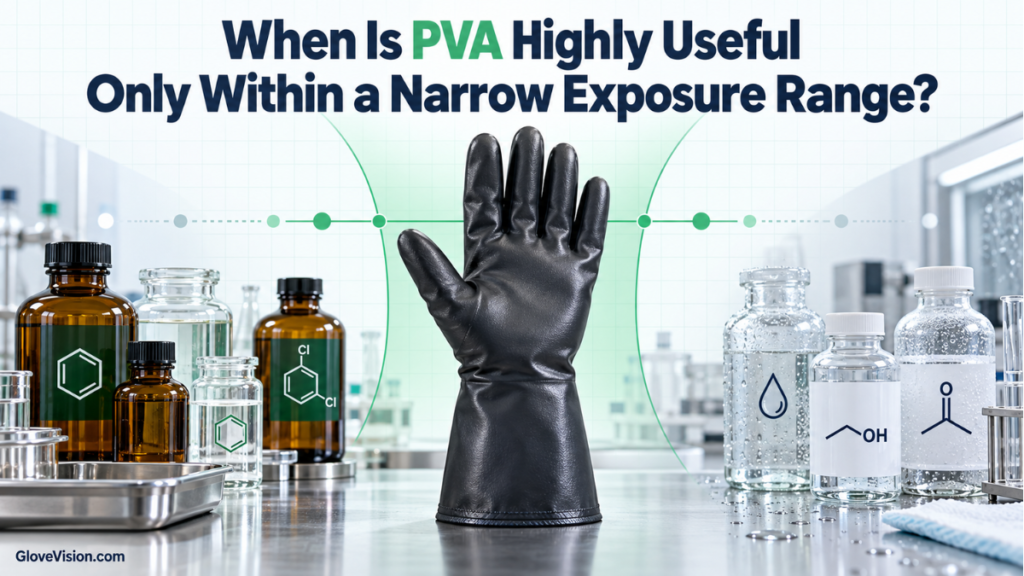
When Is PVA Highly Useful Only Within a Narrow Exposure Range?
PVA Gloves are most useful when a task involves a dry organic solvent that falls squarely within their specialist resistance profile, especially selected aromatic, chlorinated, aliphatic, ester, ether, and ketone exposures. Inside that narrow zone, PVA can provide unusually valuable chemical protection.
Their usefulness contracts quickly when water, high humidity, light alcohols, acetone, uncertain mixtures, excessive temperature or duration, or incompatible physical task conditions enter the exposure. PVA should therefore be treated as a narrow specialist, moving from range definition and specialist value through dry-condition requirements, boundary checks, alternative comparison, and exact-product verification.
What Defines the Narrow Exposure Range of PVA Gloves?
The narrow exposure range of PVA Gloves is defined by dry, well-characterized organic solvents that fall within documented PVA resistance while excluding moisture, weak chemical zones, and unsupported mixtures or task conditions.
Which Chemical Families Sit Inside the Core Range?
Generic OSHA glove-selection guidance places PVA in a specialty organic-solvent role and lists aliphatics, aromatics, chlorinated solvents, ketones except acetone, esters, and ethers among its use categories. [OSHA] These groups define candidate zones rather than universal approval for every member of each family. The chemistry behind this specialization is explored further in PVA solvent resistance.
Which Conditions Sit at or Outside the Edge?
The most important generic boundary conditions are water, high humidity, light alcohols, acetone, aqueous solvent mixtures, and formulations whose complete composition is unknown. These factors can move an otherwise promising solvent task out of the defensible PVA range.
Why Is the Range Narrow?
PVA does not interact with every liquid in the same way. The useful model is: favorable behavior with selected dry organics + unfavorable interaction with water or selected polar chemicals → highly polarized resistance profile. That is why PVA’s specialist solvent reputation should never be translated into universal organic-solvent resistance.
Why Can Narrow Specialization Still Be Highly Valuable?
A narrow range can be highly valuable when it overlaps precisely with a difficult hazard. The relevant relationship is: narrow chemical envelope + excellent verified match to a difficult hazard = strong specialist value. A broader-use glove is not automatically the better barrier when its resistance to the actual solvent is inadequate.
What Is the Correct First Screening Question?
Ask: Is this a dry, well-characterized organic-solvent exposure that falls inside documented PVA resistance? If the answer is unclear, PVA should move from automatic selection to compare or escalate status.
| Exposure Factor | PVA Direction | Range Effect |
|---|---|---|
| Dry aromatic | Strong candidate | Core range |
| Dry chlorinated solvent | Strong candidate | Core range |
| Dry aliphatic | Strong candidate | Core range |
| Dry ester / ether | Candidate | Verify exact product |
| Selected ketone | Candidate | Chemical-specific |
| Acetone | Weak / exception | Outside generic range |
| Water | Major weakness | Range can collapse |
| High humidity | Major concern | Range contracts |
| Light alcohol | Weak | Outside preferred generic range |
| Unknown mixture | Uncertain | Escalate |
Why Does the Specialist Value Zone Make PVA Gloves Highly Useful?
PVA Gloves become highly useful when a difficult dry solvent exposes a protection gap in more general-purpose glove materials and an exact PVA product provides stronger applicable resistance.
Why Do Difficult Organic Solvents Increase PVA Gloves Value?
Some demanding organic solvents can expose limitations in more general-purpose glove materials. PVA occupies a specialist role because its resistance profile can align strongly with selected dry organic-solvent hazards that require more than general-purpose convenience.
Why Are Aromatics Important for PVA Gloves?
Aromatics form an important PVA specialty zone. Ansell specifically describes the PVA coating of its AlphaTec 15-554 as providing advanced resistance to aromatic and chlorinated solvents. [Ansell] That model-specific evidence must not be transferred automatically to every PVA glove. See the separate PVA aromatic-solvent guide.
Why Are Chlorinated Solvents Important for PVA Gloves?
Chlorinated solvents form another important generic PVA candidate zone, but selection still requires the exact chemical, exact glove, and relevant exposure conditions. Family-level positioning is a screening signal, not permission to treat all chlorinated solvents as interchangeable. See PVA chlorinated-solvent resistance.
Why Can Specialist Performance Be More Valuable Than General-Purpose Convenience?
The decision is not specialist versus convenient in isolation. It is whether the barrier matches the hazard: easy-to-use glove + inadequate barrier = poor protection, while specialist glove + strong verified barrier = justified specialization.
When Does PVA Add Little Value?
PVA adds less practical value when another exact glove already provides adequate chemical protection and duration while offering better moisture tolerance, mechanical performance, cost, fit, or workflow simplicity. Specialist value exists only when the specialization solves a real protection problem.
The visual separates the high-value dry-solvent corridor from exposures that progressively lose generic PVA confidence.
Text equivalent for Figure 1: PVA has a narrow specialist corridor centered on selected dry aromatic, chlorinated, aliphatic, ester, ether, and ketone exposures. Water, high humidity, light alcohols, acetone, wet mixtures, and unknown formulations sit outside or threaten that corridor. Chemical-family placement is only a screening step; exact chemical and exact-product evidence remain necessary.
| Exposure | PVA Specialist Value | Control Point |
|---|---|---|
| Dry aromatic | High | Verify exact chemical and product |
| Dry chlorinated solvent | High | Verify exact chemical and product |
| Dry aliphatic | Moderate–high | Confirm product evidence |
| Dry ester / ether | Potentially high | Chemical-specific verification |
| Selected ketone | Product-specific | Do not include acetone automatically |
| Water-based chemical | Very low generic confidence | Wet-condition evidence required |
| Light alcohol | Low generic fit | Compare exact alternatives |
| Acetone | Low / exception | Do not infer from ketone family |
| Mixed wet solvent | Low or uncertain | Mixture-specific evidence required |
Which Dry-Solvent Conditions Best Preserve the Specialization of PVA Gloves?
PVA Gloves preserve their strongest specialist value when the solvent is dry, chemically well characterized, used within supported temperature and duration conditions, and handled with an exact glove whose construction and barrier evidence match the task.
Why Must the Solvent Be Dry for PVA Gloves?
Dryness protects the central condition behind PVA’s specialist role: dry compatible solvent → PVA remains within its favorable operating envelope. Water is not a minor inconvenience for PVA. It can fundamentally change whether the material remains appropriate.
Why Does Solvent Purity Matter for PVA Gloves?
A solvent identified by one headline name may also contain water, alcohol, cleaning additives, stabilizers, or other co-solvents. Those additional components can change the glove decision, so purity and full formulation matter rather than the primary ingredient alone.
Why Does Controlled Humidity Matter for PVA Gloves?
Humidity should be treated as a product-specific environmental variable. For example, Ansell warns that contact with water or use in high-humidity environments greatly decreases chemical protection for AlphaTec 15-554. [Ansell] That warning is strong evidence for that exact model and should not be silently converted into an identical numerical limit for every PVA glove. See the broader PVA dry-only limits.
Why Does Temperature Matter for PVA Gloves?
Temperature can change diffusion, polymer mobility, solvent uptake, evaporation, and moisture conditions. Chemical data generated under one temperature should therefore not be assumed to establish performance at a substantially hotter process condition.
Why Does Contact Duration Matter for PVA Gloves?
Splash, intermittent contact, repeated contact, continuous exposure, and immersion are different exposure scenarios. Longer and more continuous contact generally demands stronger applicable permeation and degradation evidence for the exact product.
What Does a Strong PVA Gloves Task Look Like?
The strongest task profile is: known dry solvent + controlled moisture + applicable temperature + supported duration + exact PVA data + acceptable physical task demands. All of these conditions need to remain aligned; solvent-family reputation alone is not enough.
Which Moisture, Chemical, and Exposure Conditions Narrow the Useful Range of PVA Gloves?
The useful range of PVA Gloves contracts when moisture, poorly compatible chemicals, mixture uncertainty, higher temperature, prolonged contact, or incompatible task demands move the exposure away from PVA’s dry-solvent specialty zone.
Why Is Water the Main Boundary for PVA Gloves?
Water directly challenges a defining weakness of PVA. OSHA’s generic glove-selection guidance identifies PVA as water-sensitive, while Ansell states that the PVA used in AlphaTec 15-554 is water soluble. [OSHA] [Ansell] The practical rule is: dry compatible solvent → strong candidate; same solvent + meaningful water → reassess suitability.
Why Does High Humidity Matter for PVA Gloves?
A water-sensitive material can encounter moisture without being immersed in liquid water. High humidity can therefore become relevant, particularly when the exact glove manufacturer identifies it as a limitation.
Which Hidden Moisture Sources Matter for PVA Gloves?
Condensation, wet equipment, rinse residues, aqueous cleaning chemicals, humid process areas, and water-containing formulations can all undermine an assumption that a nominally “solvent” task is actually dry.
Why Are Light Alcohols Important Exceptions for PVA Gloves?
OSHA’s generic selection table identifies PVA as poor against light alcohols. [OSHA] Methanol, ethanol, and isopropanol may therefore be treated as warning examples for screening, but the final decision still belongs to chemical-specific evidence for the exact glove.
Why Is Acetone a Critical Exception for PVA Gloves?
OSHA’s generic PVA entry lists ketones while explicitly excluding acetone. [OSHA] This makes acetone a useful reminder that ketone family candidate ≠ automatic acetone compatibility.
Why Should Other Ketones Still Be Verified Individually for PVA Gloves?
The inverse assumption is also unsafe. Differences in molecular size, polarity, solvent affinity, and diffusion behavior can alter barrier performance, so acetone’s weakness does not establish the behavior of every other ketone.
Why Are Alcohol-Water Mixtures Especially Problematic for PVA Gloves?
They can combine two generic PVA concerns: water sensitivity and weak performance against light alcohols. The resulting screening principle is: multiple PVA weak factors in one formulation → sharply reduced generic confidence.
Why Are Mixed Solvents Harder to Predict for PVA Gloves?
A mixture can combine a strong PVA candidate solvent with water, alcohol, ketones, or other co-solvents and additives. OSHA advises that formulated products and mixtures require attention to the component with the shortest breakthrough time when specific mixture data are unavailable. [OSHA]
Why Does Unknown Composition Matter for PVA Gloves?
Headline solvent ≠ complete formulation. If the formulation is incomplete or proprietary components remain unresolved, the exposure cannot safely inherit the resistance profile of the named major solvent.
Why Does Longer Contact Matter for PVA Gloves?
Longer contact provides more opportunity for permeation or degradation to become important. Short splash evidence should not automatically be extended to prolonged contact or immersion.
Why Does Higher Temperature Matter for PVA Gloves?
Higher temperature can change diffusion, solvent uptake, polymer mobility, evaporation, and moisture behavior. Evidence generated under cooler test conditions should not automatically be transferred to hotter use.
Why Is Immersion More Demanding Than Splash for PVA Gloves?
Immersion creates continuous contact, a sustained concentration gradient, and greater cumulative exposure. It therefore requires evidence applicable to that contact mode rather than a generic assumption based on brief contact.
Which Task Conditions Can Narrow PVA Gloves Fit Even When Chemistry Is Favorable?
Wet/dry workflow switching, grip, dexterity, puncture, abrasion, cost, and glove-change burden can all determine whether the chemically promising barrier is practical for the complete task. Chemical resistance and mechanical suitability must be evaluated separately.
When Should PVA Gloves Be Removed From the Candidate List?
Move PVA to compare, escalate, or reject status when water content is unknown, dryness cannot be maintained, mixture composition is incomplete, light alcohol or acetone dominates, exposure exceeds supported temperature or duration, exact product evidence is absent, or mechanical demands exceed the construction. Related failure mechanisms are covered in PVA resistance failure.
Text equivalent for Figure 2: PVA begins with strong specialist value when a compatible organic solvent is dry. Water or humidity, chemical exceptions, mixture uncertainty, higher temperature, prolonged contact, immersion, and incompatible task demands progressively narrow the defensible operating window. When the protection margin becomes too narrow or unsupported, limit the PVA use, switch to another barrier for the incompatible stage, or compare another exact glove.
How Should PVA Gloves Be Compared and Verified Before Their Narrow Exposure Range Is Accepted?
PVA Gloves should remain the selected barrier only when the exact exposure falls clearly inside their verified specialty range and no alternative provides equally adequate protection with fewer chemical, moisture, mechanical, or workflow constraints.
When Can Fluoroelastomer Be a Better Candidate Than PVA Gloves?
An exact fluoroelastomer glove may warrant comparison when strong organic-solvent resistance is still needed but moisture or alcohol conditions make PVA less practical, provided the fluoroelastomer product has stronger applicable evidence. See fluoroelastomer adoption limits.
When Can Butyl Be More Appropriate Than PVA Gloves?
Butyl may warrant comparison for selected glycol ethers, ketones, and esters where exact butyl evidence better matches the exposure or where PVA’s chemical profile is weaker. OSHA’s generic chart identifies Butyl as a specialty glove used against glycol ethers, ketones, and esters, but exact-product verification still controls the decision. [OSHA] See Butyl selection trade-offs.
When Can Nitrile Be More Practical Than PVA Gloves?
An exact nitrile glove can be more practical where its chemical data support the exposure, moisture is present, greater mechanical performance is required, or PVA’s narrow solvent specialization provides no meaningful benefit. This is a task-specific comparison rather than a universal material ranking.
When Can Neoprene Be More Practical Than PVA Gloves?
An exact neoprene construction can be considered for selected wet or mixed chemical environments where neoprene compatibility is documented and PVA cannot reliably remain dry. See neoprene specialization trade-offs.
When Can a Multilayer Barrier Be Better Than PVA Gloves?
A verified multilayer barrier may be more appropriate for complex mixtures, wet organic-solvent processes, high-consequence exposures, or broad chemical uncertainty when mixture-specific or exact-product evidence supports that construction.
Why Is There No Universal Replacement for PVA Gloves?
Every alternative has chemical gaps, physical limitations, fit characteristics, cost, and task restrictions. Replacing PVA therefore means finding an exact product whose complete protection profile better matches the actual exposure—not choosing a universally “better” material.
| PVA Limiting Condition | PVA Direction | Alternative Direction |
|---|---|---|
| Dry aromatic / chlorinated solvent | Strong candidate | PVA may remain the selected specialist if exact evidence supports it |
| Water present | Weak | Compare a wet-compatible exact barrier |
| Light alcohol | Weak generic fit | Compare fluoroelastomer or another verified exact material |
| Acetone | Poor generic fit | Compare Butyl or another exact barrier with applicable evidence |
| Complex mixture | Uncertain | Compare mixture-tested or appropriate multilayer product |
| Heavy mechanical demand | Construction-dependent | Compare a mechanically suitable exact product |
| Routine low-risk task | May be over-specialized | Compare a verified general-purpose glove if it fully satisfies the hazard |
What Chemical Information Must Be Confirmed for PVA Gloves?
Record the exact chemical, CAS number, concentration, solvent purity, and complete formulation. A family name or major ingredient is not enough when minor components can introduce water, alcohol, or another incompatible chemical.
What Moisture Information Must Be Confirmed for PVA Gloves?
Check water content, humidity, condensation, wet surfaces, rinse residues, and any aqueous process stages. The workflow must be evaluated as a complete sequence rather than only at the nominal solvent-handling step.
Which Exposure Conditions Must Be Defined for PVA Gloves?
Document temperature, splash versus immersion, duration, frequency, and pressure or mechanical stress. These conditions determine whether available chemical data actually represent the intended use.
Which Product Details Must Match for PVA Gloves?
Verify manufacturer, exact model, PVA coating or formulation, thickness, liner or support, cuff, intended use, and relevant standards or certifications. Do not transfer AlphaTec 15-554 data to an unrelated PVA construction.
Which Performance Evidence Must Be Reviewed for PVA Gloves?
Review chemical-specific permeation, breakthrough endpoint, degradation, test concentration, temperature, duration, material thickness, and applicable mechanical performance. OSHA’s PPE guidance recommends obtaining manufacturer documentation showing that glove performance is appropriate for the anticipated hazard. [OSHA]
When Is Evidence Insufficient for PVA Gloves?
Escalate when water exposure cannot be excluded, mixture composition is incomplete, exact-solvent data are missing, test conditions do not match actual use, the exact glove construction differs from the tested product, or physical task performance remains unsupported.
Chemical Gate
- Exact solvent identified.
- CAS number confirmed.
- Concentration known.
- Solvent purity known.
- Complete formulation reviewed.
Moisture Gate
- Water content known.
- Humidity acceptable for the exact product.
- Condensation controlled.
- Wet surfaces addressed.
- Rinse residues considered.
- Aqueous process stages identified.
Exception Gate
- Light alcohol checked.
- Acetone checked.
- Mixture-specific concerns reviewed.
Exposure Gate
- Temperature known.
- Duration defined.
- Splash or immersion confirmed.
- Frequency defined.
- Mechanical stress assessed.
Product Gate
- Exact PVA manufacturer and model identified.
- Construction matches the evidence.
- Thickness or coating documented.
- Liner or support documented.
- Manufacturer limitations reviewed.
Performance Gate
- Chemical-specific permeation reviewed.
- Breakthrough endpoint understood.
- Degradation acceptable.
- Temperature supported.
- Duration supported.
- Physical performance adequate.
- No generic safe-wear time inferred.
Alternative Gate
- Fluoroelastomer compared where moisture or alcohol conditions justify it.
- Butyl compared where selected ketones or esters justify it.
- Nitrile compared where adequately protective and more practical.
- Neoprene compared for supported wet or mixed conditions.
- Multilayer construction considered for complex or high-consequence mixtures.
- Every alternative assessed as an exact product.
Final Decision
What Should Readers Remember About the Narrow Exposure Range of PVA Gloves?
PVA Gloves are highly useful precisely because they are specialized. Their strongest generic role lies in selected dry organic-solvent exposures—including important aromatic, chlorinated, aliphatic, ester, ether, and selected ketone zones—where their barrier specialization can provide value beyond more general-purpose materials. Use PVA Gloves when a well-characterized dry organic solvent falls squarely inside the exact product’s verified specialty range.
Their value depends on remaining inside that narrow envelope. Water, high humidity, light alcohols, acetone, uncertain mixtures, excessive temperature or duration, wet/dry workflow switching, and incompatible mechanical demands can rapidly remove the PVA advantage, so the exact solvent, environment, product, and task must all support the final selection; move away from PVA when those conditions remove its narrow specialist advantage.
Which Questions Clarify the Narrow Exposure Range of PVA Gloves?
Why Are PVA Gloves Considered Narrow-Specialty Gloves?
PVA Gloves are narrow-specialty gloves because their strongest value lies in selected dry organic-solvent exposures rather than broad all-purpose chemical use. Their useful range can contract quickly when moisture or unsupported chemicals enter the task.
Which Exposure Types Best Fit PVA Gloves?
Generic candidate zones include dry aliphatics, aromatics, chlorinated solvents, esters, ethers, and selected ketones, but exact chemical and exact-product evidence must still govern use.
Why Does Water Push PVA Gloves Outside Their Useful Range?
Water interacts strongly with PVA and can undermine the material conditions that support dry-solvent performance. Meaningful water exposure or high humidity therefore requires exact-product evidence for those conditions or comparison with another barrier.
Are All Organic Solvents Inside the PVA Gloves Range?
No. Generic OSHA guidance identifies light alcohols as a weak PVA zone and acetone as an exception within the otherwise listed ketone category, demonstrating why chemical-family assumptions are insufficient.
When Should Another Material Replace PVA Gloves?
Compare another exact material when water or high humidity cannot be controlled, light alcohols or acetone dominate, mixture composition is uncertain, exposure exceeds supported temperature or duration, physical task demands exceed the glove construction, or another glove provides adequate protection with fewer operating constraints.