
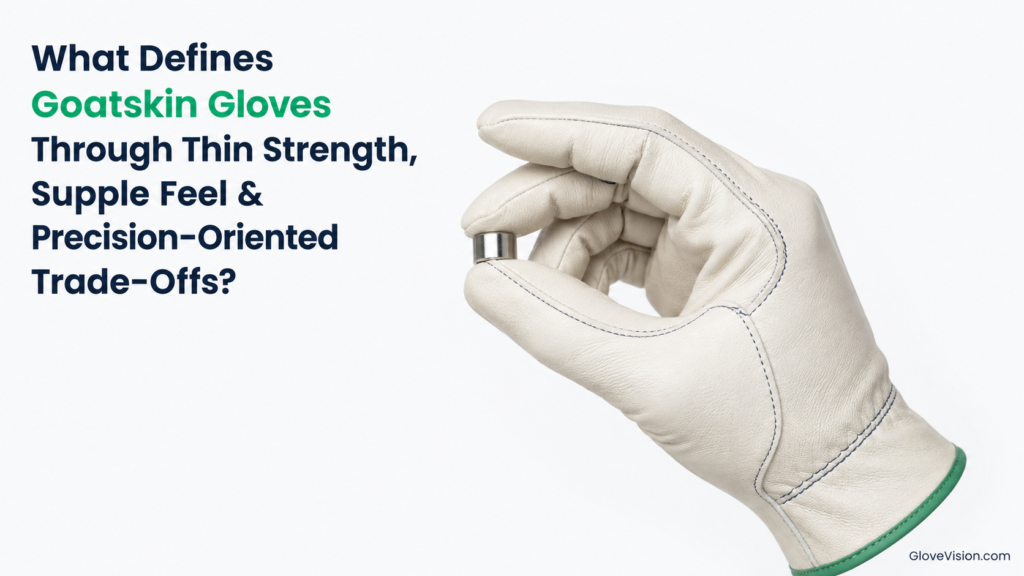
What Defines Goatskin Gloves Through Thin Strength, Supple Feel & Precision-Oriented Trade-Offs?
Goatskin Gloves are processed goat-hide hand protection that can combine relatively low material bulk with useful strength, supple movement, surface grip, tactile feedback and precision-oriented handling.
Those characteristics vary with leather grade, thickness, tanning, finish, panel orientation, seams, reinforcement, lining and fit—and may trade cushioning, abrasion life, puncture resistance, weather tolerance, thermal protection or chemical protection for lower bulk and easier movement.
What Are Goatskin Gloves, and How Does Their Hide Structure Shape Performance?
Goatskin Gloves are made from processed goat hide whose collagen-fiber network, grain surface, thickness, tanning and finish influence flexibility, tensile behavior, surface wear, moisture response and glove feel. Biological variation means the leather is not a perfectly uniform manufactured film.
What Is the Material Composition of Goat-Leather Gloves?
Goat hide is built mainly from interwoven collagen-fiber bundles. The grain layer forms the outer surface, while the deeper corium supplies much of the fibrous body. Fiber density, direction and natural variation can differ within one hide and between hides, so the broader Leather Gloves category cannot predict one finished goatskin product.
How Does the Grain Surface Affect Goatskin Gloves?
The grain surface can influence contact texture, finish adhesion, friction, visible wear and moisture interaction. Processing and use conditions matter; a grain label alone does not establish grip or durability.
How Do Tanning and Finishing Change Goatskin Gloves?
Tanning, fatliquoring and finishing can modify flexibility, dimensional stability, surface friction, moisture response, color, aging and break-in behavior. No tanning system should be ranked without the intended use and finished-glove evidence.
Why Can Goatskin Gloves Vary Between Products?
Hide source, cutting location, grade, thickness, fiber orientation, tanning, finish, panel selection, seams and quality control all contribute. ISO 21420 covers general glove design, construction, comfort, marking and information, but it does not independently establish protection against a specific hazard. [ISO 21420]
Goatskin Gloves Structure-to-Behavior Table
| Goatskin feature | Possible contribution | What it does not guarantee |
|---|---|---|
| Collagen-fiber network | Strength, flexibility and elongation behavior | Finished-glove protection |
| Grain surface | Contact texture and surface durability | Universal grip |
| Relatively thin leather | Lower bulk and possible tactile feedback | Adequate hazard resistance |
| Tanning and fatliquoring | Stability and suppleness | Equal performance across products |
| Surface finish | Modified friction and moisture interaction | Waterproofing or chemical resistance |
| Fiber orientation | Direction-dependent strength and stretch | Uniform strength across every panel |
How Do Goatskin Gloves Combine Thin Strength With a Supple Feel?
Goatskin Gloves can combine relatively thin construction with useful strength when suitable leather quality, fiber structure, tanning, panel orientation and glove construction preserve mechanical integrity without unnecessary bulk. “Thin strength” is descriptive—not a standardized test class.
What Does “Thin Strength” Mean for Goatskin Gloves?
It means useful mechanical behavior relative to material bulk. Less material may preserve movement and contact perception, but it does not mean every thin goatskin glove has adequate protection for every task.
How Does Leather Thickness Affect Goatskin Gloves?
Thickness can influence tensile and tear behavior, abrasion life, flexibility, tactile feedback, hand closure and wear reserve. Thin does not always mean dexterous, and thick does not automatically mean protective.
Why Can Goatskin Gloves Feel Supple?
Low material bulk, fiber mobility, tanning, fatliquoring, finish, panel geometry, moisture content and break-in may all contribute. Animal source alone does not establish suppleness.
How Does Fiber Orientation Affect Goatskin Gloves?
Leather strength and stretch can vary by direction. Pattern orientation may therefore change how a palm, finger or high-stress panel behaves, which is why complete-glove testing remains necessary.
Why Can Soft Goatskin Gloves Still Wear or Tear?
Softness does not prove abrasion, tear, seam or puncture performance. Load, repetition, contact texture, contamination, moisture, thickness, reinforcement and care determine how quickly wear becomes service-affecting. The 23 Glove Materials Explained guide provides broader material context without ranking one hide universally.
How Do Goatskin Gloves Support Precision Handling Without Eliminating Trade-Offs?
Goatskin Gloves can support precision handling when supple leather, controlled thickness, anatomical paneling, secure fit and suitable seam placement allow movement without excessive bulk or internal slipping. Lower bulk can improve feedback while also reducing cushioning or wear reserve.
How Does Low Bulk Affect Tactile Feedback?
Less bulk may support direct contact perception, easier flexion and small-object handling. The trade-off may be less cushioning, less material between hand and hazard, or faster wear in some constructions.
How Does Fit Affect Goatskin Gloves Precision?
Stable palm contact, controlled fingertip length, natural alignment, full opening and functional closure matter. Oversizing can create internal slip, folds, bunching, seam stress and reduced control.
How Do Seams Affect Dexterity?
Fingertip, thumb and palm seam placement can add bulk, pressure or interference. Supple leather cannot compensate for a disruptive seam or unstable thread construction.
How Do Reinforcements Change Handling?
Palm or thumb-crotch reinforcement may support high-wear zones, but it can add stiffness, bulk, seam edges and uneven flexibility. ASTM E3109 supports the principle that protection may vary by glove zone, although its scope is specifically law-enforcement and corrections gloves—not universal goatskin work gloves. [ASTM E3109]
How Do Linings and Cuffs Affect Precision?
Linings may add comfort or thermal buffering but can retain moisture, increase drying time and reduce feedback. Cuffs can improve stability or coverage while restricting wrist movement when poorly matched.
Goatskin Gloves Precision-and-Protection Trade-Off Matrix
| Construction variable | Possible precision benefit | Possible protection contribution | Trade-off |
|---|---|---|---|
| Thin palm | Direct tactile feedback | Limited material separation | Lower cushioning or wear reserve |
| Close anatomical fit | Stable hand contact | Less internal movement | Pressure if incorrectly sized |
| Supple grain leather | Easier flexion | Product-dependent coverage | Variable abrasion life |
| Palm reinforcement | Supports high-wear areas | Additional local material | Bulk and reduced feedback |
| Low-profile seams | Less pressure and interference | Structural continuity | Requires suitable placement and thread |
| Lining | Comfort or thermal buffering | Additional layer | Less dexterity and slower drying |
| Secure cuff | Stable glove position | Wrist-area coverage | Restriction if poorly fitted |
Where Do Goatskin Gloves Provide Protection, and Where Do Their Limits Begin?
Goatskin Gloves may provide useful protection against surface abrasion and selected mechanical contact, but cut, puncture, impact, thermal, chemical, biological and electrical protection must be established separately for the exact finished glove.
How Much Abrasion Protection Can Goatskin Gloves Provide?
Abrasion performance depends on grade, thickness, finish, reinforcement, seams, exposure severity and finished-glove results. ISO 23388 evaluates abrasion, blade cut, tear, puncture and applicable impact as separate mechanical properties. [ISO 23388]
Do Goatskin Gloves Resist Cuts or Punctures?
Not automatically. Abrasion, tear, blade cut, general puncture and needle puncture are distinct. A suitable Cut-Resistant Glove Lining may contribute only when the complete construction has relevant evidence.
Can Goatskin Gloves Protect Against Impact?
Only when the complete glove includes appropriate impact components and supporting test results. Goatskin alone does not prove knuckle, finger, crush or backhand-impact performance.
Can Goatskin Gloves Be Used Around Heat or Flame?
Only when the exact glove is designed and documented for the specific thermal task. Leather, lining, seams, thread, cuff, heat mode and exposure duration must be evaluated together.
Do Goatskin Gloves Provide Chemical Protection?
Not by hide name. Porous leather and seams may absorb liquids, retain contamination or allow penetration. ISO 374-1:2024 applies to gloves intended for dangerous-chemical protection; goatskin alone does not establish compliance. [ISO 374]
Can Goatskin Gloves Provide Electrical Protection?
Grain goatskin may appear in leather protector gloves covered by ASTM F696-24, but those protectors provide mechanical protection for rubber insulating gloves—not electrical insulation. [ASTM F696] OSHA likewise treats protector gloves as part of a rubber-insulating-glove system with specific use and inspection rules. [OSHA Electrical]
Goatskin Gloves Hazard-Boundary Matrix
| Hazard | Possible goatskin role | Required evidence | Main boundary |
|---|---|---|---|
| Surface abrasion | Product-dependent wear resistance | Finished-glove abrasion rating | Not abrasion-proof |
| Tear | Product-dependent resistance | Tear testing and seam assessment | Thin or damaged areas may fail |
| Blade cut | No automatic protection level | Cut-specific testing | Leather can be cut |
| Puncture or needle | No automatic protection level | Hazard-specific puncture evidence | Sharp points may penetrate |
| Impact | No verified role without components | Impact-specific glove testing | Goatskin alone is not impact protection |
| Heat or flame | Possible specialist-construction role | Thermal or task-specific rating | Ordinary products may be inadequate |
| Chemicals | No verified barrier role from hide alone | Exact finished-glove chemical evidence | Leather may retain contamination |
| Electrical exposure | Mechanical protector in an approved system | Complete-system requirements | Not electrical insulation |
| Wet conditions | No assumed wet-use protection | Complete-glove documentation | Absorption may alter fit and grip |
How Should Goatskin Gloves Be Selected, Fitted, Inspected, and Maintained?
Goatskin Gloves should be selected for the exact task and hazard, fitted for stable handling, inspected before use, maintained according to product instructions and retired when protection or control can no longer be verified. OSHA requires glove selection to reflect the task, conditions, duration and identified hazards. [OSHA Hand]
Which Goatskin Gloves Match Different Work Requirements?
Precision handling may prioritize close fit, low bulk and low-interference seams. Assembly adds repeated movement and tool contact. Rough handling may demand reinforcement and separate cut or puncture evidence. Welding, wet work and electrical protector systems require documented specialist constructions—not a generic goatskin label.
What Should Be Defined Before Selection?
Identify contact surfaces, abrasion, sharp edges, puncture, impact, heat, chemicals, moisture, electrical exposure, grip, dexterity, coverage and use duration. The Glove Basics hub can support the general selection process without replacing task-specific evidence.
Which Construction Details Should Be Checked?
Review leather grade, thickness, grain condition, palm, fingers, thumb, reinforcements, seams, thread, backhand, lining, cuff, closure, markings, intended use and applicable ratings.
How Should Fit and Function Be Tested?
Confirm natural finger alignment, controlled fingertip space, minimal bunching, limited internal slip, full opening, functional closure, usable thumb movement and reliable control without numbness, pain or disruptive pressure.
What Should Be Inspected Before Use?
Look for cuts, holes, punctures, critical abrasion, thin spots, cracking, hardening, stretching, shrinkage, open seams, detached reinforcement, displaced lining, cuff damage, contamination, unauthorized repair and missing markings.
How Should Goatskin Gloves Be Cleaned, Dried and Retired?
Follow the exact product instructions for cleaning, water exposure, drying, conditioning, storage, decontamination and permitted repair. Do not universalize soaking, machine washing, direct heat, tumble drying, oils, waxes or conditioners. Retire gloves when structure, fit, grip, markings or required protection can no longer be verified.
Goatskin Gloves Selection-and-Condition Checklist
Hazard Match
- The exact task is defined.
- Mechanical hazards are separated.
- Thermal, chemical and electrical hazards are assessed.
- Required ratings are known.
Construction
- Leather grade and intended use are documented.
- Palm and fingertips provide suitable coverage.
- Reinforcement matches high-wear zones.
- Seams, thread, cuff and lining match the task.
Fit and Precision
- Finger length is appropriate.
- Palm bunching is limited.
- The hand remains stable inside the glove.
- Required controls can be handled reliably.
Condition
- No holes or critical thin spots are present.
- Seams remain closed.
- Leather is not unacceptably hard or cracked.
- Identity, ratings and contamination status remain verifiable.
Conclusion
Goatskin Gloves can combine relatively thin construction, useful mechanical strength, suppleness and precision-oriented handling, but none of these qualities can be assumed from the goatskin name alone. Fiber structure, orientation, thickness, tanning, finish, panels, seams, reinforcement, lining and fit all affect performance, and “thin strength” remains descriptive rather than a formal rating.
Abrasion does not establish cut or puncture resistance; goatskin is not automatically chemical-resistant, waterproof, heat-rated or electrically insulating. Select and retain the exact glove through its hazard match, ratings, complete construction, fit, handling performance, maintenance history and current condition.
Frequently Asked Questions
Are Goatskin Gloves Strong Despite Being Thin?
They can provide useful strength in relatively thin constructions, but this is not universal. Grade, thickness, fiber direction, tanning, finish, seams, reinforcement, wear and complete-product testing all matter.
Do Supple Goatskin Gloves Always Provide Better Dexterity?
No. Dexterity also depends on size, anatomical patterning, fingertip length, seam placement, lining, reinforcement, grip and the movements required by the task.
Do Goatskin Gloves Protect Against Cuts and Punctures?
Only to the level demonstrated by the exact glove. Goatskin alone does not establish blade-cut, puncture or needle resistance.
Can Goatskin Gloves Be Used for Welding or Electrical Work?
Only within appropriately designed and documented systems. Welding gloves require relevant thermal performance; leather protectors in electrical systems provide mechanical protection and do not replace rubber insulating gloves.
When Should Goatskin Gloves Be Replaced?
Replace or reassess them when abrasion, cuts, punctures, open seams, hardening, cracking, stretching, shrinkage, contamination, failed reinforcement, unstable fit or reduced handling makes protection unreliable or unverifiable.