
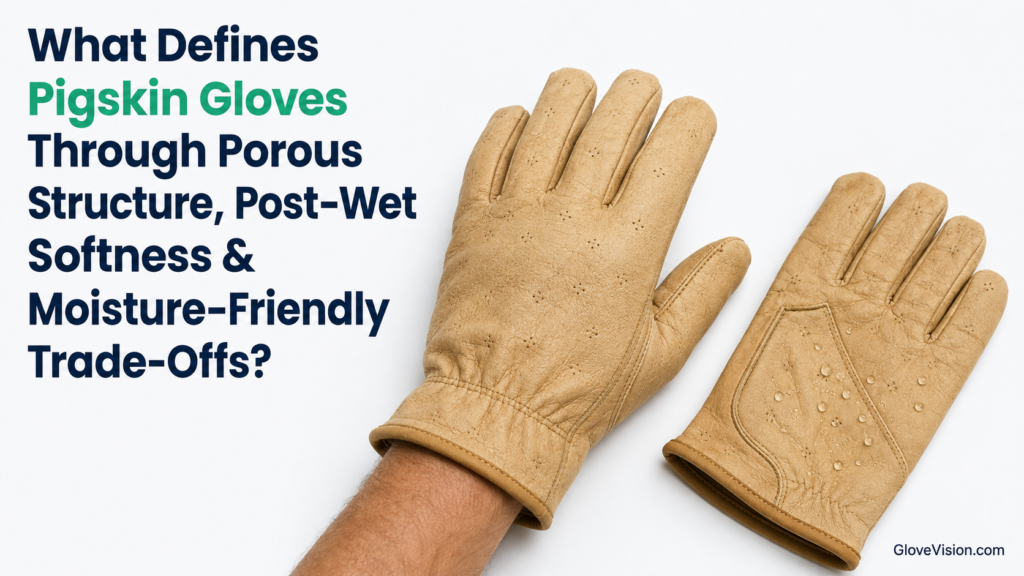
What Defines Pigskin Gloves Through Porous Structure, Post-Wet Softness & Moisture-Friendly Trade-Offs?
Pigskin Gloves are processed porcine-hide hand protection whose follicular grain and collagen-fiber structure can support flexible handling, useful abrasion performance, moisture interaction and product-dependent suppleness after wetting and drying.
“Moisture-friendly” is a practical trade-off, not waterproof protection. Results depend on leather grade, thickness, tanning, finish, water-resistant treatment, seams, lining, fit, drying method, care history and current condition.
What Are Pigskin Gloves, and How Does Their Porous Hide Structure Affect Performance?
Pigskin Gloves are made from processed porcine hide whose collagen-fiber network and distinctive follicular channels influence texture, flexibility, moisture interaction and surface behavior.
What is the material composition of pig-leather gloves?
Pigskin is a biological material, not a uniform synthetic sheet. Its grain surface and deeper layers contain interwoven collagen-fiber bundles whose arrangement, thickness and condition vary across the hide. For broader construction context, see the Leather Gloves guide.
Why does pigskin have a distinctive three-pore grain pattern?
Hair follicles produce recognizable openings, commonly grouped in triangular sets of three and sometimes extending deeply into the hide. This pattern can help identify pigskin; it is not a safety or performance rating. [Pig]
What does “porous structure” mean for Pigskin Gloves?
Follicular openings and spaces within the fiber network may influence water-vapor exchange, liquid uptake and drying. “Porous” does not independently establish measured breathability, quick drying, waterproofing or predictable chemical permeation.
How do tanning and finishing change Pigskin Gloves?
Tanning, fatliquoring, coatings, oils, waxes and surface finishes can alter fiber stability, flexibility, friction, water uptake, vapor movement, drying, appearance and aging. The exact finished glove—not animal source alone—must support the claim.
Why can Pigskin Gloves behave differently between products?
Hide quality, anatomical source, thickness, finish, water-resistant treatment, panel selection, seams and lining all modify performance. A useful overview of material-level variables is available in 23 Glove Materials Explained.
| Pigskin feature | Possible physical effect | What it does not guarantee |
|---|---|---|
| Follicular openings | Distinctive pattern; possible moisture pathways | Measured breathability |
| Collagen network | Flexibility and mechanical structure | Uniform strength |
| Thickness | Changes bulk, wear reserve and movement | Complete protection |
| Tanning and fatliquoring | Influence softness and water response | Identical post-wet behavior |
| Surface finish | Alters friction and liquid interaction | Waterproofing |
| Lining or backing | Changes comfort and moisture retention | Faster drying |
| Water-resistant treatment | May reduce water uptake | Permanent waterproof protection |
How Do Pigskin Gloves Manage Wetting, Drying, and Post-Wet Softness?
Some Pigskin Gloves may retain useful flexibility after clean-water exposure because processed fiber structure, tanning, lubricating components and finishes can support post-drying suppleness—but the result is product- and exposure-specific.
How does water enter Pigskin Gloves?
Water may enter through grain-surface absorption, follicular channels, seams, stitch holes, the cuff, untreated panels or damaged finishes. A treated palm does not make the complete glove waterproof.
What happens when pigskin leather becomes wet?
Water uptake can swell collagen fibers, increase weight, temporarily soften or stretch leather, change friction, saturate linings and destabilize fit. A study of pig shoe-lining leather helps explain water absorption and collagen-related structural change, but it does not prove finished work-glove performance. [Wet]
Why may Pigskin Gloves remain supple after drying?
Tanning chemistry, fatliquoring, retained lubricating components, surface treatment, thickness and controlled drying can help. Animal source alone never guarantees post-wet softness.
Why can Pigskin Gloves still harden or distort?
Repeated wet–dry cycles, excessive heat, contamination, inappropriate cleaning, lubricant movement, shrinkage, uneven drying, aging and earlier wear can all alter the glove.
Does post-wet softness prove the gloves are undamaged?
No. After complete drying, inspect for stretching, shrinkage, cracks, thin areas, failed seams, changed grip, displaced lining and contamination before deciding on reuse.
How should “moisture-friendly” be interpreted?
It describes a product-dependent ability to remain functionally flexible after certain moisture exposures when correctly processed, dried and inspected. It does not mean waterproof, safe while saturated or unaffected by repeated soaking.
Clean-water route
Follow product-specific drying instructions, wait until fully dry, then confirm fit, grip, flexibility and construction.
Hazardous or unknown-liquid route
Isolate the gloves and follow workplace and manufacturer decontamination rules. Ordinary drying does not neutralize contamination.
Where Do Pigskin Gloves Provide Useful Protection, and Where Do Their Limits Begin?
Pigskin Gloves may provide useful abrasion resistance, flexible mechanical coverage and task-oriented grip, but cut, puncture, impact, thermal, chemical, biological and electrical protection must be verified separately.
How much abrasion protection can Pigskin Gloves provide?
Leather grade, thickness, finish, reinforcement, seam placement, moisture and exposure severity all matter. ISO 23388 treats abrasion, blade cut, tear, puncture and impact as distinct properties, so one result cannot substitute for another. [Mech]
Do Pigskin Gloves automatically resist cuts or punctures?
No. Abrasion, tear, blade cut, general puncture and needle puncture require separate hazard-specific evidence. General requirements under ISO 21420 also do not independently establish hazard protection. [Gen]
Can Pigskin Gloves provide impact protection?
Only when the complete glove includes tested padding or knuckle, finger and backhand components. Pigskin alone does not prove impact performance.
Can Pigskin Gloves be used around heat or flame?
Only if the exact product is designed and tested for the heat source, process and duration. Contact heat, sparks, flame, radiant heat, lining, thread and cuff must all be considered.
Do Pigskin Gloves provide chemical protection?
Not automatically. Leather can absorb and retain hazardous liquids; ISO 374-1 applies to gloves intended for dangerous-chemical protection and requires evidence for the complete barrier under specified conditions. [Chem]
Can Pigskin Gloves provide electrical protection?
Pigskin may appear in specified leather protectors worn over rubber insulating gloves. ASTM F696-24 describes that mechanical-protector role; the leather protector is not primary electrical insulation. [Elec]
| Hazard or condition | Possible pigskin role | Evidence required | Main boundary |
|---|---|---|---|
| Surface abrasion | Product-dependent wear resistance | Finished-glove rating | Not abrasion-proof |
| Blade cut or puncture | No automatic protection | Hazard-specific testing | Leather can be cut or penetrated |
| Impact | Role only with added components | Impact-specific testing | Pigskin alone is insufficient |
| Clean water | May remain flexible after drying | Product care guidance | Not waterproof |
| Chemicals | No verified barrier role alone | Exact chemical and glove data | May absorb contamination |
| Heat or flame | Specialist construction only | Task-specific thermal rating | Ordinary gloves may fail |
| Electrical work | Mechanical protector in a system | System requirements | Not primary insulation |
Which Pigskin Gloves Match Different Tasks and Moisture Conditions?
The right Pigskin Gloves depend on task, liquid exposure, required grip, abrasion severity, sharp hazards, weather, dexterity, coverage and documented protection of the complete glove.
Which Pigskin Gloves suit general material handling?
Match surface roughness and repetition to palm thickness, reinforcement, seam durability, cuff, fit and dexterity. OSHA requires hand protection to be selected around the identified hazards, task conditions and required performance. [OSHA]
Which Pigskin Gloves suit outdoor or intermittently wet work?
Look for documented water resistance, wet grip, seam construction, lining behavior, drying requirements and post-drying function. Intermittent weather exposure is not immersion.
Which Pigskin Gloves suit frequent wet–dry cycles?
Verify moisture tolerance, finish, treatment, drying burden, fit stability and replacement expectations. Untreated pigskin should not be assumed suitable for repeated soaking.
Which Pigskin Gloves suit cold or insulated work?
Assess insulation, retained moisture, lining, drying time, finger movement, cuff coverage, grip and complete-product thermal evidence.
Which Pigskin Gloves suit welding or hot work?
Only a product documented for the exact welding process or heat exposure should be used. Palm, backhand, seams, thread, cuff and lining all matter.
When should another glove replace Pigskin Gloves?
Choose another verified construction for chemical permeation resistance, liquid impermeability, high cut or needle protection, heavy impact, sustained thermal exposure, primary electrical insulation or clinical barriers. Compare the specific need—not species rankings—with focused pages such as Cowhide Gloves or Goatskin Gloves.
Task first
Define contact, duration, motion, surface and hazards.
Liquid identity
Separate clean water, weather and hazardous contaminants.
Construction next
Check palm, seams, lining, reinforcement and cuff.
Evidence decides
Confirm ratings, instructions, fit and present condition.
How Should Pigskin Gloves Be Selected, Fitted, Dried, and Retired?
Pigskin Gloves should be selected through the exact task and hazard, fitted for stable handling, dried according to product instructions, inspected after moisture exposure and retired when protection, fit, grip or condition cannot be verified.
What should be defined before selecting Pigskin Gloves?
Identify task, surfaces, abrasion, sharp points, impact, heat, liquid identity, chemicals, weather, electrical exposure, grip, dexterity, coverage and duration. The Glove Basics hub explains the underlying fit and hazard-selection principles.
Which construction details should be checked?
Review leather grade, grain condition, thickness, treatment, palm, fingers, thumb, reinforcement, seams, thread, backhand, lining, cuff, closure, applicable ratings and manufacturer instructions.
How should Pigskin Gloves fit be checked?
Confirm natural finger alignment, controlled fingertip space and palm bunching, full opening and closure, usable thumb movement, a secure wrist and reliable task control without pain or numbness.
What should be inspected before and after use?
Look for holes, cuts, thin areas, cracking, hardening, stretching, shrinkage, seam failure, detached reinforcement, lining movement, cuff damage, contamination, unauthorized repairs and missing markings.
How should wet Pigskin Gloves be dried?
Follow the exact product’s directions for surface cleaning, water removal, position, ventilation, permitted heat, reshaping and conditioning. Complete a fresh inspection only after drying; no universal method applies.
How should contaminated Pigskin Gloves be managed?
Use workplace procedures, safety-data information and manufacturer guidance. Ordinary drying does not remove or neutralize hazardous contamination.
When should Pigskin Gloves be retired?
Retire or technically reassess gloves with worn-through leather, open seams, cuts, punctures, hardening, deep cracks, unstable fit, restricted movement, failed grip, damaged lining, heat damage, unresolved contamination or unverifiable identity and protection.
Hazard match
- Exact task and liquid identified
- Mechanical hazards separated
- Required ratings known
- Thermal, chemical and electrical hazards assessed
Construction and function
- Leather grade and treatment documented
- Palm, fingers, seams and cuff checked
- Fingers and thumb align naturally
- Grip and task control remain stable
Post-exposure condition
- Exact drying instructions followed
- No unresolved contamination
- No hardening, stretching or shrinkage
- Seams and reinforcement intact
Final decision
- Use: evidence, fit and condition pass
- Dry and inspect: approved care incomplete
- Reassess: condition needs evaluation
- Replace: protection or control uncertain
Final pathway: Exact task and hazard → liquid identity → complete construction → product evidence → functional fit → wet–dry requirements → post-exposure inspection → use, reassess or replace.
Conclusion
Pigskin Gloves can provide flexible mechanical coverage and product-dependent post-wet suppleness, but porous structure and moisture tolerance must never be confused with waterproofing or verified hazard protection. Follicular grain, collagen structure, tanning, finish, thickness and complete construction all matter.
Clean water and hazardous liquids require different responses; abrasion does not establish cut or puncture protection; and chemical, thermal and electrical suitability require separate evidence. Continued use depends on verified fit, grip, drying, inspection, contamination status and current condition.
Frequently Asked Questions
Are Pigskin Gloves waterproof?
Not automatically. Pigskin may absorb water unless the finished leather or complete glove has documented water-resistant or waterproof construction; seams, linings, cuffs and wear also affect entry.
Why do some Pigskin Gloves stay soft after getting wet?
Tanning, fatliquoring, finish, thickness and controlled drying may help preserve flexibility. Animal source alone does not guarantee post-wet softness.
Are Pigskin Gloves better for wet work than other leather gloves?
Not universally. Suitability depends on the exact glove, liquid, treatment, wet grip, drying requirements, hazards and condition.
Do Pigskin Gloves protect against cuts, chemicals, or electricity?
Not by default. Each hazard requires separate evidence. Pigskin may be a mechanical protector in an approved electrical-glove system, but it does not replace the insulating glove.
When should wet Pigskin Gloves be replaced?
Replace or reassess them when wetting, contamination or drying causes persistent hardening, stretching, shrinkage, cracking, open seams, lining damage, unreliable grip, unstable fit or unverifiable protection.