
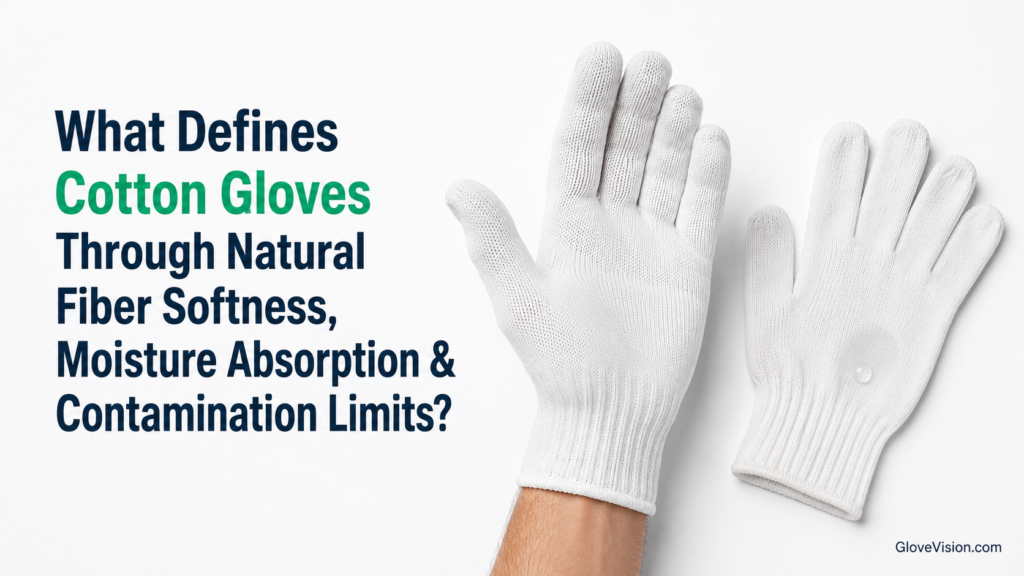
What Defines Cotton Gloves Through Natural Fiber Softness, Moisture Absorption & Contamination Limits?
Cotton Gloves are cellulose-based fabric handwear commonly used for a soft hand interface, moisture absorption, suitable light handling, minor friction reduction and glove-liner applications.
The same absorbent structure can become saturated, retain or transfer contaminants, lose comfort and reduce handling stability. Cotton Gloves are not substitutes for hazard-specific protective gloves.
What Are Cotton Gloves, and How Does Their Natural Fiber Structure Shape Performance?
Cotton Gloves derive their basic behavior from cellulose fibers, but softness, absorption, strength, dexterity and durability depend on how those fibers are spun, blended, knitted, woven, finished and assembled.
What is the material composition of Cotton Gloves?
Cotton is a natural fiber made primarily of cellulose. Its hydrophilic structure can interact with water, but fiber quality, processing and the surrounding fabric determine how much moisture a finished glove takes up. NIST confirms cotton fibers are hydrophilic and absorb moisture, although its research concerned fabric swatches rather than gloves. [NIST]
How do yarn and fabric construction change Cotton Gloves?
Knitted shells tend to stretch and conform, while woven shells are often more dimensionally stable. Yarn size, knit gauge, weave density, fabric weight, seams and finishing affect flexibility, airflow, snagging, moisture movement, wear and shape stability.
How do cotton blends and finishes change Cotton Gloves?
Polyester blends can change drying and shape retention; the Polyester Gloves guide explains that synthetic-fiber lens. Nylon reinforcement can change strength and bulk, as covered in the Nylon Gloves guide. Grip dots, treatments and coatings must be evaluated as complete-product features.
Why can Cotton Gloves feel soft without being highly protective?
Flexible fibers and conforming fabric can separate skin from a clean surface and reduce minor rubbing, but comfort is not evidence of abrasion, cut, puncture, chemical or thermal resistance. OSHA describes cotton or other fabric gloves as useful against dirt, slivers and chafing, but insufficient for rough, sharp or heavy materials. [Fabric]
| Construction factor | Possible behavior | Practical benefit | Important limitation |
|---|---|---|---|
| Cellulose fiber | Interacts with and absorbs moisture | Perspiration or light-moisture management | No dependable liquid barrier |
| Knitted fabric | Stretches and conforms | Flexible fit | Fabric openings may permit penetration |
| Woven fabric | Greater dimensional stability | More predictable shape | May provide less stretch |
| Heavier fabric | Adds material between hand and object | More cushioning in some products | More bulk; no automatic protection rating |
| Blended yarn | Combines fiber properties | Modified fit, strength or drying | Performance becomes blend-specific |
| Polymer coating | Changes surface and barrier behavior | May support grip or liquid contact | The coating—not cotton—provides that role |
How Do Cotton Gloves Provide Softness and Moisture Absorption During Light Handling?
Cotton Gloves can absorb some perspiration and incidental moisture while creating a soft layer between the hand and a handled surface, but usefulness declines when the fabric becomes saturated, loose, contaminated or mechanically damaged.
How does cotton absorb moisture inside Cotton Gloves?
Water can interact with cellulose, enter fibers and remain in spaces between yarns. Absorption into fibers, surface wetting, movement through fabric openings and true barrier exclusion are different mechanisms; none should be treated as interchangeable.
When can Cotton Gloves moisture absorption support comfort?
It may help manage perspiration during clean, dry, light work or function as a removable liner, depending on duration, temperature, activity, fabric weight, fit and drying opportunity. That role differs from the warmth and moisture-buffering questions owned by the Wool Gloves guide.
How does softness help Cotton Gloves reduce minor friction?
A soft fabric interface can reduce direct rubbing and minor chafing while handling clean, dry, non-sharp objects. It does not establish abrasion, cut, puncture or impact protection.
When does absorbed moisture reduce Cotton Gloves performance?
Saturation can add weight, increase fabric cling, destabilize fit, reduce tactile control, soften skin during prolonged wet wear, retain contaminants and lengthen drying time.
How can fit change the performance of Cotton Gloves?
Excess fingertip space, palm bunching and internal movement can reduce tactile feedback and grip or create snagging. Functional fit supports finger alignment, a stable palm, full opening and closure, controlled fingertip space and task-appropriate grip.
Moisture pathway: Dry Cotton Gloves → absorb perspiration or incidental moisture → approach saturation → retain liquid and dissolved material → increase skin-contact and transfer concerns → remove, assess, clean appropriately or retire.
Why Can Cotton Gloves Retain Contamination Instead of Providing a Barrier?
Cotton Gloves can absorb or trap liquids and particles within fibers and fabric spaces, allowing contamination to remain close to the skin or transfer to other surfaces rather than being excluded by a continuous protective barrier.
How can liquids enter and spread through Cotton Gloves?
Liquids can move through open fabric spaces, wet fibers, travel by capillary action or enter through seams, stitch holes and cuffs. Gripping pressure and continued contact after saturation can move contamination toward the interior.
Which contaminants can become trapped in Cotton Gloves?
Water mixed with dirt, oils, cleaning agents, solvents, pesticides, metalworking fluids, biological material, fine particles and unidentified liquids may remain in porous fabric. OSHA requires chemical-glove selection to consider chemical identity, concentration, temperature, contact type, duration, grip, dexterity, mechanical hazards, coverage and fit. [Dermal]
How can contaminated Cotton Gloves increase skin exposure?
Absorbent fabric can prolong skin contact, press residue against the hand, contaminate an outer-glove liner or spread material during removal. NIOSH warns that a permeated glove can increase exposure by trapping a chemical close to skin; this supports the retention mechanism but does not validate cotton for any chemical task. [NIOSH]
How can Cotton Gloves cause cross-contamination?
Material can transfer from object to glove, glove to another object, clothing, face, personal item or storage area. Reusable liners can also receive contamination during outer-glove removal or later handling.
What should happen when Cotton Gloves become contaminated?
Identify the contaminant, stop exposure, remove the gloves safely and follow workplace procedures. Clean only when approved; isolate, discard or retire them whenever safe reuse cannot be verified. Drying or appearance alone does not prove decontamination.
Stop
End contact before absorbent fabric extends exposure.
Identify
Determine the contaminant and applicable procedure.
Control
Remove without spreading residue to skin or clean zones.
Decide
Clean only when approved; otherwise isolate or retire.
Which Tasks and Protection Boundaries Apply to Cotton Gloves?
Cotton Gloves are most appropriate for selected clean, dry, light-duty tasks where comfort, minor friction reduction, product handling or liner use is needed and no unsupported hazard claim is being made.
Which light-duty tasks may suit Cotton Gloves?
After a task assessment, they may suit clean product handling, inspection, packing, light warehouse work, handling dry non-sharp components, surface-mark reduction, light dust separation or liner use. OSHA requires glove selection to match tasks, conditions, duration and identified hazards. [OSHA]
When should coated Cotton Gloves be evaluated separately?
A coating may change grip, abrasion, liquid contact, dexterity, airflow, moisture buildup and care. Any coating-related protection belongs to the complete glove; see Coated Fabric Gloves for that separate construction lens.
Why are Cotton Gloves unsuitable as chemical barriers?
Porous fabric can absorb liquids and lacks dependable barrier continuity or chemical-specific breakthrough data. The exact chemical, concentration, temperature, contact type, duration and finished-glove data must drive selection.
Why are Cotton Gloves insufficient for sharp or high-mechanical hazards?
Abrasion, blade cut, tear, puncture and applicable impact are separate mechanical risks under ISO 23388:2018. A result for one cannot be assumed for another. [Mech] Where documented cut or thermal performance is required, the Aramid Gloves guide explains a materially different fiber family without implying universal protection.
Why are ordinary Cotton Gloves unsuitable for flame, heat or electrical hazards?
Untreated cotton can ignite under sufficient exposure, fabric thickness does not establish heat or flame resistance and cotton does not provide electrical insulation. OSHA’s arc-flash appendix discusses ignition limits for untreated cotton clothing; that mechanism does not prove glove protection. [Arc] An exact tested product or rated glove system is required.
When should another material replace Cotton Gloves?
Use a documented glove or system for chemical permeation, biological fluids, cutting, needles, high puncture, impact, heat, flame, electricity, waterproofing or sterility. The 23 Glove Materials Explained guide provides broader material navigation.
| Task or hazard | Possible Cotton Gloves role | What cotton does not establish | Required verification |
|---|---|---|---|
| Clean, dry handling | Soft separation and light handling | Strong abrasion protection | Task assessment |
| Minor friction | May reduce direct rubbing | Cut or puncture resistance | Product construction |
| Perspiration | May absorb some moisture | Waterproofing | Fit and saturation check |
| Outer-glove liner | May support interface comfort | Combined-system certification | Layer compatibility |
| Chemical liquid | No dependable barrier role | Chemical resistance | Chemical-specific glove data |
| Biological material | No automatic protective role | Infection-control barrier | Approved PPE glove |
| Sharp edge | Minimal unsupported role | Cut or puncture protection | Mechanical test rating |
| Hot object or flame | Ordinary cotton may be unsuitable | Thermal or flame resistance | Exact certified product |
| Electrical exposure | No ordinary protective role | Electrical insulation | Voltage-rated system |
How Should Cotton Gloves Be Selected, Layered, Inspected, and Maintained?
Cotton Gloves should be selected only after the task and hazards are defined, then verified for construction, fit, layering compatibility, care requirements, contamination controls and current condition.
What should be checked before selecting Cotton Gloves?
Define the task, contact hazards, dry or wet conditions, expected contamination, grip, dexterity, duration, reuse, possible outer glove, care requirements and manufacturer instructions. ISO 21420 covers general glove design, construction, comfort, marking and manufacturer information but does not establish specific protection by itself. [General]
How should Cotton Gloves fit?
Check finger length, palm stability, bunching, seams, wrist position, full opening and closure, tool control, outer-glove compatibility and absence of painful pressure or numbness.
How should Cotton Gloves be layered beneath protective gloves?
The outer glove must provide the required hazard protection. Combined sizing, dexterity, grip, heat and moisture buildup, contamination control, donning and removal must remain acceptable; a cotton liner does not create a certified system automatically.
What should be inspected before reusing Cotton Gloves?
Inspect for holes, tears, open seams, thinning, stretching, shrinkage, hardening, persistent dampness, residue, unknown contamination, lost fit, damaged cuffs, displaced grip dots, texture change and unapproved repairs.
How should Cotton Gloves be laundered and dried?
Follow the exact manufacturer and workplace instructions for whether laundering is permitted, detergent, water temperature, wash and drying method, reshaping, reuse limits and contamination control. Washing does not automatically prove decontamination or restored performance.
How should clean Cotton Gloves be stored?
Keep approved reusable gloves fully dry, identifiable and separated from used or contaminated items. Prevent chemical contact, recontamination, persistent dampness, distortion and loss of product identity.
When should Cotton Gloves be removed from service?
Remove, isolate or replace them when contamination is unknown, decontamination cannot be verified, fabric or seams fail, shrinkage restricts movement, fit becomes unstable, residue remains or required performance can no longer be confirmed.
Task verification
- The exact task is defined
- Contact conditions are understood
- Hazards are assessed separately
- No unsupported protection claim is required
- The exact finished glove is identified
- Required evidence is available
Fit and function
- Fingers align correctly
- Palm fabric does not bunch excessively
- Full hand movement is possible
- Grip matches the task
- Dexterity matches the task
- The cuff remains secure
- No painful pressure occurs
Layering
- The outer glove supplies required protection
- The liner does not compromise fit
- No harmful pressure points occur
- Dexterity remains functional
- Heat and moisture remain manageable
- Contamination controls include the liner
Condition
- No holes or tears are present
- Seams remain intact
- Fabric is not excessively thin
- No unexplained residue is present
- No unresolved contamination remains
- The glove is completely dry before approved reuse
- Product identity remains verifiable
Final decision
- Use: task, fit and condition match
- Layer: a compatible outer glove supplies protection
- Clean: approved laundering can restore condition
- Isolate: contamination requires controlled handling
- Resize: fit affects movement or compatibility
- Select another glove: required protection exceeds cotton’s role
- Replace: wear, shrinkage or contamination affects function
- Do not use: suitability cannot be verified
Final decision rule: Task and hazard → contact conditions → exact Cotton Gloves construction → protection boundary → fit and layering → contamination controls → care requirements → condition → use, layer, clean, isolate, replace or reject.
Conclusion
Cotton Gloves provide a soft, absorbent fabric interface that can support suitable light-duty handling, but their porous cellulose structure does not create a dependable barrier against hazardous liquids or contaminants. Yarn, knit, weave, weight, blends, finishes and complete construction determine the finished result.
Choose Cotton Gloves only when their exact construction, fit, condition, absorbency, contamination controls and intended light-duty role match the task. Use another documented glove whenever the hazard requires a dependable chemical, biological, mechanical, thermal, flame, liquid or electrical barrier.
Frequently Asked Questions
Are Cotton Gloves protective?
Only for the limited functions documented for the exact product. They may support light handling, minor friction reduction, cleanliness or liner use, but cotton alone does not establish chemical, biological, mechanical, thermal, flame or electrical protection.
Do Cotton Gloves absorb sweat and water?
They can absorb moisture because cotton cellulose interacts with water. The amount absorbed and its effect on comfort depend on fabric construction, finishes, fit, conditions, duration and saturation.
Can Cotton Gloves protect against chemicals?
Ordinary uncoated Cotton Gloves should not be treated as chemical-resistant barriers. Their fabric can absorb and retain liquids, so chemical protection requires exact chemical-specific glove compatibility and performance data.
Can Cotton Gloves be worn under protective gloves?
Sometimes. Cotton liners may support comfort or moisture management, but they must not compromise outer-glove fit, dexterity, protection, removal or contamination control.
When should Cotton Gloves be replaced?
Replace Cotton Gloves when holes, thinning, seam failure, shrinkage, unstable fit, persistent dampness, unresolved contamination or other deterioration prevents safe and reliable use.