
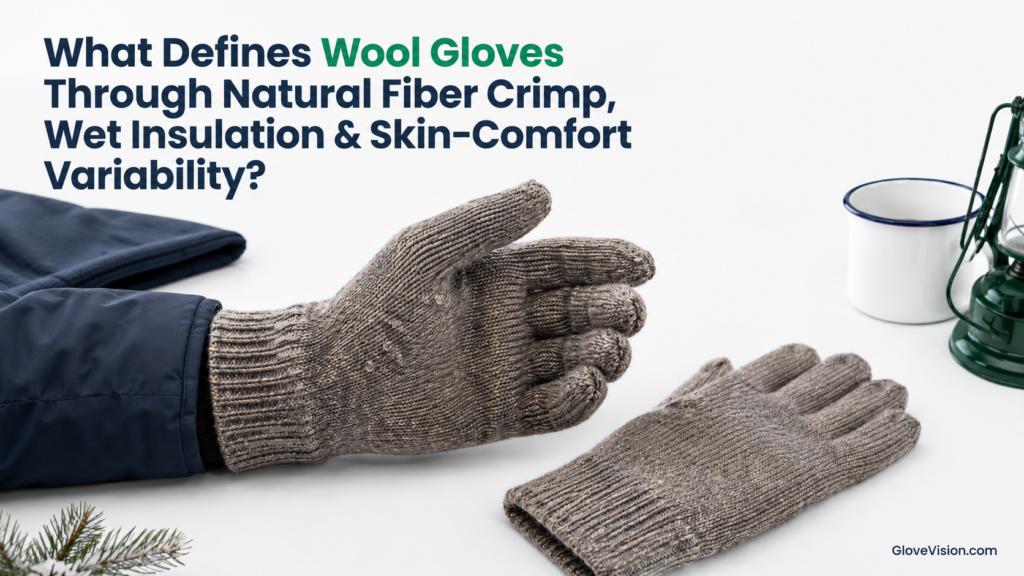
What Defines Wool Gloves Through Natural Fiber Crimp, Wet Insulation & Skin-Comfort Variability?
Wool Gloves are natural-fiber handwear made from crimped keratin fibers that can create fabric loft, trap insulating air, absorb moisture vapor, and retain useful thermal performance during some damp conditions.
They are not waterproof and do not remain equally warm when saturated. Actual insulation and skin comfort depend on wool fineness, fabric construction, thickness, wind, wetness, fit, layering, exposure duration, and individual skin response.
What Are Wool Gloves, and How Does Natural Fiber Crimp Shape Their Performance?
Wool Gloves use protein-based fibers whose natural waviness can help create a resilient fabric structure containing small insulating air spaces. Wool content alone cannot establish finished-glove warmth.
What Is the Material Composition of Wool Handwear?
Wool is an animal-derived, keratin-based fiber with a cuticle, cortex, and natural crimp. It differs from the cellulose structure discussed in the Cotton Gloves guide. Fiber identity does not set one universal warmth level, construction, moisture response, or rating.
How Does Wool Fiber Crimp Create Glove Loft?
Crimp separates neighboring fibers and helps yarn and fabric hold pockets of still air. Those pockets can slow heat transfer while loft remains. Yarn, density, compression, lining, fit, wind, and moisture determine the useful result. Woolmark describes crimp and vapor uptake as general fiber properties, not a guarantee for every glove. [Woolmark]
How Do Yarn and Fabric Construction Change Wool Gloves?
A loose knit may favor flexibility but admit more air; dense or felted fabric may control airflow better while adding bulk or reducing flexibility. Yarn fineness, brushing, lining, and multiple layers also alter loft, dexterity, shape retention, and drying.
How Do Wool Blends Change Wool Gloves?
Blend performance belongs to the complete yarn and glove. Polyester may alter drying, nylon may reinforce wear zones, and elastane may modify stretch; none supplies a universal outcome.
| Structural Feature | Physical Behavior | Contribution | Limitation |
|---|---|---|---|
| Natural crimp | Spaces neighboring fibers | Supports loft | Compression reduces loft |
| Keratin fiber | Interacts with vapor | Moisture buffering | Does not block water |
| Dense knit | Reduces some airflow | May improve warmth | Can increase bulk |
| Open knit | Flexible and ventilated | May aid dexterity | Limited wind control |
| Felted fabric | Denser structure | May reduce airflow | May reduce flexibility |
| Synthetic blend | Modifies recovery | May aid fit or wear | Blend-specific result |
How Do Wool Gloves Preserve Useful Insulation When Damp?
Wool Gloves may retain useful insulation when damp because their fibers can take up moisture while parts of the fabric continue holding insulating air, but warmth declines as liquid content, compression, airflow, and exposure increase.
How Do Wool Fibers Interact With Moisture Vapor?
Hygroscopic fibers can take up and release water vapor within their structure. That may buffer the hand microclimate, but it is not liquid-water exclusion, a waterproof membrane, or a universal drying-time claim.
Why Can Damp Wool Gloves Still Feel Insulating?
Some air may remain between fibers while part of the moisture is held within them. If adequate loft survives, fabric can continue limiting heat transfer. This is conditional damp performance—not proof that saturated gloves remain safe.
When Does Moisture Reduce Wool Gloves Warmth?
Saturation, wind, compression, low activity, prolonged exposure, cuff entry, wet shells, and insufficient drying erode the thermal margin. Wind increases convective loss and evaporation removes heat.
Why Are Wool Gloves Not Waterproof?
Knit openings, seams, cuffs, fiber wetting, and pressure-driven movement create liquid entry routes unless the complete glove has a separately documented waterproof component.
Air spaces are most available.
Useful insulation may remain.
Compression and wind reduce the margin.
Leave exposure, dry, replace, or add a suitable shell.
Why Does Skin Comfort Vary Between Wool Gloves?
Skin comfort varies between Wool Gloves because fiber diameter, protruding ends, yarn, seams, finishes, moisture, heat, friction, fit, and individual skin condition change the hand–fabric interface.
How Does Fiber Diameter Affect Wool Gloves Prickle?
Coarser protruding fibers resist bending and may mechanically stimulate skin. Mean diameter does not describe every fiber, and fabric construction controls which ends contact the hand.
Does Itching Mean Someone Is Allergic?
Not automatically. Prickle, friction, sweat, detergent, finishes, another component, or an existing condition may contribute. A peer-reviewed review did not support wool fiber itself as a common cutaneous allergen and associated irritation more strongly with coarse fibers; this does not guarantee comfort for every wearer. [Monash]
Are Merino Wool Gloves Always Comfortable?
No. Comfort still depends on fiber-diameter distribution, yarn, knit, seams, finishes, detergent residue, fit, moisture, friction, and individual response.
How Do Seams, Heat, and Fit Change Comfort?
Fingertip pressure, palm bunching, tight cuffs, excess finger length, sweat, cling, and shell compression can increase irritation or restrict circulation. Persistent rash, swelling, blistering, hives, broken skin, or breathing difficulty needs assessment.
Which Tasks and Protection Boundaries Apply to Wool Gloves?
Wool Gloves are most useful where adaptable insulation, vapor buffering, or liner performance is needed. Additional components may be required for wind, rain, mechanical, chemical, flame, heat, or electrical hazards.
Which Cold-Weather Uses May Suit Wool Gloves?
Dry everyday cold, walking, light activity, indoor cold, removable-liner use, and some low-hazard work may suit when temperature, wind, moisture, activity, duration, construction, and evidence align.
When Should Wool Gloves Be Used as Liners?
A liner can add insulation and vapor buffering beneath a compatible shell. Check sizing, circulation, dexterity, cuff overlap, drying, safe doffing, contamination, and the shell’s rating.
When Is a Windproof or Waterproof Shell Needed?
Strong wind, rain, wet snow, repeated contact, or prolonged exposure may require a documented shell. The shell supplies its verified resistance; wool supplies only its documented insulation role.
Where Do Mechanical Limits Begin?
Wool composition does not establish abrasion, cut, puncture, impact, chemical, flame, heat, or electrical performance. ISO 21420 addresses general glove design, comfort, marking, and information but not hazard protection by itself. [ISO 21420] ISO 23388 treats mechanical risks separately. [ISO 23388] A rated Aramid Gloves system may answer a specific hazard, but its rating must still match the task.
Which Hazards Require Protection Beyond Wool?
Chemicals, biological contamination, flame, high contact heat, electrical exposure, machinery, severe wet cold, and sharp hazards demand a verified system. OSHA lists contact type, duration, mechanical risk, dexterity, grip, thermal protection, size, and comfort among glove-selection factors. [OSHA] Use 23 Glove Materials Explained when another family is needed.
| Context | Wool Contribution | Limitation | Additional Requirement |
|---|---|---|---|
| Dry cold | Insulation | Wind may penetrate | Dense glove or shell |
| Active cold | Vapor buffering | Sweat may accumulate | Layer management |
| Damp conditions | Some useful insulation | Warmth declines | Dry replacement or shell |
| Rain/wet snow | Insulating layer | Not waterproof | Waterproof outer glove |
| Sharp work | Minimal thermal role | No automatic cut rating | Rated protective glove |
| Chemical work | No dependable barrier | Absorption | Compatible chemical glove |
| Electrical work | No primary role | Not voltage-rated | Approved electrical PPE |
How Should Wool Gloves Be Selected, Layered, Dried, and Maintained?
Wool Gloves should be selected for temperature, wind, moisture, activity, dexterity, skin comfort, and duration, then fitted and maintained according to the exact finished-product instructions.
Which Conditions and Features Should Be Defined?
Identify temperature, wind, precipitation, duration, activity, sweat, dexterity, grip, hazards, shell needs, replacements, and skin sensitivity. Check wool percentage, blend, knit density, thickness, loft, lining, seams, reinforcement, cuff, care, and environmental data.
How Should Wool Gloves Fit and Layer?
Fingers should move without excess material, palm bunching, painful seams, or a restrictive cuff. A shell must fit without compressing loft, circulation, or control. More layers can reduce useful warmth if they cause compression.
How Should Wet Wool Gloves Be Managed?
Leave exposure, remove safely, assess contamination, follow instructions, reshape if directed, dry completely, and inspect. Do not rely on body heat to dry saturated gloves, apply uncontrolled direct heat, store damp, or treat drying as decontamination.
How Should Wool Gloves Be Washed and Dried?
Follow the finished-product label for method, temperature, detergent, agitation, reshaping, and drying. Woolmark likewise makes tumble drying conditional on the exact care label. [Care]
What Should Be Inspected Before Reuse?
Check holes, thinning, open seams, compressed loft, shrinkage, felting, distorted fingers, cuffs, persistent dampness, contamination, lining displacement, repairs, and product identity. Replace when condition prevents reliable fit, warmth, movement, or verification.
Environment
- Temperature, wind, wetness, duration, and activity are defined.
- Dry replacement availability is known.
Construction
- Wool percentage, blend, knit, lining, and shell are verified.
- Claims match intended conditions.
Fit & Layering
- Movement and circulation remain unrestricted.
- Loft is not compressed; cuffs align.
Condition
- No holes, open seams, collapse, or distortion.
- Gloves are clean, dry, and identifiable.
Final Decision
- Use: all requirements match.
- Layer: a shell supplies missing protection.
- Dry/Clean: approved care can restore condition.
- Resize: fit restricts circulation or control.
- Replace/Reject: damage or missing evidence blocks use.
Numbness, pale or grayish skin, and firm or waxy skin are recognized frostbite warning signs requiring prompt action and medical care. [CDC]
Conclusion
Wool Gloves can provide adaptable insulation because crimped wool fibers help create air-holding loft and interact with moisture, but warmth and comfort remain dependent on the complete glove, environment, fit, and current moisture level.
Choose Wool Gloves only when their construction, loft, fit, skin comfort, and layering system match the environment, and use another documented glove or shell whenever protection exceeds wool’s verified role.
Frequently Asked Questions
Are Wool Gloves Still Warm When Wet?
They may retain useful insulation when damp, but do not remain equally warm under every wet condition. Warmth declines as saturation, wind, compression, and duration increase.
Are Wool Gloves Waterproof?
No, unless the complete glove includes a separately documented waterproof component. Ordinary wool can absorb moisture and allow liquid entry through fabric, seams, or cuffs.
Why Do Some Wool Gloves Feel Itchy?
Prickle commonly relates to coarse or protruding fibers, construction, friction, heat, moisture, and individual sensitivity. Itching alone does not confirm allergy.
Are Merino Wool Gloves Always Softer?
Not automatically. Comfort still depends on fiber distribution, yarn, knit, seams, finishes, fit, moisture, and skin response.
When Should Wool Gloves Be Replaced?
Replace them when holes, seam failure, persistent shrinkage, distorted fit, collapsed loft, unresolved contamination, or inadequate thermal performance prevents reliable use.