
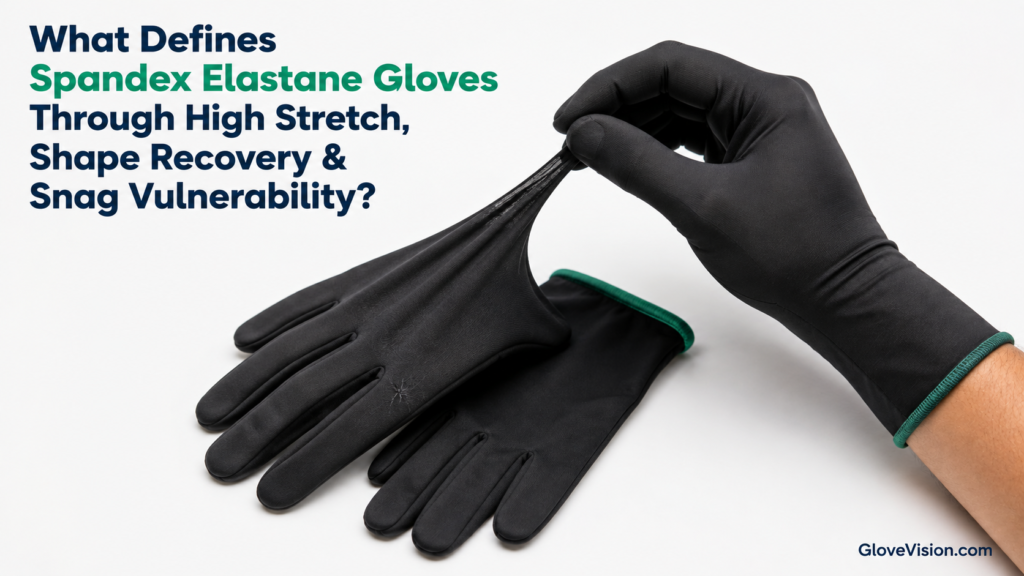
What Defines Spandex Elastane Gloves Through Elastic Recovery, Mobility Support & Low-Protection Role?
Spandex Elastane Gloves are blended textile handwear using segmented-polyurethane elastic fibers, reversible stretch, strategic yarn placement, stretch panels, and elastic cuffs to help the glove conform and move with the hand.
Actual performance varies with elastane chemistry, blend percentage, carrier fiber, yarn construction, stretch direction, knit structure, coating, fit, repeated loading, heat, chemicals, and current condition. Elastane normally supports fit and mobility rather than supplying primary hazard protection.
What Are Spandex Elastane Gloves, and How Does Their Segmented-Polyurethane Structure Create Elasticity?
Spandex Elastane Gloves contain elastic fibers formed from segmented polyurethane, whose flexible and restraining molecular regions allow substantial reversible deformation.
Are Spandex and Elastane Different Materials?
No. Spandex is the common North American generic term and elastane the widely used generic term elsewhere. Neither is a brand; commercial formulations can still differ. Industry definitions describe substantial extension followed by recovery, but do not establish one finished-glove stretch value. CIRFS
What Is Elastane Fiber Made From?
Elastane is a manufactured long-chain segmented-polyurethane fiber. Flexible soft segments permit molecular movement, while more restraining hard regions act as physical anchors. Spinning creates the textile fiber; this page does not transfer one chemistry to every commercial product.
How Do Soft and Hard Segments Produce Stretch and Recovery?
Applied force extends and rearranges flexible regions while restraining regions help preserve a return path. Removing force allows partial or substantial recovery, which may be immediate or delayed and may change under repeated strain. Experimental segmented-polyurethane findings explain the mechanism—not universal glove behavior. Segments
How Does Elastic Recovery Differ From Stretch?
Stretch is length increase under force; recovery is return after release; recovery force is the returning force; residual extension is unrecovered length; creep or bagging is progressive deformation. A glove can stretch easily yet recover poorly.
Why Is Elastane Usually Combined With Other Fibers?
Covered, plated, inlaid, core-spun, or blended elastane needs carrier fibers for bulk, surface coverage, wear behavior, moisture interaction, feel, stability, or reinforcement. Nylon, polyester, cotton, wool, and engineered fibers each retain their own limits.
| Structural element | Physical role | Glove contribution | Limitation |
|---|---|---|---|
| Soft segments | Permit extension | Flexible movement | Change with heat and aging |
| Hard regions | Restraining points | Recovery | Not hazard resistance |
| Covered yarn | Stabilizes elastic core | Textile processing | Depends on covering fiber |
| Elastane proportion | Modifies stretch | Conformity | Percentage predicts little alone |
| Strategic placement | Directs stretch | Knuckle or cuff mobility | Poor placement creates pressure |
| Carrier fiber | Forms textile surface | Durability and comfort | Evaluate separately |
| Coating | Changes surface contact | Grip role | Not supplied by elastane |
How Do Spandex Elastane Gloves Use Elastic Recovery to Support Fit and Mobility?
Spandex Elastane Gloves can support mobility by extending across moving hand regions and recovering as the fingers relax, helping the glove remain aligned without requiring excessive loose fabric.
Which Hand Movements Can Benefit From Controlled Stretch?
Finger bending and extension, thumb opposition and abduction, knuckle flexion, palm cupping, full hand opening and closure, and wrist movement near a cuff may benefit. This is a movement claim—not medical joint support.
How Do Conformity and Stretch Direction Affect Mobility?
Correct placement can reduce slack, stabilize finger alignment, limit palm bunching, and retain the cuff. Lengthwise, widthwise, two-way, multidirectional, localized-panel, and cuff stretch must correspond to the task movement. Pattern, size, seams, and finger length remain decisive.
How Does Recovery Force Affect Comfort?
Too little may produce bagging, twisting, internal slip, and weak cuff retention; too much may create pressure, compressed finger webs, restriction, marking, numbness, or tingling. Persistent pain, discoloration, swelling, or lost movement requires removal and appropriate assessment.
Do Tighter Spandex Elastane Gloves Provide Better Dexterity?
Not automatically. Excess tightness can restrict movement, distort seams, overstretch coatings, accelerate fiber fatigue, and complicate doffing. Close fit is useful only when movement, pressure, circulation comfort, and control remain acceptable.
How Should Mobility Be Function-Checked?
Open the hand, form a fist without force, touch the thumb to each fingertip, pick up and position a small object, operate controls, hold the intended tool, repeat movements, and stop for pressure, slip, twist, numbness, or lost grip.
Hand movement → elastane fabric extends → glove follows fingers and knuckles → movement ends → fabric recovers → fit stabilizes
How Do Spandex Elastane Gloves Change When Combined With Other Fibers and Coatings?
Spandex Elastane Gloves derive their complete performance from the interaction between elastane, carrier fibers, coatings, reinforcements, seams, and glove geometry—not from elastic fiber alone.
How Do Nylon–Elastane Gloves Behave?
Nylon Gloves explain how nylon can supply low-bulk textile strength and heat-sensitive behavior; elastane may add stretch and recovery. Neither automatically proves cut or chemical protection.
How Do Polyester–Elastane Gloves Behave?
Polyester Gloves may contribute stability and construction-dependent moisture transport, while elastane adds conforming stretch. Low absorbency still does not guarantee dry hands.
How Do Cotton–Elastane Gloves Behave?
Cotton Gloves may add softness and fiber absorption while elastane supports fit. Absorbed liquid can remain in fabric; the blend is not automatically a chemical or biological barrier.
How Do Protective-Fiber and Elastane Blends Behave?
Reinforcing fibers may create tested mechanical performance while elastane supports movement. Elastane can also change yarn spacing or protective-fiber proportion in some regions. Coverage and ratings must be verified. Aramid Gloves illustrate why the complete construction owns the rating.
Why Must Elastane Fiber and Polyurethane Coating Stay Separate?
Elastane is an elastic textile fiber; polyurethane coating is a deposited surface layer that may change grip, wear, flexibility, ventilation, and liquid contact. Polyurethane-Coated Gloves require coating-specific evidence. Shared polyurethane chemistry does not make the functions interchangeable.
How Can Stretch Affect a Coating?
Repeated extension may flex, smooth, crack, or delaminate coating and expose liner areas. Formulation, thickness, coverage, adhesion, strain, and task control the effect.
Which Tasks and Protection Boundaries Apply to Spandex Elastane Gloves?
Spandex Elastane Gloves may be useful where close fit, repeated hand movement, cuff recovery, or reduced fabric slack is needed, but elastane itself normally provides little independent protection against workplace hazards.
Which Light-Duty Tasks May Benefit From Elastane Fit?
After assessment, inspection, light assembly, packing, sorting, component positioning, precision handling, general product handling, flexible lining, and repeated opening and closure may benefit. Carrier fiber, coating, grip, and hazards still determine suitability.
When May Elastane Improve a Coated Glove or Liner?
It may help the liner follow fingers, stabilize the back, recover the cuff, reduce slack, or limit bunching beneath an outer glove. Verify outer size, pressure, movement, circulation comfort, doffing, contamination control, and system compatibility. The coating—not elastane—supplies coating-specific grip.
Why Does Elastane Provide Little Independent Mechanical Protection?
Elasticity does not establish resistance to blades, sharp edges, needles, punctures, severe abrasion, tearing, impact, or crush. Protective fibers and complete-glove testing are required. OSHA selection guidance likewise centers the identified hazard, dexterity, duration, physical stress, fit, and documented performance. OSHA PPE
Why Is Elastane Not a Chemical, Liquid, or Medical Barrier?
Elastane usually sits in porous textile fabric; stretch can alter yarn spaces, seams and cuffs remain entry routes, coatings may be partial, and chemical-specific data may be absent. Polyurethane chemistry does not make the fiber a chemical glove, and porous fabric has no automatic medical certification.
Why Is Unverified Heat or Flame Exposure Unsuitable?
Heat can change recovery, modulus, shape, coating, carrier fibers, and fit. Commercial elastic fibers vary thermally, so one study cannot define every glove. Thermal Thin stretch panels do not establish thermal separation or a rating.
Which Hazards Require Protection Beyond Elastane?
Electrical or ESD work, heat, flame, sparks, molten material, chemical immersion, biological contamination, needles, heavy abrasion, impact, severe cold, and entanglement need verified protection. Use 23 Glove Materials Explained for broader orientation.
| Task or hazard | Possible elastane contribution | Not established | Verification |
|---|---|---|---|
| Precision handling | Close fit and movement | Universal dexterity | Function test |
| Repeated flexion | Stretch and recovery | Fatigue prevention | Controlled trial |
| Elastic cuff | Retention | Liquid seal | Cuff construction |
| Outer-glove liner | Reduced bunching | System certification | Layer compatibility |
| Coated glove | Liner mobility | Grip or chemical resistance | Coating data |
| Sharp component | Fit within reinforced glove | Cut or puncture protection | Mechanical rating |
| Chemical or biological | No dependable barrier role | Permeation or infection barrier | Approved glove |
| Heat, flame, electrical | No ordinary role | Thermal or electrical protection | Rated system |
| Electronics | Fit and mobility | ESD control | Verified ESD construction |
The construction-and-protection matrix assigns elastane a mobility role without implying independent hazard protection.
How Should Spandex Elastane Gloves Be Selected, Function-Tested, Maintained, and Replaced?
Spandex Elastane Gloves should be selected according to the task and required protection first, then evaluated for fiber blend, stretch placement, size, recovery, pressure, grip, coating compatibility, care requirements, and current condition.
What Should Be Defined and Verified?
Define task, hazards, movements, dexterity, grip, duration, surface, chemicals, heat, sharp objects, layering, pressure tolerance, contamination, reuse, and snag risk. Verify elastane percentage where disclosed, carrier fiber, yarn, stretch direction, density, panel and cuff construction, palm, coating and coverage, reinforcement, ratings, size, care, and retirement guidance.
How Should Fit, Stretch, and Recovery Be Checked?
Confirm finger position, limited fingertip excess, stable palm, uncompressed webs, free thumb, full movement, safe cuff, no twist, stable grip, and no numbness or discoloration. Then use: observe relaxed fit → move → hold briefly → release → observe recovery → repeat → check pressure, bagging, alignment, coating, and control.
How Can Common Problems Be Corrected?
Restriction requires size and recovery-force review; numbness or tingling requires immediate removal; bagging, internal slip, loose cuff, coating cracks, or failed recovery require cause assessment and usually resizing, construction change, or replacement. If protection is uncertain, stop and verify the complete-glove rating.
How Should Gloves Be Cleaned and Dried?
Follow exact instructions for permission to launder, method, detergent, water and drying temperature, bleach or chlorine, agitation, rinse, tumble drying, direct heat, cycles, and contamination. Chlorinated-water tests exist because some elastane fabrics can measurably degrade; swimwear testing is not direct glove evidence. SATRA Environmental and chlorine research also cannot supply a universal glove-life estimate. Exposure
What Should Be Inspected Before Reuse?
Check holes, tears, seams, broken elastic yarn, loose loops, bagging, permanent extension, uneven recovery, shrinkage, hardening, distortion, tight cuff, coating cracks or peeling, grip, residue, dampness, functional fit, and product identity. Laundering does not repair lost elasticity or restore ratings.
When Should Gloves Be Removed From Service?
Remove, isolate, or replace for permanently stretched fabric, harmful pressure, numbness, tingling, pain, discoloration, broken elastic yarn, seam or coating failure, heat distortion, unreliable grip, unsafe contamination, unverifiable ratings, missing identity, or loss of assigned role. OSHA expects inspection, maintenance, and controlled handling when PPE cannot be safely decontaminated. OSHA Care
Task and Protection
- Task and hazards defined
- Elastane not treated as barrier
- Ratings match hazard
- Coating and reinforcement verified
Fit and Mobility
- Finger and palm fit correct
- Webs not compressed
- Stretch direction matches movement
- Recovery restores fit
- Cuff pressure acceptable
Function
- Grip maintained
- No twist or internal slip
- No numbness or pain
- Coating stable in flexion
- Layering not excessive
Condition
- No broken yarn or bagging
- No holes or open seams
- Coating intact
- No heat damage or contamination
- Dry, identified, and traceable
Task and hazard → complete construction → elastane placement and blend → stretch direction → fit and pressure → recovery check → grip → coating and ratings → exposure and care → condition → use, resize, change, clean, isolate, replace, or reject
Conclusion
Spandex Elastane Gloves use elastic fiber to help blended glove fabrics stretch with the hand and recover toward a stable fit, but elastane normally contributes mobility rather than primary hazard protection.
Choose Spandex Elastane Gloves only when their complete construction, documented ratings, stretch placement, fit, pressure, mobility, grip, and current condition match the task—and select another tested glove whenever the hazard exceeds elastane’s fit-and-mobility role.
Frequently Asked Questions
Are Spandex and Elastane the Same Material?
Yes. They are regional generic terms for the same class of segmented-polyurethane elastic fiber, although exact commercial formulations may differ.
Does Elastane Make Gloves More Dexterous?
It can support dexterity by reducing loose fabric and helping the glove move with the hand. Actual dexterity still depends on size, pattern, finger geometry, seams, coating, thickness, grip, and required movement.
Do Spandex Elastane Gloves Provide Cut or Chemical Protection?
Not because of elastane. Cut or chemical protection requires a separately tested complete glove using appropriate reinforcement, barrier material, coating, and product-level evidence.
Is Elastane the Same as a Polyurethane Glove Coating?
No. Elastane is an elastic textile fiber, while polyurethane coating is a surface layer that may change grip, abrasion behavior, and object contact.
When Should Spandex Elastane Gloves Be Replaced?
Replace them when permanent stretching, bagging, broken elastic yarn, unstable fit, harmful pressure, seam failure, coating deterioration, heat damage, unresolved contamination, or lost recovery prevents reliable use.