
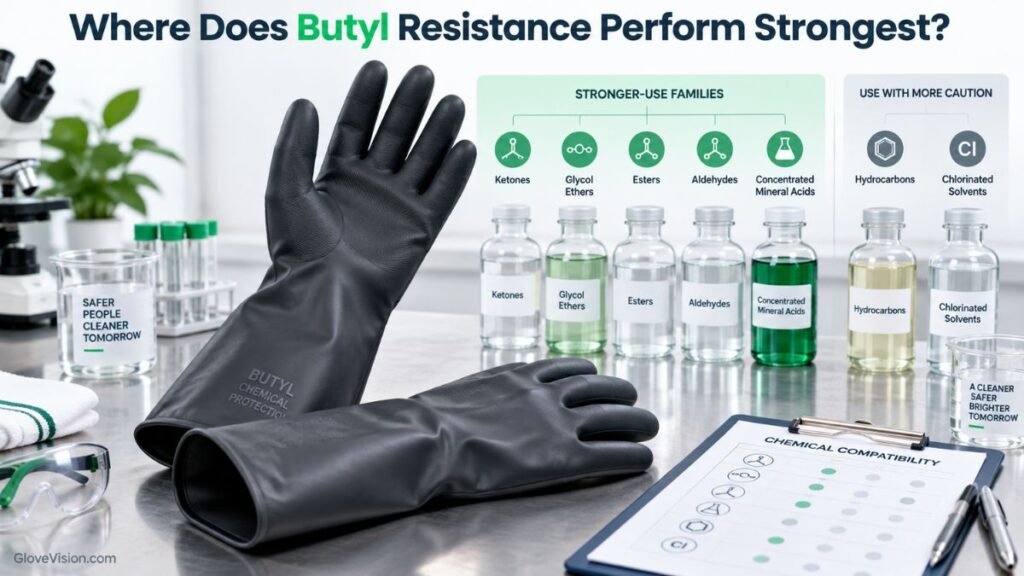
Where Does Butyl Resistance Perform Strongest?
Butyl Rubber performs strongest as a specialist chemical barrier when exact finished-glove data support selected ketones, glycol ethers, esters, aldehydes, and certain concentrated mineral-acid exposures.
These are strength zones, not automatic approvals. Performance changes with exact chemical identity, concentration, temperature, mixture composition, splash versus immersion, duration, thickness, construction, and glove model, while hydrocarbons and chlorinated solvents remain important generic Butyl warning zones. This page moves through strength definition, chemical mechanism, strongest families, exact verification, and final resistance boundaries.
What Defines Where Butyl Rubber Resistance Performs Strongest?
A chemical belongs inside a strong Butyl Rubber resistance zone only when the exact finished glove has adequate evidence for that chemical, concentration, temperature, contact pattern, and duration—not merely because its chemical family is commonly associated with Butyl.
Why Must Exact Chemical Identity Come First?
Use the family name only to shortlist a candidate. Final assessment needs the exact chemical name, CAS number, concentration, complete formulation, carriers, stabilizers, and water content. OSHA’s PPE guidance requires glove performance to match the anticipated hazard and manufacturer test documentation. [OSHA-PPE]
How Do Permeation Results Define Strong Butyl Rubber Resistance?
Review breakthrough detection or standardized breakthrough time, permeation rate, cumulative permeation where available, challenge concentration, temperature, specimen thickness, and test method. ASTM F739-20 treats longer breakthrough and lower permeation as characteristics of more effective barriers under the tested continuous-contact conditions. [F739]
How Do Degradation and Penetration Change the Classification?
Permeation is only one barrier question. Degradation can involve swelling, softening, hardening, cracking, tackiness, dimensional change, or strength loss; penetration can occur through holes, tears, seams, and defects. ISO 374-4:2019 treats degradation as a separate chemical-contact test, while ISO 374-2:2019 addresses penetration resistance. [ISO-4] [ISO-2]
Why Is the Exact Butyl Rubber Product More Important Than the Material Name?
Formulation, thickness, cure, lining, support, cuff, surface finish, and model-specific test data can all change performance. OSHA notes that apparently similar protective materials can perform differently across manufacturers and models. [OSHA-OTM]
That is why Butyl Rubber gloves must be evaluated as finished products.
| Factor | Why It Matters | Evidence Required |
|---|---|---|
| Exact chemical | Family members can behave differently | Chemical/CAS |
| Concentration | Changes chemical activity and polymer interaction | Matching concentration |
| Temperature | Can accelerate permeation/degradation | Relevant test temperature |
| Contact pattern | Splash differs from immersion | Matching exposure evidence |
| Duration | Longer contact increases barrier demand | Defined task duration |
| Thickness | Changes diffusion path | Exact tested thickness |
| Construction | Liner, seams, and cuff affect whole glove | Finished-product data |
| Degradation | Physical change can undermine function | Chemical-specific degradation |
| Penetration | Defects bypass molecular barrier | Whole-glove integrity |
Why Does Butyl Rubber Favor Selected Polar Organic Chemicals?
Butyl Rubber’s specialist performance reflects the interaction between its low-permeability molecular structure and the affinity of the exact chemical for the polymer; favorable interactions can produce excellent barrier performance, while strongly sorbing chemicals can erase that advantage.
How Does Low-Permeation Structure Support Chemical Protection?
The isobutylene-rich matrix restricts molecular transport and provides a strong low-permeation foundation, but gas-barrier behavior cannot be transferred directly to liquid compatibility. See Butyl low-permeation behavior for the molecular mechanism.
Why Does Polymer–Chemical Affinity Matter?
Lower uptake can support slower transport, while stronger affinity can increase sorption, swelling, and polymer mobility. That is why chemical family can suggest a candidate but cannot replace exact testing.
Why Can Selected Polar Organics Fit Better Than Many Hydrocarbons?
OSHA’s current material comparison describes Butyl as a specialty glove for polar organics, listing glycol ethers, ketones, and esters as common uses while flagging hydrocarbons and chlorinated solvents as important limitations. [OSHA]
Why Is Polarity Alone an Incomplete Predictor?
Molecular size, shape, functional groups, concentration, temperature, formulation, and the exact Butyl compound also influence the outcome. “Polar = good, nonpolar = bad” is too crude for glove approval.
Which Chemical Families Show the Strongest Butyl Rubber Resistance?
Butyl Rubber’s strongest broadly recognized candidate zones include selected ketones, glycol ethers, and esters, while current finished Butyl products also demonstrate strong applications involving aldehydes and concentrated mineral acids.
Why Are Ketones a Major Butyl Rubber Strength Zone?
OSHA identifies ketones as a core Butyl application, and current AlphaTec 38-514 product documentation includes ketones among its supported chemical categories. Exact ketone, concentration, temperature, model, thickness, and contact duration still control use. Butyl ketone resistance owns the deeper chemical-specific treatment.
Why Do Glycol Ethers Fit Butyl Rubber Specialization?
OSHA explicitly includes glycol ethers within Butyl’s specialist range. The exact glycol ether, water content, co-solvents, concentration, and glove model must still be verified.
Why Are Esters Another Important Candidate Zone?
Esters are another established Butyl screening category, and current finished Butyl products also target ester protection. Do not infer ester performance from ketone results. See Butyl ester resistance.
Where Do Aldehydes and Concentrated Mineral Acids Fit?
Ansell describes AlphaTec 38-514 as protecting against aldehydes, ketones, esters, and concentrated mineral acids. This evidence belongs to that exact finished product and must not be transferred automatically to every Butyl glove. [Ansell]
| Chemical Family | Page-Level Position | Critical Variables | Final Decision |
|---|---|---|---|
| Ketones | Major strength zone | Exact ketone, concentration, temperature | Strong candidate with product data |
| Glycol ethers | Major specialist zone | Exact glycol ether, formulation | Strong candidate |
| Esters | Strong candidate zone | Exact ester, concentration | Product-specific verification |
| Aldehydes | Strong product-supported zone | Complete formulation | Exact glove evidence |
| Concentrated mineral acids | Product-specific strength | Acid identity, concentration, temperature | Matched data required |
| Mixed formulations | Conditional | All components | Mixture-specific evidence preferred |
Where volatile or high-consequence exposure is the central question, use Butyl vapor protection.
How Should Butyl Rubber Strong-Resistance Claims Be Verified Before Selection?
A strong Butyl Rubber reputation should only shortlist the material; final selection requires matching the exact chemical and workplace exposure to current evidence for the exact finished glove.
What Must Be Defined Before Selection?
Document the exact chemical and CAS number, concentration, complete mixture, temperature, physical state, stabilizers, carriers, and current SDS. Then define splash, intermittent contact, continuous contact, immersion, duration, frequency, spray/pressure, mechanical demand, and required coverage.
Which Butyl Rubber Product Details Must Match?
Verify manufacturer, model, Butyl formulation, thickness, support or lining, cuff, seams, surface finish, and reusable/disposable construction. The test evidence should belong to a sufficiently matching specimen.
Which Chemical Results Matter Most?
Review breakthrough, permeation rate, cumulative permeation where available, degradation, penetration/leak performance, challenge concentration, temperature, thickness, and test standard. ISO 374-1:2024 provides the current terminology and performance-requirement framework for chemical-protective gloves. [ISO-1]
How Should Conflicting Charts Be Resolved?
Prioritize exact chemical → exact concentration → exact product → thickness → temperature → contact mode → test standard → current source. Do not average ratings, select the most favorable generic chart, or transfer another manufacturer’s data.
Strong-Resistance Verification Checklist
Chemical Identity
- Exact chemical/CAS is known.
- Concentration is confirmed.
- Complete formulation is reviewed.
- Temperature is known.
- Co-solvents/additives are identified.
Exposure
- Contact mode is defined.
- Duration and frequency are known.
- Pressure/spray is considered.
- Mechanical demands are known.
Exact Product
- Exact Butyl glove is identified.
- Thickness and construction match relevant data.
- Cuff/coverage are suitable.
- Material/formulation is confirmed where available.
Evidence
- Permeation data are reviewed.
- Breakthrough is interpreted in context.
- Degradation is reviewed.
- Penetration is considered.
- Test concentration, temperature, and contact mode match sufficiently.
Exact evidence supports the task.
Only narrower conditions are supported.
Another polymer deserves evaluation.
Mixture or exposure uncertainty remains.
Generic Butyl reputation is the main evidence.
When Do Chemicals or Conditions Push Butyl Rubber Outside Its Strongest Resistance Zone?
Butyl Rubber moves outside its strongest resistance zone when harsher exposure conditions reduce the margin of an otherwise compatible chemical or when the chemical itself belongs to a family with poor Butyl affinity and rapid sorption, swelling, degradation, or permeation.
How Do Concentration, Temperature, and Immersion Shift Performance?
Higher concentration can change chemical activity and polymer interaction; higher temperature can accelerate transport; continuous immersion creates a sustained chemical gradient. Data from lower concentration, lower temperature, or splash contact should not be transferred automatically.
Why Do Mixtures Create Higher Uncertainty?
OSHA advises conservative selection for mixtures when matched data are unavailable because one component may have the shortest breakthrough and solvents can carry other ingredients through polymer barriers. Butyl selection trade-offs covers the broader alternative-material decision.
| Exposure Change | Why Performance Can Shift | Required Response |
|---|---|---|
| Higher concentration | Polymer–chemical interaction may increase | Match tested concentration |
| Higher temperature | Molecular transport can accelerate | Use temperature-relevant data |
| Continuous immersion | Sustained transport challenge | Require continuous-contact evidence |
| Thinner construction | Shorter diffusion path | Match exact thickness |
| Mixture | Another component may dominate | Review complete formulation |
| Repeated flexing/abrasion | Physical barrier can deteriorate | Assess construction and inspect |
Why Are Hydrocarbons and Chlorinated Solvents Warning Zones?
OSHA’s generic material chart identifies hydrocarbons and chlorinated solvents as major Butyl limitations. Aromatic hydrocarbons such as benzene, toluene, and xylene, and chlorinated solvents such as dichloromethane, chloroform, trichloroethylene, and tetrachloroethylene, therefore deserve strong comparison or escalation unless exact Butyl evidence supports the task.
When Should Butyl Rubber Be Escalated or Rejected?
Escalate or reject when chemical identity or mixture composition is unknown, high-consequence exposure lacks product-level data, conditions materially exceed testing, significant swelling or degradation appears, construction differs from the evidence, or mechanical integrity is compromised. Where repeated movement and handling affect whole-task suitability, review Butyl flexibility limits.
| Exposure | Generic Butyl Position | Main Concern | Required Direction |
|---|---|---|---|
| Aliphatic hydrocarbons | Weak/high caution | Sorption/swelling/permeation | Exact data or compare |
| Aromatic hydrocarbons | Weak/high caution | Strong polymer affinity possible | Specialist comparison |
| Chlorinated solvents | Major generic limitation | Permeation/degradation | Alternative often deserves priority |
| Hydrocarbon-rich mixtures | High uncertainty | Multiple interacting components | Mixture-specific evidence |
| Unknown formulation | No defensible position | Compatibility cannot be established | Identify/escalate |
| Strength-zone chemical under harsher conditions | Conditional | Margin may fall with heat/concentration/immersion | Reverify exact conditions |
Decision rule: Exact chemical → family → formulation → concentration → temperature → contact pattern → exact Butyl Rubber glove → thickness/construction → permeation + degradation + penetration evidence → use, limit, compare, escalate, or reject.
What Should Readers Remember About Where Butyl Rubber Resistance Performs Strongest?
Butyl Rubber’s clearest specialization lies in selected polar-organic exposures, particularly ketones, glycol ethers, and esters, while specific finished products can also provide strong protection against aldehydes and concentrated mineral acids.
Those strengths do not make Butyl Rubber an all-solvent barrier. Hydrocarbons and chlorinated solvents remain important warning zones, and even a strength-zone chemical can move outside the acceptable range when concentration, temperature, immersion, mixture composition, thickness, or product construction changes.
Which Questions Clarify the Strongest Resistance Zones of Butyl Rubber?
Is Butyl Rubber Especially Resistant to Ketones?
Ketones are one of Butyl Rubber's best-established specialist zones. OSHA specifically identifies ketones among Butyl applications, and current Butyl products also target this chemistry. Exact ketone, concentration, temperature, glove model, and contact conditions still control selection.
Does Butyl Rubber Resist Esters and Glycol Ethers Well?
Both are major Butyl candidate families in OSHA's generic guidance, but family membership alone is not approval. Verify the exact ester or glycol ether, concentration, formulation, temperature, and exact finished glove.
Is Butyl Rubber Strong Against Aldehydes?
Selected current Butyl products are specifically designed for aldehyde protection, including AlphaTec 38-514. Whole formulations still matter because aldehyde solutions can contain water, alcohols, stabilizers, and other ingredients.
Does Butyl Rubber Resist Concentrated Mineral Acids?
Certain finished Butyl products are designed for selected concentrated mineral-acid exposures, but acid identity, concentration, temperature, contact pattern, and exact product evidence remain mandatory.
When Should Butyl Rubber Not Be Chosen Despite Its Strong Chemical Resistance?
Avoid generic Butyl selection when the exposure involves poorly supported hydrocarbons or chlorinated solvents, exact product data are missing, mixtures are unresolved, actual conditions exceed testing, meaningful degradation occurs, or another exact barrier provides stronger relevant evidence.