
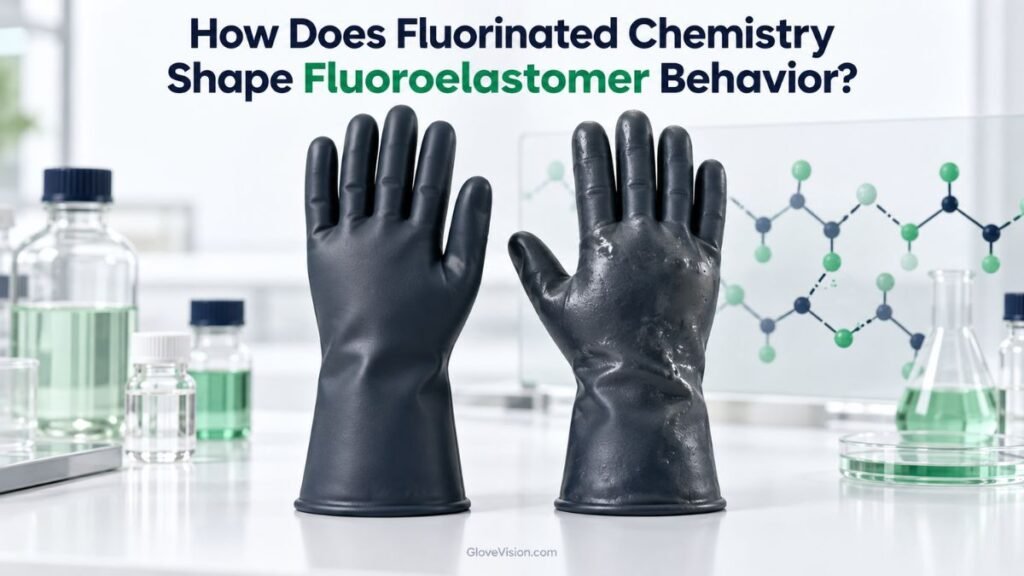
How Does Fluorinated Chemistry Shape Fluoroelastomer Behavior?
Fluorinated chemistry shapes Fluoroelastomers by influencing chemical stability, solvent uptake, swelling, diffusion, heat resistance, flexibility, and mechanical behavior. Carbon–fluorine bonds contribute to these tendencies, but the final property balance emerges from the complete polymer architecture and compound.
No single structural feature improves every property. Fluorine content, monomer composition, cure chemistry, additives, temperature, and finished construction can shift fluid resistance, permeation, low-temperature flexibility, and mechanical behavior. The discussion moves from molecular structure to chemical interaction, representative exposure zones, property trade-offs, and exact-grade/product verification.
What Molecular Features of Fluoroelastomers Determine Their Material Behavior?
Fluoroelastomers derive their behavior from the complete molecular architecture: carbon–fluorine bonding, monomer composition, fluorine content, backbone mobility, crosslinking, and finished compound formulation work together.
How Do Carbon–Fluorine Bonds Contribute to Stability?
Strong carbon–fluorine bonding contributes to resistance against selected chemical and thermal deterioration mechanisms. It does not by itself predict whether solvent molecules sorb into, swell, or permeate a particular Fluoroelastomer.
Why Do Backbone and Monomer Choices Matter?
Vinylidene fluoride (VDF or VF₂), hexafluoropropylene (HFP), tetrafluoroethylene (TFE), and selected fluorinated vinyl ethers are important building blocks in different grades. Their ratios change chain chemistry, hydrogen-containing segments, packing, and mobility. Not every FKM grade uses the same monomers.
Does More Fluorine Improve Every Property?
No. Chemours explains that fluid resistance generally improves with higher fluorine content within its conventional Viton A/B/F families, while low-temperature flexibility can decline; specialty monomers alter that conventional balance. The relationship is family- and grade-specific, not a universal law. [Chemours]
What Do Crosslinking and Additives Change?
Curing forms an elastomeric network that influences elastic recovery, dimensional stability, and swelling restraint. Cure ingredients, fillers, and processing aids can also change hardness, strength, thermal response, and processability. An uncured base polymer is not equivalent to a finished compound.
For the distinction between material identity and a usable PPE construction, see Fluoroelastomer gloves. The wider material-family context is covered under Glove materials explained.
| Structural factor | Molecular effect | Performance consequence | Evidence boundary |
|---|---|---|---|
| Carbon–fluorine bonding | Contributes to chemical and thermal stability | Resistance to selected deterioration mechanisms | Does not establish impermeability |
| Monomer composition | Changes chain chemistry | Different fluid and temperature responses | Grade-specific |
| Fluorine content | Changes fluid interaction and mobility | Fluid resistance/flexibility balance | Not universally monotonic |
| Backbone architecture | Changes packing and chain movement | Chemical, thermal, and mechanical response | Family/grade-specific |
| Crosslinking | Forms a three-dimensional network | Recovery and dimensional stability | Cure-system dependent |
| Fillers and additives | Modify the compound | Hardness, strength, processing, and response | Compound/product-specific |
How Does Fluorinated Polymer Chemistry Control Chemical-Barrier Behavior in Fluoroelastomers?
Chemical-barrier behavior in Fluoroelastomers depends on chemical stability and molecular transport. A material can remain visibly intact while absorbing or transmitting molecules, so swelling, degradation, and permeation must be assessed separately.
How Do Affinity, Sorption, and Swelling Differ?
When a chemical contacts the polymer, grade-specific affinity influences how much enters the material (sorption). Uptake can change dimensions, hardness, or strength; swelling is one possible response, not a direct measurement of how fast molecules cross the barrier.
How Does Diffusion Produce Permeation?
After sorption, molecules can diffuse through intact material and emerge on the opposite side. Permeation is the completed transport process. Chemical degradation, such as loss of physical properties, is a different endpoint; penetration through holes or seams is different again.
Why Is a Long Breakthrough Result Not a Safe-Wear Time?
ASTM F739-20 measures continuous-contact permeation using defined endpoints, including breakthrough detection, standardized breakthrough, rate, and cumulative permeation. A result above a test interval does not establish zero lower-rate transport or a universal safe exposure duration. Use exact material, chemical, temperature, and test-condition evidence. [ASTM F739]
Competing outcome: an incompatible chemical may increase uptake, swelling, property loss, or transport. Low swelling alone does not certify a protective barrier.
Which Chemical Exposures Reveal the Strengths and Weaknesses of Fluoroelastomers?
Hydrocarbons, oils, and selected fuels illustrate important Fluoroelastomer candidate zones, while ketones, esters, amines, high-pH chemicals, chlorinated solvents, and mixtures require grade-specific evaluation rather than general approval.
Which Hydrocarbons Are Candidate Zones, and How Should Chlorinated Solvents Be Assessed?
Chemours identifies selected aliphatic and aromatic hydrocarbons, oils, and fuels as material-level Viton candidate zones, while its conventional-grade data identify limitations with some low-molecular-weight carbonyl compounds and high-pH fluids. Do not infer compatibility with a chlorinated solvent from this hydrocarbon evidence: each chlorinated agent and finished glove requires its own relevant test data. These are grade-level screening tendencies, not finished-glove approval. [Chemours]
Why Are Fuels and Mixed Solvents Separate Questions?
Fuel oxygenates, additives, and co-solvents can change polymer affinity and the complete mixture response. A favorable result for one hydrocarbon cannot validate a fuel blend or a mixed workflow. Seek mixture-specific evidence; when comparing other specialist polymer trade-offs, see Butyl selection trade-offs and PVA selection trade-offs.
How Can Specialty Monomers Change Conventional FKM Limitations?
Chemours describes its specific Viton Extreme ETP-600S copolymer of ethylene, TFE, and perfluoromethylvinyl ether as providing improved resistance in selected low-molecular-weight ketones, esters, aldehydes, amines, and high-pH fluids compared with conventional Viton families. Those manufacturer claims belong to this specialty polymer system and related tested formulations; they do not certify ETP-based protective gloves or other grades. [Chemours ETP]
Why Must Every Component of a Mixture Be Considered?
The nonmandatory glove-selection guidance in 29 CFR 1910 Subpart I, Appendix B recommends obtaining manufacturer test evidence and, when mixture-specific results are unavailable, using the component with the shortest breakthrough time as a conservative selection basis. A formulation cannot be judged solely by its dominant ingredient; mixture-specific testing remains preferable. [29 CFR App B]
| Chemical exposure | General material tendency | Important qualification | Evidence needed |
|---|---|---|---|
| Aliphatic hydrocarbons | Established conventional FKM candidate zone | Exact fluid, grade, and temperature | Grade/product data |
| Aromatic hydrocarbons | Useful material-level strength zone | Individual aromatics and mixtures differ | Chemical-specific results |
| Oils and lubricants | Common Fluoroelastomer application | Additives and heat matter | Complete-fluid data |
| Fuels | Candidate zone for selected compositions | Oxygenates may change behavior | Actual fuel formulation |
| Chlorinated solvents | No family-wide approval established here | Evaluate the individual solvent and finished product | Exact-agent/product evidence |
| Ketones and esters | Conventional FKM limitation area | ETP and other specialty grades may differ | Exact grade and chemical |
| Amines and high-pH fluids | Strong formulation dependence | Monomer and cure choices matter | Compound-specific results |
| Mixtures | Cannot infer response from main ingredient | Co-solvents may control | Complete-mixture evidence |
Boundary: This is a qualitative screening matrix, not a universal solvent compatibility chart or glove approval.
How Do Thermal, Mechanical, and Formulation Trade-Offs Change Fluoroelastomers Performance?
Fluoroelastomers offer different balances of heat stability, fluid resistance, cold flexibility, and mechanical performance because monomer choice, fluorine content, cure chemistry, compound ingredients, and service conditions vary.
How Can Heat Resistance Coexist With Chemical Limitations?
The fluorinated backbone and cured network can retain useful properties at elevated temperatures, but hot chemical contact also changes uptake, transport, and possible deterioration. Air-oven aging, seal service, and hot-solvent glove exposure are different tests; one must not substitute for another.
Why Can Fluorine Content Shift Cold Flexibility?
Chemours’ product-selection guidance distinguishes conventional A, B, and F families and specialty low-temperature types. Within conventional families, greater fluorination may improve some fluid-resistance measures while reducing cold flexibility; specialty monomer chemistry can change that pattern. The trade-off is grade-specific. [Chemours grades]
What Do Cure Systems, Fillers, and Mechanical Testing Add?
Bisphenol, peroxide, and specialty cure choices produce different networks; fillers and reinforcement further alter hardness, elasticity, tear behavior, and processing. Heat resistance does not prove chemical protection at heat, and chemical compatibility does not establish abrasion, puncture, or glove dexterity.
For the wider limits of adopting this material family, see Fluoroelastomer adoption limits.
| Property requirement | Main chemistry/formulation driver | Potential trade-off | Verification needed |
|---|---|---|---|
| Fluid resistance | Monomer design and fluorine content | Cold flexibility may shift | Grade-specific fluid data |
| Heat stability | Backbone and crosslinked network | Hot chemical transport may still increase | Thermal + chemical exposure tests |
| Low-temperature flexibility | Chain mobility and specialty monomers | Different fluid-resistance profile | Exact low-temperature grade data |
| Chemical breadth | Specialty monomer/cure design | No universal solvent coverage | Exact chemical results |
| Elastic recovery | Cure/network structure | Response changes by end use | Application-specific tests |
| Mechanical durability | Compound and reinforcement | Chemistry does not establish mechanics | Physical tests |
| Barrier performance | Sorption, diffusion, thickness | Low swelling need not mean low permeation | Permeation data |
| Finished-product performance | Compound plus construction | Seal data may not apply to gloves | Exact product |
How Should Fluoroelastomers Material Performance Be Verified for a Protective Product?
Fluoroelastomers should be selected only after the exact grade, compound, chemical exposure, required properties, and finished-product construction have been matched to relevant test evidence.
Which Application and Material Identity Must Be Confirmed?
Identify the intended glove, seal, gasket, hose, boot, or other component. Record the grade, monomer system where known, nominal fluorine content, cure system, formulation, and final construction. Raw-polymer or seal immersion results cannot automatically certify a glove.
Which Exposure and Performance Results Must Match?
Record the exact chemical or full mixture, concentration, temperature, contact duration and mode, repeated exposure, pressure if relevant, and mechanical stress. Compare chemical-specific volume change, retained physical properties, degradation, and—where dermal barrier performance matters—permeation data. ASTM F1383-20 addresses intermittent contact, a different testing question from continuous-contact F739; splash evidence is not immersion approval. [ASTM F1383]
What Makes a Finished Glove Acceptable for the Task?
Chemical adequacy is the first gate. After confirming relevant exact-product chemical evidence, assess whether the glove’s construction, coverage, fit, grip, and mechanical performance support the actual task and exposure conditions. Do not substitute seal or raw-material data for finished-glove performance.
When Should Uncertain or Conflicting Evidence Stop Selection?
Do not average incompatible grades or equate swelling percentages with breakthrough times. Escalate if chemistry, grade, test temperature, measured endpoint, construction, or mechanical capability is unresolved. Compare alternatives only when their exact-product chemical protection is adequate.
Fluoroelastomers Grade-and-Product Verification Checklist
Material identity
- Exact Fluoroelastomer family and grade identified.
- Monomer composition and fluorine content reviewed where available.
- Cure system and compound formulation understood where available.
Exposure conditions
- Exact chemical or complete mixture identified.
- Concentration, temperature, and duration defined.
- Continuous/intermittent contact and mechanical conditions recorded.
Performance evidence
- Swelling and retained physical properties assessed.
- Permeation, breakthrough endpoint, and degradation reviewed where relevant.
- Thermal, cold-flexibility, and mechanical results fit the intended application.
Finished product
- Exact manufacturer and product identified.
- Thickness, layers, reinforcements, seams, and interfaces match the evidence.
- Manufacturer documentation addresses the actual chemical and task.
Exact grade and product evidence supports the task.
Only narrower verified conditions are supported.
Another validated grade or barrier suits the complete task.
Chemical, thermal, mechanical, or product evidence is incomplete.
Generic fluorination reputation is the principal selection evidence.
What Should Readers Remember About Fluorinated Chemistry in Fluoroelastomers?
Fluorinated chemistry shapes Fluoroelastomers through carbon–fluorine bonding, monomer composition, fluorine content, polymer–chemical affinity, crosslinking, and compound formulation. These combined features influence chemical and thermal strengths as well as swelling, diffusion, flexibility, and mechanical response.
No single structural feature determines every outcome. Conventional FKM and specialty grades can balance fluid resistance, cold flexibility, chemical breadth, and physical performance differently. Use fluorinated chemistry to understand and shortlist materials, then rely on exact-grade, exposure-specific, finished-product evidence to establish suitability.
Which Questions Clarify How Fluorinated Chemistry Affects Fluoroelastomers?
Why Do Fluoroelastomers Have Strong Chemical Resistance?
Their fluorinated molecular architecture can provide chemical stability and favorable resistance to selected oils, fuels, hydrocarbons, acids, and other fluids. Actual performance still depends on grade, formulation, exact chemical, temperature, and exposure conditions.
Does More Fluorine Always Improve Fluoroelastomers Performance?
No. Within some conventional FKM families, increasing fluorine content can improve selected fluid-resistance characteristics while shifting low-temperature flexibility. Specialty monomers and compound chemistry can change that relationship, so fluorine percentage alone does not determine suitability.
Why Do Different Fluoroelastomers Grades Resist Different Chemicals?
Grades can differ in monomers, fluorine content, cure system, and compound formulation. These differences change polymer–chemical affinity, swelling, physical-property retention, and potentially permeation behavior.
Does Fluorinated Chemistry Make Fluoroelastomers Impermeable?
No. A chemically stable fluoroelastomer can still transmit molecules through intact material. Protective use requires chemical-specific permeation evidence separate from swelling or degradation results.
When Should Fluoroelastomers Be Rejected Despite Their Fluorinated Structure?
Reject or reassess the proposed material when exact-grade compatibility is unknown or inadequate, relevant permeation or temperature evidence is insufficient, mechanical performance is unsuitable, or the finished product differs materially from the tested construction.