
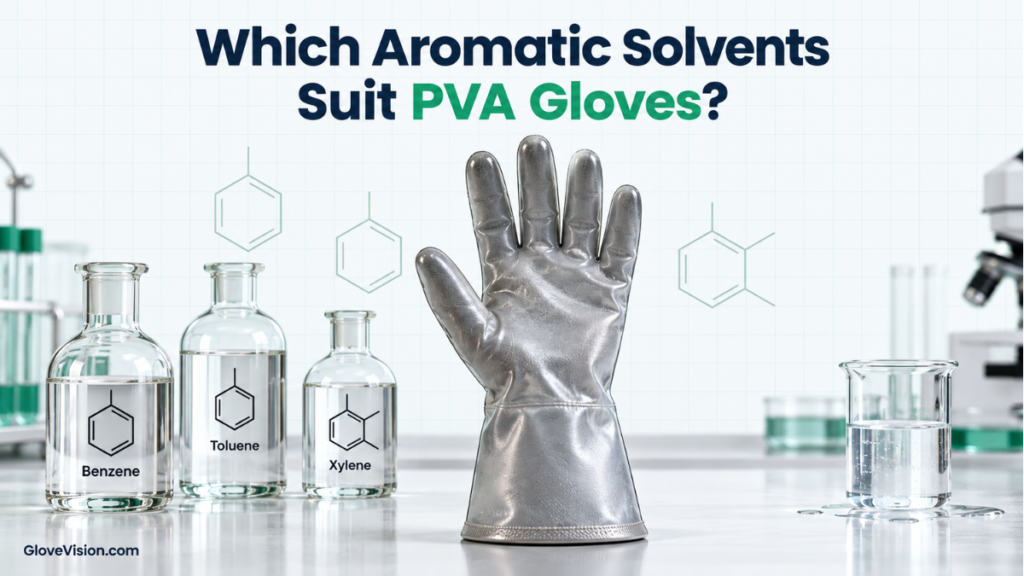
Which Aromatic Solvents Suit PVA Gloves?
PVA Gloves are strong screening candidates for many dry aromatic solvents, including benzene, toluene, and xylene, because PVA is a specialty organic-solvent barrier and aromatics fall within its principal generic resistance zone.
That does not make every aromatic formulation suitable. Water content, commercial blends, substituted functional groups, temperature, contact duration, immersion, and glove construction can materially change performance, so selection should move from aromatic-suitability criteria and barrier mechanism through BTX candidates and mixture boundaries to exact-product verification.
What Determines Whether an Aromatic Solvent Suits PVA Gloves?
An aromatic solvent suits PVA Gloves only when the exact chemical and finished glove are supported under the actual solvent purity, water content, temperature, contact duration, and contact mode.
Why Does Aromatic Identity Matter?
Aromatic molecules can differ in molecular size, substitution pattern, polarity, volatility, functional groups, polymer affinity, and transport behavior. Membership in the same aromatic family therefore does not establish one shared permeation response.
Why Does Solvent Purity Matter?
Pure toluene is not equivalent to paint thinner, aromatic naphtha, an adhesive formulation, a coating solvent blend, or a degreasing mixture. Other ingredients can become the controlling barrier challenge even when an aromatic is the named primary solvent.
Why Is Water Content a Priority Check?
OSHA identifies PVA as a specialty organic-solvent glove but also identifies the material as water sensitive. Dry-aromatic evidence therefore should not automatically be transferred to an aromatic/water formulation. [OSHA]
Why Do Temperature and Contact Duration Matter?
Temperature, duration, frequency, and physical exposure conditions affect the relevance of glove-performance evidence. A short splash at one temperature should not be treated as equivalent to repeated contact or immersion under more demanding conditions.
Why Must the Exact PVA Glove Be Identified?
Finished performance can vary with PVA coating thickness, support material, liner, cuff, processing, geometry, and manufacturer design. Generic polymer reputation identifies a candidate material; the finished product establishes the glove actually being selected. The broader chemistry behind this specialization is explained in PVA solvent resistance.
The graphic and table form one proof asset. The foreground shows the decision gates that must be passed before aromatic-family compatibility becomes an exact-glove decision.
| Selection Factor | Why It Matters | Decision Requirement |
|---|---|---|
| Exact aromatic | Molecules can permeate differently | Chemical-specific data |
| Isomer / form | Xylene and related formulations may differ | Identify exact material |
| Solvent purity | Commercial blends add other barrier challenges | Review full formulation |
| Water content | PVA is water sensitive | Treat as a major selection gate |
| Temperature | Transport behavior can change | Match relevant test conditions |
| Contact duration | Longer contact increases barrier demand | Use duration-relevant evidence |
| Contact mode | Splash is not equivalent to immersion | Match actual task |
| Glove construction | Coating, support, and thickness vary | Verify exact model |
Why Do Aromatic Solvents Often Match the Resistance Profile of PVA Gloves?
Many dry aromatic solvents can fit the specialist resistance profile of PVA Gloves because favorable aromatic exposures may interact less strongly with the cohesive PVA matrix than water, helping the material remain comparatively stable and limiting rapid swelling and transport.
What Must an Aromatic Solvent Do to Cross PVA?
At a simplified level, the liquid contacts the outer surface, sorbs into the PVA layer, diffuses through the polymer, and eventually reaches the inner surface. Strong barrier behavior depends on restricting one or more parts of that transport process.
Why Does Limited Swelling Matter?
Lower solvent uptake can mean less polymer expansion and a more stable diffusion environment. That can support slower molecular transport, but low visible swelling does not prove that permeation is absent.
Why Is PVA Considered a Specialist Organic-Solvent Material?
OSHA’s material guidance identifies PVA as a specialty glove for organic solvents and includes aromatics among its generic use areas. That makes aromatic identity a strong screening signal, not an exact-glove approval. [OSHA]
Why Does Chemical Stability Not Equal Zero Permeation?
A glove can remain visually intact and show little obvious dimensional change while molecular transport still occurs. Appearance, touch, or lack of visible swelling cannot substitute for applicable permeation data.
Why Must Manufacturer/Test Evidence Override Polymer Reputation?
Generic chemistry explains why an aromatic is worth investigating. Exact evidence is needed to establish the tested chemical, breakthrough behavior, permeation rate, degradation, temperature, duration, and construction relevant to the proposed glove.
Which Benzene, Toluene, and Xylene Exposures Best Fit PVA Gloves?
Benzene, toluene, and xylene are strong PVA Gloves screening candidates, but each should be treated as a separate chemical exposure and matched to exact product data rather than assigned one shared BTX breakthrough value.
When Can Benzene Suit PVA Gloves?
Benzene belongs to the aromatic family and therefore enters PVA’s strong generic screening zone. Because glove selection must reflect the specific chemical hazard and applicable performance evidence, generic aromatic compatibility should not be the sole basis for a benzene decision. [OSHA]
When Can Toluene Suit PVA Gloves?
Toluene is a strong aromatic candidate for PVA screening, but selection still requires the exact glove, solvent purity, water content, temperature, duration, and contact mode. Pure toluene data should not be transferred automatically to a coating or cleaning formulation that merely contains toluene.
When Can Xylene Suit PVA Gloves?
Separate o-xylene, m-xylene, p-xylene, mixed xylenes, and commercial xylene-containing formulations. Aromatic-family membership supports screening, but it does not establish identical transport behavior across isomers or mixtures.
Why Should BTX Chemicals Not Share One Breakthrough Value?
BTX is a useful operational grouping for benzene, toluene, and xylenes, not one chemical identity. Molecular structure, formulation, test conditions, and finished-glove construction can differ, so each exposure requires applicable evidence.
Why Are BTX Process Tasks Relevant?
Ansell specifically lists cleaning furnaces, distillation pumps, valves, lines, and crackers in BTX processes among recommended applications for AlphaTec 15-554. The same current product documentation identifies that model as PVA-coated and positioned for aromatic and chlorinated solvents. Those statements apply to AlphaTec 15-554 and should not be transferred to every PVA glove. [Ansell]
The BTX identity graphic and matrix form one candidate-selection asset. The foreground keeps benzene, toluene, xylene isomers, and commercial blends as separate verification decisions.
| Aromatic Exposure | Generic Candidate Status | Main Qualification | Decision |
|---|---|---|---|
| Benzene | Strong PVA screening candidate | Exact chemical and product evidence essential | Verify |
| Toluene | Strong candidate | Water, temperature, duration, and purity matter | Verify |
| o-Xylene | Strong candidate | Chemical-specific evidence preferred | Verify |
| m-Xylene | Strong candidate | Chemical-specific evidence preferred | Verify |
| p-Xylene | Strong candidate | Chemical-specific evidence preferred | Verify |
| Mixed xylenes | Strong but formulation-specific | Isomer blend and composition matter | Verify formulation |
| BTX blend | Potential strong fit | Complete blend evidence needed | Mixture-specific |
| Commercial aromatic blend | Conditional | Other components may control barrier selection | Full formulation |
Which Water, Mixture, and Substituted-Aromatic Conditions Limit PVA Gloves?
PVA Gloves become more uncertain when an aromatic is chemically substituted, mixed with other solvent families, contaminated with water, used in wet or product-restricted high-humidity conditions, or exposed at temperatures and durations not represented by applicable evidence.
Why Does Chlorobenzene Need Its Own Evidence?
Chlorobenzene combines an aromatic ring with chlorine substitution. Aromatic and chlorinated-solvent screening categories can both make PVA worth investigating, but overlap between favorable candidate families does not establish exact-product suitability.
Why Do Alkyl-Substituted Aromatics Need Separate Data?
Ethylbenzene, trimethylbenzenes, and cumene retain aromatic character, but substitution changes molecular size, shape, volatility, and potentially transport behavior. Their aromatic identity supports screening, not automatic transfer of benzene, toluene, or xylene data.
Why Do Aromatic Oxygenates Need More Caution?
Benzyl alcohol, phenolic compounds, and aromatic ethers introduce functional groups that can change polarity, hydrogen-bonding behavior, and polymer affinity. An aromatic ring alone does not make these chemicals equivalent to BTX hydrocarbons.
Why Do Aromatic Amines Need Separate Evaluation?
Aniline-type compounds should be treated as separate chemical cases. Aromatic-ring presence does not establish benzene-like permeation behavior when another functional group materially changes chemical properties.
Why Does Water Create the Most Important PVA Boundary?
PVA’s water sensitivity can undermine the dry-solvent advantage that made the glove attractive in the first place. For the exact AlphaTec 15-554 model, Ansell explicitly warns that contact with water or use in high-humidity environments will greatly decrease chemical protection. That warning is model-specific and should not be generalized into a universal humidity threshold for every PVA glove. [Ansell]
Why Can High Humidity or Wet Surfaces Matter?
Relevant moisture can come from condensation, damp drums, rinsed equipment, wet benches, aqueous residues, or other process conditions. Dry-solvent evidence should not automatically be transferred to those conditions.
Why Are Commercial Aromatic Mixtures Harder to Predict?
A commercial formulation may combine an aromatic solvent with alcohols, ketones, esters, water, surfactants, or other additives. OSHA advises that where mixture-specific test data are unavailable, chemical-glove selection should consider the component with the shortest applicable breakthrough time because solvents can carry other ingredients through polymeric materials. This is a conservative selection approach, not a prediction of the mixture’s actual breakthrough value. [OSHA]
Why Does Higher Temperature Matter?
Higher temperature can create a more demanding molecular-transport condition, so relevant-temperature test evidence should be used rather than assuming a lower-temperature result transfers unchanged.
Why Does Longer Contact Matter?
Longer contact creates more diffusion time and greater cumulative permeation opportunity. Incidental splash, repeated contact, continuous wetting, and immersion therefore should not be treated as interchangeable exposure modes.
When Should PVA Aromatic Use Be Escalated?
Escalate when water content is unknown, mixture composition is incomplete, aromatic identity is unclear, a substituted aromatic lacks applicable evidence, test temperature or duration does not match the task, immersion is unsupported, or the exact manufacturer’s moisture restrictions conflict with the intended environment. Broader material-selection consequences are discussed in PVA selection trade-offs.
The boundary landscape and matrix form one proof asset. The background uses the same faint GloveVision square-grid visual system.
| Exposure Condition | PVA Direction | Main Concern |
|---|---|---|
| Dry benzene | Strong screening candidate | Exact chemical and product evidence |
| Dry toluene | Strong candidate | Temperature and duration |
| Dry pure xylene | Strong candidate | Exact isomer and product |
| Mixed xylenes | Strong but mixture-specific | Composition |
| Chlorobenzene | Candidate | Exact-product evidence |
| Alkyl-substituted aromatic | Candidate / conditional | Substitution changes transport |
| Aromatic oxygenate | Conditional | Different polarity and H-bond behavior |
| Aromatic amine | Conditional | Distinct chemistry |
| Aromatic + water | High concern | PVA moisture sensitivity |
| Aromatic + aqueous phase | Poor generic fit | Water-sensitive polymer |
| High humidity | Product-specific concern | Check exact manufacturer guidance |
| Complex aromatic blend | High uncertainty | Other components may control selection |
How Should PVA Gloves Be Compared and Verified Before Aromatic-Solvent Use?
PVA Gloves should be used for aromatic-solvent work only when the exact dry aromatic exposure matches the exact PVA product’s chemical-barrier and task-performance evidence; otherwise, compare another barrier under the same conditions.
When Can Fluoroelastomer Be More Appropriate?
An exact fluoroelastomer product may warrant comparison when aromatic resistance remains important but moisture conditions or other task requirements make the proposed PVA product unsuitable. The alternative still requires chemical-specific evidence rather than a universal material ranking. See fluoroelastomer adoption limits.
When Can Neoprene Be Considered?
An exact neoprene product can be considered where its evidence better matches the chemical, concentration, temperature, duration, water exposure, and physical task. Generic aromatic-family reputation should not be transferred from one neoprene construction to another. See the neoprene specialization trade-off.
When Can Nitrile Be Considered?
Nitrile can be evaluated chemical-by-chemical where an exact product has applicable evidence and its physical characteristics better suit the task. Familiarity with nitrile does not establish family-wide aromatic protection.
Why Is Butyl Usually Not the First Aromatic Alternative?
Generic material guidance may make other candidates more useful starting points for many hydrocarbon/aromatic tasks, but that screening logic is not an overall ranking. Exact product evidence remains controlling.
When Can a Multilayer Barrier Be More Appropriate?
A verified multilayer product may deserve evaluation when water is present, the aromatic mixture is complex, the consequence of breakthrough is high, or broader verified chemical coverage is needed. Multilayer construction is not automatically superior for every task.
Why Must Alternatives Be Compared Under the Same Conditions?
Match the exact aromatic and CAS number, isomer where relevant, concentration, full formulation, water content, temperature, contact duration, splash or immersion mode, glove thickness and construction, test method, and mechanical task. Changing the conditions changes the comparison.
What Chemical Information Must Be Confirmed?
Record the exact aromatic, CAS number, isomer or formulation where relevant, concentration, purity, and full commercial formulation. Unknown chemical identity or mixture composition leaves the selection incomplete.
What Moisture Information Must Be Confirmed?
Check water content, aqueous phase, humidity where relevant, condensation, wet equipment, and cleaning residues. Unknown moisture conditions are particularly important because dry-solvent evidence may not represent the real PVA exposure.
Which Product Details Must Match?
Verify manufacturer, model, PVA coating or material, thickness, support, liner, cuff, certification, and intended contact mode. AlphaTec 15-554, for example, is documented by Ansell as a supported PVA-coated glove with an interlock cotton liner and gauntlet cuff; it should not be treated as the physical template for every PVA glove. [Ansell]
Which Test Results Matter?
Review chemical-specific breakthrough information, permeation rate, cumulative permeation where available, degradation, concentration, temperature, tested thickness, duration, and test method. Standardized permeation testing describes performance under defined laboratory conditions; it should not be converted automatically into a workplace safe-wear time. [ASTM]
When Is PVA Evidence Insufficient?
Escalate when only generic material guidance exists, the exact aromatic is unidentified, xylene isomer or formulation is unclear, water content is unknown, commercial-blend composition is incomplete, the glove differs from the tested construction, temperature or duration exceeds the evidence, immersion is unsupported, or mechanical requirements remain unresolved. General comparison principles are also covered in glove materials explained.
Chemical Gate
- Exact aromatic identified.
- CAS number confirmed.
- Xylene isomer or formulation known where relevant.
- Concentration known.
- Purity or commercial formulation reviewed.
Water / Mixture Gate
- Water content known.
- Aqueous phase excluded or supported.
- Complete solvent blend reviewed.
- Humidity considered where exact-product guidance makes it relevant.
- Wet surfaces and cleaning residues considered.
Exposure Gate
- Temperature defined.
- Splash, intermittent, continuous, or immersion contact defined.
- Duration known.
- Frequency known.
- Mechanical stress assessed.
Product Gate
- Manufacturer and model confirmed.
- Exact PVA construction confirmed.
- Thickness or coating documented.
- Support and liner known.
- Cuff and coverage adequate.
- Relevant certification and intended use checked.
Performance Gate
- Chemical-specific permeation evidence reviewed.
- Breakthrough endpoint understood.
- Permeation rate reviewed.
- Degradation reviewed.
- Test concentration applicable.
- Test temperature applicable.
- Test duration relevant.
- No automatic safe-wear time inferred.
Alternative Gate
- Fluoroelastomer compared where exact evidence better matches moisture and aromatic conditions.
- Neoprene compared where exact chemical and wet-condition evidence supports it.
- Nitrile compared chemical-by-chemical rather than family-wide.
- Multilayer barrier considered for complex mixtures or high-consequence exposure.
- Every alternative supported by exact-product evidence.
Final Decision
What Should Readers Remember About Aromatic Solvents and PVA Gloves?
PVA Gloves are strong generic screening candidates for many dry aromatic solvents, including benzene, toluene, xylene, and selected related chemicals, because aromatics fall within PVA’s specialty organic-solvent resistance range. That family-level strength makes PVA worth serious consideration, not automatic approval; treat dry BTX-type aromatics as strong candidates only when exact-product evidence supports the task.
Water, product-restricted high humidity, substituted functional groups, solvent blends, temperature, duration, glove construction, and exact permeation behavior can all change the result. The exact aromatic and finished glove must therefore be verified together, and dry-aromatic strength should not be transferred automatically to wet, mixed, substituted, or differently tested aromatic exposures.
Which Questions Clarify Aromatic-Solvent Use of PVA Gloves?
Are PVA Gloves Good for Benzene?
Benzene falls within PVA’s strong generic aromatic candidate zone, but its high hazard makes exact-product permeation and degradation evidence especially important. Generic aromatic compatibility alone should not determine selection.
Are PVA Gloves Good for Toluene?
Toluene is a strong PVA screening candidate because it belongs to the aromatic-solvent family, but exact model data, solvent purity, water content, temperature, duration, and contact mode must still support the task.
Are PVA Gloves Good for Xylene?
Xylene exposures are strong PVA screening candidates, but distinguish o-xylene, m-xylene, p-xylene, mixed xylenes, and commercial formulations. Do not assume they all share identical permeation behavior.
Can PVA Gloves Be Used for Aromatic Solvents When Water Is Present?
Not generically. Water is a defining PVA limitation, and exact commercial PVA glove guidance can impose strong water or humidity restrictions. Use PVA only where the exact product and applicable evidence support the real moisture condition.
When Should Another Barrier Replace PVA Gloves for Aromatic Solvents?
Compare another exact glove when water or problematic humidity cannot be excluded, the aromatic is part of a complex blend, product-specific permeation data are missing, temperature or duration exceeds the available evidence, or mechanical and task demands undermine PVA’s specialist advantage.