
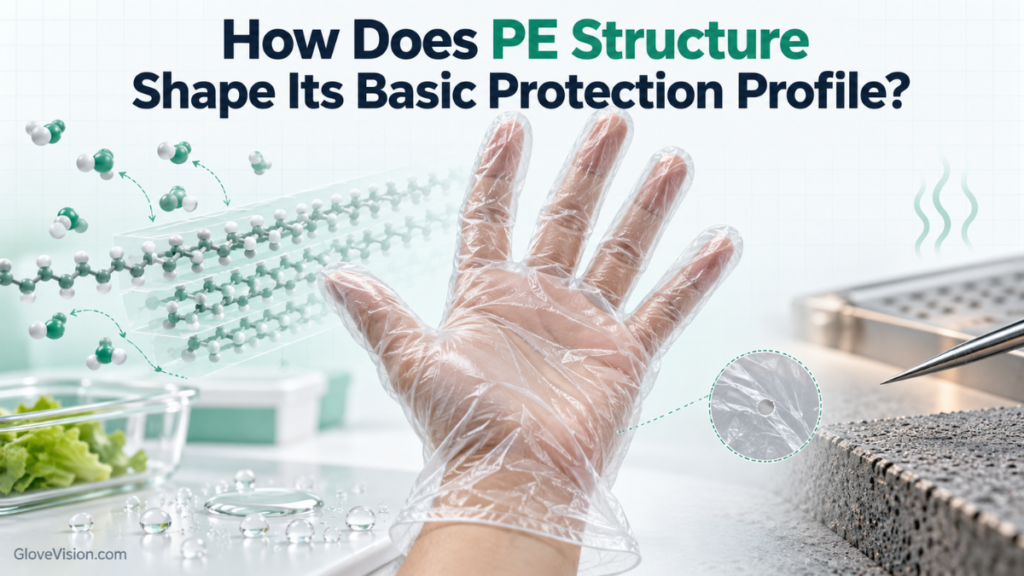
How Does PE Structure Shape Its Basic Protection Profile?
PE Gloves derive their basic protection profile from polyethylene’s simple, largely nonpolar hydrocarbon structure. That chemistry gives the material low water affinity, very low moisture uptake, and useful stability in many basic aqueous-contact situations, while thermoplastic processing allows lightweight disposable films.
Those material strengths do not make every PE glove a chemical or mechanical protection glove. Thin film, loose fit, seams, pinholes, puncture, abrasion, heat, and unsupported solvent exposure can dominate the real barrier, while specialty PE/EVOH laminates and UHMWPE fiber systems must not be confused with ordinary PE film.
What Molecular Structure Gives PE Gloves Their Basic Protection Profile?
PE Gloves inherit their basic barrier behavior from polyethylene’s simple –CH₂–CH₂– hydrocarbon chain, low polarity, and semicrystalline structure, but the protection of a finished glove still depends on film construction and physical integrity.
What Is the Basic Polyethylene Chain in PE Gloves?
Polyethylene is built primarily from repeating –CH₂–CH₂– units. Its backbone therefore consists mainly of carbon and hydrogen rather than strongly polar functional groups. This simple molecular architecture helps explain the baseline moisture behavior of PE without establishing the performance of a particular glove.
Why Are PE Gloves Based on a Largely Nonpolar Polymer?
The PE backbone lacks strongly polar groups such as hydroxyl or nitrile groups. The useful qualitative relationship is simple hydrocarbon chain → low polarity → low attraction to water. This molecular explanation should be kept separate from finished-glove approval.
Why Does Low Polarity Matter for Water Contact With PE Gloves?
Low water affinity contributes to very low moisture uptake by polyethylene. Representative bulk-material data report very low water absorption for LDPE and HDPE. [Material Data] These are material-level properties, not evidence that every thin PE glove is leakproof or approved for immersion.
Why Does Low Water Uptake Not Make PE Gloves Automatically Waterproof?
Water does not need to diffuse through intact polyethylene to reach the hand if it can instead pass through a pinhole, weak seam, tear, open cuff, or other physical opening. The practical rule is water-resistant polymer + physical opening = failed glove barrier.
What Does Semicrystalline Structure Mean for PE Gloves?
Polyethylene contains both more ordered crystalline regions and less-ordered amorphous regions. This mixed morphology influences stiffness, transport behavior, and other material properties, but it should not be converted into a universal glove-performance rating.
How Can Crystallinity Affect Transport Through PE Gloves?
At a qualitative level, more ordered molecular packing can reduce accessible free volume and make molecular transport paths more restricted. The actual barrier of a finished film also depends on grade, thickness, processing, orientation, temperature, chemical identity, and defects.
How Does Density Relate to the Structure of PE Gloves?
Broadly, LDPE tends to contain more branching and to show a softer, more flexible material profile, while HDPE generally allows more linear chain packing and a stiffer material tendency. Representative bulk-material data show different typical densities for LDPE and HDPE. [Material Data] These trends do not rank finished LDPE and HDPE gloves universally.
Why Is Density Alone Insufficient to Predict PE Gloves Performance?
A glove’s behavior depends on PE grade, film thickness, processing, orientation, geometry, seams, surface design, and manufacturing quality. A higher-density polymer does not automatically produce the better glove for every barrier, fit, or mechanical task.
| Structural Factor | Material Effect | Glove Consequence |
|---|---|---|
| Hydrocarbon backbone | Low polarity | Low water affinity |
| Few strongly polar groups | Limited water interaction | Low moisture uptake at the polymer level |
| Semicrystalline structure | Ordered and amorphous regions | Influences transport and stiffness |
| PE density | Changes packing and structural tendencies | Contributes to flexibility/stiffness balance |
| Thin-film construction | Low material mass | Lightweight barrier with limited mechanical reserve |
| Film seams or defects | Direct penetration paths | Can dominate real protection despite favorable polymer chemistry |
Text equivalent for Figure 1: Ordinary polyethylene film has a largely nonpolar, semicrystalline polymer structure with low attraction to water. Ordered crystalline regions and less-ordered amorphous regions form the film. Favorable polymer-level moisture behavior applies only to intact material. A pinhole, tear, seam defect, or other physical opening creates a direct penetration route that bypasses the polymer barrier, so low water absorption does not guarantee a leakproof finished glove.
How Does Thin-Film Construction Shape the Basic Use Zone of PE Gloves?
Thin-film construction gives PE Gloves their biggest practical advantage: lightweight, rapidly replaceable hand coverage for simple short-duration barrier tasks, but that same construction limits the protection that can be inferred from favorable bulk-polymer properties.
Why Can PE Gloves Be Made as Lightweight Films?
Polyethylene is a thermoplastic widely processed into film. For ordinary disposable gloves, this allows relatively low material use and lightweight construction suitable for high-volume basic-barrier applications.
What Practical Advantages Follow From Thin PE Gloves?
Potential advantages include light hand coverage, rapid donning, frequent replacement, simple contamination control, and practicality for low-complexity tasks where substantial mechanical protection is not required.
Why Can Loose PE Gloves Still Work for Simple Tasks?
Loose construction can remain practical for simple pickup, short transfer, brief handling, and other low-stress activities that do not require close fingertip conformity or high tactile precision.
Why Is Loose Fit Also a Limitation of PE Gloves?
Loose film can reduce fingertip control, tactile feedback, grip stability, and precision while increasing the amount of material available to snag on nearby objects. Fit therefore becomes part of the protection decision rather than a comfort issue alone.
Why Can Brief Water Contact Fit the Basic Profile of PE Gloves?
The low water uptake of polyethylene provides a material-level reason for considering intact PE film in selected brief moisture-barrier tasks. That tendency does not establish waterproofness, immersion performance, or suitability of a specific seam or finished glove.
Why Can Selected Aqueous Chemicals Be Candidate Exposures for PE Gloves?
Bulk polyethylene can have useful resistance to selected aqueous chemicals, but the evidence-transfer boundary is critical: bulk PE compatibility ≠ thin-glove approval. Chemical identity, concentration, temperature, contact mode, duration, construction, and exact manufacturer evidence still control the finished-glove decision.
Why Do Organic Solvents Need More Caution With PE Gloves?
Organic chemicals can interact with polymer films differently from water. Depending on the exact solvent and conditions, sorption, swelling, permeation, or mechanical-property changes may become relevant. OSHA advises selecting chemical-protective gloves according to factors including the chemical, frequency and duration of contact, nature of contact, concentration, temperature, physical stresses, dexterity, and grip. [OSHA]
Why Is Methylene Chloride a Critical Boundary Example for PE Gloves?
Methylene chloride is an especially useful example of why generic material names must not be used as the sole basis for glove approval. OSHA publications are not fully consistent in how they describe polyethylene for this exposure. An OSHA methylene-chloride hazard alert recommends PE/EVOH or other resistant laminates and states that polyethylene gloves do not protect against methylene chloride. [OSHA Hazard Alert]
However, OSHA’s industry-specific Methylene Chloride Facts No. 7 lists an inner glove made from PE/EVOH, PE, or laminate as part of a two-glove system for preventing methylene-chloride penetration. [OSHA Facts No. 7] Because those OSHA materials differ, this page does not assign methylene-chloride protection to ordinary thin PE film from the polymer name alone. Verify the exact glove construction and current chemical-specific manufacturer evidence before use.
This matrix is a screening framework for ordinary PE film, not a chemical-resistance chart or substitute for exact-product evidence.
Text equivalent for Figure 2: Ordinary PE film has a central basic-use zone that includes brief moisture barriers, contamination control, and simple low-stress handling. Selected aqueous chemical contact lies in a conditional zone requiring exact formulation, duration, concentration, temperature, glove integrity, and product evidence. Specialist solvent exposure, prolonged immersion, sharp or abrasive work, and hot or thermal hazards lie outside what can be assigned from generic PE chemistry. Evidence requirements increase as the task moves away from the basic-use core.
| Exposure / Task Zone | Generic PE Direction | Main Qualification |
|---|---|---|
| Water / moisture | Favorable material tendency | Integrity still controls |
| Dry contamination barrier | Strong practical fit | Intended use and product condition |
| Mild aqueous solution | Candidate | Exact formulation required |
| Selected dilute acid / base | Material-level candidate only | Glove-specific evidence required |
| Short food / general handling | Practical candidate | Intended-use compliance must be verified |
| Organic solvent | Conditional | Chemical-specific product data required |
| Methylene chloride | Do not assign a generic ordinary-PE rating | OSHA publications differ in their PE wording; identify the exact construction and verify current chemical-specific product evidence |
| Long immersion | Not inferred from PE chemistry | Exact test and product evidence required |
Which Mechanical, Heat, and Fit Limits Define the Boundary of PE Gloves?
The basic protection boundary of PE Gloves is often controlled less by favorable polyethylene moisture behavior than by thin-film mechanical reserve, loose fit, physical damage, and thermoplastic heat sensitivity.
Why Does Thinness Reduce the Puncture Margin of PE Gloves?
A thin film provides limited material between the hand and a sharp point, rough edge, or concentrated load. Polyethylene chemistry alone therefore cannot establish puncture protection.
Why Can Small Tears Become Important in PE Gloves?
A small notch, cut, seam defect, or puncture can create a localized stress concentration. Continued pulling or handling can then enlarge the opening, creating a direct contamination path through the glove.
Why Does Abrasion Matter for PE Gloves?
Repeated rubbing against rough surfaces can thin or damage lightweight film, create weak areas, aggravate seam damage, or initiate openings. OSHA includes abrasion, puncture, and tear resistance among the task factors that can affect glove selection. [OSHA]
Why Can Loose PE Gloves Increase Snag Risk?
Excess film around the fingers or palm can catch on packaging, corners, tools, or equipment edges. A snag can interfere with handling or apply concentrated force to the film, so loose construction should be matched only to tasks where that geometry is acceptable.
Why Does Poor Fit Reduce Dexterity in PE Gloves?
Loose fit can reduce fingertip positioning, tactile response, grip consistency, and fine manipulation. Dexterity and grip therefore need to be evaluated as task-specific requirements rather than inferred from the polymer itself.
When Can PE Gloves Still Work Despite Loose Fit?
Loose ordinary PE may remain practical for simple pickup, light transfer, short low-risk handling, and other tasks where precision is modest and mechanical stress is low.
Why Is Heat a Separate Limitation for PE Gloves?
Polyethylene is thermoplastic, so its physical behavior changes as temperature rises. Temperature can therefore change the suitability of a finished PE glove, and room-temperature material behavior should not be converted into hot-use approval.
Why Doesn’t Water Resistance Mean Hot-Water Protection for PE Gloves?
Resistance to water as a chemical medium is different from protection against thermal energy. Chemical resistance to water ≠ thermal protection against hot water. A thin PE glove should not be treated as a heat-protective glove merely because the polymer has low water absorption.
When Should Another Glove Replace PE Gloves?
Another construction should be evaluated when work involves sharp objects, repetitive abrasion, substantial puncture risk, high gripping force, precision manipulation, hot liquids, significant heat, or hazardous contamination for which film damage would have serious consequences.
Which Material Categories Must Be Kept Separate From Ordinary PE Gloves?
Ordinary PE Gloves must not inherit the chemical or mechanical performance of other polyethylene-containing systems simply because all of them contain the letters “PE.”
Why Is PE/EVOH Different From Ordinary PE Gloves?
PE/EVOH is a multilayer barrier construction rather than ordinary monolayer PE film. The additional polymer layers change the barrier behavior of the complete material, so chemical performance data for a PE/EVOH laminate belong to that laminate construction and should not automatically be transferred to ordinary PE film.
Why Is Methylene Chloride an Important Category Test for PE Gloves?
Methylene chloride demonstrates why category precision and exact-product verification matter. OSHA’s methylene-chloride hazard alert recommends PE/EVOH or other resistant laminate gloves and states that polyethylene gloves do not provide methylene-chloride protection. [OSHA Hazard Alert]
At the same time, OSHA’s industry-specific Methylene Chloride Facts No. 7 includes PE alongside PE/EVOH and laminate as possible inner-glove materials in a two-glove system. [OSHA Facts No. 7] Because OSHA’s published wording is not fully consistent, this page does not transfer either statement into blanket approval for ordinary disposable PE film. The exact construction and current chemical-specific product documentation must control the decision.
Why Is UHMWPE Different From Ordinary PE Gloves?
UHMWPE is a distinct very-high-molecular-weight form of polyethylene that can be processed into high-strength fiber systems. A textile engineered from those fibers is structurally and functionally different from a thin disposable PE film glove.
Why Should UHMWPE Cut Resistance Never Be Assigned to Ordinary PE Gloves?
The shared polyethylene name does not make the constructions equivalent. Molecular weight, chain organization, fiber processing, textile architecture, thickness, and finished-glove design differ substantially. Same broad polymer family ≠ same glove performance.
What About PE-Coated Fabrics Compared With Ordinary PE Gloves?
A PE-coated textile is a supported composite construction. Its backing fabric, coating thickness, adhesion, geometry, and intended task can alter performance, so supported constructions should be evaluated from their own product documentation rather than treated as disposable PE film.
Why Does Category Separation Matter for PE Gloves Safety?
Category confusion can lead to unsupported conclusions such as assigning UHMWPE cut protection to ordinary film, assigning specialist laminate solvent performance to monolayer PE, or treating evidence for an industrial composite as proof that a disposable glove is approved for the same task.
Similar material names do not make these glove systems interchangeable. Their physical construction shows why performance evidence cannot automatically move between categories.
Text equivalent for Figure 3: Four polyethylene-containing constructions are shown as separate categories. Ordinary PE film is a single thin polyethylene layer used as a basic lightweight barrier. PE/EVOH is a multilayer chemical-barrier architecture whose data should not automatically transfer to monolayer PE. UHMWPE glove systems use engineered high-strength fibers, so their mechanical or cut-performance data do not apply to thin disposable PE film. PE-coated textiles combine a PE coating with a supporting fabric and must be evaluated as their own composite product. Shared polyethylene terminology does not make these constructions equivalent.
| Product Type | Structure | Typical Protection Role | Equivalent to Ordinary PE Film? |
|---|---|---|---|
| Ordinary PE film glove | Thin monolayer polyethylene | Basic moisture / contamination barrier | Reference category |
| LDPE glove | Low-density PE film | Flexible disposable basic barrier | PE subtype |
| HDPE glove | Higher-density PE film | Thin basic barrier | PE subtype |
| PE/EVOH laminate glove | Multilayer polymer barrier | Specialist chemical protection where exact evidence supports it | No |
| UHMWPE fiber glove | Very-high-MW textile / fiber construction | Mechanical / cut-protection systems where rated | No |
| PE-coated textile | Supported coating system | Product-specific | No automatic equivalence |
How Should PE Gloves Be Compared and Verified Before Use?
PE Gloves should be selected only when the exact ordinary PE product matches a simple barrier task; when fit, puncture, heat, chemical, duration, or specialist-barrier requirements exceed that role, another exact glove construction should be compared.
When Can Vinyl/PVC Be More Practical Than PE Gloves?
An exact vinyl/PVC product may warrant comparison when closer fit, a more substantial film construction, improved hand conformity, or chemical-specific aqueous performance is needed. The decision should be based on the exact PVC product rather than a universal material ranking. See vinyl/PVC selection trade-offs.
When Can Nitrile Be More Practical Than PE Gloves?
An exact nitrile product can be considered where elasticity, closer fit, tactile control, puncture performance, or chemical-specific resistance is important. Nitrile should not be treated as universally superior; the exact hazard and finished product still control selection.
When Can Neoprene Be More Appropriate Than PE Gloves?
Neoprene may warrant comparison when the chemical task requires a more substantial specialist barrier and exact neoprene evidence fits the exposure. Its own solvent and chemical boundaries still apply. See neoprene specialization trade-offs.
When Can Butyl Be More Appropriate Than PE Gloves?
An exact butyl glove can be evaluated for selected demanding chemical exposures where ordinary thin PE is not an adequate basis for protection. Butyl has its own chemical and practical trade-offs and should be verified product by product. See Butyl selection trade-offs.
When Can Fluoroelastomer Be Compared With PE Gloves?
An exact fluoroelastomer construction may warrant comparison for selected difficult organic-solvent tasks far beyond the intended basic-barrier role of ordinary PE film. Adoption limits, construction, chemical data, and practical usability remain product-specific. See fluoroelastomer adoption limits.
When Is PE/EVOH the Relevant Comparison for PE Gloves?
PE/EVOH becomes relevant when an exact difficult chemical exposure is supported by laminate-specific evidence rather than monolayer PE data. It should be treated as a distinct multilayer chemical-barrier construction, not simply as “better PE.”
When Do Ordinary PE Gloves Remain the Practical Choice?
Ordinary PE can remain useful when the barrier need is simple, contact is brief, mechanical stress is low, precision requirements are modest, frequent replacement is practical, and specialist chemical or thermal protection is unnecessary.
Why Should PE Gloves and Alternative Materials Never Be Ranked Universally?
Every glove material and construction has chemical gaps, physical limitations, fit characteristics, temperature boundaries, costs, and intended-use constraints. The useful comparison is therefore exact product versus exact task. For broader material context, see glove materials explained.
What Hazard Must Be Defined Before Selecting PE Gloves?
Identify the contamination type, exact chemical and concentration where relevant, temperature, duration, frequency, contact mode, physical stress, and consequence of exposure. Those variables establish the task that the exact glove must be able to satisfy.
Which PE Gloves Construction Must Be Identified?
Confirm whether the glove is ordinary monolayer PE, LDPE, HDPE, a PE/EVOH laminate, or a supported/coated PE construction. Do not infer the category or its performance from the word “polyethylene” alone.
Which Physical Details Matter for PE Gloves?
Verify film thickness where documented, seam construction, cuff and coverage, size, surface texture, visible condition, and other physical features relevant to the task. A favorable polymer cannot compensate for an inadequate finished construction.
Which Task Variables Matter for PE Gloves?
Document duration, frequency, splash versus immersion, temperature, abrasion, puncture, tear risk, dexterity, grip, and any snagging or precision requirements. The task profile should then be compared with the performance evidence for the exact finished glove.
Why Must Exact Product Data Override Generic PE Gloves Properties?
Final protection belongs to the exact finished glove rather than the polymer name. Film thickness, construction, chemical compatibility, physical performance, intended use, and applicable manufacturer documentation should therefore control the final selection.
When Is the Evidence for PE Gloves Too Weak?
Escalate the decision when the exact construction is unclear, chemical-specific evidence is missing, mechanical demand is high, precision fit is required, significant heat is present, prolonged immersion is expected, published guidance conflicts, or the selection depends mainly on bulk-polymer properties.
Hazard Gate
- Hazard identified.
- Exact chemical and concentration known where relevant.
- Temperature known.
- Contact mode and duration defined.
- Consequence of exposure understood.
Construction Gate
- Ordinary PE and PE/EVOH distinguished.
- Ordinary PE and UHMWPE distinguished.
- LDPE or HDPE identified where available.
- Film thickness reviewed where documented.
- Seams and construction reviewed.
Integrity Gate
- No visible holes or pinholes.
- No tears.
- No visibly weak or damaged seams.
- Fit adequate for the task.
- Cuff and coverage adequate.
Task Gate
- Mechanical stress sufficiently low.
- Puncture risk acceptable for the exact product.
- Abrasion risk acceptable.
- Dexterity adequate.
- Grip adequate.
- Contact duration supported.
- Heat exposure within supported conditions.
Evidence Gate
- Exact-product documentation reviewed.
- Chemical compatibility supported where needed.
- Conflicting published guidance identified rather than silently resolved.
- No chemical data transferred automatically from PE/EVOH to ordinary PE.
- No cut-performance data transferred from UHMWPE fiber to PE film.
- No bulk-material property treated as finished-glove approval.
Alternative Gate
- PVC considered where a closer or more substantial film construction may help.
- Nitrile considered where fit, puncture, tactile, or chemical demands increase.
- Neoprene or Butyl considered where exact chemistry requires specialist protection.
- PE/EVOH considered only when exact laminate evidence applies.
- Every alternative evaluated as an exact finished product.
Final Decision
What Should Readers Remember About the Basic Protection Profile of PE Gloves?
PE Gloves derive their basic protection profile from polyethylene’s simple nonpolar hydrocarbon structure, low moisture affinity, semicrystalline organization, and ability to form lightweight films. Those properties make ordinary PE useful for selected short-duration moisture, contamination, and basic aqueous-contact tasks. Treat PE Gloves as lightweight basic barriers whose structure favors moisture resistance and simple short-duration protection.
Those polymer-level strengths do not make ordinary PE film a specialist chemical or mechanical barrier. Thin construction, loose fit, pinholes, seams, puncture, abrasion, heat, unsupported organic solvents, conflicting generic guidance, and product variability can dominate real protection, while PE/EVOH laminates and UHMWPE fiber systems belong to separate performance categories. Require exact finished-glove evidence before assigning specialist chemical, mechanical, thermal, or prolonged-immersion performance.
Which Questions Clarify the Structure and Protection Profile of PE Gloves?
Why Do PE Gloves Resist Water Well?
Polyethylene is largely nonpolar and absorbs very little water, so the polymer itself has low water affinity and little water-driven swelling. Finished-glove integrity still matters because holes, seams, tears, poor fit, and cuff openings can allow direct penetration.
Are PE Gloves Chemically Resistant?
Polyethylene can show useful chemical resistance at the material level, particularly for selected aqueous exposures, but ordinary thin PE glove suitability must be established from the exact finished product and the actual chemical, concentration, temperature, duration, and contact conditions.
Are PE Gloves Good for Puncture or Sharp-Object Work?
Ordinary thin PE film should not be assumed to provide strong puncture, tear, abrasion, or cut protection. Those hazards require separate product evidence or a mechanically stronger glove.
Are PE/EVOH Chemical Gloves the Same as Ordinary PE Gloves?
No. PE/EVOH is a multilayer chemical-barrier construction with different performance. Chemical data for a PE/EVOH laminate must not be transferred to ordinary monolayer PE film.
When Should Another Material Replace PE Gloves?
Compare another exact glove when the task requires closer fit, stronger puncture or abrasion resistance, greater dexterity, prolonged chemical contact, significant heat protection, specialist solvent resistance, or stronger evidence than ordinary PE film can provide.