
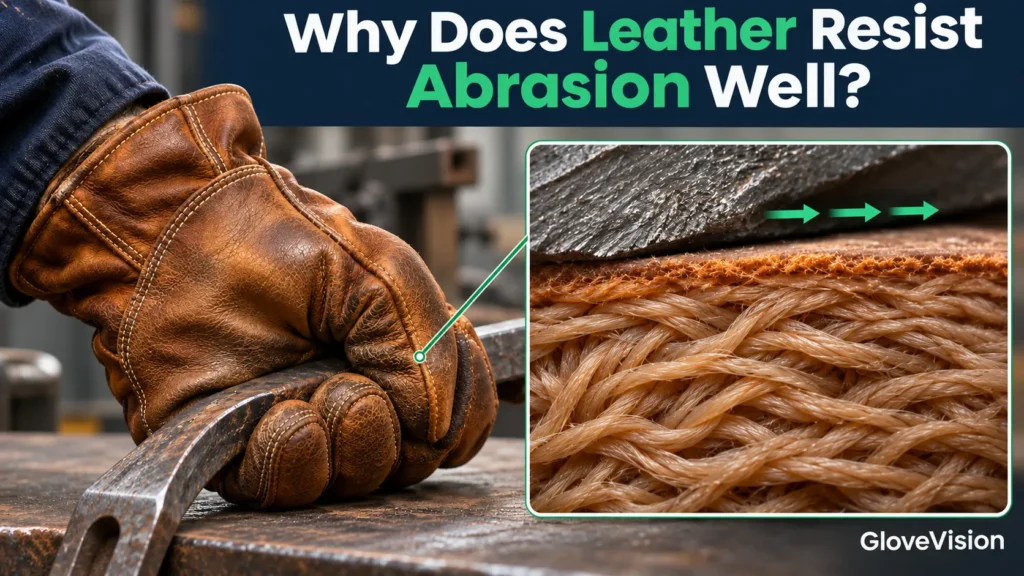
Leather can resist abrasion well because its interconnected collagen-fiber network, cohesive contact surface, material thickness, and finishes can delay progressive surface loss during repeated friction. However, abrasion resistance varies with the exact leather, glove construction, abrasive surface, contact pressure, and operating conditions.
This article explains leather surface-wear mechanisms, the differences between grain and split leather, thickness and finishing effects, common causes of premature deterioration, EN 388 abrasion testing, workload-specific selection, and safe inspection and replacement decisions.
What Makes Leather Abrasion Resistance Effective Against Repeated Friction?
Leather abrasion resistance describes its ability to withstand progressive surface deterioration during repeated rubbing or scraping. Collagen cohesion, surface characteristics, material depth, and finishing can affect how the wear progresses, but only appropriate tests establish a measured level.
What Is Leather Abrasion Resistance?
It is the ability of leather to withstand material loss during repeated abrasive contact under specified conditions. Unlike a single blade cut or puncture, abrasion typically involves repeated contact that gradually changes or removes the exposed surface.
Why Can Leather Withstand Repeated Rough-Surface Contact?
Leather has a cohesive fibrous framework that can help its surface remain intact under repeated mechanical contact. Material quality, finish, thickness, and the opposing abrasive surface all influence the actual response.
The broader guide to leather glove materials and construction explains how these characteristics relate to finished protective products.
How Does Progressive Wear Affect the Glove Surface?
Repeated friction may cause polishing, surface roughening, loosening of exposed fibers, coating loss, material thinning, and eventually wear-through. The sequence and severity depend on the particular leather and contact conditions.
Which Work Activities Involve Significant Abrasion?
Handling rough timber, masonry products, coarse equipment surfaces, or abrasive building materials can repeatedly load a glove’s palm and fingers. Pressure, grip pattern, frequency, and movement determine the exposure rather than the object category alone.
Why Is Abrasion Resistance Only One Aspect of Protection?
Abrasion testing does not independently establish safety against sharp blades, puncturing objects, tearing, or impacts. Each relevant hazard requires appropriate evidence for the exact finished glove.
| Factor | Leather Response | Potential Contribution | Limitation | Practical Meaning |
|---|---|---|---|---|
| Collagen cohesion | Fibers maintain material continuity. | May delay loss of surface integrity. | Not a measured abrasion result. | Verify glove performance. |
| Grain surface | Outer, relatively fine fiber structure. | Surface-dependent wear behavior. | No guaranteed superior rating. | Evaluate finish and tests. |
| Split surface | Exposed fibrous contact region. | Different texture and contact response. | Grip does not equal abrasion resistance. | Check exact product. |
| Thickness | More or less material depth. | May influence wear-through. | No universal thickness-to-rating formula. | Review measured results. |
| Finishing | Changes surface contact properties. | May influence friction or wear. | Some coatings wear independently. | Inspect surface condition. |
| Repeated friction | Progressive surface loss. | Defines abrasion exposure. | No fixed service life. | Match glove to workload. |
| Natural variation | Variable fibers and finishing. | Different responses between products. | No material-wide guaranteed grade. | Compare tested models. |
Tables can scroll horizontally on smaller screens.
In controlled tribological testing of Ti-Ag-O-coated goat leather, researchers observed contact-dependent abrasive and adhesive wear mechanisms. These results describe the studied coating and contact materials, not a universal EN 388 result for work gloves. Leather Tribology Research
How Does the Collagen-Fiber Network Support Leather’s Resistance to Abrasion?
Leather’s connected collagen fibers help maintain structural continuity during repeated contact. That provides a plausible mechanical explanation for surface durability, but collagen organization alone cannot predict a glove’s tested abrasion level.
How Is Leather’s Collagen-Fiber Network Organized?
Leather contains collagen fibrils grouped into fibers and bundles that form a variable, interconnected structure. Processing, moisture, hide location, and species can change that organization. Structural studies describe the framework, not direct finished-glove abrasion performance.
Collagen Processing ResearchHow Does Fiber Cohesion Affect Surface Wear?
Connected fibers may help the exposed material remain cohesive during mechanical contact. Whether the structure provides greater abrasion resistance depends on the actual leather, surface treatment, and test conditions.
What Happens to Fibers During Repeated Abrasion?
Abrasion can disturb exposed fibers, produce surface debris, wear a finish, and progressively reduce material depth. Specialized coated-leather experiments have identified different wear mechanisms depending on the contacting materials and friction.
Wear Mechanism StudyDoes Collagen Fiber Orientation Prove Abrasion Resistance?
No. Collagen alignment can influence some mechanical properties, but findings from tensile or tear studies cannot be used to assign abrasion ratings. The appropriate abrasion test must be used instead.
Why Can Damaged Fibers Accelerate Visible Surface Deterioration?
Previously disturbed material can leave less intact surface structure at a heavily contacted location. Further rubbing may continue the deterioration, particularly at palms or fingertips. The progression is product- and task-dependent.
How Do Grain and Split Leather Surfaces Differ in Abrasion Resistance?
Grain and split leather have different exposed fiber structures and surface characteristics, but neither is automatically more abrasion-resistant. Hide quality, thickness, finishing, contact conditions, and tested construction determine performance.
What Is the Grain Surface of Leather?
Grain leather retains the outer hide region, with a comparatively fine fiber structure near the surface. Grain density and finishing vary across products, so its appearance does not establish a universal abrasion grade.
What Is Split Leather?
Split leather is obtained from a lower separated portion of the hide and commonly exposes a more fibrous texture. Split thickness, hide quality, and treatment influence its behavior. A suede-like surface does not automatically indicate weakness or damage.
How Can Surface Structure Influence Wear?
A smoother or more fibrous contact surface may undergo different frictional interactions, polishing, fiber disturbance, or material removal. Neither appearance nor roughness alone reveals the standardized abrasion result.
Does Rougher Split Leather Have Better Abrasion Resistance?
Not necessarily. Frictional grip and abrasion resistance are different properties. A surface may grip an object well but still experience significant material loss during repeated abrasive contact.
Is Grain Leather Always More Abrasion-Resistant?
No. Compare exact glove models or suitably matched material samples using abrasion-specific evidence. The surface label does not override thickness, finish, quality, or tested results.
For bovine-hide context, see cowhide glove surface and wear characteristics .
| Feature | Grain Leather | Split Leather | Wear Consideration | Verification |
|---|---|---|---|---|
| Surface origin | Outer grain region. | Separated lower region. | Different structures. | Confirm material. |
| Texture | May have smoother face. | Often fibrous. | Different contact behavior. | Do not infer rating. |
| Thickness | Product-dependent. | Product-dependent. | May influence wear-through. | Compare construction. |
| Finishing | May include surface coating. | May be treated or finished. | Finish may wear separately. | Check surface testing. |
| Grip | Condition-dependent. | Condition-dependent. | Not equivalent to abrasion. | Assess task handling. |
| Durability | No universal superiority. | No universal inferiority. | Test results decide. | Compare finished gloves. |
Research on polyurethane-containing leather sealing coats has measured contact angle, surface energy, and adhesion characteristics. Such evidence helps explain finishing effects but does not establish an EN 388 abrasion level. JALCA Finishing Study
How Do Leather Thickness and Surface Finishing Affect Abrasion Resistance?
Thickness may provide greater material depth before wear-through, while finishing can change the leather’s friction and surface response. Neither factor alone guarantees a higher EN 388 rating or longer glove life.
How Can Thickness Affect Wear-Through?
More material depth may affect when wear-through occurs under otherwise comparable conditions. But abrasive contact, fiber quality, finishing, and construction prevent a simple thickness-to-performance prediction.
Does Greater Thickness Guarantee a Higher EN 388 Rating?
No. The rating is based on a standardized abrasion test of the relevant glove material. Thickness alone cannot substitute for the measured performance.
How Can Surface Finishing Influence Friction and Wear?
A coating or finishing system can alter surface friction, adhesion, or moisture response. For example, the published polyurethane sealing-coat research measured changes in surface energy and wetting. It did not report a general improvement in the EN 388 abrasion rating of leather work gloves.
Polyurethane Seal-Coat StudyCan Coatings Wear Separately From the Leather?
Yes. Coatings may abrade, peel, crack, or detach while the leather underneath remains partly intact. Inspect surface finishing and underlying material as separate aspects of the glove’s condition.
How Do Tanning and Fatliquoring Relate to Surface Behavior?
Tanning stabilizes the leather structure, while fatliquoring can influence fiber lubrication and flexibility. These processes may alter handling or material response, but they do not establish an abrasion-performance improvement without testing.
What Handling Trade-Offs Can Thickness and Finish Introduce?
Added thickness or a stiff coating may increase bulk or reduce some finger movement and tactile control. The effect varies by product, so glove fit and representative handling must be assessed alongside tested protection.
| Feature | Possible Wear Effect | Handling Trade-Off | Evidence Needed | Limitation |
|---|---|---|---|---|
| Thickness | Additional material depth. | Possible bulk. | Abrasion test. | Not an automatic rating. |
| Grain finish | Different contact response. | Altered friction. | Finished-surface tests. | Not always better. |
| Surface coating | Can change friction or wear. | May affect flexibility. | Coating-specific tests. | Can deteriorate separately. |
| Tanning | Changes collagen stability. | Processing-dependent feel. | Product data. | No universal wear gain. |
| Fatliquoring | Changes fiber movement. | Can change softness. | Appropriate evaluation. | Not a restored PPE rating. |
| Surface damage | May expose underlying leather. | Potential altered grip. | Inspection. | Appearance alone insufficient. |
Test-method distinction: SATRA TM193 evaluates leather thickness removed through a rotating-cylinder abrasion procedure, mainly for heavy leather such as footwear soling. It is not interchangeable with EN 388 Martindale classification for protective gloves. SATRA TM193
Why Can Leather Glove Abrasion Resistance Decline Under Harsh Working Conditions?
Abrasive exposure can progressively damage a glove when rough contact, pressure, repeated motion, embedded particles, or changing material condition accelerates wear. The actual severity depends on the glove and working environment.
How Does Continuous Rough-Surface Handling Wear Leather?
Repeated contact removes or disturbs material over time. Pressure and movement concentration may increase localized wear, but no universal working-life estimate can be inferred.
Where Does Abrasion Commonly Concentrate on a Work Glove?
Palms, fingertips, thumb regions, and reinforcement edges may experience concentrated abrasion where they repeatedly touch objects. The actual pattern depends on hand position, task and glove geometry.
Can Embedded Grit Accelerate Surface Deterioration?
Yes. Abrasive particles trapped in a contact region can contribute additional rubbing damage. Use manufacturer-approved cleaning methods and replace gloves when safe cleaning or continued performance cannot be established.
How Do Wetting, Drying and Contamination Affect Wear?
Moisture and contaminants can alter leather’s stiffness, surface contact, and condition. This does not mean all wet leather has the same response. Assess the exact product and follow its care and use instructions.
Which Visible Signs Indicate Progressive Abrasion Damage?
Significant thinning, loose or missing fibers, holes, coating separation, and damaged reinforcements are warning signs. Cosmetic polishing alone does not prove loss of all protective performance, but appearance cannot exclude hidden deterioration either.
When Does Repeated Premature Wear Require a Different Glove?
When unacceptable wear repeatedly affects protection, reassess the glove’s tested abrasion performance, reinforcement placement, workload, and replacement process. Safety takes priority over reducing glove expenditure.
| Condition | Mechanism | Warning Sign | Concern | Response |
|---|---|---|---|---|
| Rough contact | Repeated friction. | Surface thinning. | Loss of coverage. | Review glove choice. |
| Palm pressure | Localized rubbing. | Concentrated wear. | Uneven material loss. | Inspect palm and reinforcement. |
| Embedded grit | Particle abrasion. | Scratches or fiber damage. | Accelerated deterioration. | Approved cleaning or replacement. |
| Moisture cycling | Condition changes. | Stiffness or distortion. | Handling problems. | Check product guidance. |
| Coating wear | Surface layer degradation. | Peeling or cracks. | Lost finish function. | Assess replacement criteria. |
| Seam contact | Repeated rubbing at edges. | Loose stitches. | Reduced protection. | Remove if compromised. |
| Early wear-through | Excessive task exposure. | Repeated holes. | Inadequate model suitability. | Choose tested alternative. |
How Is Leather Abrasion Resistance Measured Under EN 388 Testing?
EN 388:2016+A1:2018 classifies protective-glove abrasion performance by standardized rubbing of palm specimens against an abrasive material. Its levels describe the laboratory result, not how long a glove will last at work.
What Is EN 388:2016+A1:2018?
It is a European standard covering mechanical protection tests for gloves, including separate abrasion, blade cut, tear, puncture, and applicable impact results. It does not certify all leather products as equally protective.
SATRA — EN 388How Does the Martindale Abrasion Test Work?
Specimens from a glove’s palm are rubbed against standardized 180-grit abrasive using a Martindale machine. Four specimens are tested for a single material, with the lowest result used for its classification. Different procedures apply to specified multilayer constructions.
What Are the Four EN 388 Abrasion Levels?
Levels 1 through 4 have minimum defined laboratory thresholds of 100, 500, 2,000 and 8,000 cycles. Level 0 is below the Level 1 threshold. There is no EN 388 abrasion Level 5.
| Level | Minimum Cycles | Interpretation | Limitation |
|---|---|---|---|
| 0 | Below 100 | Below first rating threshold. | Not evidence of zero wear resistance. |
| 1 | 100 | First defined level. | No guaranteed service time. |
| 2 | 500 | Second defined level. | No direct workplace cycle equivalence. |
| 3 | 2,000 | Third defined level. | Actual contact may differ. |
| 4 | 8,000 | Highest defined abrasion level. | Not 8,000 guaranteed work movements. |
| X | No numeric result reported | Not tested or not applicable as reported. | Not the same as 0. |
The thresholds and methodology are documented in SATRA’s technical explanation and ATG’s EN 388 standards guide. SATRA Thresholds ATG EN 388 Guide
What Does the First EN 388 Pictogram Character Mean?
The first character represents abrasion level. Subsequent positions report other mechanical properties. The letter X does not simply mean that a glove achieved Level 0.
Does a Level 4 Rating Guarantee 8,000 Workplace Movements?
No. Laboratory movements use controlled abrasive material and test conditions. Actual work differs in pressure, surface, motion, and moisture. Laboratory cycles are not a guaranteed number of hours, days, or field movements.
Can Leather-Specific Abrasion Tests Replace EN 388 Ratings?
No. SATRA TM193 measures thickness lost through a rotating-cylinder procedure, primarily for heavy leather. EN 388 uses a different method and performance classification. Their results should not be converted into each other.
SATRA TM193 DescriptionSafety boundary: A high abrasion rating does not establish blade-cut, puncture, needlestick, thermal, chemical or electrical protection.
Which Leather Glove Abrasion Resistance Features Matter Most for Different Workloads?
The right glove combines measured abrasion performance with construction, grip, fit, reinforcement coverage, and any other hazard-specific protection required by the actual job.
What Matters for Light Abrasive Work?
Choose a glove with appropriate test evidence and functional handling. Light work does not have one universal minimum EN 388 level; severity must be assessed.
What Matters for Repeated Rough-Material Handling?
Frequent contact with rough surfaces may justify higher documented abrasion performance and appropriately positioned palm or fingertip reinforcement. Compare exact products.
When Are Reinforced Palm Zones Useful?
Reinforcements may add material at high-contact areas. Their benefit depends on placement, secure attachment, and task exposure. They may also add bulk or produce new seam wear zones.
How Should Grain, Split and Thickness Be Evaluated?
Treat them as construction characteristics, not automatic abrasion grades. Compare tested performance, grip, material quality, and fit rather than relying on a leather label.
Why Must Grip and Fit Be Assessed Separately?
A glove with high abrasion resistance may still reduce control if its grip is inadequate or its fit restricts natural movement. Representative handling must remain safe.
When Are Additional Protection Ratings Required?
Sharp edges, points, impact hazards, heat, and other exposures require the corresponding additional evidence. Abrasion does not substitute for cut or puncture protection, and gloves may create entanglement hazards around machinery.
How Should Cost and Replacement Be Considered?
Compare suitable glove models using actual purchase cost, observed wear, and replacement frequency without compromising required protection. Do not invent fixed lifespan or savings from abrasion grades.
| Workload | Exposure | Glove Feature | Evidence Needed | Selection Priority |
|---|---|---|---|---|
| Light handling | Low or variable abrasive contact. | Fit and palm surface. | Suitable test results. | Match actual severity. |
| Rough timber | Friction and possible splinters. | Palm and finger coverage. | Abrasion and relevant puncture data. | Separate hazards. |
| Masonry | Rough repeated contact. | Wear-zone durability. | Abrasion results. | Assess pressure. |
| Equipment | Variable objects and motion. | Grip and seam strength. | Task-specific performance. | Check machinery hazards. |
| Palm friction | Repeated local wear. | Reinforcement placement. | Applicable testing. | Inspect attachment. |
| Sharp surfaces | Abrasion plus sharp edges. | Specialist protection. | Separate cut and puncture ratings. | No abrasion-only choice. |
| Wet contact | Moisture-dependent handling. | Documented suitability. | Manufacturer data. | No assumed waterproofing. |
What Leather Abrasion Resistance Checks Help Prevent Premature Glove Failure?
Prevent premature glove failure by verifying the selected product, inspecting high-contact areas, checking finishes and seams, removing abrasive particles only through approved methods, and replacing gloves when their protective suitability is compromised.
Is the Selected Glove Rated for the Intended Work?
Check the exact model, intended use, abrasion performance, and all additional hazard ratings.
Are High-Wear Contact Areas Intact?
Inspect palms, fingertips, thumb regions, and reinforcement edges where rubbing may concentrate.
Is There Significant Thinning or Material Loss?
Look for serious thinning, worn-through areas, holes, and loss of surface integrity. Remove gloves when damage undermines required protection.
Are Surface Finishes and Seams Sound?
Check for peeling finishes, open stitching, broken thread, cracks, and separated reinforcement.
Is Embedded Abrasive Material Present?
Inspect for trapped grit or abrasive debris. Follow the manufacturer’s cleaning or replacement instructions.
Are Fit and Handling Still Acceptable?
Confirm functional grip, suitable flexibility, secure fit, and reliable hand movement.
Should the Glove Be Replaced?
Replace or remove it from service when wear, contamination, damaged construction, or loss of function makes protection inadequate or uncertain. Unapproved repairs and conditioning do not restore certified performance automatically.
- Exact glove model and intended use verified.
- Required abrasion result documented.
- Other relevant hazards assessed separately.
- Palm surface remains intact.
- Fingertip and thumb areas inspected.
- No unacceptable thinning or wear-through.
- Finishes checked for peeling and cracks.
- Seams and reinforcement remain secure.
- Embedded grit and contamination assessed.
- Grip, movement and fit remain suitable.
- Manufacturer care instructions followed.
- Replacement decision documented when necessary.
Final decision: Leather can provide useful surface durability, but required protection depends on the tested finished glove, task exposure, construction, and present condition.
What Ultimately Determines Leather Glove Abrasion Resistance?
Leather’s cohesive collagen fibers, grain or split surface, thickness, and finish can influence how material responds to progressive friction and scraping. Its wear resistance also depends on hide variation, surface contact, and processing conditions.
Actual glove suitability requires relevant abrasion test evidence, other hazard ratings, secure construction, fit, effective grip, routine inspection, and timely replacement. Neither a premium leather label nor a high abrasion rating guarantees universal protection or a fixed service life.
Frequently Asked Questions
Why Is Leather Good at Resisting Abrasion?
Its connected collagen structure, surface characteristics, thickness, and finishes may help delay material loss under repeated friction. Results remain product-dependent.
Is Full-Grain Leather More Abrasion-Resistant Than Split Leather?
Not universally. Grain and split leather differ in surface structure, but a fair comparison requires relevant test results and complete-product information.
Does Thicker Leather Always Last Longer Against Abrasion?
No. Additional thickness may affect wear-through but does not guarantee a higher EN 388 rating or longer service life in every workplace.
What Does EN 388 Level 4 Abrasion Resistance Mean?
It means the tested glove material reaches the 8,000-cycle threshold under the defined laboratory method. It is not a guarantee of 8,000 work movements or a fixed lifespan.
When Should Abraded Leather Gloves Be Replaced?
Remove or replace them when serious thinning, holes, damaged seams, lost grip, or other deterioration compromises required protection or function. Follow manufacturer and workplace replacement procedures.

4 Responses