
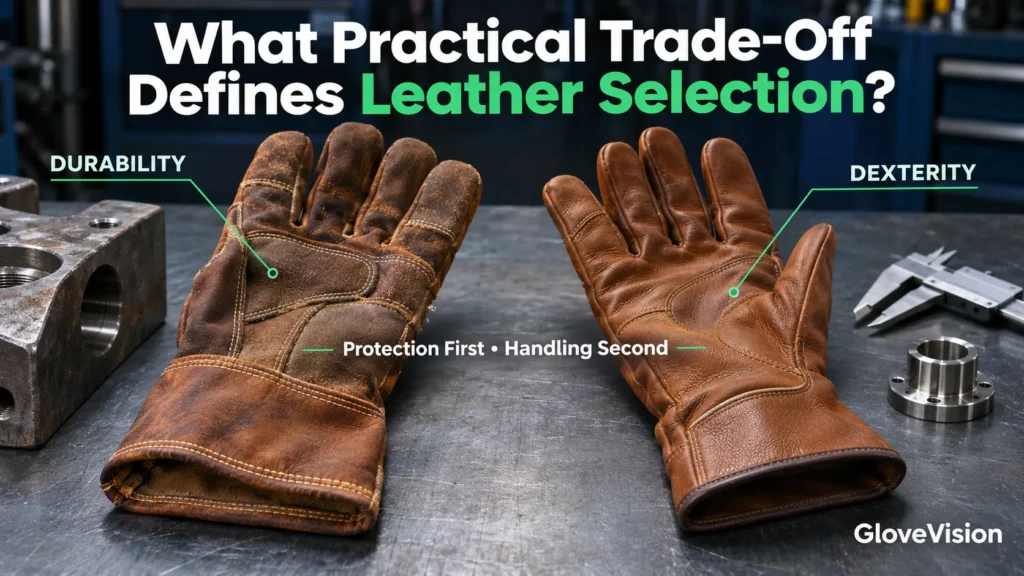
The main leather glove selection trade-off is balancing suitable mechanical durability and tested protection with the dexterity, grip, flexibility and comfort needed for the work. Thicker leather or added reinforcement may increase material depth or local wear resistance, but it can also add bulk and does not automatically improve a glove’s protective rating.
This guide explains how leather glove construction affects practical handling, how to assess fit and mechanical protection, why common buying decisions fail, and how to compare alternatives and operating costs. The goal is to select a glove that satisfies mandatory safety requirements before considering convenience or price.
What Makes Leather Work Gloves a Practical Choice for Mechanical Tasks?
Leather work gloves can be practical for selected mechanical tasks because suitable processed leather offers a flexible, durable contact material. However, actual protection depends on the finished glove’s construction, documented performance and fit—not the leather label alone.
What Are Leather Work Gloves?
Leather work gloves are protective or handling gloves made wholly or partly from processed animal hide. Full-leather designs use leather over much of the glove, while leather-palm designs combine leather contact areas with other materials.
The broader guide to leather glove construction and material properties explains these material characteristics in greater detail.
Why Are Leather Gloves Used for Rough-Material Handling?
Appropriate leather constructions may withstand repeated surface contact during selected timber, masonry or equipment-handling tasks.
That does not mean every leather glove is suitable for every rough object. Sharp edges, moving equipment and other hazards still require assessment.
Which Characteristics Make Leather Practical?
Leather may provide useful surface toughness, flexibility, contact friction and resistance to particular forms of wear.
These are potential material advantages, not universal statements about measured abrasion, cut, puncture or impact performance.
What Variations Exist in Leather Glove Construction?
Leather work gloves may use grain or split leather, full-leather or leather-palm coverage, reinforced contact zones, different seam arrangements and a range of cuffs or linings.
Each design can change the balance between durability, dexterity and comfort.
Why Must Buyers Evaluate the Finished Glove?
The finished glove determines how its panels, seams, reinforcements, fit and tested protective properties work together.
Buyers should verify the exact manufacturer’s product and its intended use rather than assuming a leather type guarantees performance.
Practical conclusion: Leather is a material option, not a complete safety decision. Select the finished glove according to the actual task and documented hazards.
How Does the Leather Glove Durability–Dexterity Trade-Off Shape Selection?
The central trade-off is choosing enough material durability and required protective performance without unnecessarily restricting hand movement, finger control or grip. Durability and dexterity are not always opposites, but particular constructions can favor one at the expense of the other.
What Is the Main Durability–Dexterity Trade-Off?
A glove designed for substantial repeated contact may use thicker materials or reinforcement, while a glove designed for fine manipulation may prioritize flexibility and tactile sensitivity.
Neither characteristic should be optimized without first establishing the task’s mandatory protection requirements.
How Can Thicker Leather Affect Hand Movement?
Additional leather depth may increase bulk or stiffness, depending on the material and construction. This can affect finger bending, full hand closure and feedback when handling small tools.
Thickness alone cannot predict the final glove’s protection level.
Why Can Supple Leather Improve Handling?
More flexible leather may allow easier bending or closer conformity to the hand in some designs.
Softness may improve usability, but it does not prove superior cut, puncture or abrasion resistance.
How Do Work Tasks Change the Required Balance?
Repeated rough-material handling may place greater demands on wear zones. Tool adjustments and precision-oriented operations may require more finger movement and tactile control.
The correct glove must satisfy both the actual hazards and essential handling requirements.
Does Maximum Thickness Always Produce the Best Choice?
No. Excessive bulk may reduce handling efficiency without demonstrating improved protection for the specific hazard.
A thinner design should not be selected if it fails required protection, either.
What Selection Principle Resolves the Trade-Off?
Select a glove that meets all mandatory protective requirements while introducing no unnecessary restriction to the movements needed for safe work.
The best choice is task-dependent and supported by product evidence.
| Task Requirement | Protective Need | Construction Consideration | Dexterity Implication | Selection Priority |
|---|---|---|---|---|
| Rough-material handling | Verified protection against relevant wear and contact hazards. | Appropriate leather and contact-zone construction. | Bulk may affect grasping. | Protection and dependable control. |
| Repetitive gripping | Suitable wear performance and functional grip. | Flexible palm and suitable fit. | Excessive stiffness may increase effort. | Secure repeated handling. |
| Tool adjustments | Required task-specific protection. | Flexible fingers and appropriate fingertip design. | Bulk may reduce precision. | Controlled tool manipulation. |
| High-contact palm work | Relevant palm protection. | Possible localized reinforcement. | Added material may affect hand closure. | Verify coverage and movement. |
| Mixed wear and precision | Evidence covering every identified hazard. | Balanced or hybrid construction. | Check both grip and fine control. | Neither requirement can be ignored. |
| Sharp-edge handling | Verified cut protection for the identified hazard. | Tested cut-protective design where necessary. | Movement evaluated after protection passes. | Required cut performance first. |
Examples are selection considerations, not certifications or ratings for particular products.
HSE — Protection and Dexterity SATRA — EN 388 Mechanical TestingHow Do Leather Glove Thickness and Construction Affect Protection and Flexibility?
Leather thickness and construction influence material depth, wear distribution, flexibility, fit and hand control. Their effect depends on how the actual glove is designed and tested, so no single thickness, leather grade or reinforcement pattern is universally best.
How Does Leather Thickness Affect Protection and Mobility?
Greater thickness can add material depth or cushioning, but may also increase bulk or resistance to bending.
The finished glove’s protective performance must still be verified independently.
How Do Grain and Split Leather Differ?
Grain leather retains a natural outer grain surface, while split leather comes from a separated lower hide layer and may have a more fibrous surface.
Their actual wear behavior, flexibility and grip depend on processing and construction. Neither is universally superior.
The article about cowhide glove durability and flexibility provides a relevant example of these differences.
How Do Reinforced Palms and Fingertips Affect Performance?
Reinforcement may increase material coverage in selected high-contact areas, such as the palm, thumb or fingertips.
It may also increase bulk and alter movement. Local reinforcement does not automatically establish complete-glove cut or puncture protection.
Why Do Seams and Stitching Matter?
Seam location, stitching integrity and construction affect how a glove withstands repeated movement and contact.
Poorly positioned or damaged seams can create pressure points, discomfort or early failure.
What Is the Difference Between Full-Leather and Leather-Palm Gloves?
Full-leather designs use leather over more of the glove, while leather-palm designs combine leather contact areas with other materials.
The difference can affect coverage, flexibility, ventilation and wear, but does not establish a universal protection ranking.
How Can Finger Patterns and Flexible Sections Improve Handling?
Appropriate finger shaping, panel placement and flexible sections may support grasping and bending.
Their actual performance should be checked through product documentation and safe functional assessment.
| Construction Feature | Possible Durability Contribution | Handling Trade-Off | Verification Requirement |
|---|---|---|---|
| Thick leather palm | Additional material depth and contact coverage. | May reduce tactile feedback. | Exact product and relevant testing. |
| Supple leather | May support repeated bending. | Softness alone proves no protective level. | Product performance and safe handling check. |
| Grain surface | Product-dependent surface behavior. | Feel and friction vary. | Finished-glove testing. |
| Split surface | Potential contact friction in selected conditions. | May behave differently with moisture or objects. | Task-specific evaluation. |
| Reinforced fingertips | Additional material in selected zones. | Possible bulk at fingertips. | Coverage and ratings. |
| Thumb reinforcement | May manage repeated local wear. | Possible change in thumb movement. | Placement and wear evidence. |
| Seam placement | May reduce direct stress at selected locations. | Poor placement can create pressure. | Construction inspection. |
| Full-leather construction | Leather coverage over more areas. | Ventilation and movement may vary. | Complete-product evidence. |
| Leather-palm construction | Contact material concentrated in the palm. | Other panels may have different properties. | Whole-glove coverage and ratings. |
Why Do Leather Work Glove Fit, Grip, and Comfort Influence Selection?
Fit, grip and comfort affect how successfully workers can handle tools or materials. They should be evaluated alongside required protection, because a glove that passes a relevant mechanical test may still be unsuitable if it prevents safe task control.
Why Does Correct Glove Sizing Matter?
Correct sizing helps stabilize the glove on the hand while permitting suitable finger, thumb and wrist movement.
Both excess material and restriction can interfere with handling.
How Can Oversized Gloves Reduce Handling Control?
Oversized gloves can bunch at the palm or fingertips, shift internally and interfere with precise manipulation.
The actual effect depends on the glove and work task.
Why Can Tight or Stiff Gloves Increase Effort?
Gloves that restrict hand closure or finger bending may make repeated grasping more difficult.
Fit should be checked under representative movements without requiring hazardous exposure.
Does Leather Surface Texture Guarantee Good Grip?
No. A rough or smooth leather surface does not guarantee suitable grip on every object.
Functional control depends on the object material, glove condition, surface contamination and task.
How Do Wet and Oily Conditions Affect Grip?
Moisture or oil can change the frictional interaction between a glove and the object being handled.
Evaluate applicable product data and safe simulations; do not expose workers to hazardous liquids simply to test grip.
Why Does Comfort Matter During Repetitive Work?
Comfort influences whether a worker can sustain necessary hand movement through the expected wearing period.
Lining, flexibility, moisture buildup and pressure points may matter, but comfort does not establish hazard protection.
How Should Fit and Handling Be Evaluated?
After required protective evidence is reviewed, use suitable nonhazardous handling exercises to assess finger closure, grasp stability, wrist motion and tool control.
Document whether the actual wearer can perform the necessary movements without unsafe restriction.
Which Leather Glove Protection Limits Affect Practical Material Selection?
Leather’s usefulness for selected mechanical work does not establish protection against every workplace hazard. Cut, puncture, chemical, thermal, electrical and entanglement risks must be assessed separately using relevant evidence and controls.
Why Does Abrasion Resistance Not Establish Cut Protection?
Abrasion resistance concerns surface wear, while cut resistance concerns cutting by a blade under defined conditions.
A glove with useful abrasion performance may still lack the cut resistance a task requires.
When Is Specialized Puncture Protection Required?
Specialized protection is needed when the identified pointed-object hazard exceeds the selected glove’s verified capability.
Standard EN 388 puncture testing uses a defined probe and must not be interpreted as evidence of protection against hypodermic needles. Needle hazards require appropriate separate evidence.
Can Leather Gloves Be Used for Chemical Handling?
Ordinary leather must not be assumed chemically protective. Hazardous liquid handling requires chemical-specific compatibility evidence for the exact glove and appropriate workplace exposure controls. No leather-material description establishes universal chemical resistance.
When Is Thermal Protection Relevant?
Thermal protection matters when the work presents contact heat, flame, sparks, radiant heat or other relevant thermal exposures.
The finished glove must have documentation suitable for the actual heat hazard. No universal safe temperature can be inferred from leather alone.
Do Leather Gloves Provide Electrical Insulation?
Ordinary leather work gloves are not substitutes for rated electrical insulating gloves.
Under applicable electrical protective equipment rules, certain rubber insulating glove systems use leather protectors subject to specific requirements and exceptions. The leather protector does not replace the rated insulating barrier. Only authorized, correctly selected equipment and procedures should be used.
How Can Moving Machinery Affect Glove Selection?
Glove material may become caught in certain moving equipment, creating an entanglement hazard.
Use guarding, authorized work procedures and equipment-specific risk assessment. Decisions about whether gloves may be worn near machinery must follow the applicable safety procedure; removing gloves alone does not make equipment safe.
What Does EN 388 Establish?
EN 388:2016+A1:2018 addresses distinct mechanical protection tests, including abrasion, circular-blade cut, tear, puncture and relevant straight-blade cut assessment under EN ISO 13997. Impact protection has an additional applicable marking when assessed.
Each reported result must be interpreted independently, including the test method and the part of the glove assessed. EN 388 does not establish a universal glove lifespan, grip rating, chemical barrier, thermal protection or electrical insulation.
| Workplace Hazard | Required Performance | Possible Leather Limitation | Required Evidence | Selection Decision |
|---|---|---|---|---|
| Abrasion | Appropriate resistance to relevant surface wear. | Performance varies by construction. | Relevant abrasion testing. | Compare exact glove results. |
| Sharp edges | Suitable cut protection. | Tough appearance does not prove cut rating. | Appropriate cut test results. | Reject insufficient protection. |
| Pointed objects | Relevant puncture protection. | Ordinary leather may be penetrated. | Task-appropriate testing; needle-specific data if needed. | Assess actual point hazard. |
| Impact | Protection for identified impact zones. | Reinforcement alone proves no impact rating. | Applicable impact test and coverage information. | Verify the protected area. |
| Hazardous liquids | Chemical-specific barrier protection. | Ordinary leather may absorb or retain chemicals. | Finished-glove compatibility data. | Use verified chemical PPE. |
| Heat | Appropriate thermal performance. | No universal leather temperature rating. | Relevant heat or task-specific certification. | Verify the heat exposure. |
| Electrical exposure | Proper insulating protection. | Ordinary leather is not an insulating substitute. | Applicable electrical PPE requirements. | Use authorized insulating systems. |
| Moving equipment | Controlled entanglement risk. | Gloves may be caught by moving parts. | Task and machinery risk assessment. | Follow guarding and authorized procedures. |
How Can Poor Leather Glove Selection Increase Wear, Discomfort, or Safety Risks?
Poor selection can create unnecessary bulk, unstable grip, premature wear or inadequate protection. The corrective action is to identify the task mismatch and reassess the glove’s exact design, fit and performance instead of relying on material reputation.
Why Can Selecting the Thickest Glove Be a Mistake?
Additional thickness may add bulk without proving the relevant protective performance. Excess restriction can make necessary movements harder.
However, do not reduce protective construction where the hazard assessment requires it.
Why Is Choosing Only for Comfort Unsafe?
A comfortable glove may lack the tested protective properties required for sharp edges, heat or other hazards.
Comfort is assessed after the mandatory protection criteria are established.
How Does Incorrect Sizing Affect Use?
Poor sizing may cause bunching, pressure, internal slipping or restricted closure.
Correct sizing should be verified for the actual wearer.
Why Is Selecting Leather by Reputation Insufficient?
Labels such as full-grain, split, rugged or heavy-duty do not independently establish a product’s protective ratings.
Use the manufacturer’s exact evidence rather than relying on marketing descriptions.
How Can Poor Construction Cause Premature Wear?
Unsuitable seam placement, unprotected contact zones or poor reinforcement may contribute to localized deterioration.
Repeated failure should trigger investigation of the task and product—not an automatic purchase of the same design.
What Happens When Leather Is Chosen for the Wrong Hazard?
The glove may remain visibly intact while lacking required cut, chemical, electrical or other protective performance.
The correct response is to identify and use a verified protective solution.
What Does Repeated Failure Indicate?
Repeated palm wear, damaged seams or recurring grip problems may indicate a mismatch between construction, working conditions or handling methods.
Reassess all three rather than assuming normal wear is the only explanation.
| Selection Mistake | Warning Sign | Possible Consequence | Required Reassessment | Corrective Action |
|---|---|---|---|---|
| Excessive thickness | Restricted finger closure. | Less usable control. | Required protection versus mobility. | Evaluate appropriately tested alternatives. |
| Insufficient protection | Required rating not documented. | Uncontrolled hazard exposure. | Hazard assessment and product evidence. | Reject unsuitable glove. |
| Oversized fit | Palm bunching or internal slipping. | Reduced precision. | Sizing and fit. | Fit-test appropriate sizes. |
| Restrictive fit | Poor hand closure or pressure. | Movement difficulty. | Finger and palm dimensions. | Choose suitable fit. |
| Poor grip | Unstable object handling. | Reduced task control. | Contact surface and glove design. | Verify suitable functional grip. |
| Premature palm wear | Localized thinning or damage. | Early replacement. | Contact pattern and construction. | Review reinforced designs. |
| Seam damage | Opening or thread failure. | Reduced integrity. | Seam location and task stresses. | Reassess construction. |
| Unsuitable chemical contact | Unverified barrier performance. | Potential contamination. | Chemical identity and compatibility. | Use appropriate chemical PPE. |
| Misread EN 388 result | One score used for every hazard. | Incorrect protection assumption. | Each mechanical test category. | Review exact performance markings. |
How Can Buyers Evaluate Leather Work Glove Suitability Before Purchase?
Buyers should use a repeatable evaluation that defines the task, confirms mandatory hazards, reviews the exact glove’s documentation, tests fit through safe handling and compares operating costs only among suitable products.
How Should the Task Be Defined?
Describe the workpieces, contact surfaces, repeated movements, wearing duration, environmental conditions and tools.
A job title alone is not a complete hazard assessment.
Which Hazards Must Be Evaluated?
Review abrasion, sharp edges, puncture, impact, heat, chemicals and interaction with moving machinery wherever relevant.
Establish the appropriate controls and required protective performance.
What Product Documentation Should Be Reviewed?
Record the exact manufacturer, model, intended use, leather construction, reinforcement, protected zones and applicable test results.
Check relevant instructions and limitations.
How Should EN 388 Be Used?
Compare the appropriate mechanical performance categories against the specific hazards.
Do not use an abrasion result as proof of cut, puncture or impact resistance.
How Should Fit and Dexterity Be Assessed?
After required protection is verified, assess representative nonhazardous movements for sizing, finger mobility, hand closure and grip.
A comfort trial must not replace protective testing.
How Should Total Operating Cost Be Compared?
Compare actual purchase price, appropriate replacement frequency, product consumption and relevant documented interruptions across similar working conditions.
Avoid estimates that assume a glove will last a fixed number of days without supporting records.
When Should a Candidate Be Rejected?
Reject a candidate when mandatory protection is insufficient, intended use is unsuitable or necessary task control cannot be achieved.
Missing documentation should lead to clarification or rejection, not an assumption of safety.
- Exact work task documented.
- Contact surfaces identified.
- Mechanical hazards assessed.
- Other relevant hazards identified.
- Required protective performance established.
- Exact manufacturer and model identified.
- Documented intended use checked.
- Leather construction reviewed.
- Thickness and reinforcement examined.
- Product test evidence reviewed.
- Applicable EN 388 categories checked.
- Fit and finger movement evaluated safely.
- Grip and task control evaluated.
- Actual purchasing costs recorded.
- Replacement and consumption records considered.
- Approval, rejection or follow-up documented.
Procurement gate: A glove that fails mandatory protection should not proceed to final purchasing comparison, even when its price or comfort is attractive.
Which Leather Glove Alternatives Better Match Different Protection and Dexterity Needs?
Alternative glove designs may be appropriate when a leather glove cannot meet a mandatory protective requirement or the movement and grip demands of the work. No material family is universally superior; each alternative must be evaluated as a finished protective product.
When Do Leather Gloves Remain a Practical Choice?
Leather remains a candidate when the exact glove has appropriate documented protection and provides suitable handling for the identified task.
Selected rough-material operations may benefit from leather contact surfaces, subject to the hazard assessment.
When Might Flexible Coated-Fabric Gloves Be Better?
Some coated-fabric products may provide suitable dexterity and grip for particular handling operations.
Their protective ratings and use limitations must be checked before substituting them for leather.
When Are Specialized Cut-Resistant Gloves Needed?
Specialized cut protection is needed where the cutting hazard requires performance not demonstrated by the leather candidate.
Verify the relevant cut test and protective coverage.
When Are Puncture-Resistant Designs Needed?
A puncture-resistant design is needed when the actual pointed-object hazard requires tested resistance beyond the proposed glove.
Needlestick risks require needle-specific protection evidence where applicable; general puncture classifications alone must not be used to claim needle resistance.
When Must Chemical-Resistant Gloves Replace Leather?
A suitable chemical-protective glove is necessary when the work requires verified resistance to a hazardous chemical and the proposed leather product does not provide it.
Selection depends on the exact chemical, concentration, temperature, contact and glove performance. No candidate polymer material should be treated as universally chemical-resistant.
When Is Thermal Protection More Important Than Leather Durability?
Tested thermal protection takes priority when the task exposes hands to relevant heat, flame, sparks or other thermal hazards.
Ordinary leather durability is not a substitute for documented thermal suitability.
Can Hybrid Designs Improve the Balance?
Some hybrid gloves combine durable contact zones with flexible back or finger sections.
The benefits and limitations depend on the complete design. Layering or mixing materials does not automatically improve protection.
How Should Alternatives Be Compared Economically?
Compare the real operating costs of gloves that already meet mandatory safety and handling requirements.
A lower purchase price must never justify selecting inadequate PPE.
The wider guide to glove material selection factors provides the broader context for comparing material families.
| Task Requirement | Possible Leather Suitability | Alternative Design | Required Test Evidence | Selection Principle |
|---|---|---|---|---|
| Rough handling | May suit selected repeated-contact tasks. | Suitable coated or reinforced work glove. | Relevant mechanical performance. | Confirm task protection and control. |
| Fine tool manipulation | May be limited by certain bulky designs. | Appropriate flexible glove. | Required protection plus safe handling. | Dexterity after protection. |
| Sharp-edge exposure | No automatic cut rating. | Specialized cut-resistant product. | Relevant cut testing. | Required cut protection first. |
| Puncture risk | Protection is construction-dependent. | Tested puncture-protective design. | Suitable point or needle-specific test. | Match the actual object. |
| Chemical handling | Ordinary leather is not an assumed barrier. | Chemical-specific protective glove. | Compatibility and relevant barrier evidence. | Verify actual substance. |
| Heat exposure | Requires separately documented suitability. | Appropriately rated thermal glove. | Relevant thermal performance. | Match the heat hazard. |
| Wet or oily grip | Surface interaction varies. | Suitable textured or coated design. | Product information and safe task evaluation. | Check real handling needs. |
| Mixed handling and wear | May suit some combined requirements. | Hybrid or multi-material design. | Evidence for all identified hazards. | Accept no protective compromise. |
What Leather Work Glove Selection Checks Confirm the Right Practical Trade-Off?
The correct selection meets the exact work hazards, has suitable product-level protection evidence and preserves the movement, grip and comfort necessary for safe use. Cost and material preference are considered only after those essential requirements are met.
Does the Glove Match the Intended Work?
Yes, only when its intended use, workpiece contact and required movements match the actual task.
Is Protection Adequately Verified?
Required protection is adequately verified only when relevant exact-product test evidence and manufacturer information support it.
Is Durability Appropriate Without Unnecessary Restriction?
The construction is appropriate when it meets wear and protection requirements without adding avoidable restrictions to safe handling.
Are Fit and Grip Acceptable?
Fit and grip are acceptable when the wearer can complete representative safe movements with stable control and no excessive pressure or slipping.
Are Other Hazards Addressed?
Chemical, thermal, electrical, moving-equipment and other relevant hazards require separate consideration and controls.
Does the Glove Provide Practical Value?
Value is established by comparing suitable products using actual purchasing, use, replacement and operational information.
When Should an Alternative Be Selected?
Select a suitably verified alternative when the leather candidate cannot meet the required protection or necessary task function.
- Exact task identified.
- Workplace hazards assessed.
- Mandatory protection verified.
- Leather construction evaluated.
- Thickness appropriate.
- Reinforcement suitable.
- Dexterity sufficient.
- Grip and fit acceptable.
- Nonmechanical hazards addressed.
- Operating cost considered.
- Replacement criteria understood.
- Alternative chosen where necessary.
- Reassessment conditions documented.
Final decision principle: Choose leather work gloves when their documented protective performance and durability meet the hazards while preserving sufficient dexterity, grip, comfort and practical value. Do not approve a glove simply because it is thicker, softer, more expensive or labeled heavy-duty.
What Is the Final Practical Trade-Off When Selecting Leather Work Gloves?
The practical trade-off in leather glove selection is balancing necessary mechanical durability and verified protective performance against the bulk, stiffness and handling effects of leather thickness, reinforcement and overall construction. More material may support certain wear demands, but it does not automatically deliver a better protective or functional outcome.
The correct choice satisfies mandatory safety requirements first, then provides suitable grip, dexterity, fit, comfort and documented operating value. If the finished leather glove cannot meet the task, a properly assessed alternative should be selected instead.
Frequently Asked Questions
What Is the Main Trade-Off When Choosing Leather Work Gloves?
The main trade-off is balancing verified mechanical protection and durability with the dexterity, grip, comfort and operating value needed for the task. Mandatory safety requirements take priority.
Are Thicker Leather Gloves Always Better?
No. Greater thickness can add material depth but may restrict movement or tactile sensitivity. It does not automatically establish better protective ratings.
Are Full-Grain Leather Gloves Better Than Split Leather Gloves?
Not universally. Grain and split leather have different surface and structural characteristics, but suitability depends on the exact finished glove, intended task and tested performance.
Can Leather Gloves Provide Both Protection and Dexterity?
Yes. Some leather glove constructions can provide useful durability and functional movement while meeting task-specific protective requirements. Actual suitability must be verified for the glove and work conditions.
When Should Workers Choose an Alternative to Leather Gloves?
Choose a properly evaluated alternative when the leather glove cannot meet required cut, puncture, chemical, thermal or other protection needs, or when its fit and handling restrictions make it unsuitable for the task.