
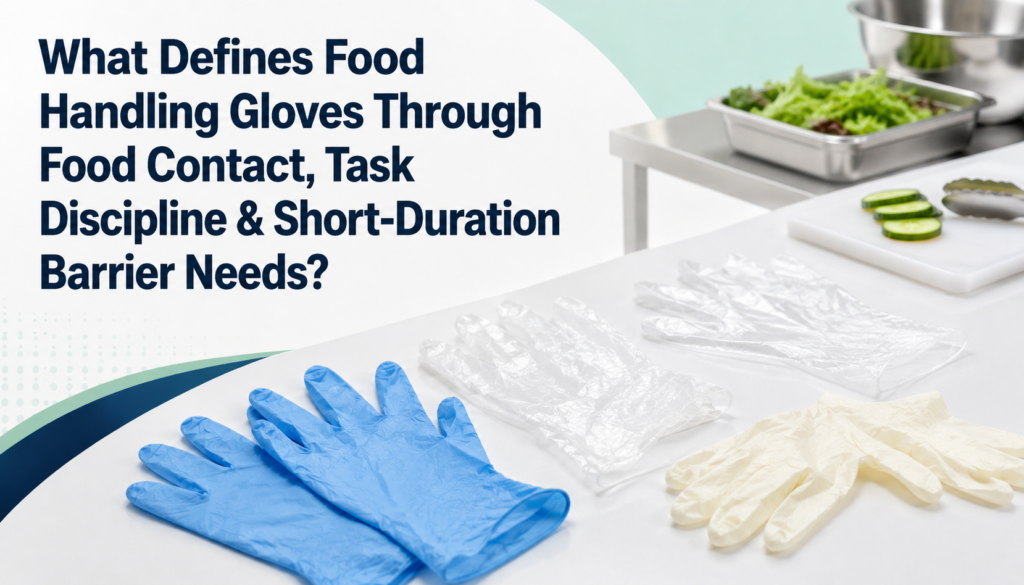
What Defines Food Handling Gloves Through Food Contact, Task Discipline & Short-Duration Barrier Needs?
Food handling gloves are defined by verified food-contact suitability, the service or processing environment, one-task discipline, material and fit, short-duration limits, and safe change-out rules. They support food-safety controls but do not replace handwashing, sanitation, safe storage, worker-health rules, or task separation.
This page explains food-service and food-processing demands, task discipline, material choices, tactile fit, color workflows, event-based change-out triggers, common failures, and final verification before use or purchase.
This article provides educational food handling glove guidance and does not replace local food codes, manufacturer food-contact declarations, workplace sanitation procedures, handwashing requirements, or professional hazard assessment. Food-contact suitability must be verified for the finished glove and intended conditions of use. Tasks involving knives, machinery, heat, steam, cold, or chemicals may require separately rated protective equipment.
What are food handling gloves, and how do they differ from general disposable or protective gloves?
Food handling gloves are gloves selected for direct or indirect food contact, hygiene workflows, contamination control, and task-specific handling requirements.
They are not automatically interchangeable with general disposable, medical, household, laboratory, or industrial gloves. The material name alone does not establish food-contact suitability, and medical-use labeling does not automatically establish suitability for a food-contact task. [FDA]
Gloves can support hygienic handling, but they do not replace handwashing, approved utensils, sanitized surfaces, safe storage, temperature controls, task separation, or worker-health procedures. A glove that looks clean may still carry contamination.
The FDA Food Code is a model code rather than identical law in every jurisdiction. When a page targets a specific country, state, municipality, or food authority, verify adoption and wording through the exact local authority source and follow the stricter applicable requirement. [FDA]
Additional cut, heat, chemical, machinery, cold, impact, or puncture hazards require separately verified protection rather than a thicker basic food-contact glove. [OSHA]
Verify the finished glove, intended food type, contact duration, temperature, and conditions of use.
Use one pair for one controlled activity and replace it before crossing foods, zones, or surfaces.
Route knives, heat, chemicals, machinery, and cold exposure to separately rated protection.
| Glove Context | Common Task | Main Barrier Role | Main Limitation | Verification Needed |
|---|---|---|---|---|
| Food-service single-use glove | Assembly, portioning, garnishing, serving, ready-to-eat handling | Supports short food contact and task separation | Limited durability and highly change-dependent | Finished-glove suitability, local rules, task change |
| Food-processing glove | Repetitive wet, cold, oily, production, ingredient, or packaging work | Supports sustained food contact, fit, grip, and workflow | May not address blades, machinery, heat, or chemicals | Processing conditions, grip, cuff, additional hazards |
| General disposable glove | Hygiene or short general-purpose task | Thin temporary barrier | Not automatically suitable for food contact | Intended-use documentation |
| Medical glove | Clinical examination or procedure context | Medical barrier support | Medical status does not establish food-task suitability | Medical and food-contact claims separately |
| Work or hazard glove | Mechanical, cut, thermal, chemical, or industrial task | Hazard-specific protection when rated | May not be suitable for direct food contact | Hazard rating plus food-contact suitability where needed |
How do food-service and food-processing gloves differ by operating environment?
Food-service and food-processing gloves differ because quick preparation and serving tasks place different demands on a glove than repetitive, wet, cold, oily, or production-line handling.
Glove requirements change with the operating environment because food-service and food-processing gloves serve different task patterns.
Food-service work prioritizes easy donning, tactile control, ready-to-eat discipline, and frequent glove changes. Food-processing work may need more secure fit, sustained grip, cuff stability, moisture control, and durability appropriate to the task.
Blades, sharp bones, machinery, heat, steam, cold, and chemicals require separate assessment because a basic food-contact glove is not final PPE approval. [OSHA]
| Environment | Common Tasks | Contact Pattern | Main Glove Need | Main Limitation | Deeper Route |
|---|---|---|---|---|---|
| Food service | Sandwiches, salads, bakery handling, garnishing, portioning, ready-to-eat service | Short and frequently changing | Easy donning, tactility, task separation, documented suitability | Low durability and strong dependence on correct replacement | Food-service-specific page when supplied |
| Food processing | Meat, seafood, produce, ingredients, packaging, production lines | Repetitive, wet, oily, cold, or longer-duration | Secure fit, sustained grip, cuff stability, durability, moisture control | Basic glove may not address machinery, blades, heat, or chemicals | Food-processing-specific page when supplied |
| Mixed environment | Preparation plus packaging or sanitation transitions | Multiple zones and task changes | Clear workflow, glove access, zone separation, frequent reassessment | High cross-task contamination risk | Facility sanitation procedure and task map |
Why does task discipline matter when using food handling gloves?
Task discipline matters because a glove can transfer contamination between foods, tools, surfaces, equipment, and zones when the same pair crosses beyond its assigned task.
Hygienic glove use depends on workflow because task-change discipline controls when one pair must stop being used.
Cross-task control also matters because clean and contaminated tasks should not share the same glove pair.
Confirm that the worker is cleared for the food task under applicable worker-health and facility rules before glove selection begins. [FDA]
Follow the handwashing and drying procedure required by the applicable code, contamination event, task transition, and facility procedure. Do not convert glove changes into one unsupported universal handwashing schedule.
Select a finished glove documented for the task, then don it without contaminating the outer food-contact surface.
Use one pair for one defined task. Stop after raw-to-ready-to-eat movement, clean-to-contaminated or contaminated-to-clean movement, contact with doors, phones, waste, controls, clothing, or cleaning tools, visible soil, damage, or interruption.
A glove that looks clean is not proof of cleanliness. Approved utensils can be used as alternatives where the applicable procedure allows or requires them. [FDA]
Remove and discard the glove safely, follow the required handwashing procedure for the event, and begin the next controlled task with a new pair. Safe workflow also depends on access to sinks, soap, gloves, and separated work areas. [CDC]
How do polyethylene, TPE, vinyl, latex, and nitrile food handling gloves differ by task?
Polyethylene, TPE, vinyl, latex, and nitrile food handling gloves differ by fit, elasticity, grip, durability, allergy concerns, and the conditions under which the finished glove is intended to contact food.
Material names require deeper verification because food-contact material risks depend on the finished glove and its documented conditions of use.
How does polyethylene fit very short food tasks?
Polyethylene may suit very short and frequently changing tasks because it is easy to don, but its loose fit, limited stretch, and lower puncture resistance restrict control.
How does TPE fit short preparation or packaging work?
TPE may provide closer fit and more flexibility than loose PE styles, but formulation, grip, and durability vary by product.
How does vinyl fit selected lower-stress tasks?
Vinyl may suit selected short and lower-stress handling, but lower elasticity can create loosening during active work.
How does latex fit tactile food handling?
Latex can provide elasticity and tactile control where workplace policy permits it, but natural-rubber latex can create allergy concerns for sensitized workers. [NIOSH]
How does nitrile fit wet or oily food handling?
Nitrile may support closer fit, texture, and durability in selected wet or oily food tasks, but it is not automatically knife-, heat-, or chemical-protective.
Product-specific suitability should be verified from the finished glove rather than generalized from the polymer name.
- Technical data sheet for the finished glove
- Food-contact declaration and intended conditions of use
- Relevant food types and food phases
- Contact duration and temperature conditions
- Single-use or repeated-use status
- Powder status where relevant
- Storage and shelf-life instructions
- Chemical compatibility information when cleaners are involved
Do not generalize one manufacturer’s declaration to every PE, TPE, vinyl, latex, or nitrile glove. [FDA]
| Material | Possible Food Task | Fit / Grip Strength | Main Limitation | Verification Question |
|---|---|---|---|---|
| Polyethylene | Very short, frequent-change preparation or service | Fast donning and low-cost task separation | Loose fit, low tactility, weak tear and puncture performance | Is the finished glove suitable for this food and contact condition? |
| TPE | Selected short preparation, service, or packaging tasks | Closer fit and flexibility than some loose PE styles | Formulation, grip, and durability vary | Does the declaration cover the intended food and conditions? |
| Vinyl | Selected lower-stress, short-duration handling | Latex-free option and easy donning | Lower elasticity and possible loosening | Does documentation cover food type, duration, moisture, fat, and temperature? |
| Latex | Tasks requiring close fit and tactile control where permitted | Elasticity and dexterity | Latex-allergy concern | Is latex permitted and supported for the food-contact task? |
| Nitrile | Selected wet, oily, raw-food, packaging, or higher-dexterity tasks | Secure fit, texture, and durability | Not automatic cut, heat, or chemical protection | Is the exact glove documented for the food, duration, and exposure? |
How should thickness, texture, and fit be evaluated for tactile food handling?
Thickness, texture, and fit should be evaluated together because tactile control can decline when a glove is too loose, too bulky, too smooth, worn, or mismatched to the actual food and utensil surface.
Fit and thickness should preserve control because tactile feedback affects pinching, plating, portioning, wrapping, and utensil handling.
Thin film may improve touch but tear sooner. Greater thickness may improve durability in selected tasks but does not prove cut, chemical, or thermal protection.
Texture may support wet or oily control, but it cannot correct poor fit, severe contamination, or the wrong material. Hot trays, steam, and burn hazards require utensils or separately rated thermal protection.
| Feature | What It May Improve | Trade-Off | Practical Test | What It Does Not Prove |
|---|---|---|---|---|
| Thinner film | Fingertip sensation and movement | May tear sooner under friction or repetitive use | Perform the real pinch, plate, wrap, or portion movement | Cut, puncture, chemical, or heat protection |
| Greater thickness | Durability in selected tasks | May reduce tactility and increase fatigue or sweat | Compare control and wear under the actual task | Automatic food-contact or chemical suitability |
| Finger texture | Control of small, wet, or smooth items | Limited benefit if fit is poor or the surface is contaminated | Handle the intended utensil, food, or packaging safely | Guaranteed grip |
| Palm texture | Larger-surface handling and grip | May wear or retain soil depending on design | Check wet or oily grip and clean-task transition | Universal processing suitability |
| Secure palm fit | Less twisting and bunching | Too-tight fit can increase strain or tearing | Close the hand and grip the actual utensil | Correct size without full fit assessment |
| Correct finger fit | Pinch and portioning control | Slack reduces control; compression causes strain | Test fingertip and thumb movement | Hazard protection |
| Cuff stability | Reduced slippage and improved workflow control | Longer cuff does not prove chemical or thermal protection | Check movement, sleeve interface, and contamination route | Forearm hazard protection |
What do glove colors signal across food preparation and processing zones?
Glove colors can support task, zone, department, material, size, or shift identification, but color alone does not prove food-contact suitability, cleanliness, or protective performance.
Facilities may assign different colors to raw protein, produce, bakery, ready-to-eat, allergen-controlled, cleaning, or packaging zones. High-contrast colors may also support fragment visibility against selected foods.
The facility must define and train the color system. Replacement still depends on contamination, task change, damage, and documented procedure.
| Facility-Defined Color | Assigned Zone or Task | Intended Visual Cue | Change Trigger | What Color Does Not Prove |
|---|---|---|---|---|
| Facility color A | Raw protein or incoming raw ingredients | Zone identification | Leaving raw zone, contamination, damage | Food-contact approval or cut protection |
| Facility color B | Ready-to-eat assembly | Clean-task visibility | Contact with raw food, waste, equipment, or non-food surface | Cleanliness by appearance |
| Facility color C | Produce or bakery | Task separation | Moving to another food phase or allergen zone | Allergen control by itself |
| Facility color D | Cleaning or sanitation | Prevent return to food handling with cleaning glove | Completion of cleaning or return to food zone | Chemical compatibility |
| High-contrast color | Foods where fragments may be easier to see | Visual inspection support | Tear, missing fragment, damage | Guaranteed fragment detection |
| Any assigned color | Department, size, material, or shift | Inventory and workflow control | Facility-defined event | Regulatory compliance |
When should food handling gloves be changed during service or processing tasks?
Food handling gloves should be changed when the assigned task ends, contamination occurs, the worker changes zones or food phases, the glove is damaged or degraded, the task is interrupted, or a stricter documented rule applies.
Replacement should follow contamination events because food-preparation glove changes matter at specific points in the workflow.
Food-contact selection must also include duration because short-use limits define when the glove is no longer appropriate for the task.
Do not apply one unsupported minute-based rule to every operation. Use event-based triggers and follow stricter manufacturer, workplace, or jurisdiction-specific requirements when they apply.
| Trigger | Contamination or Failure Risk | Immediate Action | Handwashing Requirement | Deeper Verification |
|---|---|---|---|---|
| Assigned task is complete | Glove may carry residue into the next task | Remove and discard | Follow applicable procedure before the new task | Facility workflow |
| Raw-to-ready-to-eat transition | Cross-contamination | Stop, remove, separate task, use new pair | Follow applicable code and facility requirement | Task-separation plan |
| Contact with waste, phone, door, controls, clothing, or cleaning tools | Non-food surface contamination | Remove before returning to food | Follow the contamination-event rule | Facility sanitation procedure |
| Tear, puncture, stretch, looseness, or visible soil | Barrier and handling failure | Stop and replace promptly | As required by contamination and procedure | Fit and material review |
| Task interruption | Uncontrolled contact opportunity | Discard previous pair and restart correctly | Follow restart procedure | Workflow design |
| Swelling, softening, stiffness, wrinkling, stickiness, or grip loss | Material incompatibility or degradation | Stop use and verify suitability | Clean hands as required by exposure and procedure | Manufacturer documentation |
| Stricter manufacturer or workplace limit | Product- or process-specific risk | Follow the stricter documented limit | Follow the linked workplace procedure | Exact technical source |
Why do food handling gloves fail, and how can common hygiene, grip, and comfort problems be corrected?
Food handling gloves fail when material, fit, grip, task duration, workflow, change-out discipline, or additional-hazard protection does not match the food operation.
Tearing, palm bunching, wet or oily grip loss, task crossover, skin irritation, and hazard mismatch should trigger immediate correction rather than continued use.
For itching, burning, redness, swelling, or inflammation, stop the suspected glove, dry the hands, and reassess the material, fit, wear pattern, and hygiene products. Persistent, spreading, painful, swollen, blistered, oozing, or worsening symptoms should be assessed by a qualified occupational or medical professional; this page does not diagnose allergy, dermatitis, eczema, infection, or occupational skin disease.
| Failure Signal | Likely Cause | Immediate Correction | Prevention Step | Better Owner |
|---|---|---|---|---|
| Tears during repetitive preparation | Wrong fit, low tear resistance, sharp food edge, extended wear, poor donning | Stop and replace | Reassess material, fit, duration, and cut hazard | Cut-resistant guidance if a sharp hazard exists |
| Palm bunches or glove becomes loose | Poor sizing, low elasticity, sweat, material relaxation | Replace with a more secure fit | Test actual movement and task duration | Fit tool when supplied |
| Grip fails on wet, oily, or fatty food | Smooth surface, contamination, poor fit, wrong texture or material | Stop and replace if handling is unsafe | Match texture and fit to the actual surface | Processing or material child page |
| Same gloves cross several tasks | Poor zoning, low glove availability, weak training, time pressure | Stop, discard, follow hygiene procedure | Improve glove placement, supervision, workflow, and access | Task-discipline child page |
| Hands become sweaty, itchy, red, or inflamed | Occlusion, friction, latex, accelerators, soaps, wet work, extended wear | Stop the suspected glove and dry hands | Reassess material, fit, wear time, and hygiene products | Occupational or medical guidance |
| Task involves knife, machinery, heat, steam, cold, or strong chemical | Basic glove used outside its role | Stop and use appropriate controls or PPE | Conduct additional-hazard assessment | Work, thermal, cut, or chemical owner |
Which checklist helps verify food handling glove selection before use or purchase?
A food handling glove verification checklist should confirm the environment, exact task, food phase, finished-glove suitability, material, tactile fit, hygiene workflow, replacement triggers, and any additional hazards.
- ☐ Identify whether the task belongs to food service, food processing, packaging, bakery, meat or seafood handling, produce preparation, or another food-contact workflow.
- ☐ Define the exact action: assemble, portion, plate, package, cut, wash, mix, clean, or transfer.
- ☐ Identify the food phase: raw animal food, ready-to-eat food, cooked food, produce, allergen-controlled food, wet ingredients, oily ingredients, or dry goods.
- ☐ Verify the finished glove’s food-contact declaration and intended conditions of use.
- ☐ Confirm that the material suits the required fit, grip, allergy, moisture, and duration conditions.
- ☐ Test thickness, palm stability, finger movement, cuff security, texture, and tactile control against the actual task.
- ☐ Define handwashing, one-task use, raw-to-ready-to-eat separation, sanitary removal, and prohibited-contact surfaces.
- ☐ Set event-based change triggers for task completion, contamination, damage, interruption, zone change, degradation, and stricter documented limits.
- ☐ Identify additional cut, machinery, thermal, cold, impact, or chemical hazards requiring separately verified protection.
- ☐ Route deeper decisions only to approved pages or tools whose exact URLs have been supplied.
Pre-use verification: Food handling glove selection is only one control within a wider food-safety system. Verify the finished glove, intended food-contact conditions, applicable local requirements, handwashing and sanitation procedures, task-separation plan, replacement triggers, and any additional occupational hazards before use.
Conclusion
Food handling gloves work best as verified, task-specific barriers within a wider system of hand hygiene, food separation, sanitation, fit control, and timely replacement.
They do not guarantee food safety. Local requirements, manufacturer declarations, facility procedures, and separately verified protection for cut, heat, chemical, machinery, cold, and other hazards remain controlling.
Frequently Asked Questions
Do food handling gloves replace handwashing?
Food handling gloves do not replace handwashing because hands and glove surfaces can still become contaminated during donning, use, removal, and task changes. Follow applicable local rules and facility procedures.
Are all disposable gloves suitable for food handling?
Not all disposable gloves are suitable for food handling because the finished glove and its intended conditions of use must be verified. Material name alone is not approval.
What is the difference between food-service and food-processing gloves?
Food-service gloves usually support short and frequently changing preparation or serving tasks, while food-processing gloves may require more secure fit, sustained grip, cuff stability, and durability for repetitive or wet production work.
Are blue gloves always food-safe?
Blue gloves are not automatically food-safe because color is a visual workflow feature, not proof of food-contact suitability or protective performance. Facilities may use blue or other colors for visibility, inventory, department, or zone control.
When should food handling gloves be changed?
Food handling gloves should be changed after task completion, contamination, raw-to-ready-to-eat movement, contact with non-food surfaces, damage, degradation, interruption, or a stricter documented limit.
Can food handling gloves protect against knives or hot trays?
Basic food handling gloves do not automatically protect against knives, sharp machinery, hot trays, steam, or burn hazards. Separate tools, controls, and appropriately rated protection may be required.