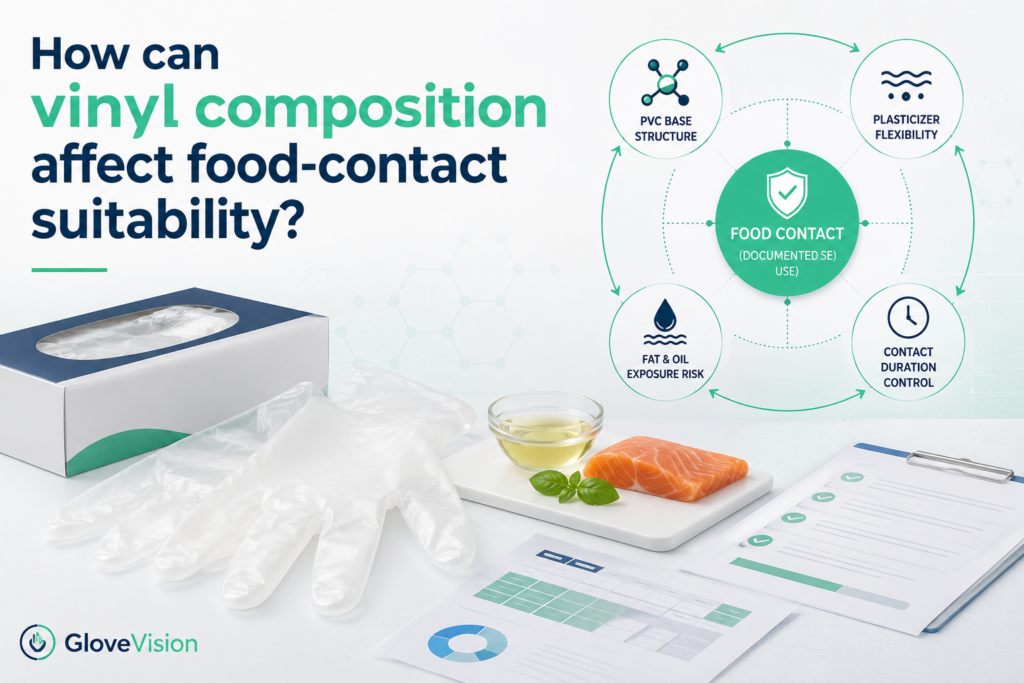
How can vinyl composition affect food-contact suitability?
Vinyl composition can affect food-contact suitability because PVC-based gloves often rely on plasticizers, and suitability depends on the finished formulation, food type, temperature, contact duration, and documentation. Vinyl Food-Contact Gloves should not be judged by the word “vinyl” alone, because PVC-based material, plasticizer use, product documentation, and local food-safety rules decide whether vinyl may be suitable for some tasks but not all tasks.
This page explains the PVC and plasticizer role, plasticizer migration concern, fatty or oily food and heat considerations, contact duration, documented formulation review, food-service handling, cross-contamination control, heat and task-stress response, and a final food-contact audit checklist.
This article provides educational guidance about Vinyl Food-Contact Gloves, PVC composition, plasticizer documentation, food-contact suitability, hygiene handling, and audit checks and does not replace product labeling, supplier documentation, migration testing, food-contact declarations, local food-safety rules, facility procedures, regulatory review, legal review, or quality assurance approval. The exact glove formulation, plasticizer declaration, food type, fat content, temperature, contact duration, glove integrity, jurisdiction, and facility policy must determine whether Vinyl Food-Contact Gloves are suitable for a specific task.
Why does plasticizer migration in Vinyl Food-Contact Gloves raise food safety concerns?
Plasticizer migration in Vinyl Food-Contact Gloves raises food safety concerns because some PVC-based glove formulations rely on plasticizers that may move under certain food-contact conditions.
Vinyl suitability belongs inside the broader category because Food Handling Gloves. Vinyl selection also sits inside the disposable category because Disposable Gloves.
What is the basic composition issue?
The basic composition issue is that Vinyl Food-Contact Gloves are commonly made from PVC-based materials that often need plasticizers to become flexible enough for disposable glove use.
Manufacturer formulation, glove thickness, intended use, food-contact documentation, local regulatory requirements, and finished product testing decide the use boundary.
Why can plasticizers migrate?
Plasticizers can migrate because many plasticizers are not permanently bonded into the PVC structure.
Migration concern depends on plasticizer type, glove formulation, food type, fat content, temperature, contact duration, glove thickness, intended-use conditions, and manufacturer testing.
Why does this matter for food-contact suitability?
This matters for food-contact suitability because a Vinyl Food-Contact Glove must be checked against documented food-contact use, plasticizer information, contact conditions, and local rules.
Food-contact suitability is not decided by the word vinyl alone because the same material family can have different use boundaries by finished formulation and documentation. [FDA FCS] [FDA Vinyl] [21 CFR 177.1950]
What should the article avoid saying?
The article should avoid saying that all Vinyl Food-Contact Gloves have the same plasticizer level, the same migration behavior, or the same food-contact suitability.
It should also avoid saying all vinyl gloves are unsafe, all vinyl gloves are food-safe, or vinyl is suitable for fatty foods, hot foods, or prolonged contact without product documentation.
| Material Factor | Why It Matters | Food-Contact Concern | Documentation Needed | Safe Wording Rule |
|---|---|---|---|---|
| PVC base | Vinyl needs a flexible finished formulation. | PVC identity alone does not prove food suitability. | Product spec sheet and food-contact statement. | Say documented PVC-based glove, not vinyl is food-safe. |
| Plasticizer type | Plasticizer choice affects flexibility and migration behavior. | Different plasticizers may have different limits. | Plasticizer declaration where required. | Say manufacturer-declared, not assumed. |
| Fat/oil contact | Fatty foods may increase migration concern. | Oils, cheese, fatty meats, cream foods need support. | Food type and migration documentation where applicable. | Say supported only with documentation. |
| Temperature | Heat may affect softening or migration. | Hot foods, steam, or pans may be unsupported. | Temperature/use-condition documentation. | Avoid heat claims without support. |
| Contact duration | Longer contact increases documentation importance. | Prolonged contact may exceed intended use. | Intended-use and duration support. | Match glove to documented duration. |
| Local rules | Jurisdiction controls compliance. | FDA, EU, and local rules may differ. | Supplier/importer conformity documents. | Do not generalize one jurisdiction globally. |
This matrix is a suitability screen, not a compliance approval, safety score, or vinyl product ranking.
How do food type and contact conditions affect Vinyl Food-Contact Gloves suitability?
Food type and contact conditions affect Vinyl Food-Contact Gloves suitability because fat content, oil exposure, heat, and duration can change whether a documented vinyl formulation is appropriate.
Retail and restaurant glove use needs task discipline because Food Service Gloves. Longer production tasks need different checks because Food Processing Gloves.
Why do fatty or oily foods matter?
Fatty or oily foods matter because they may increase migration concerns for some plasticized vinyl formulations.
Examples include oils, butter, fatty meats, cheese, cream-based foods, and oily prepared foods, but documentation must support the actual food type and condition.
Why does contact duration matter?
Contact duration matters because longer glove-to-food contact increases the importance of product documentation and intended-use conditions.
Vinyl Food-Contact Gloves should be matched to food type and contact duration, and even short-duration use should remain supported by product labeling and local food-safety rules.
Why does temperature matter?
Temperature matters because warm or hot conditions may increase material-softening or migration concerns for some vinyl formulations.
Hot food, steam, hot pans, or high-temperature handling should be avoided unless product documentation supports that use. [21 CFR 178.3740]
How should vinyl suitability be decided?
Vinyl suitability should be decided by checking product labeling, food-contact documentation, plasticizer declaration, food type, contact duration, temperature conditions, local regulations, and supplier documentation.
A supplier claim is not enough when the actual task involves fatty food, hot contact, prolonged contact, high tear risk, or unclear jurisdictional requirements.
When should alternatives be considered?
Alternatives should be considered when vinyl documentation does not support fatty-food contact, oily-food contact, hot-food contact, prolonged direct food contact, high-tear-risk tasks, or cleaning chemical exposure.
Cleaning-agent contact should not be treated as normal food contact because Cleaning Gloves.
| Food / Condition | Contact Duration | Temperature | Documentation Needed | Alternative If Unsupported |
|---|---|---|---|---|
| Dry foods | Short task contact | Room temperature | Food-contact statement and task-use support. | Utensil or documented glove if duration changes. |
| Aqueous / low-fat foods | Short to defined duration | Room or supported temp | Food type and contact-duration support. | Documented alternative if prolonged. |
| Fatty foods | Any direct contact needs review | Room or supported temp | Fatty-food support and migration docs where applicable. | Documented glove, utensil, or system. |
| Oily prepared foods | Direct contact needs review | Room or supported temp | Oily-food support and product conditions. | Documented alternative or utensil. |
| Hot food / steam | Any contact | Warm/hot/high temp | Temperature-specific documentation. | Heat-supported utensil, tong, scoop, or glove. |
| High-tear task | Repeated handling | Variable | Integrity and task-use support. | Stronger documented glove or system. |
Alternatives still require documentation for the task; they are not automatically better just because vinyl is unsupported.
Which documented formulations distinguish Vinyl Food-Contact Gloves from industrial-grade alternatives?
Documented formulations distinguish Vinyl Food-Contact Gloves from industrial-grade alternatives by showing that the exact product is intended for food contact under defined use conditions.
What does documented formulation mean?
Documented formulation means the supplier or manufacturer provides product information showing that the Vinyl Food-Contact Glove is intended for food-contact use under defined conditions.
This may include a food-contact statement, product specification sheet, plasticizer declaration, phthalate declaration, Declaration of Compliance where applicable, migration information where required, intended-use conditions, and lot or product identification.
How should phthalate-free claims be handled?
Phthalate-free claims should be handled as manufacturer-declared or supplier-documented claims, not assumed properties of every Vinyl Food-Contact Glove.
Use careful wording such as manufacturer-declared phthalate-free, supplier-documented phthalate-free, non-phthalate plasticizer formulation, and supported by product documentation. [FDA Phthalates]
How should non-phthalate plasticizers be discussed?
Non-phthalate plasticizers should be discussed as alternative formulations that still require finished-product food-contact documentation and use-condition review.
DOTP/DEHT, DINCH, adipates, or other alternatives should not be described as automatically safe because suitability still depends on formulation, migration limits where applicable, food type, temperature, contact duration, and jurisdiction.
How should regulatory compliance be framed?
Regulatory compliance should be framed as product-specific, jurisdiction-specific, and use-condition-specific.
FDA, EU, and local rules may differ, so one jurisdiction does not prove global suitability, and EU plastic food-contact rules may require Declaration of Compliance and migration context for EU-market products. [EU 10/2011] [EU 1935/2004] [EU 2023/2006]
What should managers request before procurement?
Managers should request the product specification sheet, food-contact statement, plasticizer or phthalate declaration where relevant, migration documentation where applicable, intended-use conditions, supplier conformity documents, and lot or product identification before procurement.
Products with unclear documentation should be rejected or held until the supplier provides documentation that matches the food type, temperature, duration, jurisdiction, and facility policy.
Start with product labeling, a specification sheet, or supplier statement showing intended food-contact use.
Check whether the documentation covers dry, aqueous, acidic, fatty, oily, raw, or ready-to-eat foods.
Request plasticizer and phthalate declarations where needed; do not assume phthalate-free status.
Verify contact duration, temperature, glove thickness, and intended handling task.
Match FDA, EU, local, supplier, and importer documents to the actual market and use.
Use only documented products; reject unclear industrial or non-food vinyl for food handling.
Keep product identity, lot information, declarations, and supplier documents for audit review.
How should food-service operations handle disposable Vinyl Food-Contact Gloves to help manage cross-contamination risks?
Food-service operations should handle disposable Vinyl Food-Contact Gloves through hand hygiene, clean access, food-task matching, glove-change discipline, hygienic removal, and post-removal hygiene.
Step 1: Pre-donning hand hygiene
Pre-donning hand hygiene should happen before glove use when the food-safety procedure requires it, because gloves do not replace clean hands.
Food Code principles support clean hands, safe glove use, and ready-to-eat food protection, but local adoption and facility procedure still control implementation. [FDA Food Code] [Food Code PDF]
Step 2: Clean glove access
Clean glove access means Vinyl Food-Contact Gloves should be stored and dispensed in a way that prevents contamination before use.
Workers should avoid touching multiple gloves, contaminated dispensers, raw-food surfaces, or non-food surfaces during glove selection.
Step 3: Food-task matching
Food-task matching means the chosen Vinyl Food-Contact Gloves should be used only for the food type, contact duration, temperature, and handling task supported by documentation.
Testing or chemical review is a different context because Laboratory Gloves.
Step 4: Glove-change discipline
Glove-change discipline means gloves should be changed when switching tasks, moving from raw to ready-to-eat foods, touching non-food surfaces, tearing, soiling, softening, contamination, or leaving and returning to a food-prep station.
Wearing gloves alone does not prevent cross-contamination when one pair is used across multiple food zones. [FDA Retail]
Step 5: Hygienic glove removal
Hygienic glove removal means workers should remove gloves without transferring contamination from the exterior glove surface to hands, food, utensils, or food-contact surfaces.
Softened, torn, contaminated, or visibly degraded vinyl gloves should be discarded rather than reused or continued.
Step 6: Hand hygiene reminder
Hand hygiene remains necessary after glove removal when procedure requires it because gloves can contaminate hands during removal or fail during use.
Food-contact glove policies should pair glove use with handwashing, task changes, clean utensils, and facility procedures rather than treating gloves as a complete barrier system.
- ☐Wash and dry hands as procedure requires.
- ☐Access gloves from clean storage.
- ☐Match glove use to documented food type.
- ☐Change gloves between raw and ready-to-eat tasks.
- ☐Change gloves after touching non-food surfaces.
- ☐Discard torn, soiled, softened, or contaminated gloves.
- ☐Remove gloves hygienically.
- ☐Perform hand hygiene after removal when required.
- ☐Do not reuse disposable vinyl gloves.
- ☐Use utensils or another system when glove use is unsupported.
Why can heat and task stress compromise protective Vinyl Food-Contact Gloves?
Heat and task stress can compromise protective Vinyl Food-Contact Gloves because PVC-based vinyl may soften, tear, stretch, puncture, leak, or degrade when the task exceeds the documented use conditions.
How can heat affect Vinyl Food-Contact Gloves?
Heat can affect Vinyl Food-Contact Gloves by increasing softening or migration concerns for some formulations.
Warm food, hot food, steam, hot pans, and high-temperature handling should be avoided unless the product documentation supports the temperature and contact condition.
How can task stress affect Vinyl Food-Contact Gloves?
Task stress can affect Vinyl Food-Contact Gloves by increasing tear, puncture, leakage, stretching, and barrier compromise risk.
Repeated gripping, sharp food edges, long wear, pulling, poor sizing, and wet handling can change whether vinyl is suitable for the task.
What should workers do if gloves soften, tear, or degrade?
Workers should remove and discard Vinyl Food-Contact Gloves if they soften, tear, puncture, leak, become contaminated, or show visible degradation.
The task should pause long enough to perform the facility’s food-safety procedure, assess food-contact contamination, and replace the glove or handling system.
When should vinyl be replaced with another system?
Vinyl should be replaced with another system when documentation does not support the food type, heat, contact duration, tear stress, or cleaning chemical exposure.
Chemical resistance should not rely on vinyl material name because Chemical Gloves.
Which audit checklist helps verify that Vinyl Food-Contact Gloves meet food-contact standards?
A Vinyl Food-Contact Gloves audit checklist helps managers verify documentation, food type, fat/oil exposure, contact duration, temperature, glove integrity, hygiene, cross-contamination controls, and record retention.
Food-contact audit checklist for Vinyl Food-Contact Gloves
Food-contact audit readiness depends on matching the exact glove product to the intended food, handling condition, local rules, documentation, and facility procedure.
A completed checklist does not approve the glove legally; it helps managers decide whether documentation is complete enough for quality, procurement, or regulatory review.
- ☐Product identity and lot information recorded.
- ☐Food-contact statement obtained.
- ☐Plasticizer/phthalate declaration reviewed where relevant.
- ☐Food type and fat/oil exposure checked.
- ☐Contact duration documented.
- ☐Temperature condition supported.
- ☐Migration documentation reviewed where applicable.
- ☐Glove integrity under task stress checked.
- ☐Hand hygiene and glove-change procedure confirmed.
- ☐Alternative glove, utensil, or handling system ready.
- ☐Local food-safety rules reviewed.
- ☐Supplier documents retained for audit.
Conclusion
Vinyl Food-Contact Gloves can be suitable for some food-handling tasks only when the finished PVC formulation, plasticizer documentation, intended food type, temperature, contact duration, glove integrity, and local food-safety requirements support that use.
Unsupported fatty-food, oily-food, hot-food, prolonged-contact, high-tear-risk, chemical-exposure, or unclear-documentation tasks should use a documented alternative glove, utensil, tong, scoop, barrier, or handling system. Gloves do not replace handwashing, hygienic glove removal, glove-change discipline, food-contact documentation, supplier verification, migration testing where applicable, local rules, or facility food-safety procedures.
Frequently Asked Questions
Are all Vinyl Food-Contact Gloves suitable for food handling?
No. Vinyl Food-Contact Gloves are suitable for food handling only when the exact product documentation, food type, contact duration, temperature, glove integrity, and local food-safety rules support that use.
Why do plasticizers matter in Vinyl Food-Contact Gloves?
Plasticizers matter because PVC-based vinyl often needs plasticizers for flexibility, and plasticizer behavior can depend on formulation, food type, fat content, temperature, contact duration, and documentation.
Are phthalate-free vinyl gloves automatically safe for food contact?
No. Phthalate-free wording is not an automatic food-contact approval because the finished formulation, non-phthalate plasticizer, migration documentation where applicable, intended food type, and jurisdiction still matter.
Can Vinyl Food-Contact Gloves be used with fatty or oily foods?
Vinyl Food-Contact Gloves can be used with fatty or oily foods only when product documentation supports that food type and contact condition; unsupported use should route to a documented alternative or utensil.
Can Vinyl Food-Contact Gloves be used with hot food?
Vinyl Food-Contact Gloves should not be used with hot food, steam, hot pans, or high-temperature handling unless temperature-specific product documentation supports that use.
Do Vinyl Food-Contact Gloves prevent cross-contamination by themselves?
No. Vinyl Food-Contact Gloves do not prevent cross-contamination by themselves; workers still need hand hygiene, task matching, glove-change discipline, hygienic removal, and facility food-safety procedure.