
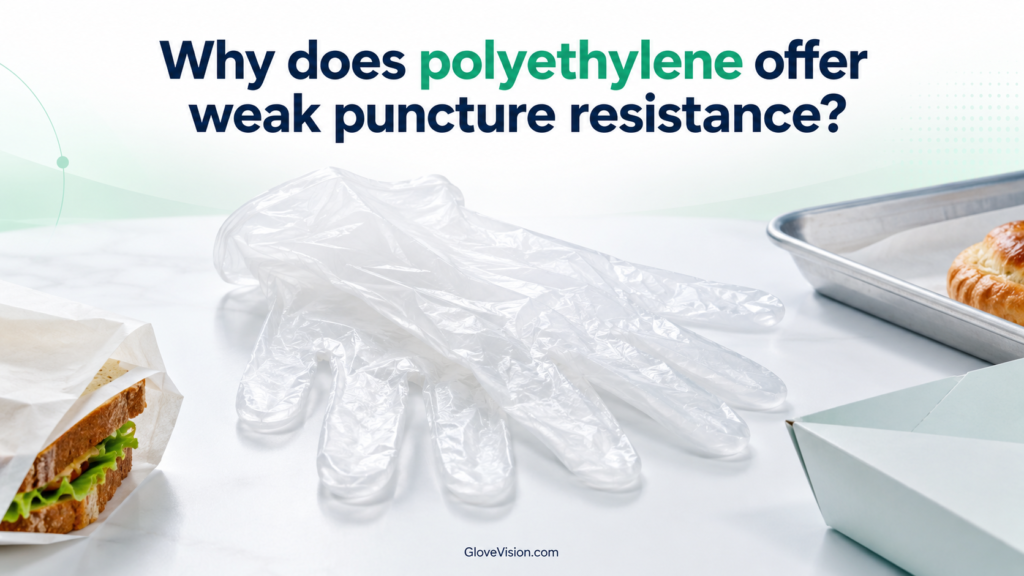
Why does polyethylene offer weak puncture resistance?
Polyethylene often offers weak puncture resistance in disposable gloves because many Polyethylene Gloves are thin, loose-fitting, low-elasticity thermoplastic film products designed for short-contact, low-stress tasks. Polyethylene Gloves behave differently from elastomer gloves because thin film structure, low elasticity, loose fit, seam design, sharp edges, and task stress can affect integrity; they may be useful for some food-service and light-duty tasks, but they are not puncture-proof, cut-resistant, heat-resistant, chemical-resistant, or medical-grade by default.
This page explains film structure and puncture limits, comparison with nitrile and vinyl alternatives, food-service task suitability, hand hygiene and glove-change discipline, tear and heat-stress response, and a procurement and verification checklist for documented Polyethylene Gloves.
This article provides educational guidance about Polyethylene Gloves, puncture limits, food-contact task suitability, glove-change discipline, hand hygiene, and failure response and does not replace product labeling, supplier documentation, food-contact documentation, facility food-safety procedure, local food-safety rules, quality assurance review, procurement review, or regulatory approval. The exact glove product, food-contact documentation, film thickness, task stress, food type, temperature, contact duration, fit, glove integrity, and facility policy must determine whether Polyethylene Gloves are suitable for a specific task.
Why do standard Polyethylene Gloves have limited puncture and tear resistance?
Standard Polyethylene Gloves have limited puncture and tear resistance because many are thin thermoplastic film gloves with loose fit, low elasticity, and light-duty design.
Polyethylene selection also sits inside the disposable category because Disposable Gloves differ by material choice, thickness, color signals, and short-use limits.
What makes Polyethylene Gloves different from elastomer gloves?
Polyethylene Gloves are different from elastomer gloves because they are usually made from thin thermoplastic film rather than elastic, cross-linked rubber-like materials.
Many Polyethylene Gloves are lightweight, easy to don, and loose-fitting, which can support fast food-service changes but can reduce stretch, close hand control, and resistance to puncture or tearing under stress. This does not mean every elastomer glove is automatically stronger for every task; it means the exact glove and task must control the comparison.
Why does film structure matter?
Film structure matters because Polyethylene Gloves work as simple barrier films whose integrity depends on thickness, polymer grade, manufacturing method, seam design, fit, and task stress.
A thin Polyethylene Glove may separate the hand from a supported food task, but the same glove can be stressed by sharp edges, repeated pulling, tight gripping, or poor sizing. Film thickness and tear information should come from product documentation, not from assumed material behavior.
Why can punctures and tears happen more easily?
Punctures and tears can happen more easily when Polyethylene Gloves contact sharp, abrasive, high-stress, or poorly matched task conditions.
Bone fragments, packaging corners, sharp food edges, rough surfaces, repeated pulling, tight gripping, long wear time, poor glove sizing, and tasks beyond product intended use can turn a simple barrier film into a compromised Polyethylene Glove.
What should the article avoid saying?
The article should avoid saying that all Polyethylene Gloves have the same strength, fail at the same force, or provide medical, cut, puncture, heat, or chemical protection.
It should also avoid saying that Polyethylene Gloves are unsafe for all food handling or suitable for all food handling. Food-contact use depends on product labeling, supplier documentation, intended food type, use conditions, local rules, and facility policy.
Low cost and product color should not be used as proof of task suitability or food-contact status; the decision still depends on product labeling, documentation, task stress, and facility policy.
What is the safer explanation?
The safer explanation is that many disposable Polyethylene Gloves have limited puncture and tear resistance because they are usually thin, loose-fitting, low-elasticity films intended for short-duration, low-stress tasks.
Performance must be checked against the exact glove, task, contact duration, food type, temperature, fit, integrity history, and product documentation. That wording protects the reader from both over-warning and over-approving Polyethylene Gloves.
How should Polyethylene Gloves be compared with nitrile or vinyl alternatives for barrier suitability?
Polyethylene Gloves should be compared with nitrile or vinyl alternatives by task risk, fit, film thickness, contact duration, temperature exposure, food-contact documentation, and intended use—not by AQL as a puncture-strength score.
Polyethylene use belongs inside the broader food-contact category because Food Handling Gloves focus on food contact, task discipline, and short-duration barrier needs. Food-contact substance and use-condition context should still be read through the exact product and documented use conditions. [FDA][eCFR]
How do Polyethylene Gloves compare with nitrile gloves?
Polyethylene Gloves generally fit low-stress, short-contact tasks, while nitrile gloves may offer better elasticity, fit, and durability for some tasks depending on the specific product.
Polyethylene Gloves often prioritize fast changes and simple barrier separation. Nitrile may be better for some higher-stress tasks, but nitrile is not automatically best for every food, temperature, chemical, or facility workflow; product labeling and task requirements control selection.
How do Polyethylene Gloves compare with vinyl gloves?
Polyethylene Gloves and vinyl gloves should both be matched to food type, contact duration, temperature, fit need, tear risk, glove-change frequency, product labeling, and local food-safety policy.
The better choice depends on the documented food type and use condition, not on material name alone. [FDA] Polyethylene fat and oil concerns should not be framed as identical to vinyl plasticizer migration; the practical checks are grip, fit, tearing, contact duration, and documented food-contact support.
Why should AQL not be used as a puncture-strength comparison?
AQL should not be used as a puncture-strength comparison because AQL is sampling or leak-quality information in specific glove categories, not a puncture-resistance rating.
In the medical glove context, AQL is tied to sampling plans and leakage defects for patient examination gloves and surgeons’ gloves. [eCFR] It should not be used to claim that Polyethylene Gloves, nitrile gloves, or vinyl gloves are mechanically stronger, and it does not prove tear resistance, cut resistance, heat resistance, chemical resistance, food-contact suitability, or task suitability.
What should be used instead of AQL for task suitability?
Task suitability should be verified through product labeling, food-contact documentation, film thickness, intended use, contact duration, fit, expected stress, temperature exposure, and facility approval.
For a documented Polyethylene Glove, the stronger verification path is product specification sheet, supplier documentation, food-contact declaration, intended food type, temperature condition, change-out rule, and a facility-approved product list.
| Material Feature | Possible Benefit | Main Limit | Higher-Risk Task Concern | Verification Needed |
|---|---|---|---|---|
| Thin PE film | Lightweight, low-cost, easy to change | Lower puncture and tear tolerance | Sharp edges, packaging corners, bones | Film thickness, intended use, supplier data |
| Loose fit | Fast donning and removal | Slippage and reduced control | Grip or precision handling | Size, style, and task control |
| Low elasticity | Simple short-contact barrier | Stretching can stress seams or film | Pulling, gripping, repeated movement | Task stress and integrity monitoring |
| Simple barrier design | Useful for low-stress separation | Not cut, puncture, heat, or chemical protection | Abrasion, hot surfaces, chemicals | Product labeling and task documentation |
| Food-contact use | May support selected food tasks | Not universal across foods or conditions | Wet/oily foods, long contact, heat | Food-contact documentation and facility policy |
| AQL comparison | May appear in medical glove contexts | Not puncture strength | Misleading mechanical ranking | Use product data, not AQL |
Use this matrix as a screening tool, not as a universal material ranking or puncture score.
Which food-handling tasks are appropriate for disposable Polyethylene Gloves based on material limits?
Disposable Polyethylene Gloves are most appropriate for short-duration, low-stress food-handling tasks when product documentation and facility policy support the use.
Retail and restaurant glove use needs quick task discipline because Food Service Gloves are shaped by short contact, fast changes, and quick fit.
Longer production tasks need different checks because Food Processing Gloves depend on wet handling, barrier build, and duration fit.
When may disposable Polyethylene Gloves be suitable?
Disposable Polyethylene Gloves may be suitable for short-duration, low-stress food-handling tasks when the product is documented for food contact and facility policy supports the use.
Examples may include sandwich assembly, bakery item portioning, simple plating, ready-to-eat food handling, deli counter tasks, short-contact serving, and low-stress ingredient handling, but those uses are not automatically approved without product documentation and local procedure support.
When should Polyethylene Gloves be used carefully?
Polyethylene Gloves should be used carefully when wet foods, oily foods, fatty foods, sharp food edges, repeated stretching, long contact, tight gripping, frequent task switching, or warm surfaces are involved.
These conditions do not automatically prohibit Polyethylene Gloves, but they require documentation, task review, glove integrity monitoring, and an alternative trigger if repeated failure occurs.
What about fat and oil contact?
Fat and oil contact should be handled by checking whether the Polyethylene Gloves are documented for the food type and whether grip, fit, tear resistance, and contact duration remain acceptable.
Unlike vinyl, Polyethylene Gloves are not usually discussed mainly as a plasticizer-migration problem. The practical food-contact question is whether the glove product is documented for the food type and intended use condition. [FDA] The remaining task checks are whether the glove loses grip or fit, whether it tears or stretches, whether contact duration is supported, and whether facility policy allows the use.
What about temperature exposure?
Temperature exposure should be avoided when Polyethylene Gloves would contact steam, hot pans, hot surfaces, or high-temperature food unless product documentation supports that use.
If heat exposure is expected, use a documented glove, utensil, tong, scoop, barrier, or handling system suitable for the temperature and task. The safer wording is not “all PE fails in heat” or “heat use is safe”; the safer wording is that temperature support must be documented for the exact product and use condition.
| Task Type | Likely Suitability | Main Risk | Documentation Needed | Alternative Needed If Unsupported |
|---|---|---|---|---|
| Sandwich assembly | Often suitable when short-contact and low-stress | Tearing from sharp edges or repeated pulling | Food-contact statement and task support | Better-fitting glove or utensil |
| Bakery portioning | Often suitable for dry, low-stress handling | Slippage or contamination from task changes | Food type and intended use | Utensil, tong, or documented glove |
| Deli / serving tasks | May suit quick changes and simple separation | Raw/RTE switching or soiling | Facility glove-change policy | New gloves or handling tool |
| Wet / oily foods | Use carefully | Grip loss, slippage, tearing | Food type and duration support | Alternative documented glove/system |
| Sharp-edge foods / packaging | Use carefully or avoid if failure repeats | Puncture, tear, seam split | Task stress review | Stronger food-contact glove or utensil |
| Warm / hot tasks | Avoid unless documented | Softening or integrity loss | Temperature support | Heat-suitable utensil, tong, scoop, or glove |
This table screens task fit; it does not approve any finished glove without documentation and facility policy support.
How should operations use protective Polyethylene Gloves to manage cross-contamination risks?
Operations should use protective Polyethylene Gloves to manage cross-contamination risks by combining hand hygiene, clean glove access, task matching, disciplined change-outs, hygienic removal, and post-removal hand hygiene.
The FDA Food Code is model guidance for retail and food-service settings, so local adoption and facility procedure still control implementation. [FDA]
Step 1: Pre-donning hand hygiene
Pre-donning hand hygiene means workers wash and dry hands before food handling or before donning Polyethylene Gloves when food-safety procedure requires it.
Hands should be scrubbed with soap and water for at least 20 seconds when handwashing is required, then dried before a worker removes gloves from the dispenser. [CDC]
Step 2: Clean glove access
Clean glove access means workers take Polyethylene Gloves from the dispenser without contaminating the glove surface or touching unnecessary gloves.
Glove boxes should be stored away from splash, food debris, raw-food zones, and chemical contamination so a clean glove does not become contaminated before use.
Step 3: Task-based glove use
Task-based glove use means Polyethylene Gloves are used only for tasks supported by product documentation and facility policy.
The same gloves should not continue across incompatible tasks. Food type, task duration, task stress, and station movement should decide whether the worker changes gloves or switches to a documented alternative.
Step 4: Change-out discipline
Change-out discipline means Polyethylene Gloves are replaced when the task, food zone, contamination status, fit, or glove integrity changes.
Workers should change gloves after raw-to-ready-to-eat transitions, task changes, non-food surface contact, soiling, tearing, splitting, leaking, fit loss, leaving/returning to station, or any condition named by the facility procedure.
Step 5: Hygienic glove removal
Hygienic glove removal means workers remove Polyethylene Gloves without transferring contamination from the glove surface to hands, food, utensils, or food-contact surfaces.
The removed glove should be discarded immediately, and workers should avoid touching clean items with a hand or glove that may have contacted contaminated surfaces.
Step 6: Post-removal hand hygiene
Post-removal hand hygiene means workers follow facility handwashing or hand-cleaning procedure after removing gloves when contamination, task switching, or food-safety rules require it.
Gloves do not replace hand hygiene, and wearing Polyethylene Gloves does not prevent cross-contamination by itself. The control system is hand hygiene, glove change discipline, clean access, task separation, and facility procedure working together.
Start with required hand hygiene before food handling or glove donning.
Use protected dispensers and avoid touching extra gloves.
Use Polyethylene Gloves only where documentation and policy support the task.
Replace after task changes, contamination, soiling, tears, leaks, or fit loss.
Discard gloves without transferring contamination to hands, food, or surfaces.
Follow post-removal hand hygiene before the next supported task.
The workflow controls use behavior; it does not make a weak or unsupported glove mechanically suitable.
What corrective actions address barrier failures or tears in light-duty Polyethylene Gloves?
Corrective actions for barrier failures or tears in light-duty Polyethylene Gloves should stop the task safely, remove the compromised glove, perform hand hygiene, assess contamination risk, and switch to a suitable documented glove or handling system when needed.
Cleaning-agent contact should not be treated as ordinary food handling because Cleaning Gloves are shaped by household chemical exposure, lining, reuse care, and task fit.
Chemical resistance should not rely on polyethylene material name because Chemical-Resistant Lab Gloves require material matching and handling-fit verification.
What should happen after a tear or puncture?
After a tear or puncture, the worker should stop the task safely, remove the compromised Polyethylene Glove, discard it, perform required hand hygiene, and replace it before continuing a supported task.
Food, utensils, or food-contact surfaces touched after the failure should be assessed under facility contamination procedure. Torn, split, leaking, or visibly compromised Polyethylene Gloves should not continue being used.
What should happen after contact with sharp food edges or packaging?
After contact with sharp food edges or packaging, the glove should be inspected and replaced if puncture, tearing, stretching, seam stress, or uncertainty appears.
If sharp-edge damage repeats, the task likely exceeds a standard Polyethylene Glove’s intended light-duty design and should move to a documented stronger glove, utensil, tong, scoop, barrier, or handling system.
What should happen after heat-related softening?
After heat-related softening, sticking, deformation, or integrity loss, the Polyethylene Gloves should be removed and the task should stop until a temperature-suitable documented system is used.
Steam, hot pans, hot surfaces, and high-temperature food contact should not be treated as ordinary room-temperature food handling unless the exact product documentation supports that condition.
What should happen after poor fit or repeated slippage?
After poor fit or repeated slippage, the operation should switch size, style, glove type, utensil, or handling method instead of forcing a loose Polyethylene Glove into a precision or grip-heavy task.
Loose fit can reduce control, increase hand movement inside the glove, increase bunching, and raise contamination or tearing concern during repeated handling.
How can repeat failures be prevented?
Repeat failures can be prevented by tracking the task, glove product, food type, temperature, contact duration, fit issue, tear point, and handling stress that caused the failure.
Testing or chemical review is a different context because Laboratory Gloves depend on chemical contact duration, material resistance, and bio-containment boundaries. Procurement and QA teams should use supplier documentation, facility observations, and product identity records instead of assuming all Polyethylene Gloves behave the same way.
| Failure Scenario | Immediate Correction | Contamination Check | Prevention |
|---|---|---|---|
| Tear or puncture | Stop, discard, wash as required, replace | Assess food and contact surfaces | Use supported task limits and monitor integrity |
| Seam split | Remove glove and switch product if repeated | Check contact after split | Review fit, pulling, and seam stress |
| Sharp-edge damage | Replace glove or use utensil/barrier | Inspect food path and tools | Use stronger documented option if recurring |
| Heat softening | Stop heat task and discard glove | Assess food and surfaces touched | Use temperature-suitable tool or glove |
| Slippage or poor fit | Change size, style, or handling method | Check whether control was lost | Match glove fit to task precision |
| Repeated failure | Remove product from that task | Escalate under facility procedure | Document product, task, stress, and replacement choice |
The correction rule is simple: do not keep using compromised Polyethylene Gloves.
Which compliance checklist verifies that Polyethylene Gloves meet food-contact and task-suitability requirements?
A Polyethylene Gloves compliance checklist verifies food-contact and task suitability by checking documentation, local regulatory authority expectations, jurisdiction, lot or product identifier, task stress, tear risk, food type, temperature, fit, glove changes, hand hygiene, and documentation retention.
A completed checklist supports internal review, but it does not replace regulatory review, local regulatory authority guidance, supplier documentation, product testing, facility procedure, or quality approval.
Polyethylene Gloves food-contact and integrity checklist
Polyethylene Gloves food-contact and integrity checklist work should confirm that the exact glove, exact food task, and exact use condition are documented before the product is placed into routine use.
The checklist should be repeated when the supplier changes, lot or product identifier changes, documentation is unclear, a supplier document becomes outdated, task changes, food type changes, temperature exposure changes, or repeated glove failure appears.
Record supplier, product name, lot or product identifier, and glove material.
Confirm documentation supports the intended food-contact use.
Check local regulatory authority expectations, local rules, and facility-approved product status.
Screen sharp edges, pulling, gripping, duration, and repetition.
Review wet, oily, fatty, raw, and ready-to-eat task conditions.
Avoid warm or hot exposure unless documentation supports it.
Verify slippage, bunching, sizing, and handling precision.
Define task, contamination, tear, leak, and station-change triggers.
Integrate pre-use and post-removal hygiene with facility procedure.
Keep documentation retention, approvals, failures, and replacement decisions traceable.
This checklist verifies readiness for review; it does not create legal approval or mechanical protection claims.
Conclusion
Polyethylene offers weak puncture resistance in many disposable gloves because thin film structure, loose fit, low elasticity, seam design, and task stress can limit mechanical integrity. Polyethylene Gloves may still fit short-duration, low-stress food-service tasks when documentation supports the use, but nitrile or vinyl alternatives should be compared by task fit, product data, contact duration, temperature, and documentation rather than by AQL as a puncture-strength score.
Polyethylene Gloves are not puncture-proof, cut-resistant, heat-resistant, chemical-resistant, medical-grade, or universally food-suitable. Food-contact use depends on exact product documentation, food type, contact duration, temperature, fit, glove integrity, and facility policy, and torn, split, leaking, softened, contaminated, or unsupported Polyethylene Gloves should be replaced or substituted with a documented glove, utensil, or handling system.
Frequently Asked Questions
Why do Polyethylene Gloves have weak puncture resistance?
Polyethylene Gloves often have weak puncture resistance because many are thin, loose-fitting thermoplastic film gloves designed for short-contact, low-stress tasks rather than sharp, abrasive, high-stress, medical, chemical, or heat-protective use.
Are Polyethylene Gloves suitable for food handling?
Polyethylene Gloves may be suitable for some short-duration, low-stress food-handling tasks when the exact product is documented for food contact and facility policy supports the use.
Are Polyethylene Gloves better than nitrile gloves?
No. Polyethylene Gloves are not generally better than nitrile gloves; polyethylene may fit fast, low-stress food-service tasks, while nitrile may provide better fit, elasticity, or durability for some tasks depending on the product.
Can AQL compare Polyethylene Gloves with nitrile or vinyl gloves?
No. AQL should not be used as a puncture-strength comparison because it is sampling or leak-quality information in specific glove categories, not a mechanical-strength rating.
When should Polyethylene Gloves be changed?
Polyethylene Gloves should be changed after contamination, task changes, raw-to-ready-to-eat transitions, non-food contact, soiling, tearing, splitting, leaking, fit loss, or leaving and returning to a food station.
Can Polyethylene Gloves be used with hot food?
Polyethylene Gloves should be used with hot food only when the exact product documentation supports that temperature and contact condition; otherwise, use a documented glove, utensil, tong, scoop, barrier, or handling system.