
Why is leather unsafe with liquid chemicals?

Ordinary leather work gloves should not be relied upon for direct contact with hazardous liquid chemicals unless the exact finished glove has suitable chemical-protection evidence. Leather may absorb or retain liquids, and an ordinary work-glove construction does not establish resistance to chemical penetration, permeation or degradation. Mechanical toughness is not proof of chemical safety. This […]
Where does leather resistance become unsafe?
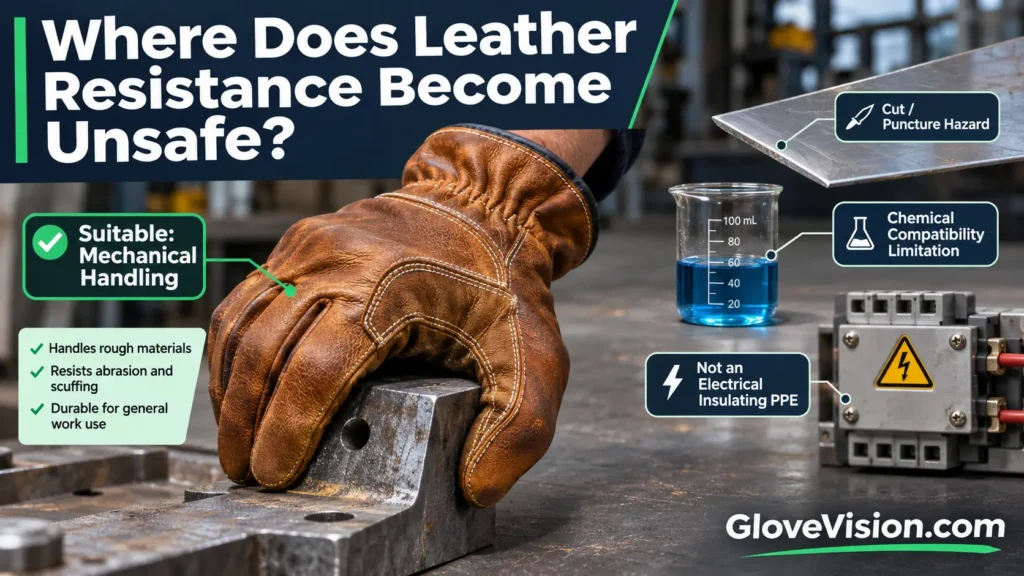
Leather glove resistance becomes unsafe when workplace hazards exceed the verified protective capability of the finished glove, when damage or contamination compromises its function, or when glove use creates an additional risk around moving machinery. General leather toughness does not establish sufficient mechanical, chemical, thermal or electrical protection for every task. This guide explains the […]
What makes leather effective in heavy mechanical work?

Leather work gloves can be effective in heavy mechanical work because appropriately selected leather offers a durable contact surface for handling rough materials while allowing useful hand movement. Their practical effectiveness depends on the complete glove’s palm construction, seams, reinforcement, grip, fit, and verified hazard-specific protective performance. This guide examines demanding mechanical tasks, leather’s functional […]
Why does leather resist abrasion well?
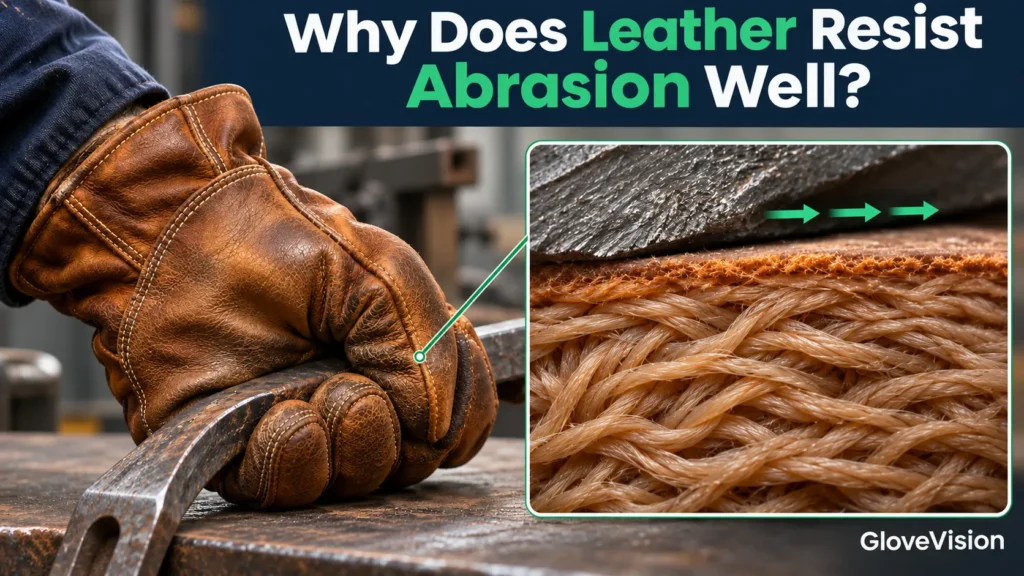
Leather can resist abrasion well because its interconnected collagen-fiber network, cohesive contact surface, material thickness, and finishes can delay progressive surface loss during repeated friction. However, abrasion resistance varies with the exact leather, glove construction, abrasive surface, contact pressure, and operating conditions. This article explains leather surface-wear mechanisms, the differences between grain and split leather, […]
How does leather structure create mechanical durability?

Leather gains much of its mechanical durability from a three-dimensional network of interconnected collagen fibers and bundles. Their orientation, packing, and connections influence how the material carries tension, transfers mechanical loads, and resists certain forms of tearing. Actual protective performance varies with hide origin, processing, thickness, construction, condition, and the specific hazard. This guide explains […]
How does recyclability influence TPE preference over vinyl?

Recyclability can influence preference for TPE gloves over vinyl only when a specific TPE product has a verified collection and material-recovery pathway that the comparable vinyl product lacks or performs less effectively within. Both TPE and PVC can have technically recyclable forms, but neither material name guarantees that used gloves will actually be recycled. This […]