
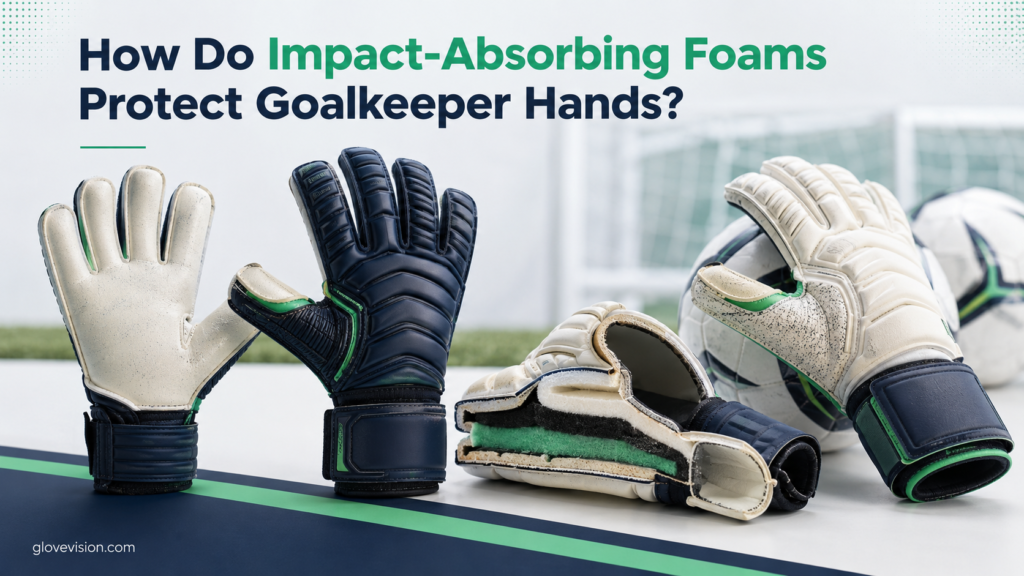
How Do Impact-Absorbing Foams Protect Goalkeeper Hands?
Impact-Absorbing Foams are compressible cushioning materials used in selected goalkeeper-glove zones such as the palm, fingers, knuckles, and backhand. Under contact, they deform and compress, helping spread part of the loading through the padded structure while managing some of the mechanical energy within the material.
That contribution is condition dependent. The result changes with the exact foam, thickness, firmness, density, layering, impact conditions, placement, anatomical fit, repeated-compression history, maintenance, and current glove condition, so padding should be evaluated as part of the complete goalkeeper glove rather than as an isolated specification.
Educational and safety notice: Impact-Absorbing Foams can cushion and redistribute some localized contact loading, but goalkeeper gloves cannot eliminate impact forces or guarantee prevention of hand, wrist, or finger injuries. Follow the exact glove manufacturer’s sizing, use, care, inspection, and replacement instructions. Persistent pain, swelling, weakness, deformity, numbness, or reduced hand movement requires appropriate assessment rather than relying on added padding.
What Are Impact-Absorbing Foams in Goalkeeper Gloves?
Impact-Absorbing Foams are compressible cushioning materials incorporated into selected goalkeeper-glove zones to manage contact through controlled deformation rather than through rigid resistance alone.
Goalkeeper glove construction can combine palm foams, layered bodies, backhand or rebound zones, glove cuts, closures, and other materials, so the exact cushioning role has to be read from the finished glove rather than inferred from a generic foam label. [uhlsport]
Where is goalkeeper glove foam positioned?
Depending on the exact glove, padding may appear in the palm, finger stalls, fingertips, knuckles, backhand, punch zones, or thumb. Product documentation should establish the actual zones rather than appearance alone.
What functions can padding perform?
Foam may cushion selected contact, spread some load through adjacent padded material, increase material separation, and improve contact comfort. It does not remove all force.
How is foam different from palm latex?
The ball-facing palm may itself provide both grip and cushioning, while another foam layer can sit underneath it. Exact layering varies.
How is foam different from finger support?
Foam primarily compresses and cushions. A finger-support system instead controls selected structural movement. Reusch documents these as separate goalkeeper-glove technologies. [Reusch]
Why evaluate the complete glove?
Foam alone cannot establish fit, coverage, grip, finger mobility, wrist stability, or overall protection. The broader framework for sports glove padding and impact management shows why padding location, compression behavior, movement, and actual sport contact zones need to be evaluated together.
How Do Impact-Absorbing Foams Reduce Contact Loads?
Impact-Absorbing Foams reduce selected contact loading by deforming under compression, using part of the impact event to compress the cellular or elastomeric structure and increasing the distance over which the hand is decelerated.
Experimental work on microcellular polyurethane elastomers shows that compressive response and energy-absorption behavior can change with density and strain rate. [PU Study] Separate polyethylene-foam impact research likewise shows loading-rate and deformation dependence rather than one universal cushioning value. [PE Study]
How does compression manage energy?
A useful model is: load → foam deformation → material compression → partial energy dissipation and temporary elastic storage → residual load continues through the glove–hand system. Saying that foam absorbs all impact would be inaccurate.
How can foam distribute load?
As the padded region deforms, adjacent material can become engaged and spread contact across a larger effective area. Coverage, seams, support layers, fit, and the loading event still matter.
How can peak loading change?
Controlled deformation can attenuate selected instantaneous loading under defined conditions, but laboratory findings should not be converted into universal goalkeeper-safe percentages or force limits.
What is bottoming out?
Foam has finite deformation travel. Cellular-foam research describes elastic response, a broader compression region, and densification as void space collapses and resistance rises. [PU Foam]
How does recovery affect repeated contact?
Resilience helps the material recover after deformation, but repeated large compression can change soft polyurethane behavior over time. [Cyclic] Visible rebound should not be treated as proof that full cushioning performance has returned.
| Loading Stage | Foam Response | Possible Protective Contribution | Limitation |
|---|---|---|---|
| Initial contact | Foam begins to deform under compression | Adds separation and begins spreading contact | Exact response depends on material, rate, placement and layers |
| Compression | Cellular or elastomeric structure shortens and changes shape | Uses available deformation distance to manage part of the event | Not all mechanical energy is removed |
| Energy management | Some energy is dissipated internally while some may be stored and returned | Can reduce selected localized loading under defined conditions | No universal goalkeeper force-reduction percentage |
| Load spreading | Adjacent padded material becomes engaged | May distribute contact through a larger padded region | Coverage gaps and poor alignment can limit this |
| Densification / bottoming out | Available compression becomes limited and resistance rises | Shows that cushioning travel is finite | Underlying layers carry more loading |
| Recovery | Foam rebounds after load removal | May restore shape for later contacts | Visible rebound does not prove full performance recovery |
Which Properties Control How Impact-Absorbing Foams Perform?
Impact-Absorbing Foams cannot be judged from thickness, density, firmness, or softness alone because these properties interact with material chemistry, loading rate, cellular structure, layers, fit, and available deformation.
Experimental foam research supports this multi-variable view: density and strain rate can influence compressive behavior, while densification shows why thickness alone cannot define performance. [PU Study] [PU Foam]
How does thickness matter?
More material may provide additional compression distance, but it can also add bulk and change tactile feedback. There is no universal thicker-equals-safer rule.
How do density and firmness differ?
Density describes mass per volume; firmness describes resistance to deformation under specified conditions. They are different properties and should not be used interchangeably.
How does resilience matter?
Resilience affects recovery and returned energy after deformation. A more visibly springy foam is not automatically better at dissipating impact energy.
How does cellular structure matter?
Open-cell, closed-cell, molded, or other descriptions should be used only where the product documents them. Appearance is not enough to identify foam chemistry.
How do temperature and moisture matter?
Material feel, flexibility, drying, and internal stability may change with moisture or temperature. These effects should remain product specific rather than universalized.
How do layers matter?
A glove can combine a grip-facing surface, cushioning foam, stabilizing material, liner, and backhand layers. Evaluate the full stack because each layer can alter compression, fit, bulk, and feedback.
| Property | Mechanical Effect | Handling Effect | Verification Requirement |
|---|---|---|---|
| Thickness | May increase available compression distance | Can increase bulk and change feedback | Use exact finished-glove documentation where available |
| Firmness | Changes resistance to deformation | May affect flex, pressure and closure feel | Do not treat firmness as density |
| Density | Can change compression and energy-absorption behavior | May influence weight and feel | Density alone does not establish finished-glove performance |
| Resilience | Influences recovery and returned energy | Can affect rebound feel | Resilience is not energy dissipation |
| Cellular structure | May affect compression, moisture and recovery | Can affect flexibility and drying | State cell type only when documented |
| Layering | Combines grip, cushioning, stabilization or liner functions | Can balance performance or add bulk | Evaluate the complete layer stack |
How Do Impact-Absorbing Foams Protect Different Goalkeeper Hand Zones?
Impact-Absorbing Foams must be evaluated by placement because the palm, fingertips, finger backs, knuckles, thumb, and backhand experience different combinations of ball contact, pressure, movement, and required flexibility.
How do palm Impact-Absorbing Foams cushion ball contact?
Palm cushioning sits behind or within the ball-contact structure, so added material can influence contact comfort and ball feedback. Cushioning should also be considered alongside goalkeeper glove grip and durability, because extra palm depth can change feel while the grip surface still needs to remain stable and usable.
How do finger zones use padding?
Localized finger padding may cushion selected contact, but it also has to preserve flexion and avoid pressure points. It should not be confused with a structural finger-support system.
How do backhand and knuckle zones use padding?
Backhand and knuckle structures can use foam or molded zones to cushion selected contact while segmentation and flex zones preserve movement. Reusch documents these as distinct elements within the complete glove. [Reusch]
How does thumb-zone padding matter?
Thumb padding has to balance local contact, wrap geometry, seam placement, movement, and bulk. A larger padded zone is not automatically better if it reduces useful thumb motion.
Where can padding gaps appear?
Seams, panel boundaries, glove geometry, poor fit, shifting layers, or damage can create areas with less effective padding coverage.
Where Do Impact-Absorbing Foams Stop Protecting Goalkeeper Hands?
Impact-Absorbing Foams provide cushioning rather than complete hand protection, so their presence must not be extended into unsupported claims about fractures, hyperextension, cuts, punctures, abrasion, wrist injury, or severe crushing events.
Can foam prevent every injury?
No. Padding can manage selected contact but cannot guarantee prevention of fractures, sprains, dislocations, tendon or ligament injury, or other trauma.
Do Impact-Absorbing Foams prevent finger hyperextension?
No automatic protection. Where backward finger movement is the concern, goalkeeper finger-support systems should be evaluated separately because structural support and impact cushioning perform different functions.
Do Impact-Absorbing Foams prove cut or abrasion protection?
No. Cushioning does not establish cut, puncture, or abrasion resistance. Those hazards require separate evidence.
Can Impact-Absorbing Foams compensate for poor fit?
No. Misaligned padding, bunching, excessive pressure, unstable internal movement, or glove rotation can undermine the usefulness of padded zones.
Does more foam always improve protection?
No. Added bulk can increase stiffness, change hand closure, reduce ball feedback, and alter fit. More formal glove impact-padding construction belongs to a different protective context, and occupational impact ratings should not be transferred to goalkeeper gloves unless the exact finished sports product carries that verified claim.
| Exposure / Need | What Foam May Contribute | What It Does Not Prove | Separate Evidence Needed |
|---|---|---|---|
| Ball contact | Cushioning and selected load spreading | Injury prevention or force elimination | Exact glove construction and fit |
| Backhand contact | Local padding over knuckles/backhand | Formal occupational impact protection | Exact finished-product evidence |
| Hyperextension | Little structural control by cushioning alone | Prevention of backward finger movement | Separate finger-support evidence |
| Abrasion | Padding may sit behind the outer surface | Abrasion rating or wear-proof protection | Separate durability evidence |
| Cut / puncture | Cushioning does not establish sharp-object resistance | Cut-proof or puncture-proof performance | Separate cut/puncture testing |
| Wrist injury | Cuff/closure may influence stability | Treatment or injury prevention | Fit and support evidence |
| Repeated loading | Recovery may preserve usable shape | Unlimited cycle life | Condition inspection and product guidance |
Which Impact-Absorbing Foams Best Match Different Goalkeeper Needs?
Impact-Absorbing Foams should be selected through the complete goalkeeper-glove construction, beginning with the contact zones, desired cushioning, ball-feedback preference, movement requirement, playing frequency, and fit.
What if direct ball feedback is the priority?
Look for a stable construction that provides enough cushioning without excessive bulk. Do not automatically prescribe the thinnest foam.
What if greater cushioning is the priority?
Evaluate available compression distance, coverage, layering, pressure, and how much extra bulk the glove adds during hand opening and closure.
What matters for frequent practice?
Repeated compression, recovery, condition, wear, and maintenance become especially important when the same glove sees many loading cycles.
What matters for backhand or punching-zone padding?
Check knuckle coverage, segmentation, flexibility, alignment, and whether the padded zone remains centered over the intended part of the hand.
What if there are previous hand problems?
Padding should not be prescribed as treatment or rehabilitation. Persistent symptoms require appropriate assessment rather than simply choosing a thicker glove.
Which evidence should be verified?
Identify the exact glove model, documented padding construction, placement, relevant manufacturer information, sizing, care guidance, and replacement instructions.
| Goalkeeper Need | Prioritize | Trade-Off to Check | Evidence / Fit Check |
|---|---|---|---|
| Direct ball feedback | Stable lower-bulk construction with controlled cushioning | Too much material may mute feedback | Palm stability, closure and exact documentation |
| Greater cushioning | Adequate deformation distance and coverage | Bulk, stiffness and pressure | Placement, layers and movement |
| Frequent practice | Recovery, durability and condition monitoring | Permanent compression or uneven zones | Inspect after repeated use |
| Backhand protection | Knuckle/backhand coverage and segmentation | Flexibility and punching-zone bulk | Exact finished-glove construction |
| Finger mobility | Padding aligned without obstructing flexion | Pressure or stiffness | Open/close hand and check finger movement |
| Previous symptoms | Appropriate assessment, not padding as treatment | False sense of protection | Do not use glove selection as medical management |
How Should Impact-Absorbing Foams Be Fitted and Function-Checked?
Impact-Absorbing Foams are useful only when their padded zones remain aligned with the intended parts of the hand without causing excessive pressure, bunching, internal slipping, or restriction of natural goalkeeper hand movement.
How should alignment be checked?
Confirm that palm, finger, knuckle, thumb, and backhand padding sits over the intended anatomy rather than rotating or shifting away from the contact zone.
How should size be checked?
Use the exact manufacturer sizing system. Padding can change internal glove volume, so the same nominal size or cut should not be assumed to fit identically across products.
How should movement be checked?
The hand should open naturally, close functionally, flex each finger, move the thumb, and retain useful wrist motion without pressure or binding.
How should ball interaction be checked?
In a controlled practice setting, check palm stability, useful feedback, functional closure, and the absence of disruptive slipping or bunching without turning the check into technique instruction.
Which problems require rejection or reassessment?
Pain, numbness, shifted padding, restricted closure, excessive pressure, unstable fit, or significant bunching indicate that the current construction is not working properly.
The broader relationship between palm grip and fit stability reinforces why padding must remain aligned without creating bunching, interior movement, pressure, or loss of useful feedback.
| Check | What to Verify | Why It Matters | Reject / Reassess If |
|---|---|---|---|
| Exact model | Manufacturer/model and documented padding construction | Avoids guessing foam chemistry or placement | Product identity cannot be verified |
| Sizing | Use exact manufacturer sizing | Padding changes internal volume | Persistent pressure or excess space |
| Alignment | Palm, fingers, thumb, knuckles and backhand line up | Padding works only where positioned | Pads shift off target zones |
| Hand opening | Full natural opening remains possible | Bulk can limit extension | Opening is restricted |
| Hand closure | Functional closure remains comfortable | Thick/stiff foam can obstruct closure | Closure is restricted or painful |
| Finger flexion | Each finger bends without binding | Finger padding can create pressure | Numbness, pressure or stiffness |
| Thumb movement | Thumb moves naturally | Thumb padding can add bulk | Thumb motion is restricted |
| Ball feedback | Controlled contact feels predictable | Too much bulk can mute feedback | Feedback is unusable for intended role |
| Internal stability | No bunching or slipping | Movement changes pad alignment | Glove rotates or padding shifts |
How Should Impact-Absorbing Foams Be Cleaned, Stored, and Inspected?
Impact-Absorbing Foams should be maintained according to the exact goalkeeper-glove manufacturer’s instructions because moisture, detergents, heat, compression during storage, adhesives, and construction materials vary between products.
Reusch provides goalkeeper-specific care guidance, which supports keeping cleaning, drying, and storage instructions tied to the exact glove rather than turning one routine into a universal foam-care rule. [Care]
How should cleaning be handled?
Use only the method and cleaning agent permitted for the exact glove. Do not assume soaking, machine washing, detergent, or one water temperature is appropriate across products.
How should drying be handled?
Verify ventilation, heat restrictions, internal drying guidance, and product-specific instructions. Foam, adhesives, liners, and coverings can react differently to heat and dampness.
How should storage be handled?
Follow exact guidance for dryness, glove shape, compression, sunlight, heat, and storage container. Avoid unapproved prolonged compression because it can distort padded structures.
What should inspection look for?
Check permanent flattening, hard or soft spots, cracking, crumbling, shifting, delamination, lumps, failed coverings, and changes in symmetry.
Can damaged foam be repaired?
Do not add foam, glue layers, insert improvised pads, stitch over damaged cushioning, or replace internal layers unless the manufacturer explicitly authorizes the repair.
What Problems Show That Impact-Absorbing Foams Are Worn or Mismatched?
Impact-Absorbing Foams may become unsuitable when repeated compression, aging, moisture, heat, layer movement, poor fit, or construction mismatch causes cushioning or handling to become uneven or unreliable.
What does permanent compression suggest?
Repeated loading, storage pressure, aging, or layer damage can leave foam visibly or functionally flattened. There is no universal failure percentage; the question is whether intended cushioning and fit remain reliable.
What do hard or soft spots suggest?
Localized hardening or softening can reflect temperature, moisture, aging, material breakdown, or uneven layer behavior.
Why can ball feedback become weak?
Excess bulk, changed layering, bunching, poor fit, internal movement, or degraded palm structures can make contact feel less direct or predictable.
Why can closure become restricted?
Thickness, shifted padding, glove cut, finger-support interaction, wrong size, or structural distortion can resist natural closure and create pressure.
When should replacement be considered?
Replacement is appropriate when foam is permanently flattened, cracked, crumbling, shifted, delaminated, structurally unreliable, misaligned, compromising fit, or restricting movement enough that intended function cannot be verified.
| Symptom | Possible Cause | What to Inspect | Next Decision |
|---|---|---|---|
| Permanent flattening | Repeated compression, storage pressure, aging | Foam height, symmetry and compression set | Reassess or replace if cushioning is unreliable |
| Uneven cushioning | Shifted layers, wear, delamination | Compare adjacent zones | Replace if alignment is no longer reliable |
| Hard spots | Aging, temperature or damaged layers | Localized firmness and surface condition | Follow guidance; replace if structural |
| Soft spots | Breakdown, saturation or layer failure | Local collapse or crumbling | Replace if stable cushioning is lost |
| Restricted closure | Too much bulk, wrong size or shifted padding | Finger/palm zones, cut and support interaction | Resize or choose another construction |
| Weak feedback | Excess layers, poor fit or bunching | Palm depth and internal stability | Choose a better balance |
| Delamination | Adhesive or layer failure | Edges, separation and lumps | Do not glue or rebuild; replace as appropriate |
| Area | Check | Rule | Retirement / Reassessment Trigger |
|---|---|---|---|
| Care guidance | Exact manufacturer cleaning instructions | Do not universalize one brand’s routine | Care cannot be performed as specified |
| Drying | Permitted ventilation and heat conditions | Follow exact product guidance | Heat or moisture damage suspected |
| Storage | Dry state, shape, compression and light/heat guidance | Avoid unapproved prolonged compression | Permanent distortion develops |
| Foam condition | Flattening, cracks, crumbling, hard/soft zones | Inspect all padded areas | Cushioning becomes uneven or unreliable |
| Alignment | Pads remain over intended zones | Fit controls padding position | Shifting persists |
| Fit | Opening, closure, finger/thumb movement and pressure | Padding must not compromise movement | Pain, numbness or unstable fit |
| Unauthorized repair | No added foam, glue, inserts, stitching or layer replacement | Repair can alter function unpredictably | Replace instead of improvising structural repair |
How Should Impact-Absorbing Foams Be Chosen for Goalkeeper Hand Protection?
Impact-Absorbing Foams should be chosen by defining the goalkeeper’s real contact zones and cushioning needs first, then evaluating the exact padding construction, complete glove, anatomical fit, movement, ball feedback, maintenance burden, and current condition.
Which final questions should be answered?
Identify the contact zones, desired cushioning, acceptable bulk, desired ball feedback, exact glove, documented padding, foam placement and layers, fit, hand opening and closure, finger and thumb movement, finger-support needs, practical care requirements, inspectability, and replacement criteria.
Which final rule should guide selection?
Choose the complete goalkeeper glove whose Impact-Absorbing Foams provide appropriate cushioning without creating unacceptable loss of fit, movement, feedback, or structural reliability.
Conclusion
Impact-Absorbing Foams can cushion goalkeeper-hand contact by deforming and managing part of the incoming loading, but their protective value depends on the exact material, construction, placement, fit, impact conditions, repeated-use history, and remaining condition.
Foam does not absorb all impact, thickness alone does not establish protection, density and firmness are different properties, resilience is not the same as energy dissipation, and padding is not a substitute for finger support, cut resistance, abrasion evidence, or correct fit. Reassess or replace the glove when compression, damage, shifting, or poor fit makes reliable cushioning or movement impossible to verify.
Frequently Asked Questions
Do Thicker Impact-Absorbing Foams Protect Goalkeeper Hands Better?
Not automatically. Additional thickness can provide more available compression distance, but actual cushioning depends on material behavior, firmness, density, loading rate, layers, placement, fit, and complete-glove construction.
Do Softer Impact-Absorbing Foams Absorb More Energy?
Not necessarily. A softer foam may compress earlier and can bottom out under a particular load. Energy management depends on the full stress-deformation response rather than softness alone.
Can Impact-Absorbing Foams Prevent Finger Injuries?
No guarantee. They may cushion selected contact but cannot reliably prevent fractures, sprains, dislocations, or hyperextension injuries.
Do Impact-Absorbing Foams Reduce Ball Feel?
They can. The effect depends on foam thickness, firmness, layers, palm construction, fit, and the level of feedback desired by the goalkeeper.
When Should Goalkeeper Gloves with Impact-Absorbing Foams Be Replaced?
Replace or reassess when permanent compression, cracking, crumbling, shifting, delamination, failed coverings, unstable fit, restricted movement, or unreliable cushioning means the glove can no longer perform its intended role.