
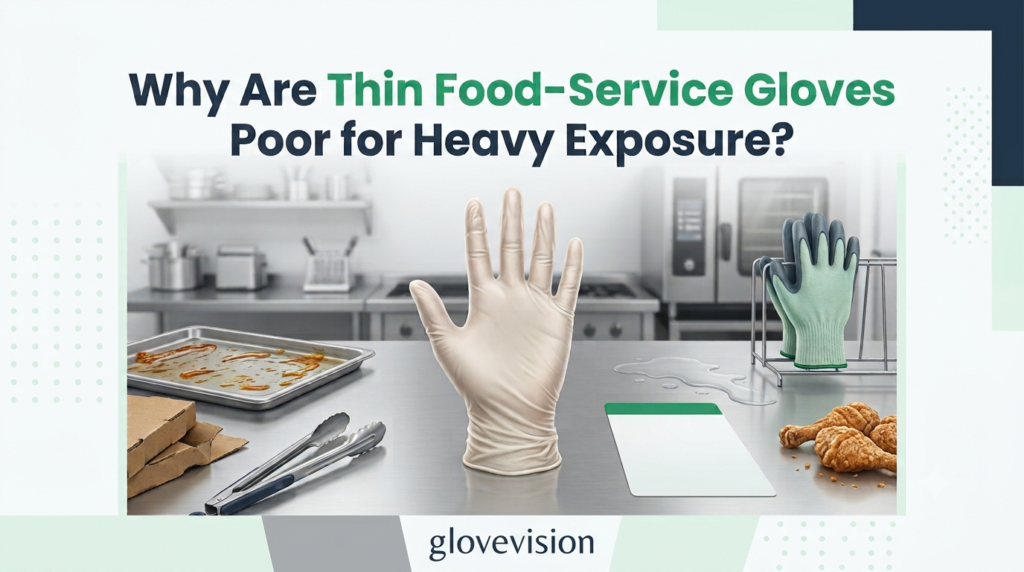
Why Are Thin Food-Service Gloves Poor for Heavy Exposure?
Thin food-service gloves can be poor choices for heavy exposure when the task’s mechanical demands, food-contact conditions, temperature, moisture, or required hazard protection exceed the capabilities documented for the exact product.
Thin does not automatically mean unsafe, and thicker does not automatically mean suitable. The decision depends on the exact product, assigned task, documented conditions, fit, observable performance, manufacturer restrictions, and whether a separate hazard control is required.
This article provides general food-glove and task-screening guidance. It does not replace adopted food-safety rules, workplace hazard assessment, machine-guarding requirements, SDS guidance, manufacturer instructions, or professional PPE evaluation. Verify the exact glove product, assigned task, applicable requirements, and separate controls before use.
What counts as heavy exposure for thin food-service gloves?
Heavy exposure occurs when a task places sustained mechanical, food-contact, environmental, or separate safety demands on a thin glove that the exact product is not documented or demonstrated to handle.
For this page, heavy exposure is an operational concept, not a standardized mil category or material ranking. The broader category matters because food-handling gloves must be assigned according to the food task and hygiene procedure, not treated as universal workplace protection. The FDA Food Code is a model offered for adoption rather than an automatically binding rule in every jurisdiction. [FC]
Which mechanical demands can exceed thin-glove capabilities?
Repeated gripping, flexing, friction, pulling, and contact with rough or sharp surfaces can exceed thin-glove capabilities when the exact product cannot maintain integrity, fit, or control. Repetitive movement, hard food surfaces, rigid containers, bones, shells, rough packaging, and sharp container edges may stress the disposable glove, but the cause should not be reduced to thinness alone.
Which demanding food-contact conditions matter?
Food-contact conditions become demanding when the food, temperature, moisture, contact duration, or repeated exposure falls outside the exact product’s documented or demonstrated operating conditions. Thickness cannot prove suitability because food-contact risks vary with the finished product, food, temperature, moisture, and contact pattern.
Which tasks require a separate control entirely?
A separate control is required when the task presents a cut, puncture, thermal, chemical, or machinery hazard outside the intended role of a disposable food glove. In U.S. workplaces, OSHA hand-protection selection is based on the task, conditions, duration, performance characteristics, and identified hazards—not thickness alone. [HP]
Why can heavy exposure exceed the limits of thin single-use gloves?
Heavy exposure can exceed the limits of thin single-use gloves because lightweight food-service gloves are usually assigned for short, controlled food-contact tasks, not for every sustained mechanical, thermal, chemical, cutting, or machinery demand.
The model Food Code limits single-use gloves to one task and requires discard when damaged, soiled, or interrupted; it does not create a universal thickness threshold or durability ranking. [GLV]
How do product design and intended use affect suitability?
The exact product’s intended use controls the suitability decision. Manufacturer identity, product name, product code, food-contact scope, temperature restrictions, contact limits, task restrictions, storage requirements, and document revision date matter more than a generic label such as food grade, powder-free, heavy duty, or industrial strength.
How do fit and repeated movement affect performance?
Fit and repeated movement affect whether the glove remains controlled during the task. Loose fingertips, bunching, overstretching, slippage, repeated adjustment, reduced tactile control, or grip decline can make the glove unsuitable even before the task is finished. A task may require reassessment when tactile feedback and grip control decline enough to affect safe manipulation.
Why does thickness alone not determine food-contact compatibility?
Thickness alone does not determine food-contact compatibility because the finished formulation, intended use, restrictions, food type, temperature, moisture, contact duration, fit, and task stress all matter. A thicker disposable glove may still be the wrong product, and a thin glove may still be acceptable for a short, controlled task when the exact product and procedure support it.
Table 1. This table separates what the worker observes from what may have contributed and what must be verified.
| Observable Sign | Possible Contributing Conditions | Immediate Action | Verification Needed | Evidence Category |
|---|---|---|---|---|
| Tear, puncture, or seam split | Sharp contact, overstretching, product limit, wrong size, storage issue | Stop, remove, discard, and assess exposure | Task, product code, lot, fit, tools, surfaces | Observable condition / facility procedure |
| Loose fingertips or bunching | Wrong size, moisture, repeated movement, product shape mismatch | Stop and correct fit or product | Worker size, grip under representative task, donning method | Observable condition |
| Grip loss or slippage | Grease, moisture, smooth texture, task stress, food residue | Replace and reassess control | Food condition, surface texture, worker feedback, task demand | Observable condition / exact-product documentation |
| Tackiness or deformation | Food, temperature, storage, lot issue, product restriction | Stop use and verify before continuing | Product instructions, storage, food type, temperature | Exact-product documentation |
| Heavy soil or internal contamination | Task crossover, extended handling, moisture, poor replacement access | Remove, discard, wash where required, and reset task | Task boundary, handwashing trigger, affected food and surfaces | Facility procedure / regulatory requirement |
| Pain, numbness, or performance-limiting discomfort | Fit problem, pressure, temperature, tool demand, unrelated health issue | Stop and report through procedure | Fit, task design, worker assignment, professional evaluation route | Workplace assessment |
Possible causes are not confirmed mechanisms, and this table does not rank materials or assign a numerical risk score.
Which signs show that a thin food-service glove is no longer suitable?
A thin food-service glove is no longer suitable when an observable integrity, function, hygiene, or worker-condition sign shows that the glove can no longer support controlled work.
Which integrity signs require replacement?
Integrity signs include tears, punctures, seam split, cuff damage, surface damage, deformation, shape loss, or missing material. Once integrity is compromised, the task should stop and the glove should be replaced rather than stretched through the remainder of the task.
Which functional signs require replacement?
Functional signs include grip loss, slippage, loose fingertips, bunching, reduced dexterity, repeated adjustment, internal movement, or tactile-control loss. Even an intact glove must be removed when short-use limits are crossed by task completion, contamination, damage, soil, interruption, or loss of control.
Which hygiene signs require replacement?
Hygiene signs include heavy soil, grease buildup, task crossover, contact with contaminated tools, internal contamination, allergen changeover, or movement from a contaminated task into a controlled task. The glove decision remains separate from food disposition and surface reset decisions.
Which worker-condition signs require action?
Worker-condition signs include moisture interfering with control, pain, numbness, discomfort, burning, swelling, rash, or another symptom affecting performance. This page does not diagnose symptoms; it routes the task to stop, reassess fit, and use the establishment’s reporting and evaluation procedure.
What should workers do when a thin food-service glove fails?
When a thin food-service glove fails, the worker should stop the task, secure tools or equipment, remove the glove, apply the handwashing procedure, inspect the hand, isolate affected food where needed, assess fragments, tools, and surfaces, restore controls, investigate the cause, and restart only after the correct product or alternative control is approved.
Once a failure trigger occurs, glove changes must be integrated with handwashing and task control.
What should happen immediately?
Immediately stop work, place tools in a safe state, move hands away from food and clean supplies, remove and discard the damaged glove, and apply the handwashing procedure required by the event. Do not continue because the task is almost finished, and do not reuse the failed glove.
How should affected food be assessed?
Affected food should be assessed separately from glove replacement. Check direct hand contact, hand condition, injury or bodily fluid, missing glove material, ready-to-eat status, later processing, facility procedure, and local requirements. Do not automatically release food because no fragment is visible, and do not automatically discard an entire batch without procedure.
How should affected tools and surfaces be restored?
Affected tools and surfaces should be restored according to the actual event, the adopted procedure, and the facility’s food-contact surface rules. FDA allergen-removal research supports using tested cleaning findings within their actual conditions rather than turning one study into a universal food-disposition rule. [CLN] Cleaning and allergen-control findings should be used within their tested scope, not as a universal food-disposition rule.
How should recurring failures be investigated?
Recurring failures should trigger a review of the exact product, product code, lot, size, fit, storage, donning method, task, food condition, temperature, packaging edges, tools, replacement access, and whether a separate protective system or process control is needed.
Pathway 1. This sequence moves from failure detection to safe restart without automatic batch disposal, automatic release, medical diagnosis, or material recommendation.
- Failure detected.
- Stop the task.
- Secure tools or equipment.
- Remove the glove.
- Apply the handwashing procedure.
- Inspect the hand.
- Isolate food where needed.
- Assess fragments, tools, and surfaces.
- Restore controls.
- Investigate the cause.
- Approve replacement or alternative control.
- Restart only when the task is controlled.
Separate injury and machinery concerns should be escalated through the applicable workplace procedure before the task restarts.
How should kitchens select the right control for heavy-exposure tasks?
Kitchens should select the right control by first separating ordinary food-contact demands from hazards that require a different protective category, tool, machine guard, or process redesign.
OSHA general PPE requirements require workplace hazard assessment, selection of protective equipment for identified hazards, communication of selection decisions, and PPE that properly fits affected employees. [HA] OSHA’s nonmandatory Appendix B also warns that PPE alone should not be relied on without guards, engineering controls, and sound practices. [AB]
When may another single-use food-contact glove be appropriate?
Another exact single-use food-contact glove may be appropriate when the demand remains within food-contact glove use and the alternative product is documented or demonstrated to handle the defined task. The alternative must be checked by exact product, not by material name, thickness impression, or marketing language.
When is a separate protective system required?
A separate protective system is required when the task involves a cut, puncture, heat, chemical, or machinery hazard outside ordinary disposable food-glove use. OSHA machine-guarding requirements address point-of-operation, ingoing nip point, rotating-part, and related machine hazards; special hand tools may supplement but do not replace guarding. [MG]
Why should kitchens not rely on vague product labels?
Vague labels such as food grade, heavy duty, premium, industrial strength, powder-free, or long lasting do not prove suitability for demanding food-preparation work. Food-service kitchen-equipment guidance highlights kitchen cutting, thermal, and equipment hazards, but exact task assessment still controls the decision. [KE]
Table 2. This matrix separates another exact food-contact glove from hazard-specific PPE, machine guarding, tools, and process controls.
| Task Demand or Hazard | Primary Control Category | Supporting Verification | Why a Thin Single-Use Glove May Be Insufficient | Better Owner |
|---|---|---|---|---|
| Repeated ordinary food handling with grip loss | Another exact food-contact product or task redesign | Product instructions, fit, texture, worker feedback | Grip or fit may fail before the task is controlled | Food-glove task suitability |
| Sustained fats, oils, moisture, or temperature | Exact-product food-contact verification | Food type, contact condition, temperature, restrictions | Food-contact conditions may exceed documented scope | Food Contact Material Risks |
| Knife, blade, bone, or shell hazard | Hazard-specific cut or puncture control | Workplace hazard assessment and task method | Disposable food gloves are not cut systems | Glove Hazard Match Tool |
| Hot trays, pans, equipment, or surfaces | Heat-rated PPE or process control | Temperature, contact duration, dexterity, task design | Food-contact gloves do not establish thermal protection | Heat-control procedure |
| Concentrated cleaner or sanitizer | Chemical-resistant PPE | SDS, concentration, temperature, duration, manufacturer data | Food-contact use does not prove chemical compatibility | SDS and compatibility review |
| Powered equipment or rotating parts | Machine guarding and equipment-specific procedure | Guarding, lockout where applicable, training, safe tools | Glove thickness is not a machinery control | Machine-guarding program |
The matrix does not assign cut ratings, heat ratings, chemical compatibility, or a universal material recommendation.
What should kitchens verify before assigning thin food-service gloves to a task?
Before assigning thin food-service gloves to a task, kitchens should verify the task demand, exact product, worker readiness, alternative controls, and final decision path.
The product and control system should reflect the operating environment, because food service and food processing can use different task structures and workplace controls.
Checklist 1. This checklist allows a supervisor to approve, restrict, or reject thin-glove use before the task begins.
- Task Demand: the task, food, temperature, duration, moisture, friction, and repeated motion are defined.
- Exact Product: manufacturer, product name, product code, intended use, restrictions, storage, and revision date are checked.
- Worker Readiness: size, fit, grip, dexterity, replacement steps, and symptom-reporting route are understood.
- Alternative Controls: cut, heat, chemical, machinery, tool, and process controls are available where the task requires them.
- Final Decision: the glove is approved, restricted, replaced with another exact food-contact product, or escalated to a separate control.
Checklist completion does not prove regulatory compliance; it only supports a documented task-suitability decision.
- FDA — Food Code 2022 Landing Page — used for model-code and current-edition context.
- FDA — Food Code 2022 Full Document — used for single-use glove, handwashing, non-reuse, and cleaning boundaries.
- OSHA — 29 CFR 1910.132 General PPE Requirements — used for hazard assessment, PPE selection, fit, damaged equipment, and training context.
- OSHA — 29 CFR 1910.138 Hand Protection — used for task-specific hand-protection selection and identified hand hazards.
- OSHA — 29 CFR 1910.212 Machine Guarding — used for guarding boundaries for powered equipment hazards.
- OSHA — Subpart I Appendix B PPE Selection Guidance — used for selection guidance and limits of PPE alone.
- OSHA — Food Services Kitchen Equipment eTool — used for kitchen-equipment hazard context.
- FDA — Allergen Removal and Transfer Study — used for tested cleaning and allergen-transfer context.
Frequently Asked Questions
Are all thin food-service gloves unsuitable for demanding tasks?
No. Thin food-service gloves are not automatically unsafe. They become unsuitable when the exact product’s documented use conditions, fit, grip, or demonstrated performance do not support the assigned task.
Does a thicker disposable glove protect against knives or bones?
Not automatically. A thicker disposable food glove may feel more robust, but cut, puncture, and sharp-contact hazards require hazard assessment and suitable controls rather than a thickness assumption.
Does nitrile, vinyl, or polyethylene alone determine durability or compatibility?
No. Material name alone cannot determine suitability. The finished product, intended use, formulation, food-contact conditions, fit, and restrictions must be verified.
Is there a universal point at which a thin glove becomes unsafe?
No. Do not use one universal mil value, wear time, or material threshold. The decision depends on the exact product, task demand, observable performance, and applicable procedures.
Does food grade or powder-free prove suitability for heavy exposure?
No. Food-contact or powder-free language does not prove durability, grip, cut protection, heat protection, chemical compatibility, or machinery suitability for a demanding task.
What should happen when a thin glove repeatedly fails during the same task?
Stop relying on repeated replacement alone. Investigate the exact product, size, fit, storage, food-contact conditions, tools, edges, temperature, worker feedback, and whether another product or separate control is required.
What should kitchens remember about thin food-service gloves?
Thin food-service gloves are not automatically unsafe, and thicker disposable gloves are not automatically suitable. The correct question is whether the exact product can support the assigned task under the food-contact conditions, fit demands, moisture, temperature, friction, duration, and observable performance expected at that station.
When heavy exposure creates integrity failure, grip loss, hygiene failure, worker-condition concerns, or hazards beyond ordinary food-contact use, the task should stop and be reassessed. The answer may be a different exact food-contact product, a separate PPE system, a tool, machine guarding, process redesign, or task reassignment—not a universal thickness rule.