
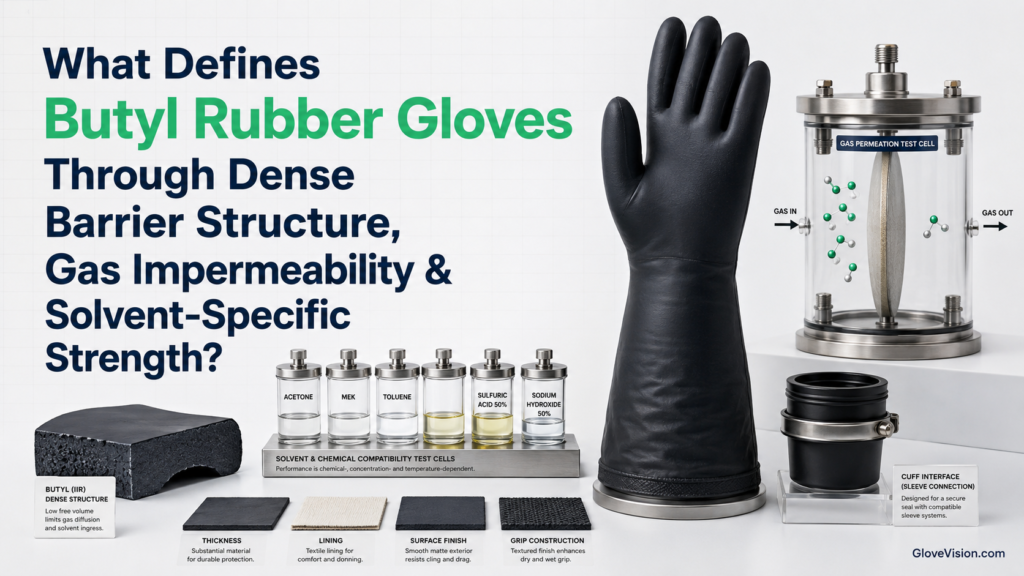
What Defines Butyl Rubber Gloves Through Dense Barrier Structure, Gas Impermeability & Solvent-Specific Strength?
Butyl Rubber Gloves are defined by a highly saturated isobutylene–isoprene rubber structure that restricts molecular diffusion, supports very low gas permeability, and provides strong resistance to selected polar solvents and corrosive chemicals.
“Gas impermeability” is relative rather than absolute, and performance depends on the exact permeant or mixture, concentration, temperature, pressure where relevant, contact type, duration, formulation, thickness, construction, PPE interfaces, fit, condition, and product-level testing.
What Are Butyl Rubber Gloves, and How Does Their IIR Structure Shape Barrier Behavior?
Butyl Rubber Gloves are made from isobutylene–isoprene rubber, a highly saturated synthetic elastomer whose restricted molecular mobility helps slow the diffusion of gases, vapors, and selected chemicals.
What Is Isobutylene–Isoprene Rubber?
Isobutylene–isoprene rubber is a synthetic copolymer composed mainly of isobutylene with a smaller amount of isoprene that provides sites for curing.
IIR names the base polymer family; compounded rubber includes cure agents and additives; cured material forms the elastic solid; and the finished glove adds thickness, cuffs, liners, surfaces, and manufacturing variables.
Why Does IIR Restrict Molecular Diffusion?
IIR can slow molecular diffusion because its polymer structure permits comparatively limited chain-segment movement and restricted transport pathways.
A permeant must interact with the polymer and move through temporary molecular-scale spaces. Temperature, thickness, and substance identity still affect that transport. The mechanism is expanded through the low-permeation behavior of butyl rubber.
How Do Compounding and Cross-Linking Change Butyl Rubber Gloves?
Compounding and cross-linking convert the base IIR polymer into a finished rubber whose flexibility, hardness, recovery, chemical interaction, and aging behavior depend on the formulation.
Cure systems, cross-link density, fillers, stabilizers, plasticizers, pigments, processing aids, and surface treatments can change both handling and barrier behavior.
How Do Standard Butyl, Chlorobutyl, and Bromobutyl Differ?
Standard butyl, chlorobutyl, and bromobutyl belong to related material families but differ in modification and curing behavior and must not be treated as interchangeable.
Exact material identity matters because modification, cure, additives, and finished construction can alter compatibility and physical performance.
Why Does the Butyl Rubber Name Not Prove Glove Performance?
The butyl rubber name identifies a material family, not a complete protection rating.
Formulation, thickness, cuff design, liners, grip, attachments, manufacturing quality, storage, prior exposure, and current condition determine whether a specific glove remains suitable.
| Material Feature | Physical Effect | Practical Contribution | What It Does Not Guarantee |
|---|---|---|---|
| Isobutylene-rich backbone | Restricts molecular movement | Very low gas permeability | Absolute impermeability |
| Limited unsaturation | Supports aging stability | Selected environmental-aging resistance | Unlimited service life |
| Cross-linked structure | Creates elastic solid rubber | Shape recovery and barrier continuity | Equal performance across formulations |
| Greater intact thickness | Lengthens some diffusion pathways | Product-specific barrier contribution | Universal chemical suitability |
| Flexible formulation | Supports hand movement | Dexterity where documented | Cut or puncture protection |
| Continuous shell | Covers the hand with barrier material | Liquid- and vapor-barrier potential | Protection through cuffs or defects |
How Do Construction Choices Change Butyl Rubber Gloves’ Barrier Performance, Dexterity, and Durability?
Construction choices change Butyl Rubber Gloves because thickness, liners, surface finishes, cuffs, and attachment systems affect both barrier coverage and the wearer’s ability to handle the task.
How Does Thickness Affect Butyl Rubber Gloves?
Thickness can lengthen a chemical’s diffusion path and add physical material, but it can also reduce finger mobility, tactile feedback, and handling precision.
Product-specific permeation data must accompany thickness. Extra material cannot correct chemical incompatibility, and a thinner tested glove is not automatically inadequate.
How Do Unsupported Butyl Rubber Gloves Behave?
Unsupported Butyl Rubber Gloves use a largely continuous rubber shell that can provide broad material coverage while preserving construction-dependent flexibility.
Thickness, cuff length, reusable design, internal moisture, inspection needs, and bulk vary by product.
How Do Liners and Reinforcements Affect Butyl Rubber Gloves?
Liners and reinforcements may improve comfort or physical support, but they can increase bulk and retain contamination.
Sweat management and donning may improve, while hidden residue, difficult drying, delamination, and liner-specific decontamination limits require inspection.
How Do Grip Finishes Affect Butyl Rubber Gloves?
Grip finishes alter contact friction but do not establish chemical resistance.
Smooth, pebbled, raised, and textured surfaces behave differently in dry, wet, or contaminated handling and may wear or become harder to clean.
Why Do Cuffs and Suit Interfaces Matter?
Cuffs and suit interfaces determine whether a chemical can bypass the glove material at the wrist or attachment point.
Short, gauntlet, extended, tapered, ring-mounted, or approved sealed systems require compatible overlap and intact attachments. Unapproved taping cannot substitute for a tested interface.
| Construction | Primary Contribution | Practical Trade-Off | Critical Verification |
|---|---|---|---|
| Thinner unsupported glove | Greater dexterity and feedback | Less physical margin | Exact permeation evidence |
| Thicker unsupported glove | Added material and barrier path | More bulk and stiffness | Task function and compatibility |
| Lined butyl glove | Comfort and internal support | Contamination retention | Decontamination instructions |
| Textured palm | Handling support | More difficult cleaning | Grip under actual conditions |
| Extended gauntlet | Forearm coverage | Cuff interference | PPE overlap and entry control |
| Integrated suit glove | Controlled ensemble interface | System-specific installation | Whole-system documentation |
How Do Butyl Rubber Gloves Limit Gas and Vapor Permeation?
Butyl Rubber Gloves can slow gas and vapor passage because IIR restricts molecular diffusion, but the rate still depends on the permeant, temperature, pressure, thickness, duration, and glove integrity.
Why Do Gases Move Slowly Through Butyl Rubber?
Gas molecules generally move slowly through intact butyl rubber because the polymer provides comparatively restricted diffusion pathways.
Transport remains permeant-specific and depends on molecular interaction, chain movement, path length, thickness, and temperature. The mechanism is developed further in butyl rubber’s gas-barrier behavior.
Why Is Butyl Gas Impermeability Not Absolute?
Butyl gas impermeability is not absolute because polymer barriers retain finite permeability under some conditions.
Gas or vapor identity, temperature, pressure, duration, cumulative permeation, formulation, thickness, and material condition can alter the rate.
How Can Gas or Vapor Bypass Butyl Rubber Gloves?
Gas or vapor can bypass the intact butyl material through cuffs, defects, damaged interfaces, or contamination pathways.
Open cuffs, pinholes, tears, punctures, attachment failures, incorrect interfaces, degradation, and contaminated doffing remain whole-glove failure routes.
Why Do Butyl Rubber Gloves Not Replace Respiratory Protection?
Butyl Rubber Gloves cover only the protected hand and wrist areas and cannot prevent inhalation or exposure to the eyes, face, torso, or uncovered skin.
A separate hazard assessment may require respiratory, eye, face, body, or gas-tight ensemble protection. Those toxic-vapor protection boundaries must not be assigned to the glove alone. [OSHA PPE]
Which Evidence Supports a Butyl Gas-Barrier Claim?
A defensible gas-barrier claim requires evidence for the exact permeant, glove model, thickness, test method, temperature, concentration or pressure, and interface conditions.
Whole-glove evidence must be distinguished from material-swatch data, and the result must inform a defined change plan rather than a universal wear time.
Where Do Butyl Rubber Gloves Provide Chemical Strength, and Where Does Their Resistance End?
Butyl Rubber Gloves are often considered for selected polar solvents and corrosive chemicals, but resistance must be verified substance by substance because performance can change sharply within a chemical family.
Which Polar Solvents May Match Butyl Rubber Gloves?
Selected ketones, esters, glycol ethers, alcohols, aldehydes, amines, and other oxygenated solvents may match tested Butyl Rubber Gloves.
Category membership is not approval; concentration, temperature, carrier solvents, and exact product data control the decision. Explore only documented ketone resistance of butyl gloves and ester resistance of butyl rubber.
How Can Butyl Rubber Gloves Perform Against Acids and Alkalis?
Some Butyl Rubber Gloves provide documented resistance to selected acids and alkalis, but neither corrosive category establishes universal compatibility.
Exact substance, concentration, temperature, splash or immersion contact, duration, degradation, and permeation all require product-level verification.
Why Are Oils and Hydrocarbons an Important Butyl Boundary?
Petroleum oils, fuels, and selected aliphatic or aromatic hydrocarbons can be important limitations for standard butyl formulations.
Possible effects include swelling, softening, strength loss, faster permeation, grip deterioration, and dimensional change. Results vary by substance and formulation.
Why Do Chlorinated Solvents Require Exact Verification?
Chlorinated solvents require chemical-specific evidence because standard butyl formulations may perform poorly against some members of this category.
A result for one chlorinated solvent cannot be transferred to another. The broader decision boundary is mapped through the strongest butyl resistance areas.
How Do Mixtures Affect Butyl Rubber Gloves?
Chemical mixtures may permeate differently from their individual components because one ingredient can change the polymer or transport behavior of another.
Swelling, carrier effects, additives, catalysts, surfactants, and reactive ingredients can change passage. A NIOSH study of tested binary mixtures supports keeping conclusions limited to the exact materials and conditions. [NIOSH Mixtures]
How Should Isocyanate Claims Be Controlled?
Butyl Rubber Gloves may perform well against a tested isocyanate formulation, but that result cannot establish universal isocyanate protection.
Any claim must remain tied to the exact isocyanate, carrier solvent, model, thickness, temperature, duration, method, and application conditions.
How Do Degradation, Penetration, and Permeation Differ?
Degradation changes the material, penetration passes through physical openings, and permeation moves molecules through apparently intact glove material.
ISO evaluates penetration and degradation as distinct properties. [ISO 374-2] [ISO 374-4] An intact-looking glove may still permit permeation.
| Exposure | Possible Butyl Contribution | Important Boundary | Required Verification |
|---|---|---|---|
| Selected gases and vapors | Very low material permeability | Not absolutely impermeable | Gas-specific permeation data |
| Selected ketones | Potentially strong resistance | Results vary by ketone | Exact product testing |
| Selected esters | Potentially strong resistance | Mixtures may behave differently | Concentration and breakthrough data |
| Selected glycol ethers | Specialty resistance potential | Temperature and duration matter | Product compatibility data |
| Selected acids or alkalis | Corrosive-liquid barrier potential | Concentration-specific behavior | Degradation and permeation evidence |
| Petroleum oils and fuels | Often an important limitation | Swelling or strength loss | Exact compatibility assessment |
| Aromatic hydrocarbons | Potential incompatibility | Degradation or permeation | Chemical-specific data |
| Chlorinated solvents | Potential incompatibility | Standard butyl may perform poorly | Exact test evidence |
| Reactive coating mixture | Product-specific potential | Carrier solvents influence results | Formulation-specific evidence |
| Chemical mixture | Unpredictable combined behavior | Individual data may mislead | Mixture-specific testing |
Which Butyl Rubber Gloves Match the Exact Exposure and Handling Task?
The correct Butyl Rubber Gloves are selected by matching an exact tested product to the substance, concentration, temperature, contact duration, exposure route, required coverage, mechanical stress, grip need, and dexterity demand.
Which Exposure Details Must Be Defined First?
Butyl Rubber Gloves cannot be selected responsibly until the exact exposure and contact conditions have been defined.
Record the chemical or gas identity, CAS number where available, mixture, concentration, temperature, pressure where relevant, splash, immersion or vapor contact, duration, frequency, emergency or routine use, and required coverage. OSHA includes these variables in hazard-led glove selection. [OSHA Dermal]
Which Butyl Rubber Gloves Suit Precision Handling?
Precision handling may favor a lower-bulk Butyl Rubber Gloves construction only when its chemical evidence and physical integrity match the exposure.
Finger mobility, tactile feedback, grip, cuff length, permeation data, puncture exposure, and task duration must all remain acceptable.
Which Butyl Rubber Gloves Suit Prolonged or Immersion Contact?
Prolonged or immersion contact requires product-specific permeation, degradation, construction, cuff, and change-schedule evidence.
Breakthrough, permeation rate, thickness, interfaces, liners, approved decontamination, and exposure temperature must match. A NIOSH study of N-methylpyrrolidone through tested butyl and natural-rubber gloves demonstrates why temperature findings remain product- and condition-specific. [NIOSH Temperature]
Which Butyl Rubber Gloves Suit Gas- or Vapor-Related Work?
Gas- or vapor-related work requires more than a low-permeability material claim because the glove must operate inside a complete exposure-control system.
Gas-specific data, whole-glove integrity, cuffs, suit interfaces, respiratory protection, eye and face protection, body protection, and emergency procedures need separate evaluation.
How Should Mechanical Hazards Affect Selection?
Mechanical hazards must be assessed independently because IIR composition does not establish cut, puncture, abrasion, snag, impact, or needle protection.
Sharp tools, grip pressure, repeated flexing, and reinforcement needs can change the acceptable construction.
How Should Fit and Dexterity Be Verified?
Suitable Butyl Rubber Gloves must preserve the hand movement and control required by the task without creating unstable fit or exposed interfaces.
Check finger alignment, thumb position, palm stability, opening, closure, tool control, cuff position, PPE compatibility, pain, and numbness. These practical butyl glove selection trade-offs must be tested during the real task.
Which Product Evidence Should Support Selection?
Selection should be supported by documentation for the exact finished Butyl Rubber Gloves product.
Verify manufacturer and model, formulation, thickness, length, intended use, compatibility chart, permeation and degradation results, applicable testing, change guidance, decontamination instructions, and retirement criteria. ISO 374-1 provides chemical-risk terminology and requirements but does not prove an unspecified glove complies. [ISO 374-1]
How Should Butyl Rubber Gloves Be Used, Inspected, and Retired?
Butyl Rubber Gloves should remain in service only while their exposure compatibility, physical integrity, fit, interfaces, change schedule, contamination status, and manufacturer-defined condition remain acceptable.
What Should Be Verified Before Use?
Pre-use verification must confirm the exact product, formulation, exposure, construction, compatibility evidence, and supporting procedures.
Confirm model, formulation, thickness, length, liner, grip, exposure conditions, gas or vapor evidence, chemical compatibility, change plan, reuse permission, decontamination procedure, and additional PPE.
How Should Butyl Rubber Gloves Be Inspected?
Inspection should cover every material, cuff, liner, seam, and interface area that could compromise protection or handling.
Inspect fingertips, finger sides, thumb crotch, palm, backhand, cuff, attachments, seams, grip, liner, repairs, swelling, softening, hardening, tackiness, cracks, punctures, tears, discoloration, and prior contamination. Only manufacturer-authorized integrity tests should be used.
How Should Butyl Rubber Gloves Be Worn During Exposure?
During exposure, Butyl Rubber Gloves must remain within the approved contact conditions, change schedule, cuff configuration, and interface procedure.
Maintain correct sizing, cuff placement, sleeve overlap, approved suit attachments, time control, contamination monitoring, scheduled changes, and emergency removal readiness.
How Should Butyl Rubber Gloves Be Removed?
Doffing must prevent contact between bare skin and the contaminated exterior while controlling runoff and secondary contamination.
Follow the approved sequence, contain removed gloves, control cuff runoff, perform hand hygiene, report exposure, and use the required disposal route. Careful removal does not reverse permeation.
How Should Reusable Butyl Rubber Gloves Be Decontaminated and Stored?
Reusable Butyl Rubber Gloves should be decontaminated and stored only according to instructions for the exact product and exposure.
Use only approved cleaning, rinsing, temperature, interior treatment, drying, inspection, rinse handling, storage, shape-preservation, and exposure-history procedures. Damaged PPE must be removed, while contaminated PPE requires approved cleaning or disposal.
When Should Butyl Rubber Gloves Be Retired?
Butyl Rubber Gloves must be retired whenever compatibility, traceability, structural integrity, or barrier reliability can no longer be verified.
Retire them after the approved interval, unknown exposure, suspected permeation, unresolved contamination, swelling, deformation, softness, hardness, tackiness, cracks, thinning, tears, interface failure, contaminated liners, or unreliable grip and fit.
What Final Decision Determines Suitability?
Final suitability requires every exposure, product, function, maintenance, and condition check to pass.
Use this sequence: exact hazard → substance or mixture → concentration and temperature → contact pattern → duration → exact model → formulation and thickness → evidence → coverage and interfaces → fit and handling → change and decontamination plan → condition → final decision. OSHA cautions that breakthrough can be shorter than expected under real conditions. [OSHA OTM]
- Exact gas, vapor, chemical, mixture, concentration, temperature, pressure, contact, duration, coverage, and mechanical hazards are defined.
- Exact model, formulation, thickness, cuff, compatibility, test conditions, limitations, change guidance, and retirement criteria are confirmed.
- Finger alignment, palm stability, closure, grip, cuff position, PPE interfaces, and comfort remain acceptable.
- No holes, cracks, tears, swelling, deformation, hardening, softening, tackiness, contamination, lost traceability, or unknown exposure history exists.
- Exposure-time control, doffing, approved decontamination, cleaning, drying, storage, and additional PPE requirements are defined.
- Use only when every check passes; otherwise change, decontaminate where permitted, reassess, retire, or do not use.
Conclusion
Butyl Rubber Gloves derive their specialist value from an IIR structure that provides very low gas permeability and strong resistance to selected polar solvents and corrosive chemicals.
That value remains chemical- and product-specific rather than universal. Final suitability depends on exact exposure data, finished-glove testing, thickness, construction, interfaces, fit, handling requirements, condition, and a defined change and retirement process.
Frequently Asked Questions
Are Butyl Rubber Gloves Completely Gas-Impermeable?
No. Butyl rubber has very low gas permeability, but passage still depends on the gas or vapor, thickness, temperature, pressure, duration, integrity, cuffs, and interfaces.
Which Solvents Are Butyl Rubber Gloves Commonly Used Against?
Tested products may perform strongly against selected ketones, esters, glycol ethers, alcohols, aldehydes, and amines. Exact glove-model compatibility and permeation data remain necessary.
Are Butyl Rubber Gloves Suitable for Oils and Hydrocarbons?
Not automatically. Standard butyl can be poorly matched with petroleum oils, fuels, and selected aliphatic, aromatic, or chlorinated hydrocarbons.
Can Butyl Rubber Gloves Be Reused After Chemical Exposure?
Only when the exact glove permits reuse, exposure stayed within documented limits, decontamination is approved, and inspection confirms continued suitability.
When Should Butyl Rubber Gloves Be Replaced?
Replace them when the approved interval is reached or when compatibility, exposure history, contamination, fit, interfaces, or structural condition can no longer be verified.