
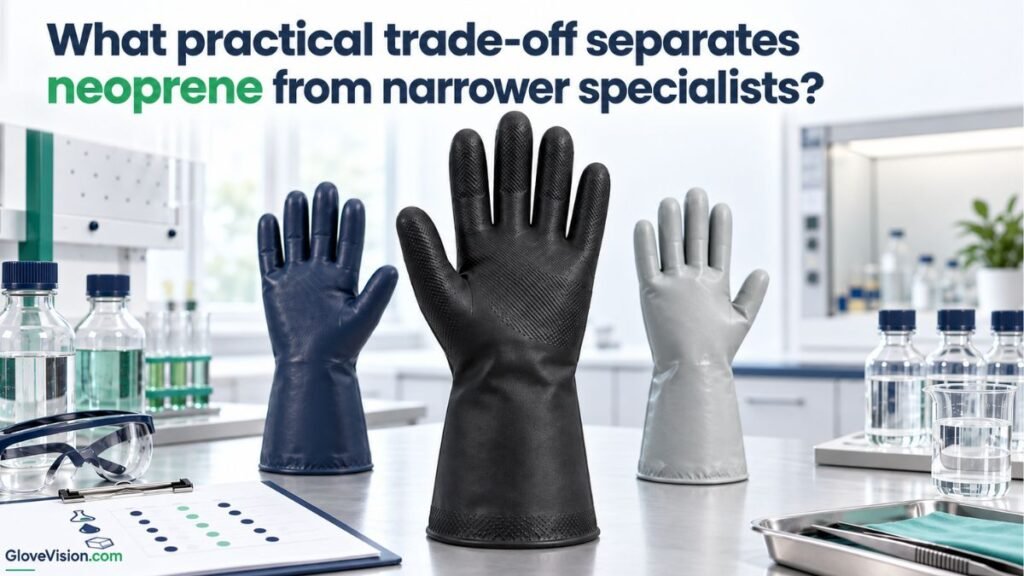
What Practical Trade-Off Separates Neoprene From Narrower Specialists?
Neoprene’s main practical trade-off is breadth and whole-task usability versus peak chemical specialization. An exact Neoprene glove may provide adequate chemical protection while also supporting the flexibility, construction, grip, coverage, and repeated handling needed across several compatible tasks, whereas a specialist may provide a larger protection margin against one dominant chemical niche.
Neither side wins automatically. Chemical identity, mixture, concentration, temperature, duration, contact pattern, glove thickness, construction, exact permeation and degradation data, mechanical stress, fit, grip, dexterity, water exposure, and current condition determine whether Neoprene’s balance or a specialist’s chemical advantage matters more.
What Practical Trade-Off Makes Neoprene a Balanced Chemical Barrier Rather Than a Narrow Specialist?
Neoprene is best understood as a balanced chemical-barrier candidate when its exact product performance adequately covers the exposure while preserving the physical and operational properties the task requires; a narrower specialist becomes preferable when superior chemical-specific performance matters enough to outweigh its own limitations. OSHA’s current generic glove chart places Neoprene in a middle screening position and shows butyl, PVA, fluoroelastomer, and specialty laminates occupying more specific niches. [OSHA-Chart]
What Does “Balanced” Mean for Neoprene?
Balance means an adequate combination of verified chemical coverage, flexibility, hand movement, construction options, mechanical durability, wet-process usability, cuff coverage, and practical handling for the defined task. It does not mean equal resistance to every chemical. Broader construction context belongs on the Neoprene gloves page, while broad resistance behavior of Neoprene explains the material’s wider screening range.
What Does “Specialist” Mean When Neoprene Is the Comparison Point?
Specialist status is defined by a pronounced advantage in a chemical niche, not by prestige. Butyl may be considered for selected polar organics, ketones, and esters; PVA for selected aromatic and chlorinated solvents under compatible dry-use conditions; fluoroelastomer for selected hydrocarbon and aggressive-solvent exposures; and multilayer systems for difficult chemical challenges.
What Can Neoprene Gain by Avoiding Extreme Specialization?
When one exact glove is verified across every relevant exposure, Neoprene may offer broader task coverage, flexible elastomeric construction, balanced mechanical usability, and fewer unnecessary material changes between compatible tasks. Convenience is a benefit only after chemical adequacy has been established.
What Can Neoprene Give Up Compared With a Specialist?
Neoprene may give up peak barrier margin for a target chemical, show shorter breakthrough in certain specialist solvent families, or provide weaker chemical-specific resistance than a material optimized for that niche. The comparison must remain chemical- and product-specific.
Why Is “Best Chemical Glove” the Wrong Question?
The useful question is: which exact glove provides adequate chemical protection and complete task performance for this exposure? OSHA’s PPE guidance explicitly adds dexterity, exposure duration and frequency, physical stresses, toxicity, and mixture behavior to glove selection. [OSHA-PPE]
Neoprene Generalist-vs-Specialist Trade-Off
| Decision Dimension | Neoprene Generalist Position | Specialist Position | Practical Question |
|---|---|---|---|
| Chemical breadth | May cover several compatible exposure classes | Often strongest in defined niches | Which chemicals dominate the task? |
| Peak chemical margin | Can be high for some exact chemicals, lower for others | May be much stronger for its target exposure | Is additional chemical margin necessary? |
| Physical/task performance | Often selected for balanced use properties | Varies widely by specialist product | Can the glove be used safely for the task? |
| Environmental constraints | Exposure and product specific | Some materials have sharp environmental limits | Does water, humidity, heat, or another condition matter? |
| Construction options | Multiple supported, unsupported, and coated systems exist | Depends on specialist material and product | Does the finished glove provide needed coverage and durability? |
| Operational breadth | Can reduce unnecessary switching when fully verified | May be optimized around a narrower hazard set | One dominant hazard or several compatible tasks? |
Why Can Neoprene Gain Operational Value by Avoiding Peak Chemical Specialization?
Neoprene gains operational value when its verified chemical protection is already adequate and its finished construction provides a useful balance of movement, grip, mechanical integrity, coverage, and repeat-task usability. If the chemical margin is inadequate, those usability advantages stop mattering.
How Can Neoprene Balance Chemical Protection With Hand Movement?
Elastomeric flexibility, finger articulation, repeated gripping, cuff movement, thickness, and support construction can all influence task usability. These are finished-product characteristics, so Neoprene should not be assumed universally more flexible than every specialist or nitrile glove.
Why Does Mechanical Durability Matter Alongside Neoprene Chemical Resistance?
Abrasion, tearing, puncture exposure, grip pressure, tool handling, and repeated flexing can determine whether a chemically adequate glove remains usable. A chemically impressive barrier that cannot tolerate the task may need a different construction or protective system.
How Can Neoprene Support Multi-Exposure Work?
Only where one exact glove has appropriate data for every relevant exposure. If several compatible chemicals are verified for one workable construction, unnecessary material switching may be reduced without sacrificing chemical evidence.
Why Is Neoprene’s Practical Value Different From Maximum Breakthrough Time?
Breakthrough is one chemical test metric. Whole-task performance can also require dexterity, wet or oily grip, mechanical integrity, fit, cuff and forearm coverage, repeated movement, and compatibility with other PPE. OSHA likewise lists chemical, contact, abrasion, coverage, dexterity, grip, and comfort factors in glove selection. [OSHA-Task]
When Does Operational Convenience Stop Supporting Neoprene?
Stop the generalist argument when permeation margin is inadequate, degradation is unacceptable, duration exceeds relevant evidence, high toxicity requires more margin, immersion exceeds tested use, or another exact product has a materially stronger protection case.
Neoprene Operational-Performance Trade-Off Matrix
| Task Need | When Neoprene Balance May Add Value | When Specialization May Matter More |
|---|---|---|
| Repeated hand movement | Verified Neoprene construction remains flexible and protective | Specialist also meets movement needs while adding needed chemical margin |
| Wet process | Neoprene evidence supports chemical and wet-use conditions | Another specialist product is also verified for wet service |
| Abrasive handling | Exact Neoprene glove combines chemical and mechanical suitability | Specialist system includes adequate mechanical protection |
| Multiple compatible chemicals | One exact glove is verified across all exposures | One chemical dominates risk and exceeds Neoprene evidence |
| Long contact | Product data support the duration | Specialist provides materially stronger relevant permeation performance |
| High-consequence chemical | Neoprene evidence provides sufficient margin | Specialist lowers uncertainty or permeation enough to justify trade-offs |
Which Narrower Specialist Barriers Can Outperform Neoprene, and What Trade-Offs Do They Introduce?
A narrower specialist can outperform Neoprene when its exact finished product provides materially stronger evidence against the dominant chemical hazard, but that advantage must be weighed against the specialist’s own chemical and environmental boundaries rather than assumed from material reputation.
When Can Butyl Outperform Neoprene?
Butyl deserves evaluation for selected ketones, esters, glycol ethers, and other polar organics. Current SHOWA 875R product evidence explicitly targets ketones and esters and uses a rough-grip construction, illustrating why both chemical niche and ergonomics belong to the exact product. [SHOWA-Butyl] Compare exact butyl selection trade-offs rather than assuming every butyl glove shares the same ergonomics or chemical limits.
When Can PVA Outperform Neoprene?
PVA can become a specialist candidate for selected aromatic, chlorinated, aliphatic, ester, ether, and other solvent exposures, but water and high humidity can sharply reduce its protection. Ansell AlphaTec 15-554 pairs aromatic/chlorinated-solvent positioning with an anatomical design, which is why PVA should not be equated automatically with poor mobility. [Ansell-PVA] See the dedicated PVA selection trade-offs.
When Can Fluoroelastomer Outperform Neoprene?
Fluoroelastomer constructions can deserve comparison for selected aromatic, aliphatic, and halogenated hydrocarbon exposures. SHOWA 891 is a specific Viton-over-butyl product positioned for aliphatic and aromatic hydrocarbons including benzene, toluene, and xylene; its performance must not be transferred to every fluoroelastomer glove. [SHOWA-891] Deeper constraints belong on fluoroelastomer adoption limits.
When Can a Multilayer or Specialty Barrier Outperform Neoprene?
Multilayer or specialty barriers may deserve comparison for difficult mixtures, very high-consequence chemicals, broad chemical challenges, or cases where a single elastomer is insufficient. OSHA’s generic Silver Shield/Norfoil example illustrates that strong chemical resistance can coexist with fit, puncture, grip, or stiffness penalties in some constructions; those penalties should not be generalized to every modern multilayer system.
Why Does Specialist Superiority Remain Chemical-Specific?
A specialist can dominate one defined chemical while losing its advantage—or becoming unsuitable—when chemical identity, formulation, water exposure, temperature, construction, or task requirements change. OSHA also warns that nominally similar glove materials from different manufacturers can perform very differently, so generic material class alone is insufficient. [OSHA-OTM]
Neoprene vs Narrower Specialist Materials Matrix
| Barrier | Where It May Have a Specialist Advantage Over Neoprene | Important Counter-Boundary | What Must Be Verified |
|---|---|---|---|
| Neoprene | Balanced verified coverage across selected chemical/task combinations | Lower peak margin in some specialist niches | Exact Neoprene product |
| Butyl | Selected ketones, esters, glycol ethers, polar organics | Many hydrocarbon/chlorinated exposures can be weak | Exact butyl product |
| PVA | Selected aromatic/chlorinated and other organic solvents | Water/high-humidity sensitivity | Exact product + dry-use conditions |
| Fluoroelastomer | Selected aromatic/aliphatic/halogenated hydrocarbons | Some ketones, esters, amines, and product-level physical limits | Exact fluoroelastomer construction |
| Multilayer/specialty barrier | Difficult or broad chemical challenge | Fit, grip, puncture, stiffness, or layering requirements may arise in some systems | Exact finished system |
How Should Neoprene Be Compared With Narrower Specialists for an Exact Task?
Neoprene should be compared with a specialist only after the exposure is precisely defined and exact products from both material families can be evaluated against comparable chemical and task requirements.
What Must Be Defined Before Neoprene Is Compared With a Specialist?
Identify the exact chemical and CAS number where applicable, concentration, complete mixture, temperature, splash or intermittent versus continuous contact, duration, pressure or spray, toxicity, mechanical hazards, wet or dry environment, required dexterity, and hand or forearm coverage.
Which Neoprene and Specialist Product Details Must Match the Comparison?
Verify manufacturer, exact model, polymer or blend, thickness, supported or unsupported design, disposable or reusable construction, liner, cuff, seams, and full or partial coating. Polymer names alone are not comparable products.
Which Chemical Results Should Be Compared First?
Prioritize permeation and breakthrough, permeation rate where available, degradation, penetration or leak performance, challenge concentration, test temperature, contact mode, test method, and specimen thickness. Exact product evidence should override generic class assumptions when conditions are better matched.
Which Operational Factors Should Be Compared After Chemical Adequacy Is Established?
Only after chemical support is adequate should the comparison move to dexterity, grip, mechanical durability, puncture and abrasion exposure, fit, cuff coverage, wet or humidity compatibility, donning and doffing, compatibility with other PPE, replacement logistics, validated reuse, and cost where protection remains equivalent.
How Should Conflicting Generic Material Charts Be Handled?
Use generic charts only for screening, then move to exact product data under comparable conditions and interpret conservatively. Do not average generic scores or let a favorable generic table override better-matched model-specific evidence.
Neoprene Generalist-or-Specialist Selection Checklist
Hazard Definition
- Exact chemical or formulation is known.
- Concentration is known.
- Temperature is known.
- Contact mode and duration are defined.
- Chemical toxicity and consequence are considered.
Neoprene Evidence
- Exact Neoprene model is identified.
- Relevant permeation evidence is available.
- Degradation is acceptable.
- Penetration and construction are appropriate.
- Thickness and test conditions match sufficiently.
Specialist Evidence
- Exact specialist product is identified.
- Its chemical advantage is demonstrated rather than assumed.
- Its own weak chemical families are considered.
- Water, humidity, or other environmental limitations are considered.
- Construction and coverage are appropriate.
Whole-Task Fit
- Dexterity is adequate.
- Grip is adequate.
- Mechanical performance is adequate.
- Cuff and coverage are appropriate.
- Interaction with other PPE is workable.
Decision
When Should Neoprene Be Limited or Rejected in Favor of a Narrower Specialist?
Neoprene should be limited or rejected when its exact chemical performance no longer provides an adequate protection margin for the defined task and another exact product offers materially stronger evidence without introducing an unacceptable new limitation.
When Does Short Neoprene Breakthrough Justify Specialist Evaluation?
When the required contact pattern or duration approaches or exceeds the relevant Neoprene evidence, the protection margin becomes inadequate and a stronger verified product deserves comparison. No universal minimum breakthrough threshold should be invented.
When Does Neoprene Degradation Override Its Usability Advantages?
Reject convenience when the exact glove shows unacceptable swelling, softening, hardening, tackiness, cracking, delamination, loss of strength, or degradation that compromises grip, fit, or barrier reliability.
When Can Aromatic or Chlorinated Solvents Favor a Specialist Over Neoprene?
Exact PVA, fluoroelastomer, or validated multilayer products deserve comparison when their product-specific evidence is materially stronger for the defined aromatic or chlorinated solvent. Material-family reputation alone is not sufficient.
When Can Ketone or Polar-Organic Exposure Favor Butyl Over Neoprene?
Butyl deserves comparison when exact product data show a substantial advantage for the target ketone, ester, glycol ether, or other polar organic. That does not establish universal butyl superiority.
When Can Water or Humidity Reverse a PVA Advantage?
PVA’s solvent advantage can be lost when water or high humidity materially reduces the exact product’s chemical protection. Ansell explicitly warns of this limitation for AlphaTec 15-554, so environment can reverse what looked like a chemical advantage on paper.
When Does High Chemical Consequence Strengthen the Case for Specialization?
When small amounts of permeation carry high dermal or systemic consequence, additional chemical-specific margin becomes more important and can outweigh convenience, flexibility, or material continuity across tasks.
When Do Mixtures Defeat a Simple Neoprene-vs-Specialist Comparison?
Mixture behavior may not match pure-component data. OSHA recommends conservative selection around the component with the shortest breakthrough when mixture-specific data are unavailable because solvents can carry other ingredients through polymeric barriers. [OSHA-Mix]
Neoprene Specialist-Escalation Decision Matrix
| Decision Trigger | Neoprene Position | Specialist Comparison | Why |
|---|---|---|---|
| Adequate exact Neoprene evidence + good whole-task fit | Retain as viable candidate | Optional | Balance may be sufficient |
| Specialist provides materially stronger relevant barrier performance | Reassess Neoprene | Strongly consider | Chemical margin may dominate |
| Unacceptable Neoprene degradation | Reject exact product | Compare | Barrier reliability is compromised |
| Aromatic/chlorinated solvent with weak Neoprene data | High caution | PVA, fluoroelastomer, or multilayer may deserve evaluation | Specialist niche may fit better |
| Ketone/polar organic with weak Neoprene data | Product specific | Butyl may deserve evaluation | Chemical-specific advantage |
| PVA candidate in water/high humidity | Neoprene or another material may regain advantage | PVA may become unsuitable | Specialist environmental boundary |
| Complex mixture without matched product data | Uncertain | Specialist or multilayer may be considered | Generic single-polymer assumptions are weak |
| High-consequence exposure + marginal Neoprene data | Do not rely on convenience | Specialist evidence becomes more important | Protection margin outweighs usability |
The broader decision between broad chemical coverage versus maximum specialization belongs on its dedicated comparison page, while Neoprene chemical-resistance boundaries define where the generalist case stops.
What Should Readers Remember About the Practical Trade-Off That Separates Neoprene From Specialists?
Neoprene’s practical value lies in balance rather than automatic dominance. When an exact Neoprene glove provides adequate chemical performance, its construction and whole-task usability can make specialization unnecessary.
A narrower specialist earns its place when its verified chemical-specific advantage is necessary enough to outweigh its own chemical, environmental, construction, or operational limitations. Material reputation starts the comparison; exact finished-product evidence decides it.
Which Questions Clarify the Trade-Off Between Neoprene and Narrower Specialists?
Is Neoprene More Versatile Than Butyl Rubber?
Neoprene can be more broadly useful across some mixed task requirements, but that does not make it chemically superior. Butyl may provide a stronger product-specific barrier for selected ketones, esters, glycol ethers, or other polar organics, while Neoprene may better fit different exposure combinations.
Is Neoprene Better Than PVA for Solvent Handling?
Not universally. PVA can provide exceptional product-specific resistance to selected aromatic and chlorinated solvents, while water sensitivity can sharply limit wet or humid use. Neoprene becomes preferable only when its exact chemical evidence and whole-task performance better match the exposure.
Is Neoprene Better Than Fluoroelastomer Gloves?
It depends on the chemical and finished products. Fluoroelastomer constructions can have strong advantages for selected hydrocarbon or aggressive-solvent exposures, while Neoprene may provide a better balance for another task. Exact chemical, concentration, construction, and test data must control the comparison.
Does Broader Neoprene Coverage Mean Lower Protection?
No. Breadth and protection level are separate attributes. An exact Neoprene glove can provide strong protection against a compatible chemical even though another material specializes more strongly in a different chemical family. Compare exact product performance, not labels such as “generalist” or “specialist.”
When Should Neoprene Be Rejected in Favor of a Narrower Specialist?
Replace or reject Neoprene when its exact permeation, degradation, penetration, construction, or exposure evidence cannot provide an adequate protection margin and another exact product provides materially stronger relevant chemical evidence without introducing an unacceptable new limitation.