
How Does Butyl Structure Create Low-Permeation Behavior?
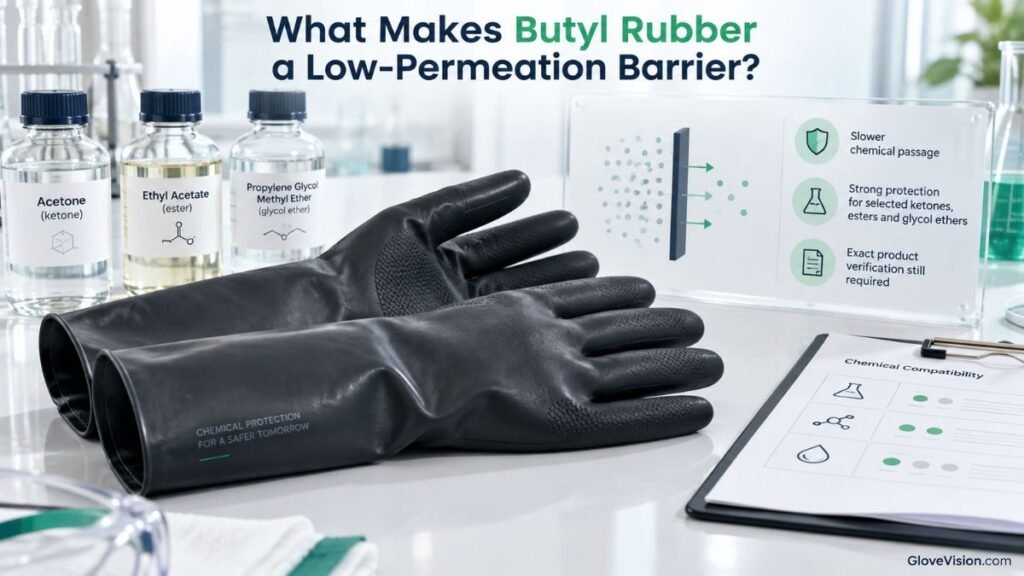
Butyl Rubber creates unusually low molecular permeability primarily through its polyisobutylene-rich architecture. Restricted segmental motion and penetrant-specific sorption behavior can reduce molecular diffusion and uptake, producing exceptional gas-barrier performance and strong chemical-barrier potential for compatible substances.
The same structure does not resist every penetrant equally. Strongly interacting hydrocarbons, chlorinated solvents, mixtures, heat, swelling, formulation differences, thickness, and finished-glove construction can increase transport or degradation, so the decision must move from structure to sorption/diffusion, practical strengths, exact-glove verification, and chemical boundaries.
Safety note: Butyl Rubber’s molecular structure can identify it as a strong barrier candidate, but chemical-glove selection must use the exact chemical or mixture, concentration, temperature, contact pattern, glove model, thickness, construction, and applicable permeation, degradation, and penetration data.
What Structural Features Make Butyl Rubber a Low-Permeability Molecular Barrier?
Butyl Rubber’s low-permeability character begins with its isobutylene-rich molecular architecture: a highly saturated backbone with dense methyl substitution and only a small isoprene fraction for cure functionality.
Why Is Butyl Rubber Predominantly Isobutylene?
Conventional Butyl Rubber is an isobutylene copolymer containing a small amount of isoprene. ExxonMobil describes that structure as highly saturated and identifies low permeability to air, gases, and moisture as a defining property. [ExxonMobil] Finished Butyl Rubber gloves still require product-level chemical data.
How Does High Saturation Support Butyl Rubber Performance?
Relatively low backbone unsaturation supports aging and weathering stability under compatible conditions, but saturation alone does not explain low permeability.
How Does Dense Methyl Substitution Affect Butyl Rubber Molecular Motion?
Polyisobutylene has unusually slow segmental dynamics above its glass-transition temperature, with peer-reviewed work attributing that behavior to steric constraints from methyl-group packing. [Dynamics] This can reduce transport opportunities for some penetrants, but it is only one part of the mechanism.
Why Does Butyl Rubber Contain a Small Isoprene Fraction?
The small isoprene fraction introduces reactive unsaturation that supports practical vulcanization. It is better understood as cure functionality than as the primary source of intrinsic gas-barrier behavior.
Why Is Crosslinking Not the Sole Cause of Butyl Rubber Low Permeability?
The intrinsic polyisobutylene-rich matrix has its own characteristic sorption and diffusion behavior. Crosslinking then stabilizes dimensions, mechanical integrity, swelling response, and finished-elastomer behavior; it modifies the barrier rather than creating the whole permeability advantage.
Butyl Rubber Structure-to-Permeability Factors Table
| Structural Feature | Molecular Effect | Barrier Relevance | Qualification |
|---|---|---|---|
| Isobutylene-rich backbone | Defines the PIB-like polymer environment | Characteristic low gas permeability | Penetrant affinity remains critical |
| High saturation | Reduces reactive backbone unsaturation | Supports aging/oxidation stability | Not proof of universal chemical resistance |
| Dense methyl substitution | Constrains segmental dynamics | Can reduce penetrant diffusivity | Not the only transport variable |
| Small isoprene fraction | Introduces cure sites | Enables practical vulcanization | Not the primary intrinsic barrier mechanism |
| Crosslinked network | Stabilizes dimensions | Influences swelling and mechanical integrity | Cure/formulation dependent |
For the application-level meaning of that gas-retention tendency, see the Butyl gas barrier page.
How Does Butyl Rubber Structure Reduce Sorption and Diffusion?
A molecule can permeate Butyl Rubber only after it partitions into the polymer and then diffuses through the matrix, so overall permeability depends on both penetrant solubility and molecular mobility within the polymer.
What Must Happen Before a Molecule Can Permeate Butyl Rubber?
The practical sequence is surface contact → sorption or partitioning → diffusion through the polymer → arrival at the inner surface → desorption. Permeation can occur through visually intact material.
Why Can Low Sorption Reduce Butyl Rubber Permeability?
Lower polymer–penetrant affinity means less penetrant is available inside the material to diffuse. That does not mean Butyl Rubber has low sorption for every chemical; hydrocarbons are an important counter-boundary.
Why Can Low Diffusivity Reduce Butyl Rubber Permeability?
Penetrants need transient molecular-scale pathways to migrate. Slower segmental dynamics can reduce those opportunities, while penetrant size and shape also affect mobility.
How Do Solubility and Diffusion Combine?
Gas-transport modeling of polyisobutylene found that its lower O₂/N₂ permeability relative to polybutadiene arose from reductions in both solubility and diffusivity rather than either term alone. [JMS] This is mechanism-level gas evidence, not a quantitative prediction for liquid solvents.
Why Is “Low Free Volume” an Incomplete Explanation?
Transport also depends on transient free-volume fluctuations, segmental dynamics, penetrant size, polymer–penetrant interactions, temperature, and formulation. A single “free-volume” label cannot replace those variables.
Why Can Permeation Occur Without Visible Damage?
Molecular transport may occur without swelling, cracking, discoloration, or other obvious change. The absence of visible degradation is therefore not evidence that permeation is absent.
Butyl Rubber Sorption–Diffusion Pathway
Which Exposures Best Demonstrate the Low-Permeation Advantage of Butyl Rubber?
Butyl Rubber’s low-permeation advantage is clearest for atmospheric gases and selected chemical classes where penetrant affinity remains compatible with its molecular barrier, but finished-glove evidence must still establish the actual protection level.
Why Is Gas-Barrier Performance a Classic Butyl Rubber Strength?
Low permeability to air and gases is a defining Butyl Rubber property at the raw-material level. In glove/PPE work, that makes low molecular transport relevant to Butyl vapor protection, but the exact hazard still needs finished-product evidence.
Why Can Butyl Rubber Be a Strong Candidate for Ketones?
OSHA’s generic material chart identifies Butyl as a specialty glove for polar organics and lists ketones, glycol ethers, and esters among its use areas while warning about hydrocarbons and chlorinated solvents. [OSHA] Exact product data must confirm the candidate; see Butyl ketone resistance.
Why Can Butyl Rubber Be a Strong Candidate for Esters and Glycol Ethers?
The same generic OSHA screening guidance supports comparison for selected esters and glycol ethers. Product-level verification remains essential, and deeper ester-specific selection belongs on Butyl ester resistance.
Why Can Selected Corrosive Chemicals Fit Butyl Rubber?
Some finished Butyl gloves are designed for defined corrosive chemical roles, but the chemical, concentration, model, thickness, test method, and contact conditions must all match before that strength is transferred to a task.
Why Does Low Permeability Matter More for High-Consequence Chemicals?
When very small exposure amounts matter, molecular transport becomes a more important selection attribute. Even then, chemical identity, concentration, temperature, permeation rate, breakthrough, degradation, thickness, and construction control the decision.
Why Must Gas Permeability and Liquid Chemical Permeation Remain Separate?
A strong gas barrier can still perform poorly against a liquid that strongly partitions into and swells the polymer. Gas-barrier reputation should therefore establish candidacy, not approval.
Butyl Rubber Low-Permeation Advantage Matrix
| Exposure Type | Butyl Rubber Position | Why It Can Be Strong | Required Qualification |
|---|---|---|---|
| Atmospheric gases | Classic strength | Very low intrinsic gas permeability | Grade, thickness, construction |
| Water vapor/moisture barrier | Strong material tendency | Restricted transport | Finished system |
| Selected ketones | Specialist candidate | Strong product-specific barrier results can occur | Exact ketone/model |
| Selected esters | Specialist candidate | Strong finished-product results are possible | Exact ester/model |
| Glycol ethers | Generic specialist zone | OSHA screening guidance supports comparison | Product-specific testing |
| Selected corrosive chemicals | Product specific | Some Butyl gloves have strong data | Concentration + exact glove |
For broader context on these candidate zones, see Butyl resistance strengths.
How Should Butyl Rubber Be Verified Before Its Low-Permeation Structure Is Used for Glove Selection?
Butyl Rubber’s structure should be used to shortlist a glove, not approve it. Final selection requires exact chemical and finished-product permeation, degradation, penetration, construction, and use-condition evidence.
Which Butyl Rubber Material Must Be Identified?
Distinguish standard IIR, chlorobutyl, bromobutyl, blends, and proprietary compounds where documented. Do not transfer results among them automatically.
Which Chemical Information Must Be Defined?
Record the exact chemical, CAS number, concentration, complete mixture, physical state, temperature, and additives or carriers.
Which Exposure Conditions Must Match the Evidence?
Define splash, intermittent, continuous, or immersion contact; duration; pressure; frequency; required coverage; and mechanical stress.
Which Permeation Results Matter?
Review breakthrough detection or standardized breakthrough time, permeation rate, cumulative permeation where available, challenge concentration, test temperature, specimen thickness, and the test method. ASTM F739-20 remains active for continuous-contact permeation testing of protective-clothing materials and specimens from finished products. [F739] ISO 374-1:2024 provides the current terminology and performance-requirement framework for protective gloves against dangerous chemicals. [ISO]
How Do Thickness and Temperature Affect the Butyl Rubber Decision?
Greater thickness lengthens the diffusion path, but thickness cannot rescue an incompatible polymer–chemical interaction. Higher temperatures generally increase molecular transport and can reduce barrier margin, so relevant test conditions matter.
Why Must Degradation and Penetration Be Checked Separately?
Swelling, softening, hardening, tackiness, dimensional change, loss of strength, tears, punctures, seams, and cuff integrity describe different failure routes. Chemical permeation can occur with little visible change, while physical defects create penetration pathways.
Why Can Finished Butyl Rubber Gloves Perform Differently?
Formulation, filler system, cure system, thickness, supported or unsupported construction, surface finish, seams, manufacturing, aging, and previous exposure can all change performance. OSHA explicitly warns that one manufacturer’s Butyl glove can perform differently from another manufacturer’s Butyl glove against the same chemical. [OSHA-OTM]
Butyl Rubber Structure-to-Glove Verification Checklist
Material Identity
- Exact glove/model identified.
- Standard Butyl, halobutyl, blend, or other compound distinguished where relevant.
- Thickness is known.
- Construction is known.
Chemical Exposure
- Exact chemical/CAS is known.
- Concentration is confirmed.
- Complete mixture is reviewed.
- Temperature is defined.
- Contact mode and duration are defined.
Transport Evidence
- Permeation data are reviewed.
- Breakthrough result is interpreted correctly.
- Permeation rate is reviewed where available.
- Test temperature and thickness match sufficiently.
- Degradation and swelling data are considered.
Whole-Glove Integrity
- Penetration risks are assessed.
- Seams, cuff, and coverage are appropriate.
- Mechanical stresses are considered.
- Previous contamination or exposure is understood.
Decision
Which Chemicals Can Overcome the Low-Permeation Advantage of Butyl Rubber?
Butyl Rubber’s structural advantage is exceeded when a penetrant interacts strongly enough with the polymer to increase uptake, swelling, or molecular transport faster than the exact glove can maintain an adequate barrier.
Why Can Hydrocarbons Challenge Butyl Rubber?
OSHA identifies hydrocarbons as a generic Butyl weakness. A plausible mechanism is stronger affinity for the hydrocarbon-rich matrix, producing greater sorption, possible swelling, and increased transport; exact product data must decide the case.
Why Are Aromatic Hydrocarbons a Major Butyl Rubber Boundary?
Mapa’s exact 22-mil Butoflex 651 data show the chemical specificity clearly: toluene 99% is listed at 7 minutes and xylene 99% at 10 minutes, while acetone 99% and MEK 99% are listed at >480 minutes. [Mapa] These figures belong only to that glove and its listed test conditions.
Why Can Aliphatic Hydrocarbons Also Defeat the Barrier?
The same Butoflex 651 product lists n-heptane 99% at 15 minutes, showing why intrinsic gas-barrier strength cannot predict liquid-hydrocarbon performance.
Why Are Chlorinated Solvents an Important Butyl Rubber Limitation?
OSHA flags chlorinated solvents as a generic weakness, and Butoflex 651 lists dichloromethane 99% at 12 minutes. Again, the exact product and exact chemical control the conclusion.
How Does Strong Sorption Weaken Butyl Rubber’s Low-Diffusion Advantage?
Greater penetrant uptake can increase swelling or chain separation, altering local mobility and transport pathways. That mechanism should be treated qualitatively rather than assumed to occur identically for every solvent.
Why Do Temperature, Concentration, and Mixtures Increase Uncertainty?
Temperature can accelerate permeation; concentration can change chemical activity, sorption, swelling, and diffusion; and mixtures may behave more aggressively than their pure components. Test conditions therefore need to resemble the real exposure closely.
When Should Butyl Rubber Be Rejected or Escalated?
Escalate when chemical identity or mixture composition is incomplete, product-level data are absent for a high-consequence exposure, a hydrocarbon or chlorinated-solvent task relies only on generic reputation, breakthrough is inadequate, swelling or degradation occurs, conditions differ materially from testing, or the glove’s construction or mechanical integrity is compromised.
Butyl Rubber Permeability-Limit Decision Matrix
| Exposure Condition | Why the Structural Advantage May Fail | Main Concern | Required Direction |
|---|---|---|---|
| Aliphatic hydrocarbon | Strong polymer affinity may increase uptake | Sorption/swelling/permeation | Exact data or compare barrier |
| Aromatic hydrocarbon | High uptake can defeat low intrinsic diffusion | Rapid permeation/swelling | Specialist comparison |
| Chlorinated solvent | Generic Butyl limitation + possible rapid breakthrough | Permeation/degradation | Exact product data; often compare |
| Unknown mixture | Polymer interactions cannot be predicted reliably | Combined transport | Identify/escalate |
| Elevated temperature | Molecular transport may accelerate | Reduced barrier margin | Temperature-relevant evidence |
| Different Butyl formulation | Transport properties may differ | Data-transfer error | Exact model verification |
| Significant swelling | Polymer state has changed | Increased transport/mechanical loss | Reject/reassess |
For the final material-versus-task decision beyond mechanism, see Butyl selection trade-offs.
What Should Readers Remember About Low-Permeation Structure in Butyl Rubber?
Butyl Rubber’s low-permeation behavior begins with its isobutylene-rich, highly saturated molecular architecture. Slow segmental dynamics and penetrant-specific sorption/diffusion behavior can produce exceptionally low gas transport, while the small isoprene fraction supports practical curing.
That intrinsic advantage remains chemical-specific. Strong penetrant affinity can increase sorption, swelling, and transport enough to erase the benefit seen with gases or compatible chemicals. Molecular structure creates the candidate; exact finished-glove evidence determines protection.
Which Questions Clarify Low-Permeation Behavior in Butyl Rubber?
Why Is Butyl Rubber Less Permeable Than Many Other Rubbers?
Butyl Rubber’s polyisobutylene-rich architecture has unusually slow segmental dynamics, and gas-transport research shows that reduced penetrant diffusivity and reduced solubility can both contribute to low permeability. The magnitude still depends on the penetrant, formulation, temperature, and material.
Does Butyl Rubber’s High Saturation Cause Its Low Permeability?
Not by itself. High saturation supports aging and chemical stability, while methyl-rich packing, segmental dynamics, penetrant solubility, diffusivity, formulation, temperature, and network properties also influence transport.
Does Crosslinking Make Butyl Rubber Impermeable?
No. Crosslinking stabilizes the elastomeric network and can influence swelling and molecular mobility, but penetrants can still permeate intact crosslinked Butyl Rubber. Exact product-level chemical data remain necessary.
Why Can Butyl Rubber Resist Ketones Better Than Many Hydrocarbons?
Permeation depends strongly on polymer–penetrant affinity. Exact Butyl products can show very long breakthrough against selected ketones while performing poorly against hydrocarbons that sorb into or swell the polymer more strongly. The comparison must remain chemical- and product-specific.
When Should Butyl Rubber’s Low-Permeability Advantage Not Be Trusted Alone?
Do not rely on structural reputation when the chemical, concentration, temperature, mixture, thickness, formulation, or exact glove data are unknown, or when rapid breakthrough, swelling, degradation, or physical damage indicates that the exposure exceeds the verified barrier capability.